








Prices for minerals and gemstones – my expert view of the market
Mineral Prices – What Stones Really Cost and Why

The prices for minerals vary enormously – from a few cents to several thousand euros per piece. Those new to the world of stones often face a confusing variety of prices. Why does an amethyst sometimes cost 5 euros and sometimes 500 euros? What really determines the value of a gemstone? From years of experience in the mineral trade, I know: behind every price lies a story – of geology, origin, rarity, and craftsmanship. In this article, I explain transparently which factors influence prices for minerals and gemstones. This way, you can make an informed decision on your next purchase.
The Most Important Factors for Mineral Prices at a Glance
No stone is like another. This applies not only aesthetically but also economically. Several criteria together determine the market price of a mineral or gemstone.
Rarity and Availability
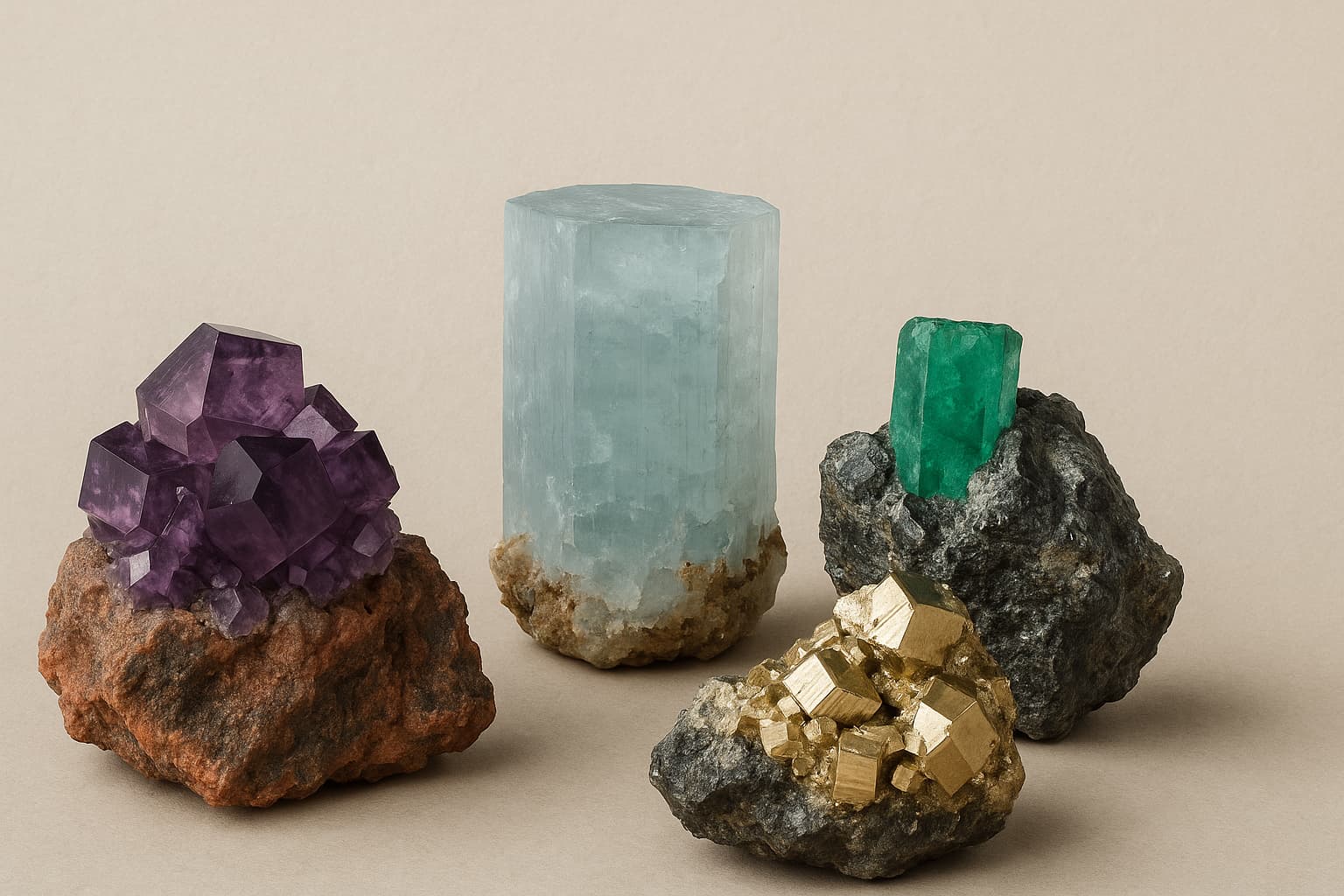
Rare minerals naturally command higher prices. Benitoite, for example, occurs almost exclusively in California worldwide. Accordingly, its collector value is high. Common stones like rose quartz or amethyst are globally widespread and therefore available at lower cost. The annual mining volume directly affects supply. If production decreases, prices rise – often within a few months.
Quality: The 4 Cs Apply to Minerals Too
Many know the so-called 4 Cs from diamond grading: Carat, Color, Clarity, Cut – i.e., weight, color, clarity, and cut. These criteria also apply, by analogy, to collector minerals.
- Color: Intense, even color tones significantly increase value. A deep violet amethyst from Uruguay is clearly more expensive than a pale stone of the same size.
- Clarity: Inclusions, cracks, and cloudiness lower the price – except in so-called phantom crystals, where inclusions can actually increase value.
- Crystal Form: Perfectly formed crystal specimens or rare habits (e.g., twin crystals) are especially sought after by collectors.
- Size and Weight: Larger specimens are disproportionately more expensive. A 500-gram tourmaline costs far more than ten times a 50-gram stone of the same quality.
Origin and Locality
The locality of a mineral can double or halve its price. Paraíba tourmalines from Brazil are considered the most valuable tourmalines in the world. Their vivid neon blue results from copper and manganese traces – and this effect does not occur with comparable intensity anywhere else. Similarly, lapis lazuli from Afghanistan: the deep, ultramarine blue of specimens from the Badakhshan mountains has been unmatched for over 6,000 years. That's why we at Crystal Paradise place great importance on transparent locality information. What to consider when buying minerals with documented locality is explained in this article.
Treatment and Naturalness
Raw, untreated stones often achieve higher prices in the collector market than treated specimens. However, this is not universal. Cut cabochons made of labradorite or polished amethyst spheres appeal to a different group of buyers. Transparency is key: was a stone heated, irradiated, or dyed? Treatments such as burning amethyst into citrine (so-called "Madeira citrine") are common in the industry – but should be clearly communicated. In our shop, we always clearly label treatments.
Price Categories: What Do I Get for My Budget?
The following overview provides a rough guide. Please note: prices vary depending on quality grade, origin, and market conditions.
- Under 10 euros: Small tumbled stones, simple raw pieces of common minerals such as rock crystal, rose quartz, or hematite. Ideal for beginners and as small gifts.
- 10 to 50 euros: Beautiful individual pieces, small amethyst points, polished freeforms, decorative stones of good quality. First collector pieces with traceable locality also fall into this category.
- 50 to 200 euros: High-quality display pieces, larger crystal specimens, special mineral varieties with known locality. This is where the actual collector market begins.
- 200 to 1,000 euros: Rare mineral species, exceptional specimens from well-known localities, fine gemstones of quality grade. For the serious collector.
- Over 1,000 euros: World-class collector pieces, museum quality, extremely rare minerals or gemstones with gemological certificate. Investments for connoisseurs.
Beginners will find an ideal starting point at Crystal Paradise. Discover our curated beginner collection with handpicked pieces for every budget.
Why Do Mineral Prices Fluctuate So Much?

Market Fluctuations and Global Trends
The mineral market is not a rigid pricing system. It reacts to global trends, trade show seasons, and social media. When malachite went viral on Instagram around 2019, its prices rose by up to 40 percent within 12 months. Something similar happened with larvikite and fuchsite. Those who buy early benefit. Those who follow the trend pay a premium.
Raw Material Prices and Mining Costs
Mining minerals is labor-intensive. Deep mining to depths of 1,200 meters or more is not uncommon. Rising energy prices, transportation costs, and export tariffs in producing countries directly affect final prices. Minerals from politically unstable regions can become even more expensive due to supply bottlenecks.
Fakes and Quality Issues
Unfortunately, dyed, synthetic, or simply mislabeled stones also exist on the market. Turquoise-colored howlite is sold as genuine turquoise. Dyed agate imitates rare varieties. Anyone buying at unusually low prices should be critical. A genuine gemological certificate or purchasing from a trustworthy dealer with a clear authenticity guarantee is the safest method. We at Crystal Paradise stand for 100% genuine natural one-of-a-kind pieces – without exception.
For advanced collectors, we recommend our Collector's Collection with curated rarities.
Gemstone Prices: Special Features in the Gemological Market
Gemstones such as ruby, sapphire, emerald, and diamond follow their own pricing rules. They are valued per carat. One carat equals 0.2 grams. Top rubies from Myanmar (Burma) can fetch over 30,000 euros per carat – more than comparable diamonds. Untreated sapphires from Sri Lanka (Ceylon sapphires) have been sought after for centuries and are priced accordingly.
For faceted gemstones of jewelry quality, the following main value criteria apply:
- Certificate of Origin: Documented provenance measurably increases value.
- Treatment Status: Untreated stones achieve premium prices compared to heated or oil-treated specimens.
- Cut Quality: A precise cut maximizes brilliance and color intensity – and thus the price.
- Certification: Reports from recognized laboratories such as GIA or Gübelin increase trust and resale value.
Externally, the Gemological Institute of America (GIA) offers extensive, free information on gemstone valuation. For mineralogical background information, the Mindat database, with over 5,800 described mineral species, is one of the world's leading reference sources.
My Expert Tip: How to Buy Minerals at a Fair Price
From my own experience in the mineral trade, some clear recommendations can be derived. Those who follow these points will never overpay:
- Compare quality, not just price. Two citrines at the same price can differ extremely in color and clarity.
- Ask about the locality. A stone without proof of origin is harder to evaluate.
- Buy from specialty dealers who disclose authenticity. We recommend paying attention to transparent product descriptions and personal advice.
- Visit mineral shows. There you can see and feel the stone before buying – and compare prices directly.
- Inform yourself beforehand. Our guide to the Top 15 Minerals for Your Collection helps you set priorities.
Those just starting out will find a solid foundation for entering the collector's world in our Beginner's Guide with 7 Starting Tips.
Frequently Asked Questions

Why are some minerals so much more expensive than others?
The price of a mineral depends on several factors: rarity, quality (color, clarity, crystal form), locality, size, and treatment status. A rare, untreated specimen from a well-known locality always fetches higher prices than a common, treated stone of comparable appearance. In addition, market fluctuations due to global trends and supply fluctuations due to changing mining conditions play a role.
How do I know if a mineral price is fair?
A fair price is based on comparable offers at mineral shows, in specialized online shops, and in auction results. Trustworthy dealers provide locality, quality description, and – for gemstones – possibly a certificate. Never buy solely based on price: extremely cheap offers are often an indication of inferior quality or fake stones.
Are expensive minerals also an investment?
High-quality minerals and gemstones can gain value over the long term – especially world-class collector pieces from well-known, depleted localities. However, the mineral market is not a regulated financial market. Prices can also fall. Those who buy minerals as an investment should focus on certified gemstones or documented collector pieces with traceable provenance, and when in doubt, consult a

Written by Christian Neumayer

Leave a comment
This site is protected by hCaptcha and the hCaptcha Privacy Policy and Terms of Service apply.