







A Beginner's Guide to Minerals: 7 Tips to Get Started
Beginner's Guide to Minerals: 7 Starter Tips to Buy and Get Going

Are you interested in minerals but don't know where to start? This beginner's guide to minerals gives you 7 concrete starter tips – from choosing your first stone to proper care. Minerals are naturally grown, inorganic solids with a defined chemical composition and crystalline structure. They form over millions of years deep within the earth. Once you discover the fascinating world of stones, it's rare to let go again. At Crystal Paradise, we accompany you as a beginner right from the start – with honest advice, verified quality, and hand-picked pieces from all over the world.
What Are Minerals, Exactly? A Brief Introduction for Beginners
Before you buy your first stone, it's worth taking a look at the basics. Minerals form through geological processes. They are not rocks, but clearly defined individual minerals. One example: quartz consists of silicon dioxide (SiO₂) and has a Mohs hardness of 7. This makes it one of the hardest and most widespread minerals on Earth.
The Mohs scale describes the scratch hardness of minerals on a scale from 1 (talc) to 10 (diamond). It was developed in 1812 by the German mineralogist Friedrich Mohs. As a beginner, you should know this scale – it helps you when buying and caring for stones.
Minerals differ in:
- Chemical composition
- Crystal system (e.g., cubic, hexagonal, monoclinic)
- Luster, color, and transparency
- Mohs hardness and cleavage
- Region of origin and locality
These characteristics determine both the aesthetic and collector value of a stone. You can find more background information in our article The Top 15 Minerals for Your Collection – A Guide by Crystal Paradise.
The 7 Starter Tips in the Beginner's Guide to Minerals

Tip 1: Start with a Theme – Not Everything at Once
Many beginners buy randomly and quickly lose track. A clear focus is better. Are you collecting by color? By country of origin? By mineral group like quartzes or carbonates? A theme gives your collection structure. From our own experience, we recommend starting with 3 to 5 starter stones – then interest grows organically.
Tip 2: Learn About the Most Important Mineral Groups
Mineralogy distinguishes over 5,000 known mineral species. For beginners, an overview of the most common groups is enough:
- Quartz group: Amethyst, smoky quartz, rose quartz – Mohs hardness 7
- Carbonates: Calcite, aragonite, rhodochrosite – often softer, Mohs hardness 3–4
- Sulfides: Pyrite, galena – metallic luster, fascinating for collectors
- Oxides: Hematite, magnetite – often dark and heavy
- Silicates: Tourmaline, topaz – often intensely colored and versatile
These groups form the foundation for basic mineralogical knowledge. Further information is available from the Mindat.org mineral database, one of the largest mineralogical resources in the world.
Tip 3: Buy from Verified Dealers – Authenticity Matters
The market for minerals is large. Unfortunately, dyed, heated, or synthetic stones are not uncommon. As a beginner, it's hard to tell at first glance whether a stone is genuine and untreated. That's why choosing the right dealer is crucial.
At Crystal Paradise, all stones are checked for authenticity. We have worked for years with suppliers from Brazil, Madagascar, India, Morocco, and many other countries. Our showroom in Feldkirchen near Munich invites you to discover pieces in person. If you like, you can experience pieces live before buying.
When buying online, watch for the following quality indicators:
- Precise origin information (locality, country)
- Clear product description with mineralogical classification
- Real product photos, not stock images
- Transparent return policy
- Accessible customer service
Tip 4: Understand Prices and Set a Realistic Budget
Minerals can cost a few dollars or several thousand dollars. The price depends on rarity, size, quality, and origin. A simple amethyst geode starts at around $10 to $30. A rare rhodochrosite specimen from Argentina can easily cost $500 or more.
For beginners, we recommend a starting budget of $50 to $150. This lets you buy 3 to 6 solid starter pieces without overextending yourself financially. Learn more about pricing in our blog article Prices for Minerals and Gemstones – My Expert View on the Market.
Tip 5: Care for Your Stones Properly
Minerals are robust – but not indestructible. Improper storage or cleaning can damage surfaces. Here are the most important care tips:
- Light: Amethyst and rose quartz fade under direct sunlight. Store them away from light.
- Water: Soft minerals like selenite (Mohs hardness 2) partially dissolve in water. Never place them in water.
- Cleaning: Hard quartzes (Mohs hardness 7) can be wiped with a soft, slightly damp cloth. Do not use harsh cleaning agents.
- Storage: Store pieces with pointed crystal terminations separately so they don't damage each other.
- Temperature: Extreme temperature fluctuations (above 50 °C or below −10 °C) can cause sensitive minerals to crack.
Tip 6: Use Accessories and Tools
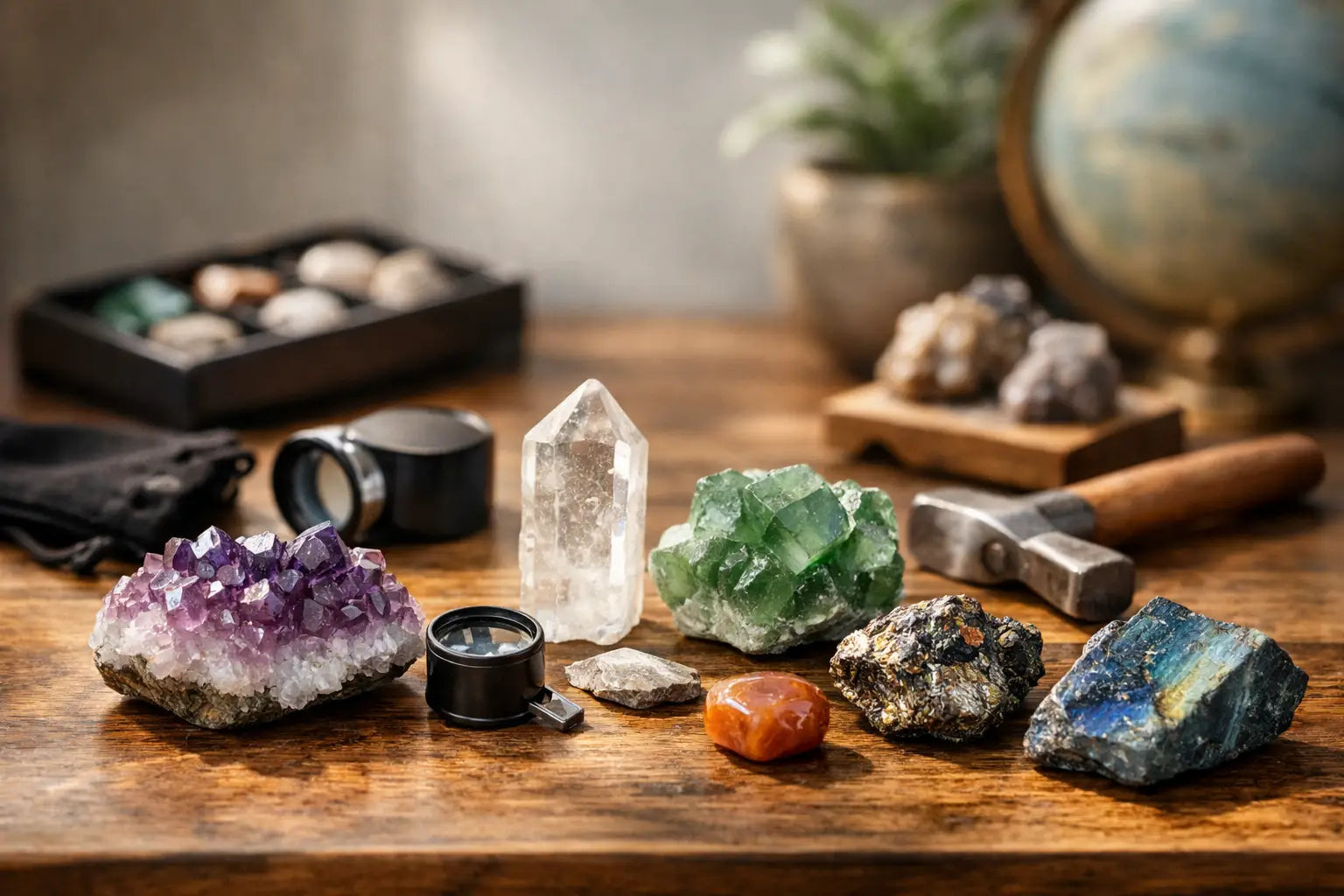
Good collectors also invest in the right accessories. This includes stands, display cases, labels, and magnifying glasses. If you collect spheres, you'll need suitable sphere stands so the pieces don't roll. Discover our Accessories for Mineral Collectors in the shop – you'll find everything you need for a professional start.
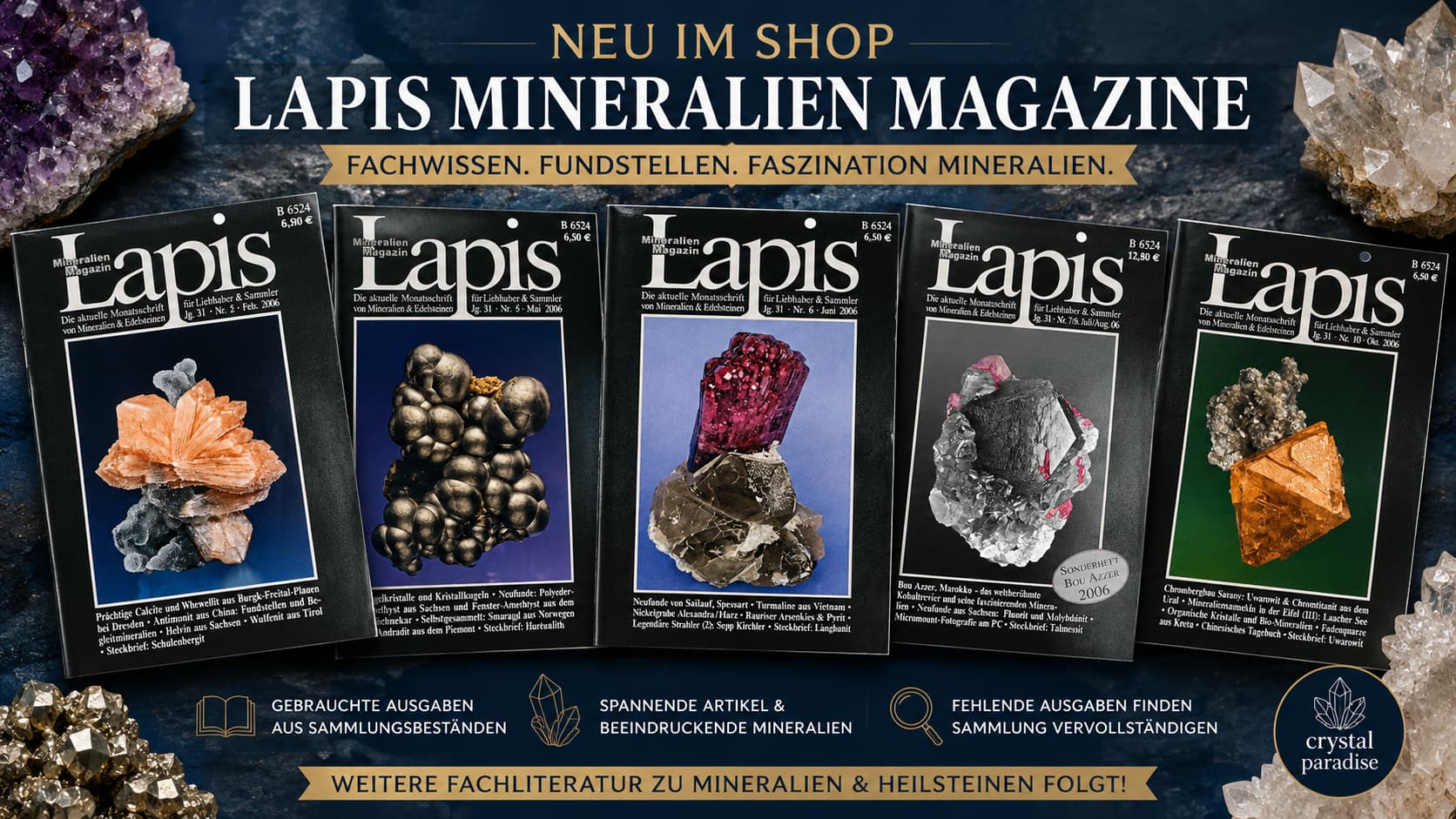
A magnifying glass with at least 10x magnification is essential for beginners. It helps assess inclusions, crystal structures, and surfaces. Reference books and identification guides are excellent additions to your knowledge. Lapis magazines, for example, are a classic among mineral collectors.
Tip 7: Combine Collecting with Personal Experience
Minerals have a long cultural history. In traditional stone lore, certain stones are said to have an energetic effect. Amethyst, for example, is traditionally regarded as a stone of inner calm. Rose quartz has been associated with heart-opening and compassion for centuries. These traditions make stones more than just collector's items – they become personal companions.
Important: These meanings are spiritual traditions. They do not replace medical advice or treatment. Anyone who appreciates stones as decoration, jewelry, or energy objects can enjoy them a great deal – without exaggerated expectations.
Browse our collection Discover the Fascinating World of Minerals for Beginners and find your first personal stone.
Where Does the Path Lead After Getting Started?
Once you've internalized the basics, you can dive deeper. Many collectors specialize over time in certain mineral groups, localities, or forms. Others are interested in rarissima – rare individual pieces of special quality. For advanced collectors, it's worth taking a look at our category Minerals for Collectors. There you'll find curated pieces with detailed origin descriptions.
The global mineral community is large and active. Shows, swap meets, and online forums offer beginners and experts alike an open, enthusiastic community. Further information on mineral localities and rarities is also available from the Mineralienatlas database – a German-language resource for collectors of all experience levels.
Frequently Asked Questions

Which minerals are best suited for absolute beginners?
Robust and readily available minerals are particularly well suited for beginners. Quartz in its many varieties (amethyst, smoky quartz, citrine) is ideal. It has a Mohs hardness of 7, is easy to care for, and available at many price points. Pyrite and calcite are also rewarding starter pieces with high recognition value.
How can I tell as a beginner whether a stone is genuine?
This is one of the most common questions for beginners. Genuine minerals often have irregularities, natural inclusions, and no perfectly uniform color. A 10x magnifying glass helps assess the crystal structure. Always buy from dealers with transparent origin information and verifiable product descriptions. If in doubt, a visit to the showroom helps.
Can I buy minerals online as a beginner?
Yes, buying online works well for beginners – as long as the dealer is trustworthy. Look for real product photos, detailed descriptions, origin information, and a clear return option. At Crystal Paradise, we offer free returns and a satisfaction guarantee. This lets you order with confidence – even as a complete newcomer.
Do I need special accessories as a mineral beginner?
To start, a simple basic setup is enough. A magnifying glass with 10x magnification, an identification book, and simple stands or a small display case are sufficient for your first pieces. As your collection grows, so does your need – from labels to specialty display cases. Check out our Accessories for Mineral Collectors.
Am I allowed to collect minerals myself while on vacation?
This depends heavily on the country and region. In many German low mountain ranges, collecting small amounts for private use is permitted. In nature reserves and on private land, however, it is prohibited. Abroad, strict export regulations for minerals sometimes apply. Always check in advance.

Written by Christian Neumayer

Leave a comment
This site is protected by hCaptcha and the hCaptcha Privacy Policy and Terms of Service apply.