










Mineral Encyclopedia & Photo Database: Free Mineral Photos for Education, Clubs, and Collectors
Free Mineral Photos: What's Behind a Good Photo Database?

Finding free mineral photos that are truly high-quality, correctly identified, and freely usable is not that easy. Many images on the internet are protected by copyright, mislabeled, or show treated specimens without disclosure. A reliable mineral photo database, on the other hand, combines precise mineralogical data with clear licensing. It is a real tool for schools, clubs, collectors, and everyone who wants not just to admire minerals, but to understand them. At Crystal Paradise, we believe: knowledge and beauty belong together. That's why, in this article, we explain what matters in such a database – and how you can find the right images for your purpose.
Why Free Mineral Photos Are So Sought After
The demand for free mineral images is steadily growing. Teachers look for illustrative image material for earth science lessons. Mineral clubs design exhibition boards and club magazines. Collectors want to identify and document their finds. Bloggers and content creators need legally safe photos for their posts.
The problem: many offers on the internet sound free, but really aren't. Either a clear license is missing, or the use is limited to private purposes. Anyone who wants to use mineral photos for educational purposes, club publications, or online media needs images with a clear Creative Commons license or explicit permission from the rights holder.
Which Licenses Are Relevant for Mineral Photos?
Not every free use is also an unrestricted use. You will frequently encounter these license types:
- CC0 (Public Domain): Complete transfer of rights – no attribution of the author required. Ideal for all purposes.
- CC BY 4.0: Free to use, but attribution and author credit required.
- CC BY-SA 4.0: Use and editing allowed, but derivative works must be published under the same license.
- CC BY-NC: Only for non-commercial use – often sufficient for clubs, but problematic for publishers.
- All Rights Reserved: No free use. Punishable if used without permission, even if shown for free on the internet.
Our tip from years of experience in the mineral trade: always check the license information directly on the source page – not just click the "download" button.
The Most Important Sources for Free Mineral Photos
There are a few platforms that truly provide reliable and high-quality mineral images free of charge. Here are the best-known and most useful ones:
Wikimedia Commons
Wikimedia Commons is the world's largest freely licensed media database. It contains tens of thousands of mineral photos – many of them under CC0 or CC BY license. The quality varies, but especially the images in the field of mineralogy and geology are often created by experts. Each image shows license information, author, and often locality data as well.
Important: always open the respective image description page to read the exact license. Not all images on Wikimedia Commons are cleared for commercial use.
Mindat.org – the Mineralogical Reference Database
Mindat.org is the world's most comprehensive mineralogical database. It contains data on over 5,800 recognized mineral species, more than 300,000 locality entries, and hundreds of thousands of photos. Many of these images have been uploaded by experienced collectors and mineralogists.
Mindat.org's terms of use generally allow use for educational purposes and non-commercial publications – attribution is always required, though. For schools, clubs, and exhibitions, this database is one of the most valuable sources available.
Natural History Museums and Scientific Institutions
Many state museums provide digitized collection photos free of charge. The Natural History Museum Vienna, for example, has run one of Europe's most significant mineral collections for over 200 years. The Senckenberg Natural History Museum Frankfurt and the Mineralogical Museum Hamburg also offer some freely usable image material.
Pixabay and Unsplash
On platforms like Pixabay and Unsplash, you can find mineral and crystal photos under CC0 license. However, the identification of the depicted minerals is often imprecise or missing entirely. Suitable for decorative and general purposes – less so for mineralogically precise education.
What Distinguishes a Good Mineral Photo Database
Not every collection of images deserves the name "database." A truly useful mineral photo database meets the following criteria:
- Correct mineralogical identification: Name, variety, chemical formula, crystal system.
- Locality information: Country, region, mine – as precise as possible. For example: "Bisbee, Arizona, USA" or "Ural, Russia."
- Scale information: Size of the piece shown in centimeters or millimeters.
- Photographer credit: Name of the photographer and license information.
- Quality of the photo: Good resolution, neutral background, correct exposure.
- Search function: Filterable by mineral name, locality, color, or crystal system.
We recommend always paying attention to all 6 points when building your own club database or school collection. A photo without locality information has only limited value for collectors and educational purposes.
Using Free Mineral Photos for Schools and Clubs – How to Do It Right

For teachers, club members, and course instructors, special options apply for image use. German copyright law contains, in § 60a UrhG, a limitation for education and teaching. According to it, up to 15% of a work may be used for teaching purposes – but only in a closed classroom setting, not for public publications.
For public club magazines, websites, or exhibitions, it is therefore always advisable to use clearly licensed images (CC0, CC BY). This is legally safe and shows a professional approach to intellectual property.
Practical Tips for Everyday Use
- Always save the source and license together with the image – best as a text file in the same folder.
- Use Google's advanced image search and filter by "Creative Commons licenses."
- Create your own photo table for your mineral identification project with locality, license, and author.
- Photograph your own collection pieces – this avoids licensing questions and creates unique image material.
- Exchange photos within your mineral club and contractually establish shared image rights.
The Crystal Paradise Mineral Encyclopedia: Our Contribution to Knowledge Sharing
At Crystal Paradise, we see ourselves not just as sellers, but as passionate mediators between nature and people. From our own experience, we know: those who understand minerals love them more deeply. That's why we continuously expand our blog encyclopedia – with well-researched articles on individual stone types, their geology, their localities, and their cultural history.
Whether you're interested in rare collector's pieces or the holistic meaning of stones: our encyclopedia is written for everyone who wants to know more. Our collection ranges from classic quartz varieties to rare sulfides to spectacular individual pieces – many of them hand-selected from regions such as Morocco, Brazil, Madagascar, Peru, or the Urals.
If you're interested in extraordinary collector's pieces, you'll find a carefully curated selection in our Minerals for Collectors collection. For particularly large-format and impressive pieces, it's worth taking a look at our XL Minerals – Monumental Fine Minerals.
You'll also find exciting background information on the mineral scene and our work with collector clubs in our article Crystal Paradise at the Mineralienfreunde München.
If you want to inspire young people about the fascination of mineralogy, we recommend our Young Collectors' Corner – a dedicated world for young explorers with affordable starter pieces and plenty of learning potential.
Creating Your Own Mineral Photos – Quality from the Start
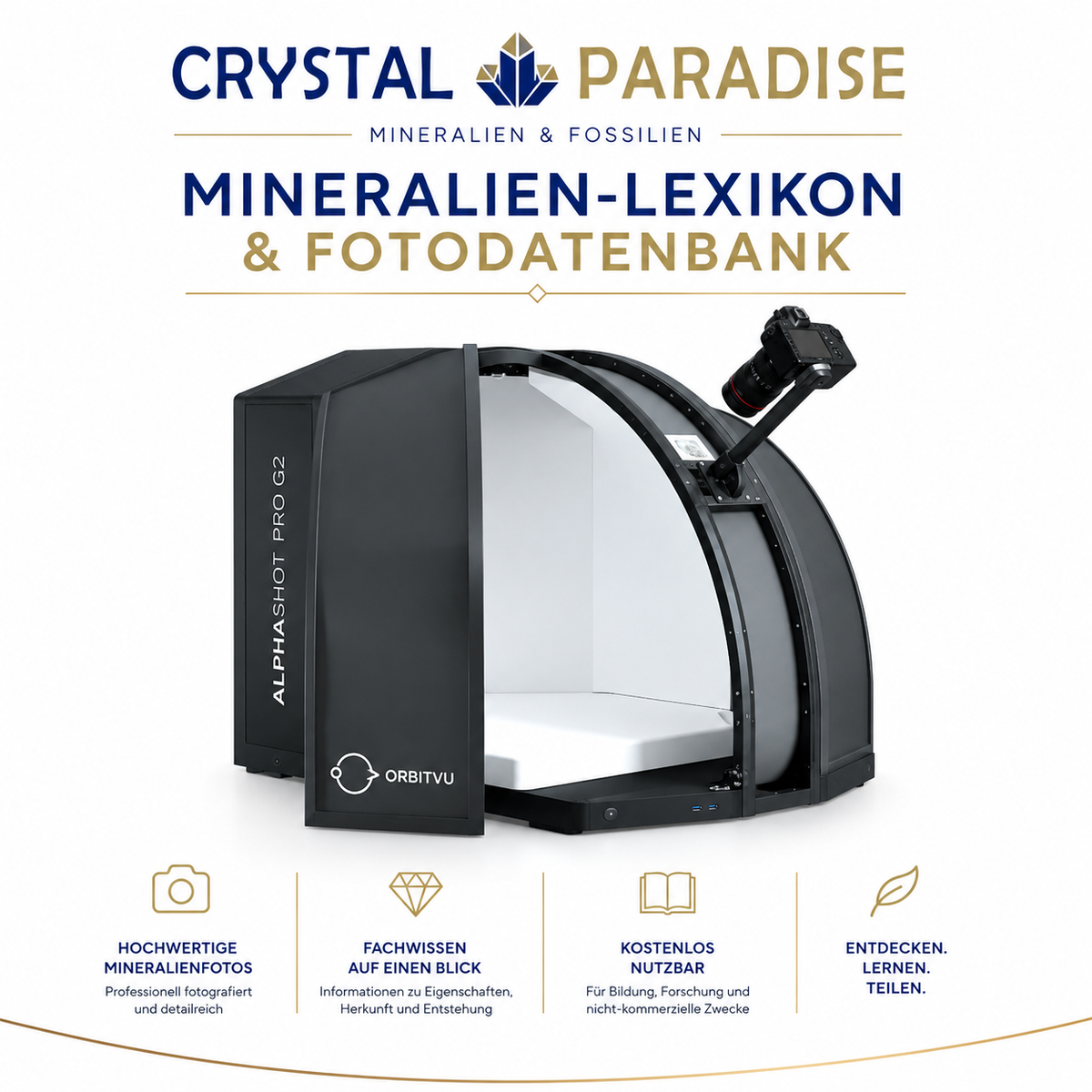
Those who photograph themselves have the most control over quality and rights. Here are some basic rules for good mineral photos:
- Background: A white or black background doesn't distract and lets colors and shine appear optimally.
- Lighting: Daylight or LED cold light without a yellow cast. Side lighting emphasizes crystal structures.
- Depth of field: For small specimens, focus stacking is useful – several shots with different focus points are combined.
- Scale: Always place a ruler or a coin in the shot to make the size recognizable.
- Metadata: Save mineral name, locality, and date directly in the image file's EXIF data.
Even a smartphone with a good camera can produce surprisingly good results with enough light and a steady hand. More important than the technology is understanding the piece itself: What makes it special? Shine, color, crystal shape? Deliberately point the camera at this feature.
Frequently Asked Questions

May I use mineral photos from the internet for free in my club magazine?
Not automatically. Only images with a clear CC0 or CC BY license may be used freely. All other photos require explicit permission from the author. A good first point of contact for royalty-free images is Wikimedia Commons, where every image carries a clear license notice. For club purposes, CC BY 4.0 and CC0 are the safest options.
How many mineral species are there worldwide, and where can I find photos of rare species?
Currently, over 5,800 mineral species are recognized worldwide by the International Mineralogical Association (IMA). About 50 to 100 new species are added each year. The most extensive photo database for rare minerals is

Written by Christian Neumayer

Leave a comment
This site is protected by hCaptcha and the hCaptcha Privacy Policy and Terms of Service apply.