







Article: The Top 15 Minerals for Your Collection – A Guide from Crystal Paradise
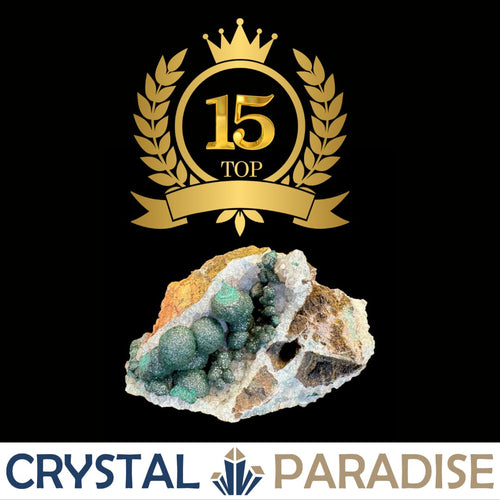
The Top 15 Minerals for Your Collection – A Guide from Crystal Paradise
The Best Minerals for Your Collection – An Overview

Building a mineral collection is one of the most wonderful hobbies there is. But which pieces truly belong in it? Minerals are naturally occurring, inorganic solids with a defined chemical composition and an ordered crystal structure. They differ fundamentally from rocks and crystals – even though these terms are often used synonymously in everyday language. In this guide, we introduce you to 15 fascinating minerals that shouldn't be missing from any serious collection. We combine mineralogical facts with aesthetic and spiritual perspectives – without exaggerated claims.
Whether you're just starting out or expanding your existing mineral collection for collectors in a targeted way: This guide provides orientation, background knowledge, and practical recommendations straight from our showroom in Feldkirchen near Munich.
What Makes a High-Quality Mineral Collection?
From years of experience in the mineral trade, we know: quality beats quantity. A good collection thrives on variety – different mineral classes, regions of origin, and formation types. Important criteria when buying include:
- Authenticity and proof of origin: Where was the stone found? Is it untreated?
- Crystal quality: How well-formed are the crystal faces, how clear or vivid is the color?
- Rarity: Some deposits are depleted – which significantly increases value.
- Aesthetics: Shape, luster, and size play an essential role.
- Care requirements: Not every stone tolerates water or sunlight.
In the XL Minerals Collection, you'll find monumental fine minerals for discerning collectors – hand-selected and sourced directly from the best sources worldwide.
The Top 15 Minerals for Your Mineral Collection

1. Amethyst – The Purple Classic
Amethyst is a violet variety of quartz (SiO₂) with a hardness of 7 on the Mohs scale. The finest specimens come from Brazil and Uruguay, where some geodes weigh over 50 kilograms. In lithotherapy, amethyst is traditionally associated with inner calm and mental clarity. It belongs in every beginner's collection.
2. Rock Crystal – Clarity in Pure Form
Pure, colorless quartz – rock crystal – is mineralogically identical to amethyst, but without iron impurities. Deposits in the Swiss Alps and Madagascar yield spectacular specimens. The stone has been regarded for centuries as a symbol of clarity and focus – according to tradition, it is said to sharpen the mind.
3. Pyrite – Fool's Gold
Pyrite (FeS₂) impresses with its metallic, golden luster and perfectly cubic crystals. Spain, especially the mine at Navajún, is world-famous for its pyrite cubes. The hardness ranges from 6 to 6.5. Pyrite is a must-have for any mineral collection aiming for mineralogical breadth.
4. Malachite – The Emerald-Green Copper Mineral
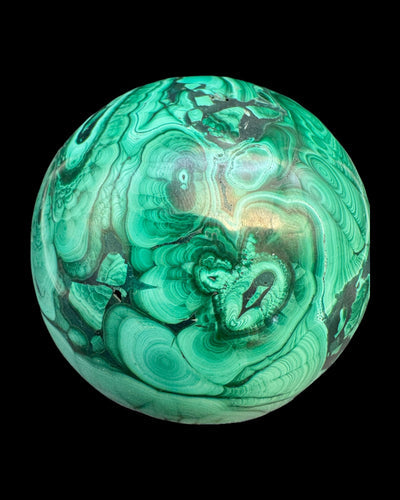
Malachite (Cu₂(CO₃)(OH)₂) comes from the Congo, Namibia, and Russia. Its characteristic banding arises from varying concentrations of copper deposits. Hardness: 3.5 to 4. Caution: do not soak malachite in water – it is sensitive to acid. In lithotherapy, it is traditionally regarded as a stone of transformation.
5. Labradorite – The Spectral Wonder
Labradorite is a feldspar with a spectacular optical effect: the so-called labradorescence. This arises from light refraction on internal layer structures. Deposits: Canada, Madagascar, and Finland. The stone has a hardness of 6 to 6.5 and is extremely sought after for its play of colors.
6. Fluorite – The Rainbow Stone
Fluorite (CaF₂) occurs in nearly every color – from colorless to green and violet to deep blue. China and the English mine Blue John are well-known deposits. At hardness 4, fluorite is delicate and should be protected from scratches. It fluoresces under UV light – an impressive experience for any collector.
7. Rhodonite – Delicate Pink from the Urals
Rhodonite is a manganese silicate with a characteristic pink to red color, streaked with black manganese veins. The most important deposits are located in the Urals (Russia). Hardness: 5.5 to 6.5. In lithotherapy it is traditionally regarded as a stone of the heart and self-love – without scientific evidence, but with a long tradition.
8. Tourmaline – The Chameleon Crystal
No other mineral group shows as much color variety as tourmaline. From colorless achroite to green verdelite to the highly sought-after Paraíba tourmaline from Brazil, the spectrum is vast. Hardness 7 to 7.5. Some specimens show color changes from green to pink within a single crystal – so-called watermelon tourmalines.
9. Selenite – Quiet Light from the Desert
Selenite is a transparent, fibrous variety of gypsum (CaSO₄·2H₂O). The enormous crystal caves of Naica in Mexico contain selenite columns up to 11 meters long. Hardness: only 2. Selenite is very soft and sensitive to water – never soak it. It exudes a quiet, meditative aesthetic.
10. Azurite – Deep Sky Blue
Azurite (Cu₃(CO₃)₂(OH)₂) is an intensely blue copper mineral that often occurs together with malachite. Morocco and the Congo produce particularly beautiful specimens. Hardness: 3.5 to 4. Because of its vivid color, azurite was formerly used as a painter's pigment – a piece of art history for your collection.
11. Obsidian – Glass from the Volcano
Strictly speaking, obsidian is not a mineral but volcanic rock glass – yet it is among the most sought-after collector's pieces. It forms from the rapid cooling of lava. Deposits: Iceland, Mexico, and Ethiopia. In lithotherapy, according to tradition, it is said to have a protective quality.
12. Rose Quartz – Gentle Energy in Pink
Rose quartz is a translucent, pink variety of quartz. Its hardness is 7. The most important deposits are located in Brazil and Madagascar. It is one of the most purchased stones worldwide – both as decoration and as a personal companion. In our shop, it is one of the most popular starter pieces for new collectors.
13. Calcite – The Mineral Group of Diversity
Calcite (CaCO₃) is one of the most common minerals on Earth and occurs in over 300 crystal forms. From orange honey calcite from Pakistan to blue varieties from Mexico – the range is enormous. Hardness: 3. Prone to breakage, but aesthetically unmatched in variety.
14. Sodalite – The Night Blue
Sodalite is a deep blue-and-white sodium aluminum silicate belonging to the feldspathoid group. Canada and Brazil are important deposits. Hardness: 5.5 to 6. It is often mistaken for lapis lazuli – but is significantly more affordable. In lithotherapy, it is traditionally regarded as a stone of inner truth and communication.
15. Epidote – The Unknown Gem
Epidote is a greenish-brown silicate mineral found in Austria, Pakistan, and Mexico. Hardness: 6 to 7. Its columnar, glossy crystals are highly valued among collectors but still little known to the general public – a true insider tip for experienced collectors. In our experience, epidote is one of the underrated highlights of any advanced collection.
Practical Tips for Beginners and Experienced Collectors
Storage and Care
Proper care greatly extends the lifespan and beauty of your pieces. Here are the most important basic rules:
- Never place soft minerals (hardness below 5) in water – e.g. selenite, malachite, azurite.
- Store light-sensitive stones in the dark – amethyst and rose quartz fade under prolonged sunlight.
- Store separately – harder minerals can scratch softer ones.
- Dust regularly – a soft, dry cloth is sufficient for most pieces.
- Use suitable stands – in our accessories for mineral collectors section, you'll find suitable display options.
Where to Buy? Tips on Sourcing
We recommend always buying minerals from specialized dealers who communicate origin and authenticity transparently. Trade shows are also an excellent opportunity – we regularly attend events such as the Rosenheim Mineral and Fossil Fair 2026. In addition, visiting our showroom in Feldkirchen near Munich offers the opportunity to inspect pieces in person and receive personal advice.
For initial orientation, take a look at our collection Discover the Fascinating World of Minerals for Beginners. There we have compiled everything important for getting started.
For those who want to dive deeper into prices and valuations, our article Prices for Minerals and Gemstones – My Expert View on the Market offers valuable insights.
For further mineralogical background, we also recommend the information pages of the German Mineralogical Society as well as the internationally recognized mineral encyclopedia Mindat.org.
Frequently Asked Questions

Which minerals are best suited for starting a mineral collection?
For beginners, we recommend amethyst, rock crystal, rose quartz, and pyrite. These minerals are readily available, affordable, sturdy, and offer a good introduction to various mineral classes. They are also aesthetically appealing and make excellent decorative pieces.
How do I recognize genuine minerals and protect myself from fakes?
Look for transparent information about origin and treatment – reputable dealers state both on their own. A price significantly below market value is the most common warning sign. Also check the typical characteristics of the respective stone type: natural inclusions, uneven color distribution, and naturally grown crystal faces indicate authenticity, while perfect uniformity tends to suggest otherwise. For individual pieces, the exact piece shown should always be the one you receive. More on this in our guide Recognizing Genuine Healing Stones.

Written by Christian Neumayer

Leave a comment
This site is protected by hCaptcha and the hCaptcha Privacy Policy and Terms of Service apply.