







Malachite: A Masterpiece of Nature
Malachite: The Green Treasure from the Heart of the Earth

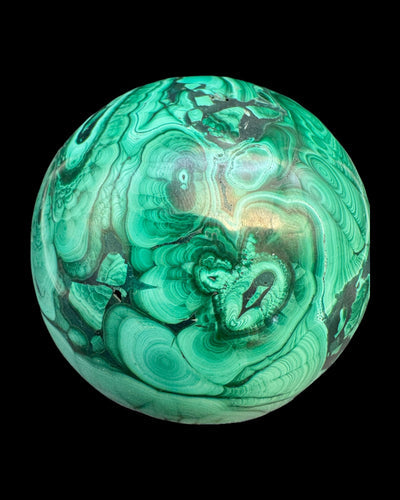
Malachite is a copper-bearing carbonate mineral with the chemical formula Cu₂(CO₃)(OH)₂. It is one of the most well-known and beautiful minerals in the world. Its characteristic green – ranging from light mint to deep emerald green – and its typical concentric banding make it unmistakable. Malachite forms through the weathering of copper-bearing ores in the oxidation zone of copper deposits. For over 4,000 years, this stone has fascinated humanity: as a pigment, as a gemstone, and as a symbol of protection and transformation.
Mineralogical Classification: What Makes Malachite So Special?
Malachite belongs to the mineral class of carbonates. Its Mohs hardness is 3.5 to 4 – making it relatively soft. This makes it more delicate than many other gemstones. Nevertheless, it has been crafted into spheres, pyramids, pendants, and decorative pieces for centuries. According to the international mineralogical database Mindat.org, malachite is among the most frequently documented copper minerals worldwide – with occurrences in over 140 countries.
Chemical and Physical Properties
- Chemical formula: Cu₂(CO₃)(OH)₂
- Mineral class: Carbonates
- Mohs hardness: 3.5 – 4
- Crystal system: Monoclinic
- Color: Light green to dark green, often with concentric banding
- Luster: Vitreous to silky luster in fibrous varieties
- Density: approx. 3.9 g/cm³
Malachite frequently occurs together with other copper minerals. Especially well known is its combination with azurite – a deep blue mineral closely related to malachite. This natural combination of green and blue is mineralogically fascinating. In our shop you'll find beautiful azurite-malachite pieces that combine both minerals in one object.
Origin and Occurrence: Where Is Malachite Found?
The most significant malachite deposits are located in the Democratic Republic of the Congo, Zambia, Russia (Urals), Australia, Namibia, and the United States (Arizona). The Russian Ural deposits supplied magnificent pieces for the tsarist courts in the 18th and 19th centuries. Even today, rooms in the Winter Palace in St. Petersburg testify to the splendor of Ural malachite.
Particularly high-quality pieces today come predominantly from the Congo and Zambia. These African deposits produce malachite with especially pronounced banding and brilliant green color. The deposits are tied to copper ore belts that stretch for thousands of kilometers across the African continent. The German Gemmological Association describes malachite as one of the few gemstones that already possesses extraordinary decorative quality in its pure form – more on the scientific classification of gemstones and minerals is available from the German Gemmological Association (DGemG).
Malachite and Its Relatives
Anyone wanting to discover the diversity of the mineral world will find a carefully curated selection at Crystal Paradise. However, malachite is just one of many fascinating stones. If you're just beginning to develop an interest in minerals, we recommend our collection Discover the Fascinating World of Minerals for Beginners – ideal for anyone new to the world of stones.
Malachite in History: Color, Jewelry, and Symbol
Malachite is one of the oldest minerals used by humanity. As early as 3000 BCE, it was used in ancient Egypt as eye makeup and as a pigment for wall paintings. The famous Egyptian green was partly based on malachite pigments.
In ancient Greece and Rome, malachite adorned amulets and jewelry pieces. Protective properties were attributed to it – a tradition that has continued through many cultures and centuries. In the Middle Ages, it was considered a stone believed to ward off evil spirits – a tradition that remains alive in the lore of healing stones to this day.
In the 19th century, malachite experienced a golden age as a decorative stone. Russian craftsmen created monumental objects using the so-called Russian mosaic technique: they cut malachite into thin slices and joined them together so that the grain flowed seamlessly into one another. This resulted in fireplaces, vases, and columns of impressive beauty.
Malachite in the Lore of Healing Stones: Traditional Meaning

In the world of healing stones, malachite holds a special place. In the lore of healing stones, it is traditionally said to accompany processes of change and transformation. It is considered a stone of transformation and renewal.
Traditionally Attributed Properties
- According to tradition, it is said to support letting go of old patterns
- Often associated with the heart chakra in the lore of healing stones
- Considered a companion for emotional clarity and inner growth
- According to spiritual tradition, it is said to have a protective and grounding effect
- Traditionally used as a travel protection stone
- In chakra work, it is frequently associated with the heart chakra and the solar plexus chakra
Anyone interested in the spiritual aspects of healing stones will find a comprehensive overview of many other minerals and their traditional attributes in our Healing Stone Lexicon: Meaning of the Stones.
The desire for inner peace and clarity is also often associated with malachite. Learn more in our article Which Stones Are Associated with Clarity and Inner Peace in the Lore of Stones?.
Caring for Malachite Properly: How It Stays Beautiful
Due to its low hardness of 3.5 to 4 on the Mohs scale, malachite requires special attention. A few important care tips help preserve its beauty over the long term.
Important Care Tips for Malachite
- No water: Malachite contains copper and is sensitive to acids. Prolonged contact with water can cause the surface to become dull or release toxic substances. Malachite therefore does not belong in gemstone water carafes or drinking water.
- No ultrasonic cleaner: The mechanical stress can damage the stone.
- No steam cleaning: Heat and steam permanently damage the surface.
- Gentle cleaning: A slightly dampened, soft cloth is completely sufficient. Pat dry immediately afterward.
- Storage: Store separately from harder stones to avoid scratches. Soft pouches or compartments in a jewelry box are ideal.
- Sunlight: Malachite can fade slightly with prolonged sun exposure. Avoid direct UV radiation over many hours.
From our years of experience working with minerals, we recommend: treat malachite like a precious work of natural art – with care and respect. This way, it will accompany you for many years and retain its unique beauty.
Malachite as Jewelry and Decoration
Few stones are as versatile for jewelry and decoration as malachite. Its intense color and unique patterns make every piece a true one-of-a-kind. Tumbled stones, pendants, rings, bracelets, and spheres made of malachite have been popular in the mineral and gemstone world for decades.
Malachite spheres or freeforms create striking accents in living spaces. If you're interested in stylish stone decoration, you'll find inspiration in our blog article Buying Crystal Decor: Elegance for Your Home with Crystals, Figurines & Natural Art.
At our showroom in Feldkirchen near Munich, interested visitors can personally experience selected malachite pieces. The direct experience of the color, the grain, and the texture cannot be replaced by any product photography. We warmly invite you to stop by and let our selection inspire you.
For collectors seeking truly special one-of-a-kind pieces, it's also worth taking a look at our collection Special One-of-a-Kind Pieces – there you'll find hand-selected natural treasures that represent true rarities.
Malachite and Azurite: An Unbeatable Natural Duo
Malachite frequently occurs in nature together with azurite. Both minerals form through the weathering of copper ores. While malachite owes its typical green to copper, azurite shines in deep cobalt blue. The combination of both minerals in a single piece – often referred to as azurite-malachite – is mineralogically and aesthetically extraordinary.
Azurite-malachite is traditionally regarded in the lore of healing stones as a particularly powerful mineral, said to promote intuition and inner insight. Chemically speaking, azurite transforms into malachite over time under the influence of water and carbon dioxide – a process that takes millions of years. Nature vividly demonstrates here how alive minerals are on a geological scale.
Frequently Asked Questions

What Is Malachite and Why Is It So Green?
Malachite is a copper-bearing carbonate mineral with the chemical formula Cu₂(CO₃)(OH)₂. It owes its intense green color to its high copper content. The copper absorbs certain wavelengths of light and reflects the green portion of the spectrum. The characteristic concentric banding results from layer-by-layer growth of the mineral in cavities of copper-bearing rocks over millions of years.
Can Malachite Be Placed in Water?
No. Malachite should not be placed in water or used for gemstone water. The mineral contains copper and is sensitive to acids. Contact with water can release copper compounds that may be harmful to health. For cleaning, a slightly damp, soft cloth is sufficient – pat the piece dry immediately afterward.
Which Chakras Is Malachite Associated with in the Lore of Healing Stones?
In the lore of healing stones, malachite is traditionally associated with the heart chakra (4th chakra

Written by Christian Neumayer
(OH)%E2%82%82.%20It%20is%20one%20of%20the%20most%20well-known%20and%20beautiful%20...)
Leave a comment
This site is protected by hCaptcha and the hCaptcha Privacy Policy and Terms of Service apply.