







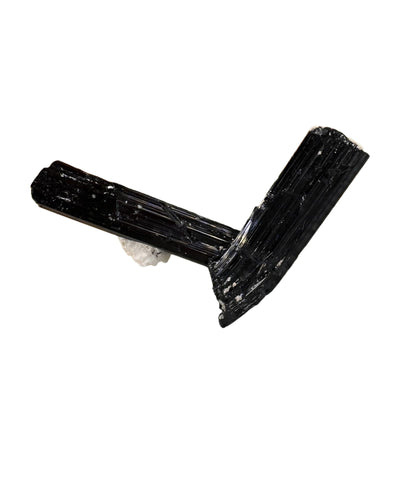
Black Schorl Tourmaline
Black Tourmaline – Mineralogical Classification and Meaning

Black Tourmaline, correctly known mineralogically as Schorl, is an iron-rich borosilicate mineral from the tourmaline group. It is one of the most common tourmaline varieties worldwide and crystallizes in the trigonal crystal system. With a Mohs hardness of 7 to 7.5, it is robust and at the same time beautifully formed – deep black, columnar crystals with characteristic longitudinal striations on their surfaces. In spiritual circles, it is considered one of the most significant protective stones of all. Anyone who buys a black tourmaline acquires not only an aesthetic natural wonder, but also a piece of earth history with centuries of symbolic power.
Formation and Origin of Black Tourmaline
Schorl forms predominantly in magmatic and metamorphic rocks. It occurs especially frequently in granites, pegmatites, and gneisses. The formation temperatures range between approximately 450 °C and 700 °C – evidence of the immense geological power contained within every stone.
The most important deposits worldwide are diverse and fascinating:
- Brazil – especially Minas Gerais, a world-famous pegmatite paradise
- Namibia and Madagascar – with especially clear, columnar crystals
- Pakistan and Afghanistan – high mountain regions with extraordinary crystal formation
- Australia and China – increasingly important supplier regions
- Germany – historical deposits in Saxony and the Bavarian Forest
Especially popular and mineralogically exciting are intergrowths of schorl with other minerals. The so-called rock crystal with schorl tourmaline is among the most aesthetically impressive combinations – here, black tourmaline needles grow directly into clear quartz. These intergrowths form in the same pegmatite cavities and are mineralogically unique.
The name "Schorl" is, by the way, historically documented: it already appears in documents from the 15th century, named after the Saxon village of Zschorlau in the Ore Mountains – one of the oldest known deposits in Europe.
Black Tourmaline in Crystal Healing – Traditional Meaning and Symbolism
In crystal healing, black tourmaline is traditionally considered one of the most powerful protective stones. It has been attributed for centuries with the ability to neutralize negative energies and stabilize the personal energy field. It is important to emphasize: these attributions are spiritual traditions without scientific proof.
Spiritual Attributions at a Glance
In traditional lore, black schorl tourmaline is attributed with the following properties:
- Energetic protection against negative influences and stress energies
- Grounding and stabilization – according to traditional lore, said to activate the root chakra
- traditionally considered in stone lore as a stone of calm and clarity
- Protection against electromagnetic fields – a belief that makes it especially popular among technology users
- Support in energetic cleansing processes
In traditional crystal healing, black tourmaline is assigned to the root chakra (Muladhara). According to spiritual tradition, it is said to ground the flow of energy and provide support to people in difficult phases of life. It is also frequently recommended for the zodiac sign Capricorn – as a companion stone for stability and grounding.
Schorl as a Protective Stone in Everyday Life
Many people wear it as a pendant or bracelet. Others place it by the entrance door, next to the desk, or on the windowsill. The idea behind this: the stone is said to build up an energetic protective barrier. Whether as a polished tumbled stone or as a raw crystal – each form has its own character and appeal.
In our Tourmaline Stone Type Collection you will find a carefully curated selection of schorl tourmalines in various forms and quality levels – from raw crystal specimens to polished forms for everyday companionship.
Buying Black Tourmaline – Quality Characteristics and Authenticity Testing

The quality of a black tourmaline can be recognized by several characteristics. From years of experience in the mineral trade, we at Crystal Paradise can tell you what really matters – and what protects you from making a poor purchase.
Characteristics of Genuine Schorl Crystals
Genuine schorl tourmaline exhibits the following characteristic properties:
- Longitudinal striations and grooving – typical for all tourmaline varieties, visible to the naked eye
- Glassy, matte luster – no complete high gloss on raw crystals
- Deep, uniform black color – caused by the high iron content
- Columnar habit – prismatic crystal shape with a triangular to hexagonal cross-section
- Natural inclusions and fracture points – a sign of authenticity, not perfection
Fake or treated stones often appear too glossy, too uniform, or too heavy (an indication of glass imitations). A simple test: with a steel knife (hardness approx. 5.5), genuine tourmaline cannot be scratched – it is significantly harder. More information on this can be found in our article Buying Genuine Tourmaline: How to Recognize Real Tourmaline.
Forms and Finishes
Black tourmaline is available in many forms. Each has its own appeal:
- Raw specimens and crystal clusters – ideal for collectors and as room decoration
- Tumbled stones – pleasant to hold, affordable, and versatile
- Pendants and bracelets – as a personal companion on the body
- Rock crystal-schorl combination pieces – mineralogically especially valuable and aesthetically impressive
Care and Cleaning of Black Tourmaline
Black schorl is comparatively easy to care for. Nevertheless, there are a few important points to keep in mind.
Practical Care Tips
Since schorl has a hardness of 7 to 7.5, it is resistant to mechanical influences. Nevertheless, we recommend the following measures:
- Water: A brief rinse under lukewarm water is entirely fine. Prolonged soaking should be avoided.
- Sunlight: Black stones are barely affected by UV radiation. Still, direct, intense sunlight over many hours is not ideal.
- Chemicals: Cleaning agents, perfume, and household chemicals should always be avoided.
- Energetic cleansing: Many enthusiasts cleanse their stone on selenite plates or with incense. This is a matter of personal practice.
- Storage: Store separately, as harder minerals (e.g., diamond, hardness 10) can leave scratches.
In our showroom in Feldkirchen near Munich, you can get personal advice – and hold the stones in your own hands before making a decision. This direct encounter with the stone cannot be replaced by any photo in the world.
Black Schorl Tourmaline and Related Minerals
Those interested in black tourmaline often discover other fascinating minerals as well. The tourmaline group comprises more than 30 recognized mineral phases. The best-known varieties besides schorl are:
- Rubellite (Red Tourmaline) – bright red, colored by manganese. Learn more in our article Red Tourmaline – A Fascinating Gemstone.
- Indicolite (Blue Tourmaline) – deep blue to blue-green, due to iron and titanium
- Verdelite (Green Tourmaline) – colored by chromium and vanadium
- Paraíba Tourmaline – neon blue, one of the rarest and most valuable gemstones in the world
All these varieties share the same basic chemical structure – a complex borosilicate with varying elemental additions – and differ mainly in their trace elements and the resulting colors.
Further mineralogical information on the tourmaline group is provided by the Mindat.org mineral database with detailed chemical formulas, crystal structure data, and worldwide locality information.
Another valuable scientific source is the International Mineralogical Association (IMA), which publishes and regularly updates the official classification of all recognized mineral species worldwide.
Frequently Asked Questions

What is the difference between schorl and black tourmaline?
There is no difference – the terms refer to the same mineral. "Schorl" is the official mineralogical term. "Black tourmaline" is the more commonly used term in trade and crystal healing. Schorl is the most common variety of the tourmaline group, making up an estimated over 95% of all naturally occurring tourmalines.
How do I recognize genuine black tourmaline?
Genuine schorl tourmaline shows characteristic longitudinal striations on the crystal surfaces, a columnar structure, and a hardness of 7 to 7.5. It cannot be scratched with an ordinary pocketknife. If it feels unusually light or has a perfect, glassy surface without any structure, it could be glass or a dyed stone. If in doubt, seek advice from an experienced dealer – as in our showroom in Feldkirchen near Munich.
Which zodiac signs is black tourmaline especially suited for?
In crystal healing, black tourmaline is traditionally assigned especially to the zodiac sign Capricorn. According to traditional lore, it is also considered a fitting companion stone for Aries and Scorpio. These associations are spiritual in nature and are not based on any scientific foundation. As a protective and grounding stone, however, it is valued by people of all zodiac signs.

Written by Christian Neumayer

Leave a comment
This site is protected by hCaptcha and the hCaptcha Privacy Policy and Terms of Service apply.