







Mineral Fair: What should you bring as a visitor to a mineral fair?
Mineral Fair Visitors: The Ultimate Packing List for Your Fair Visit

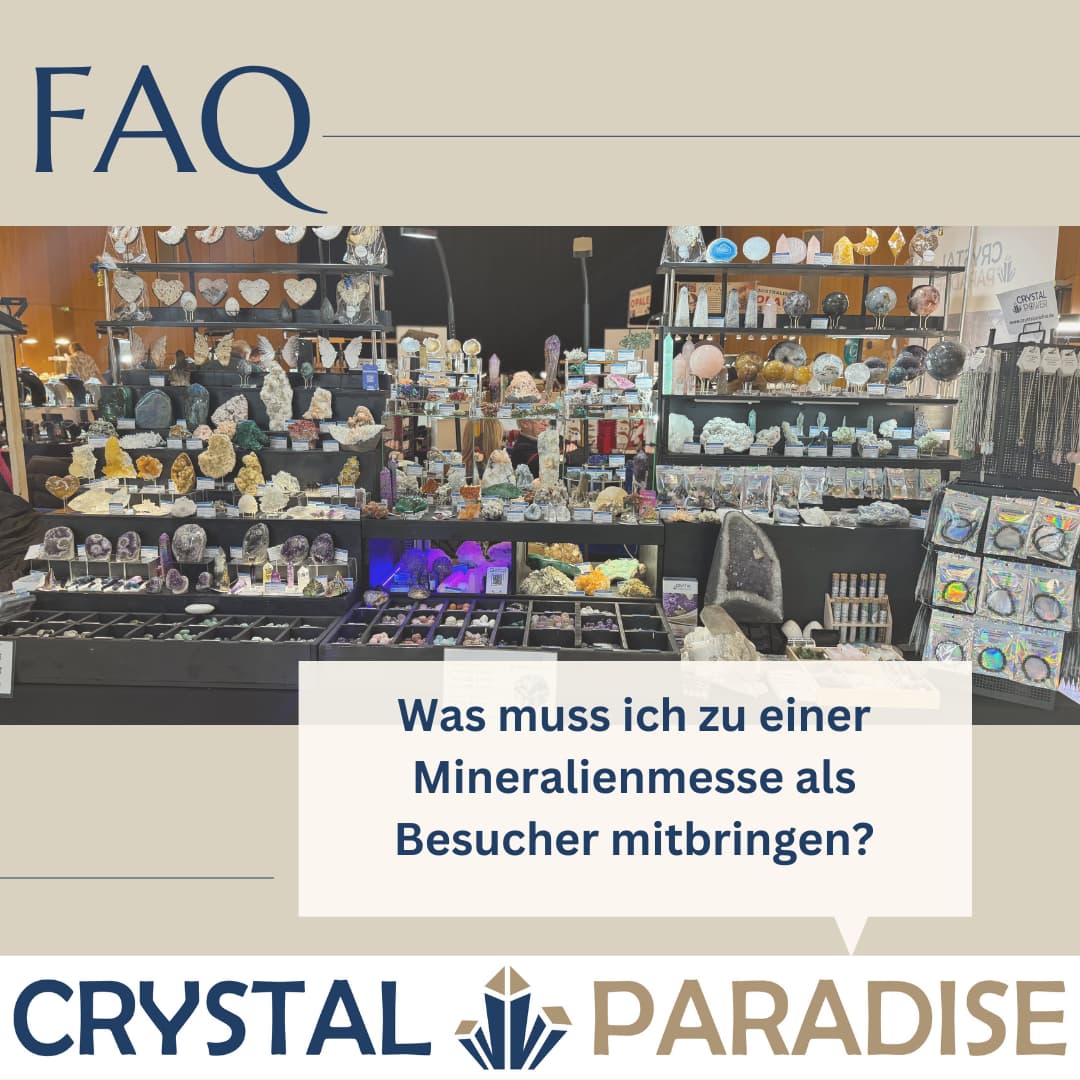
Anyone visiting a mineral and crystal fair as a mineral fair visitor for the first time quickly experiences the most beautiful kind of sensory overload. Hundreds of vendors, thousands of stones – and the question: What do I actually need to bring? A mineral fair is a specialized trade and sales show where dealers, collectors, and enthusiasts present and trade minerals, crystals, fossils, and healing stones. To make the most of your visit, you need the right preparation. This guide shows you what to pack – and what you should pay special attention to.
Why the right preparation is so crucial for mineral fair visitors
Mineral fairs like the renowned Stein+Mineral Munich or the international Munich Show (Mineralientage München) attract tens of thousands of visitors every year. Many of them arrive unprepared – and leave the fair with a bad feeling. Either they spent too much, bought the wrong pieces, or simply had no idea what they were looking for.
From years of experience in the mineral trade, we at Crystal Paradise know: the best purchases are made with a clear head and good equipment. Those who come prepared buy smarter, negotiate more confidently, and enjoy the visit much more.
Also: Many exhibitors are passionate collectors themselves. They appreciate visitors who ask questions, show interest, and bring basic knowledge. That builds trust – and sometimes even better prices.
The complete packing list for mineral fair visitors
Practical items for your bag or backpack
A mineral fair can last 4 to 8 hours. Comfort is therefore not a luxury, but a necessity. These items should be in every backpack:
- Magnifying glass (10x magnification): Essential for assessing inclusions, crystal structures, and surfaces. A good hand lens costs between 10 and 30 euros.
- Flashlight or UV lamp: Many minerals fluoresce under UV light. Especially with calcite, scheelite, or willemite, this can be a real eye-opener.
- Protective padding or cloth bags: For purchased stones. Hard minerals can damage each other. Quartz, for example, has a hardness of 7 on the Mohs scale.
- Notebook and pen: To note locations, mineral names, and prices. Alternatively: a notes app on your smartphone.
- Cash: Many small vendors don't accept card payments. Recommended: at least 50 to 200 euros in cash, depending on your budget.
- Reusable tote bag: Plastic bags are no longer a given at many fairs.
- Comfortable shoes: You'll easily spend 5 to 6 hours standing on stone floors. You'll notice this by the third hall at the latest.
- Snacks and a water bottle: Food at fairs is often expensive. Bringing your own supply saves money and time.
Expert knowledge for mineral fair visitors
Besides practical equipment, some background knowledge helps too. You don't have to be a mineralogist – but a few basic terms make the visit much more valuable:
- Mohs hardness scale: The scale ranges from 1 (talc) to 10 (diamond). If you know that fluorite has a hardness of 4, you better understand how fragile it is.
- Basic knowledge of crystal systems: Cubic, hexagonal, trigonal – these terms help when talking with exhibitors.
- Knowledge of localities: Amethyst often comes from Brazil or Uruguay. Rose quartz is often found in Madagascar or Brazil. This information helps you better assess authenticity and price.
- Reference photos: Save photos on your smartphone of stones you're looking for. This makes communication with dealers much easier.
What to watch out for when buying as a mineral fair visitor

Recognizing authenticity and treatment of stones
Fairs offer a huge range of quality. Besides genuine natural stones, dyed, irradiated, or even synthetic pieces are sometimes offered. Here are a few important tips:
Citrine is relatively rare in nature. Many citrine crystals offered for sale are actually heat-treated amethyst. The heating occurs at temperatures of around 400 to 500 degrees Celsius. The result isn't worthless – but you should know what you're buying.
Turquoise-colored howlite stones are often sold as genuine turquoise. A good dealer will state this openly. A reputable exhibitor always discloses locality and treatment status.
Feel free to ask: "Is this stone treated or dyed?" Good dealers answer honestly. If someone dodges the question, that should make you think twice.
Negotiating prices – how to do it right
Negotiating is often possible at mineral fairs – but with style. A few rules of thumb:
With smaller dealers who have handwritten price tags, there's usually more room to negotiate than with professional large exhibitors. Ask kindly: "Is there a fair price?" This is a respectful invitation to negotiate. If you buy several pieces from one dealer, a small discount is often possible.
Specifically seeking out exclusive collector's pieces
Mineral fairs are one of the best opportunities to discover rare one-of-a-kind pieces. If you're looking for extraordinary pieces, it's also worth taking a look at our Exclusive Collector's Pieces – Fine Minerals at Crystal Paradise. There you'll find hand-selected individual pieces from around the world, also available between fairs.
Spiritual and energetic aspects: What healing stone lovers should keep in mind
Many mineral fair visitors are interested not only in the aesthetics of stones but also in their traditionally attributed energetic properties. That's perfectly legitimate – as long as you keep a few things in mind.
In traditional stone healing lore, amethyst is said to have a calming effect. Rose quartz is said, according to tradition, to address the heart chakra. Black tourmaline is traditionally said to have a protective energy. These concepts have no scientific basis, but are part of a long cultural tradition.
If you buy healing stones that you want to use energetically, make sure to take good care of them after purchase. In our encyclopedia article, you can learn why you should properly discharge your rock crystal healing stone – and why this is an important step for many users.
Are you interested in water stones and gemstone water? Then feel free to read our blog article about which stones are suitable as water stones – useful reading before your fair visit if you're specifically looking for water stones.
After the fair: What to do with your new treasures?
Properly transporting and cleaning stones
Transport home is a frequently underestimated topic. Softer minerals like calcite (hardness 3) or selenite gypsum (hardness 2) are very delicate. They should be wrapped individually and transported with padding.
At home, an initial cleaning is recommended. Many stones can be carefully rinsed with lukewarm water. Exceptions are water-soluble minerals like halite (rock salt) or selenite – never place these in water.
Documenting your collection
Professional collectors photograph every new addition and note the locality, dealer, and purchase price. This significantly increases the documentary value of the collection. For rare fine mineral pieces, this can even increase the resale value.
If you want to learn even more about minerals and crystals after your visit, our blog articles on antimonite and stibnite offer fascinating insights into intriguing collector's pieces that you might even discover at the next fair.
Frequently Asked Questions

How much does admission to a mineral fair cost?
The admission price varies depending on the event. Large fairs like the Munich Show (Mineralientage München) cost between 8 and 15 euros admission. Regional fairs are often cheaper or even free. Children under 14 have free admission at many events. It's worth checking the official website of the respective fair beforehand.
Can I also sell or trade stones at a mineral fair?
This depends on the rules of the respective fair. Some events allow private trading among visitors. Official selling as a private individual without an exhibitor booth is usually not permitted. If you're interested in having your own booth, it's recommended to contact the organizer at least 3 to 6 months before the fair.
How can I, as a beginner, recognize a good dealer at the fair?
Reputable dealers clearly label their stones with the mineral name, origin region, and price. They answer questions openly and honestly – even uncomfortable questions about treatment or dyeing. They don't pressure you to buy. A good dealer is happy about your interest, whether you buy or not. You should become suspicious if localities are missing, prices are extremely low, and promises sound too good to be true.
What mineral fairs are there in Germany?
Germany has a lively fair scene. The best-known events are the Munich Show (Mineralientage München, every year in October), the "Stein+Mineral" fair in the Munich region, as well as numerous regional shows in cities like Frankfurt, Hamburg, Berlin, Cologne, and Stuttgart. Some fairs take place annually, others every 2 years. It's worth checking local event calendars throughout the year.
Am I allowed to examine stones with a magnifying glass at the fair before buying?
Yes, absolutely. This is not only allowed – it's welcomed. Professional exhibitors are happy when visitors look closely. Ask for permission before picking up a stone or shining light on it. This is simple fair etiquette and is received positively by almost all dealers.
Note: The effects of healing stones and crystals mentioned are spiritual traditions without scientific evidence. They do not replace medical advice or treatment.

Written by Christian Neumayer

1 comment
Wunderschöne Kristalle, hervorragende Qualität. Sehr schnelle Lieferung, professionelle Verpackung und ein Überraschungsgeschenk. Vielen Dank, ich melde mich bald mit einer weiteren Bestellung zurück. Alen Silobod, Kroatien
Alen Silobod
Leave a comment
This site is protected by hCaptcha and the hCaptcha Privacy Policy and Terms of Service apply.