








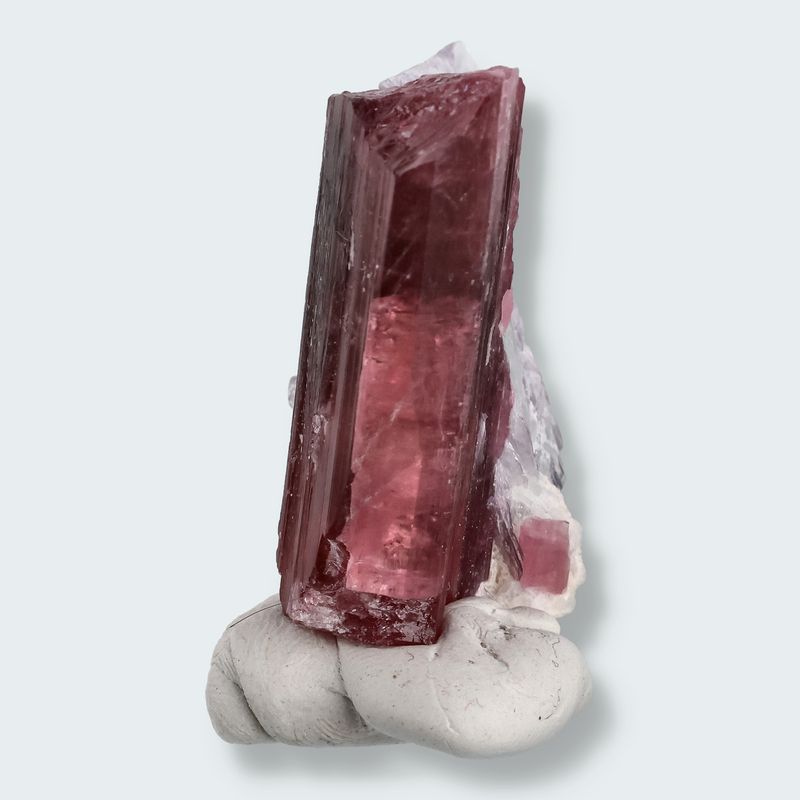
Red tourmaline – a fascinating gemstone for collectors and healing stone enthusiasts
Red Tourmaline – Mineralogical Basics and Fascinating Variety

Red Tourmaline is one of the most sought-after color varieties within the tourmaline group – a complex borosilicate mineral with extraordinary chemical diversity. The red color is caused by trace elements such as manganese within the crystal lattice. The best-known variety of red tourmaline is called Rubellite. This name derives from the Latin "rubellus" (reddish). Mineralogically, red tourmaline belongs to the trigonal crystal class and often forms well-developed prismatic crystals with characteristic longitudinal striations. It is equally attractive to collectors, jewelry lovers, and healing stone enthusiasts – visually striking and energetically significant.
Mineralogical Properties of Red Tourmaline at a Glance
Tourmalines are among the most mineralogically complex stone groups of all. This is also reflected in red tourmaline. Here are the most important properties at a glance:
- Hardness: 7 to 7.5 on the Mohs scale – making it very scratch-resistant and suitable for everyday wear
- Crystal system: Trigonal, often forming long prismatic crystals with longitudinal striations
- Chemical group: Complex cyclosilicate (borosilicate) with variable elemental content
- Density: Approximately 3.0 to 3.2 g/cm³
- Luster: Vitreous luster on cleavage surfaces, vivid refractive index
- Refractive index: Between 1.62 and 1.64 – responsible for the intense play of color
- Special feature: Tourmaline is pyroelectric and piezoelectric – it can develop electrical charges under pressure or temperature change
These physical properties make red tourmaline extremely interesting for both science and jewelry making. The piezoelectricity of tourmaline has been documented since the early 18th century. A fascinating phenomenon that distinguishes it from many other gemstones. As early as 1703, Dutch merchants brought the first tourmalines from Sri Lanka to Europe – sparking centuries of enthusiasm.
Origin and Locations: Where Does Red Tourmaline Come From?
Red tourmaline is found worldwide. The most important supplier countries for high-quality pieces are Brazil, Mozambique, Nigeria, Afghanistan, and Madagascar. Brazil in particular has been considered a significant tourmaline source for over 200 years. The mines in the state of Minas Gerais continue to produce some of the most beautiful rubellites to this day.
More recently, Mozambique has established itself as an emerging source of vividly red tourmalines. Pieces from this region are often characterized by a particularly rich, deep red coloring. Extraordinary specimens also occasionally come from Afghanistan – frequently in combination with other minerals such as quartz or lepidolite.
For ambitious collectors, the origin of a stone is a decisive quality criterion. We recommend always paying attention to the origin information when purchasing. At Crystal Paradise, you receive transparent origin information with every piece – that is our quality promise built on years of experience in the mineral trade.
Also discover our entire Tourmaline Collection with more fascinating varieties of this versatile mineral group.
Rubellite – The Finest Variety of Red Tourmaline
Not every red tourmaline may call itself rubellite. This term is reserved for a certain quality level. The stone must retain a stable, intense red color under various lighting conditions. If the color fades to a pale pink in daylight, it is generally referred to as a pink tourmaline – not true rubellite. High-quality rubellites achieve remarkable prices on the gemstone market and stand splendidly alongside ruby and spinel.
Red Tourmaline versus Garnet and Ruby – Risk of Confusion
Due to its intense color, red tourmaline is sometimes confused with other red gemstones. This most commonly involves Garnet and ruby. The decisive difference lies in the crystal structure and hardness: ruby reaches 9 on the Mohs scale, garnet lies between 6.5 and 7.5. With a bit of expert knowledge and a reliable dealer, any confusion can easily be ruled out.
Red Tourmaline in Crystal Healing – Tradition and Lore
In the world of healing stones, red tourmaline enjoys a special status. The following properties are traditionally attributed to it in crystal healing – without any scientific evidence for this. Anyone who wants to explore the meaning of healing stones in more depth can find further information on the gemological classification of gemstones on the portal of the German Gemstone Society.
- Joy of life and vitality: In traditional crystal healing, red tourmaline is considered a stone of life force. According to tradition, it is said to activate inner energy and strengthen the joy of existence.
- Grounding and stability: It is said to provide support and rootedness – especially during turbulent phases of life.
- Heart opening: Red stones are traditionally associated with the heart chakra or the root chakra. Red tourmaline is traditionally considered in crystal lore to be a stone of grounding and vitality.
- Creativity and passion: In many spiritual traditions, this stone is associated with inspiration and creative energy.
- Protective stone: As early as the Middle Ages, people wore tourmalines as protective amulets. Red tourmaline is likewise regarded as a powerful companion in this sense.
If you're interested in gemstones with emotional meaning, also check out our collection For Lovers – Gemstones for Love, Relationships, and Emotional Connection. There you'll find hand-selected pieces that are especially suited as meaningful gifts.
Red Tourmaline as a Collector's Piece – What Connoisseurs Look For

For experienced mineral collectors, red tourmaline is a true highlight of any collection. The finest collector's pieces show natural, untreated crystals with distinct longitudinal striations and vivid color. Particularly sought after are specimens or matrices in which red tourmaline occurs in combination with other minerals – such as quartz, feldspar, or lepidolite.
Quality Criteria for Purchase
You should definitely pay attention to the following criteria when purchasing a red tourmaline:
- Color: A deep, even red coloring without strong brown tones is considered particularly valuable
- Transparency: Clear to slightly included pieces are equally sought after by collectors and jewelry lovers
- Crystal shape: Well-formed prismatic crystals with recognizable termination faces significantly increase collector value
- Origin: Pieces with verifiable origin information – such as Minas Gerais (Brazil) or Mozambique – achieve higher prices among enthusiasts
- Naturalness: Untreated pieces take precedence over heated or dyed specimens
In our showroom in Feldkirchen near Munich, you can experience red tourmaline up close – color, luster, and radiance right before your eyes. From our own experience, we know: no photo replaces the direct view of a real crystal.
Learn more about the fascinating world of mineral pricing in our blog article Prices for Minerals and Gemstones – My Expert View on the Market.
Care and Cleaning of Red Tourmaline
With a hardness of 7 to 7.5, red tourmaline is relatively robust. Nevertheless, you should handle it with care. Proper care preserves its luster and radiance in the long term.
- Cleaning: Lukewarm water with a drop of mild dish soap and a soft brush – this is completely sufficient
- Avoid ultrasound: Ultrasonic cleaners can damage stones with many inclusions
- Avoid heat: Tourmaline is sensitive to strong temperature fluctuations – never expose it to direct sunlight for extended periods
- Storage: Store separately from harder stones to avoid scratches
- Energetic cleansing: In crystal healing tradition, it is said that cleansing under running water or placing the stone on an amethyst cluster is said to be effective
Also interesting: With Clear Quartz with Schorl Tourmaline you'll find fascinating combination pieces, where black schorl tourmaline is embedded in clear quartz – a mineralogical marvel of nature.
Red Tourmaline in Everyday Life and as a Gift
Whether as a raw crystal on the desk, as a polished pendant around the neck, or as a tumbled stone in your pocket – red tourmaline can be beautifully integrated into everyday life. Its vibrant color makes it a true eye-catcher. As a gift, it is an expression of warmth and joy of life. It is a meaningful companion, especially for people interested in mindfulness and inner balance.
For everyone new to the world of minerals, we also recommend a look at our Young Collector's Corner – there you'll find wonderful beginner pieces for small and large discoverers alike.
Frequently Asked Questions

What is the difference between red tourmaline and rubellite?
Rubellite is a specific, high-quality variety of red tourmaline. It is characterized by a stable, intense red coloring that does not fade even under different lighting conditions. Simple red tourmaline may appear paler or more brownish in daylight. True rubellite is accordingly rarer and more valuable.
How do I recognize genuine red tourmaline?
Genuine red tourmalines typically show a characteristic longitudinal striation on the crystal faces. They have a density of about 3.0 to 3.2 g/cm³ and are noticeably heavier than glass. A reliab

Written by Christian Neumayer


Leave a comment
This site is protected by hCaptcha and the hCaptcha Privacy Policy and Terms of Service apply.