








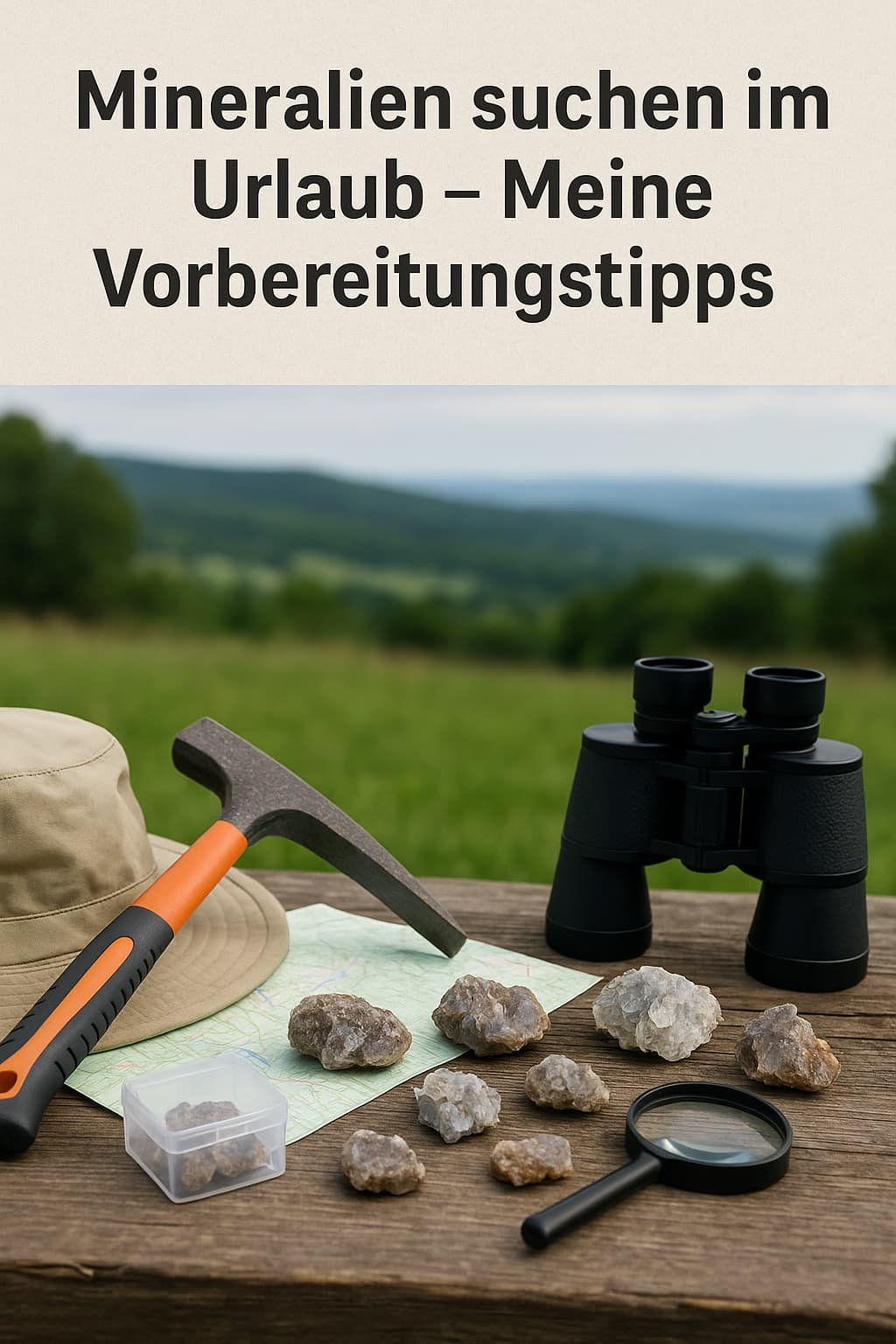
Searching for minerals on vacation – My preparation tips
Rock Hunting on Vacation – How to Prepare the Right Way

Rock hunting means: deliberately tracking down natural mineral specimens, crystals, and rock samples right at their source in nature. Whether in the Alps, on the Mediterranean, or in Scandinavian fjords – anyone who combines their vacation with searching for minerals experiences nature in a truly special way. From our own experience, we at Crystal Paradise know: preparation determines whether you come home empty-handed or with real treasures. This article shows you what matters – from the right equipment to the best collecting areas in Europe.
Why Rock Hunting Is So Fascinating
The fascination is easy to explain. You find something that the earth has shaped over millions of years. No piece is like another. Every find is unique.
Minerals form under extreme conditions. Quartz, for example, crystallizes at temperatures between 100 °C and 600 °C deep inside the earth. Some minerals need thousands of years to form. When you hold such a piece in your hand, you're holding a piece of earth's history.
For collectors, the experience is especially valuable. A self-found stone has a meaning that no purchased piece can replace. At the same time, the search opens your eyes to geology, landscape, and the forces of nature.
If you want to dive deeper into the world of minerals, we recommend our collection for mineral beginners – there you'll find handpicked pieces with detailed descriptions.
The Best Preparation for Rock Hunting
Good preparation is everything. Those who set out unprepared usually find little. Those who go about it systematically come back with real finds.
Step 1: Choose the Right Destination
Not every landscape is equally suitable. Particularly rewarding are:
- The Alps: Classic terrain for quartz, almandine garnet, and chlorite specimens. In Austria and Switzerland there are numerous digging sites.
- Saxony and the Harz (Germany): Known for amethyst, fluorite, and silver minerals. Freiberg in the Ore Mountains has a mining tradition over 800 years old.
- Scandinavia: Norway and Sweden offer larvikite, fuchsite, and rare scapolites.
- Southern Europe: Sicily is famous for sulfur crystals from the Agrigento region. Spain scores with pyrite cubes from Navajún.
- Morocco (as a travel destination): Discover desert roses, malachite, and barite specimens right on site.
Research in advance which minerals are typical in your target region. Geological maps help enormously. The Federal Institute for Geosciences and Natural Resources offers free geological maps for Germany at bgr.bund.de. For international locations, the database Mindat.org is the world's largest mineral locality database and an indispensable research tool.
Step 2: Clarify the Legal Basics
This is an important point that many forget. Collecting minerals is not allowed everywhere.
- In nature reserves, removing rock is generally prohibited.
- On private property, you always need the owner's permission.
- Some countries have an export restriction on minerals – for example Morocco and Brazil.
- In Germany, the mining laws of the individual federal states regulate what private individuals are allowed to collect.
Inform yourself before your trip at the relevant authority or with local mineral clubs. Many communities in the Alps expressly allow collecting small quantities for personal use.
Step 3: Pack the Right Equipment
Without the right equipment, rock hunting is a chore. This basic kit should be included:
- Geologist's hammer (approx. 500–1000 g): For breaking off rock samples. Fist-wedge shape for rough work, pointed hammer for more precise strikes.
- Chisels in various sizes: For extracting crystals from rock crevices.
- Magnifying glass (10x): For identifying minerals right on site. Tiny crystal forms become visible with it.
- Safety glasses: Rock chips fly when hammering. Eye protection is mandatory.
- Gloves: Cut protection against sharp-edged stones.
- Sturdy backpack liner or cloth bag: For safely transporting your finds.
- Newspaper or foam: For padding delicate crystals.
- Notebook and pen: Note the location, depth, and surrounding rock – this significantly increases the scientific value.
Tip from our team: Label each find on site with a small note in the bag. Otherwise, later you won't know which stone came from which location.
Identifying Minerals Correctly – Basic Knowledge for the Field

Identifying minerals is part of a collector's craft. A few simple tests can already help you in the field.
Mohs Hardness Test
The Mohs hardness scale ranges from 1 (talc) to 10 (diamond). With simple tools you can quickly test:
- Fingernail scratches minerals up to hardness 2.5
- Copper coin scratches up to hardness 3
- Knife blade scratches up to hardness 5.5
- Quartz (hardness 7) scratches glass easily
If you want to distinguish quartz from calcite: calcite dissolves in hydrochloric acid and has a hardness of 3. Quartz remains stable and has hardness 7. This is one of the most important identification clues of all.
Color, Luster, and Cleavage
Color alone is rarely conclusive. Quartz occurs in almost every color. Luster is more informative: metallic luster indicates sulfides like pyrite. Glassy luster is typical for many silicates. Pearly luster is characteristic of micas like muscovite or biotite.
Cleavage shows when a mineral breaks smoothly along certain planes. Feldspar cleaves in 2 directions at nearly 90°. This clearly distinguishes it from quartz, which breaks with a conchoidal fracture.
For a comprehensive introduction to identification, we recommend the article How Do I Correctly Identify Minerals? from our Crystal Paradise encyclopedia.
Typical Collecting Regions and Their Minerals
Alps: Quartz, Garnet, and Adular
The Alps are a collector's paradise in Europe. In Austria, especially in the Habach Valley in Salzburg, some of Europe's finest emeralds were found. The valley, however, is strictly protected. Free digging areas exist in certain parts of Tyrol and South Tyrol.
Typical minerals found in the Alps:
- Rock crystal (quartz, hardness 7): Often in fissure fillings of gray gneiss and granite rocks
- Almandine garnet (hardness 6.5–7.5): Deep red crystals in mica schists
- Adular feldspar: Milky-white moonstone type from Valais
- Chlorite-coated specimens: Typical greenish shimmering accompanying phases
Ore Mountains: Historic Mining District
The Ore Mountains have a mining tradition over 800 years old. Since 2019, the region has been a UNESCO World Heritage Site. Here, fluorite specimens in purple and green, barite, pyrite, and sphalerite are especially well known. Many mineral clubs organize guided digging trips – a safe and legally correct option for families.
Sicily: Sulfur Crystals from the Depths
In the region around Agrigento lie former sulfur mines. There you'll find exemplary sulfur crystals with a characteristic sulfur-yellow luster. Sulfur has a Mohs hardness of only 1.5 to 2.5 and is extremely temperature-sensitive – never store it in direct sunlight, as it begins to melt at around 119 °C.
Caring for and Storing Your Finds
After the find, the real work begins. Raw minerals often need to be cleaned and properly stored.
Initial cleaning in the field: Remove coarse rock with a soft brush or cloth. Use water sparingly – some minerals like halite (rock salt) dissolve in water.
At home, you can carefully remove stubborn dirt with a dental brush and lukewarm water. For quartz, diluted oxalic acid (approx. 5% solution) is suitable for removing iron stains. Caution: never use acids on calcite or aragonite – they will dissolve the mineral.
Store your finds dry, dust-free, and protected from direct sunlight. UV light can permanently fade sensitive minerals like amethyst.
After the Vacation: Growing Your Collection

Self-found pieces are the foundation of a real collection. Add to that pieces from dealers and shows. Crystal Paradise offers handpicked minerals from all over the world – including pieces you'd never find yourself on vacation: rhodochrosite from Argentina, tanzanite from Tanzania, or wulfenite from Mexico.
If you want to know what prices are common on the market, our article Prices for Minerals and Gemstones – My Expert View on the Market offers valuable guidance.
Another tip: visit mineral shows. There you'll meet dealers, collectors, and experts. What you should keep in mind at shows is explained in our guide Mineral Show – What Should You Bring as a Visitor?
In stone lore, rock crystal is traditionally attributed with clarity and inner strength. Garnet is said, according to tradition, to bring joy of life and

Written by Christian Neumayer


Leave a comment
This site is protected by hCaptcha and the hCaptcha Privacy Policy and Terms of Service apply.