







How do I properly identify minerals?
How to Identify Minerals Correctly – The Ultimate Identification Guide
Anyone who wonders how to identify minerals correctly is facing a fascinating task. A mineral is a naturally occurring, inorganic solid with a defined chemical composition and an ordered internal crystal structure. This scientific definition sounds dry – yet behind it lies a world of incredible beauty and history. Whether you want to buy a collector's piece, are looking for a healing stone, or are simply curious: with the right identification criteria, you can recognize genuine minerals safely and reliably. In this article, we'll show you what really matters.
The Most Important Physical Properties for Identification
Mineralogists have been using the same physical characteristics for identification for over 200 years. These methods are reliable, verifiable, and easy to apply even for beginners. From years of experience in the mineral trade, we recommend always checking several characteristics at the same time. A single characteristic can be misleading – the combination gives you the reliable picture.
Hardness – the classic first test
The Mohs hardness scale ranges from 1 to 10. It describes a mineral's resistance to scratching. Friedrich Mohs developed this scale in 1812. Talc has a hardness of 1, diamond a hardness of 10. Quartz is at hardness 7 and easily scratches ordinary window glass (hardness approx. 5.5). A simple fingernail has a hardness of about 2.5. With a pocketknife (hardness approx. 6.5), many soft minerals can be clearly distinguished from hard ones. This test costs nothing and delivers quick results.
Color and Streak Color
The visible color of a mineral can be misleading. Impurities significantly alter the color. Quartz exists in over 8 color varieties – from clear to pink (rose quartz) to deep black (morion). More reliable is the streak color: if you rub a mineral across an unglazed porcelain plate (hardness approx. 6.5), it leaves a characteristic colored streak. Hematite, for example, looks metallic gray but leaves a blood-red streak. This is an unmistakable identifying feature.
Luster and Transparency
Minerals display various types of luster: vitreous luster (quartz), metallic luster (pyrite), pearly luster (mica), silky luster (fibrous gypsum), or greasy luster (nepheline). Transparency ranges from completely clear to translucent to opaque. Both characteristics can be assessed without any tools and significantly narrow down the identification.
Crystal Form and Cleavage
Minerals crystallize in characteristic shapes. Cubic crystals indicate the cubic system – typical for fluorite or halite. Six-sided prisms are typical for quartz or tourmaline. Cleavage describes how a mineral breaks along weak bonding planes. Calcite cleaves perfectly in 3 directions – resulting in characteristic rhombohedral fragments. Quartz, on the other hand, shows no cleavage, but rather a conchoidal fracture. These characteristics are best recognized on fresh fracture surfaces.
How to Identify Minerals Correctly When Buying – Verifying Authenticity Safely
When it comes to buying minerals correctly, it's not just about identification, but also about authenticity and quality. Unfortunately, the market also offers dyed, synthetic, or composite stones. In our shop, based on years of experience, we consistently focus on hand-selected natural one-of-a-kind pieces with transparent origin information. We'll show you how to protect yourself as a buyer.
Temperature and Weight as Initial Clues
Genuine quartz feels cold – even at room temperature. Glass imitations warm up noticeably faster in your hand. Quartz has a density of about 2.65 g/cm³. Glass imitations may feel noticeably lighter or heavier. Genuine minerals have a characteristic density. Experienced collectors develop a feel for whether a piece is "properly heavy."
Inclusions and Naturalness
Natural minerals almost always have small imperfections. Tiny cracks, inclusions of other minerals, growth lines – these are signs of authenticity. Perfectly bubble-free, evenly colored stones with unnaturally intense color are often dyed or synthetic. Synthetic amethyst, for example, shows no characteristic zigzag growth under the microscope, unlike genuine Brazilian amethyst.
Origin Information and Certificates
Reputable dealers always state the region of origin. Minerals from Brazil are world-renowned for high-quality amethyst geodes, tourmalines, and rock crystals. Minerals from Afghanistan provide some of the world's most beautiful lapis lazuli, ruby, and kunzite specimens. Missing origin information is a clear warning sign. Always pay attention to transparent product descriptions when buying.
The 7 Most Reliable Identification Criteria at a Glance
- Mohs hardness: Scratch test with fingernail, coin, knife, or quartz rod – scale of 1 to 10
- Streak color: Streak on a porcelain plate – often different from the visible mineral color
- Luster: Determine metallic, vitreous, pearly, silky, or greasy luster visually
- Crystal system: cubic, hexagonal, orthorhombic, etc. – recognizable by crystal geometry
- Cleavage and fracture: perfect cleavage vs. conchoidal fracture
- Density: weight in relation to size – barite feels surprisingly heavy
- Transparency and color: always evaluate in combination with streak color
Tools for Mineral Identification

Simple tools can take you very far. Professional mineralogists rely on specialized equipment. For beginners and collectors, a modest basic set is entirely sufficient.
Simple Tools for Beginners
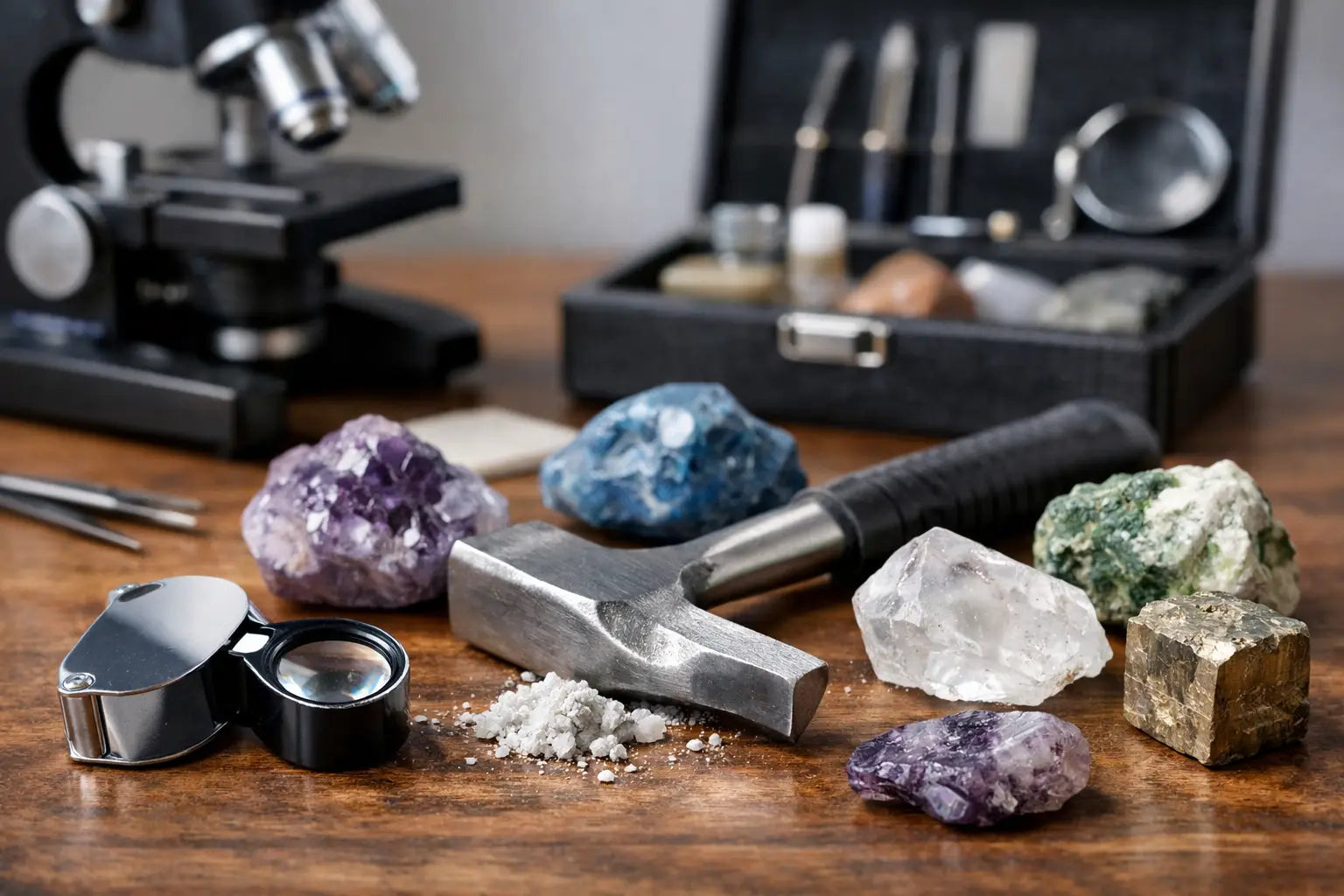
- Magnifying glass (10x magnification): Shows crystal structure, inclusions, and cleavage surfaces
- Porcelain plate: For the streak test – inexpensive and effective
- Hardness kit: Standardized minerals of the Mohs scale – available from about 15 euros
- UV lamp (blacklight): Many minerals fluoresce – fluorite often glows blue-violet, calcite orange
- Precision scale: For advanced determinations via the buoyancy method
Professional Methods
For scientifically precise identification, X-ray diffraction (XRD) and scanning electron microscopy (SEM) are used. These methods provide unambiguous chemical and structural data. For private collectors, they are rarely necessary. However, for valuable collector's pieces over 500 euros, a laboratory certification can be worthwhile. Further technical background can be found at Mindat.org – the world's largest mineralogical database with over 5,800 described mineral species.
Common Confusions and How to Avoid Them
Quartz vs. Glass: Quartz has a hardness of 7 and feels cold. Glass has a hardness of approx. 5.5 and warms up faster. Genuine quartz crystals show horizontal growth striations on the prism faces.
Pyrite vs. Gold: Gold has a density of about 19.3 g/cm³, pyrite only about 5.0 g/cm³. Pyrite leaves a black to greenish-black streak. Gold can be bent, pyrite breaks brittle. This mistake was formerly called "fool's gold."
Lapis Lazuli vs. Dyed Howlite: Genuine lapis lazuli shows golden pyrite inclusions and white calcite veins. Dyed howlite appears more uniform and feels lighter. Under UV light, the materials react differently.
Calcite vs. Quartz: Calcite has a hardness of 3 and can be scratched with a coin. It reacts with dilute hydrochloric acid, producing carbon dioxide. Quartz does not show this reaction.
For related reading, we recommend our article Choosing Minerals for Collectors Correctly – there you'll find more tips for well-informed purchasing decisions.
Learning to Identify Minerals – Practice Beats Theory
Identifying minerals is learned above all through handling them. Books and online resources are a good start. But the feel for weight, temperature, and luster only develops through direct experience. Visit mineral shows, natural history museums, or showrooms. In our showroom in Feldkirchen near Munich, you can hold pieces from all over the world in your own hands. That makes a huge difference.
For deeper insights, a museum visit is worthwhile – as our experience report from Paris shows: My Visit to the Mineral Museum in Paris. There, over 700,000 mineral specimens are on display – an unforgettable experience for any collector.
The region of origin also provides important clues for identification. Minerals from the DR Congo are especially known for vibrant malachites and rare copper minerals. Knowing these types makes them easier to classify. Mineralogical fundamentals are also provided by the German Mineralogical Society – one of Germany's oldest scientific societies, founded in 1908.
Frequently Asked Questions

How can I tell if a mineral is genuine or fake?
Check several characteristics at once: hardness, streak color, temperature behavior, and natural inclusions. Genuine minerals almost always have small imperfections. Evenly intense colors with no recognizable growth structures are a warning sign. Buy from dealers who transparently communicate origin information and insist on authenticity.
What is the simplest test for mineral identification at home?
The scratch test with the Mohs scale is the simplest and most cost-effective test. A fingernail has a hardness of 2.5, a copper coin about 3.5, a steel pocketknife about 6.5. Combine the result with a streak color test on a porcelain plate. This combination narrows down the identification to a few mineral groups and delivers quick results.
How to identify minerals correctly when buying – what should I pay attention to when buying online?

Written by Christian Neumayer


Leave a comment
This site is protected by hCaptcha and the hCaptcha Privacy Policy and Terms of Service apply.