








Citrine: Effects, Meaning & Uses
Citrine: The Golden Quartz at a Glance

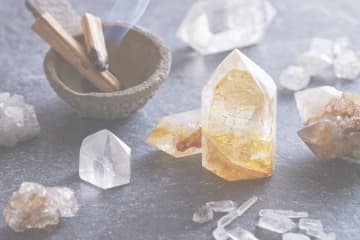
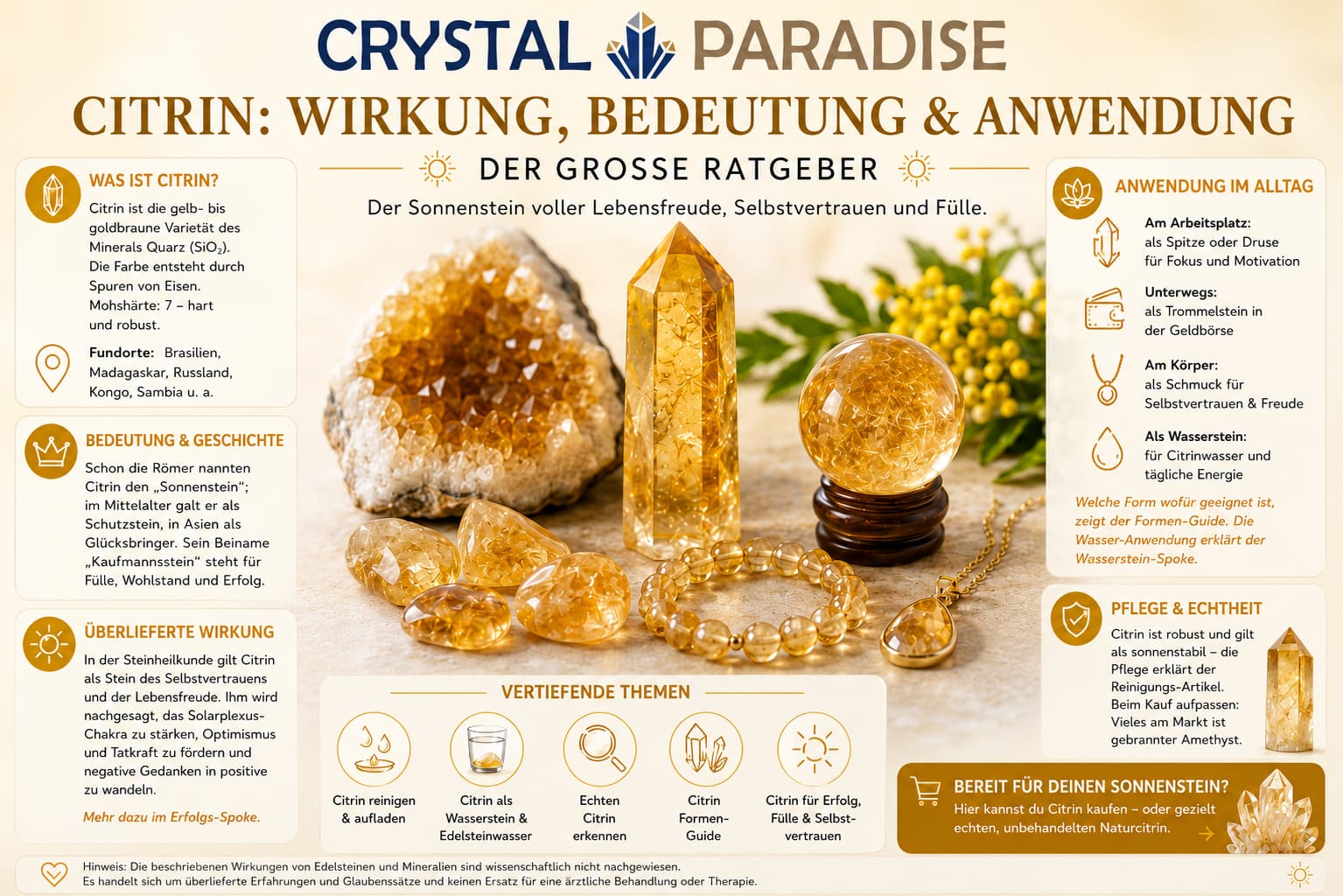
Citrine effects, meaning, and uses – anyone interested in this brightly glowing yellow stone is asking exactly these questions. Citrine is a variety of the quartz mineral with the chemical formula SiO₂ and a hardness of 7 on the Mohs scale. Its characteristic yellow-orange color results from traces of trivalent iron within the crystal lattice. In crystal healing, citrine is considered a stone of joy and positive energy. It belongs to the quartz family – just like amethyst and clear quartz.
Natural citrine is rare. A large part of the market consists of heat-treated amethyst or smoky quartz. Genuine, untreated specimens often come from Brazil, the Congo, Russia, or Zambia. At Crystal Paradise in Feldkirchen near Munich, we place the greatest value on the authenticity of our stones. From years of experience, we always recommend paying attention to the origin information when buying.
Mineralogical Basics: What Exactly Is Citrine?
Citrine belongs to the oxide mineral class and specifically to the quartz group. Its crystal structure is trigonal. Natural citrine forms in hydrothermal veins and pegmatites – that is, under high pressure and at temperatures between 100 and 300 °C deep within the Earth's crust. According to the mineral reference portal Mindat.org, citrine is counted among the commonly occurring quartz varieties, although genuine natural citrine without heat treatment is significantly rarer than its reputation suggests.
The name derives from the Latin word citrus, meaning lemon. This aptly describes the typical yellowish color. The color intensity varies from pale light yellow to a rich orange-brown. The latter is often referred to in the trade as "Madeira citrine."
Natural Citrine vs. Treated Citrine
An important distinction for buyers: Natural citrine forms without human intervention. Its color is usually paler and more irregular. Treated citrine, on the other hand, is produced by heating amethyst or smoky quartz at approximately 400 to 500 °C. It often shows a deep, orange-brown color and is less expensive to source.
Genuine quality can be recognized by the following characteristics:
- Pale to medium yellow color without artificial-looking reddish tones
- Natural inclusions and growth zones within the crystal
- Transparency with vivid inner depth
- Credible origin information (e.g., Brazil, Congo, Zambia)
- No excessively uniform color gradient
In our showroom in Feldkirchen, you can examine citrine in person. We carry only carefully handpicked pieces. Discover, for example, our selection of untreated citrine or browse our complete citrine collection.
Citrine Effects: Traditional Meaning and Spiritual Attributions
In crystal healing, citrine is considered one of the most powerful energy stones. It is traditionally said to have an uplifting and energizing effect. Many people consciously use it as a personal companion – in everyday life, at work, or in meditation.
Emotional and Mental Level
According to traditional lore, citrine is said to amplify positive energy and promote an uplifted mood. In crystal healing, it is said to:
- Be said to strengthen self-confidence and promote inner clarity
- Be said to stimulate motivation and drive
- Be said to dissolve negative thought patterns
- Be said to support creativity and mental freshness
- Be said to symbolize abundance and success as a stone of plenty
For this reason, citrine is often referred to in a spiritual context as the "merchant's stone." According to traditional lore, it is said to help pursue professional goals with joy and energy. Many entrepreneurs and creative individuals value it as a daily companion.
Chakra Assignment and Energy Work
In chakra teachings, citrine is assigned to the solar plexus chakra. This energy center stands for willpower, self-determination, and inner strength. The stone's golden-yellow hue symbolically reflects the energy of the sun. In energy work, citrine is also described as a "self-cleansing" stone – according to tradition, it is said not to store negative energies but to transform them directly.
It's also worth taking a look at related stones such as smoky quartz, which is likewise attributed properties in the area of protection and grounding.
Origin and Occurrence: Where Does Citrine Come From?
The world's most significant deposits of natural citrine are spread across several continents. The Gemological Institute of America (GIA) lists Brazil as the most important country of origin for gem-quality citrine. In addition, there are significant deposits in Africa and Eastern Europe.
- Brazil: The state of Rio Grande do Sul is considered the main supplier. Brazilian citrine often shows deep color tones and excellent crystal formation. Discover our citrines from Brazil.
- Congo: Congolese citrine impresses with vivid yellow tones and natural inclusions. Our collection from the Congo includes special one-of-a-kind pieces.
- Russia: Siberian deposits yield crystal-clear specimens of high quality. Discover our citrines from Russia.
- Zambia: Zambian citrines often show a warm, honey-yellow color play. Browse our citrine collection from Zambia.
Further deposits are found in Spain, Madagascar, Scotland, and the USA. Quality differences by locality are considerable. Collectors and connoisseurs value the indication of the exact country of origin as a quality feature.
Citrine Forms and Applications

Citrine is available in many different forms. The choice of form depends on the intended use. In our citrine forms guide, we have explained the most important variants in detail.
Popular Forms at a Glance
Raw specimens are excellent for room decoration. According to tradition, they are said to enliven the energy of a room. Spheres and freeforms are versatile – both decoratively and in meditation. Tumbled stones are handy and ideal for on the go. Pendants allow the stone to be worn on the body.
Many of our customers also use citrine as a birthstone. As one of the birthstones, it is especially popular among people born in November or under the zodiac sign Scorpio.
Practical Tips for Use
For daily use, we recommend the following proven approaches:
- Meditation: Hold the citrine in your left hand and sit quietly for 10 to 15 minutes. Consciously set your intention.
- Room energy: Place a citrine in your work area or office, e.g., next to the computer.
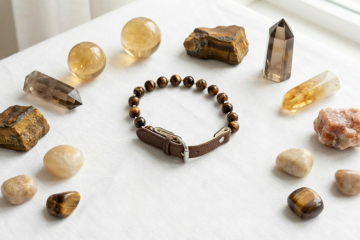
- Wearing on the body: Wear a citrine pendant or bracelet in everyday life.
- Manifestation: Use citrine as a focus stone when visualizing goals.
Care and Cleaning of Citrine
With a hardness of 7 on the Mohs scale, citrine is relatively robust. Nevertheless, it requires careful care to preserve its radiance.
The following should be noted:
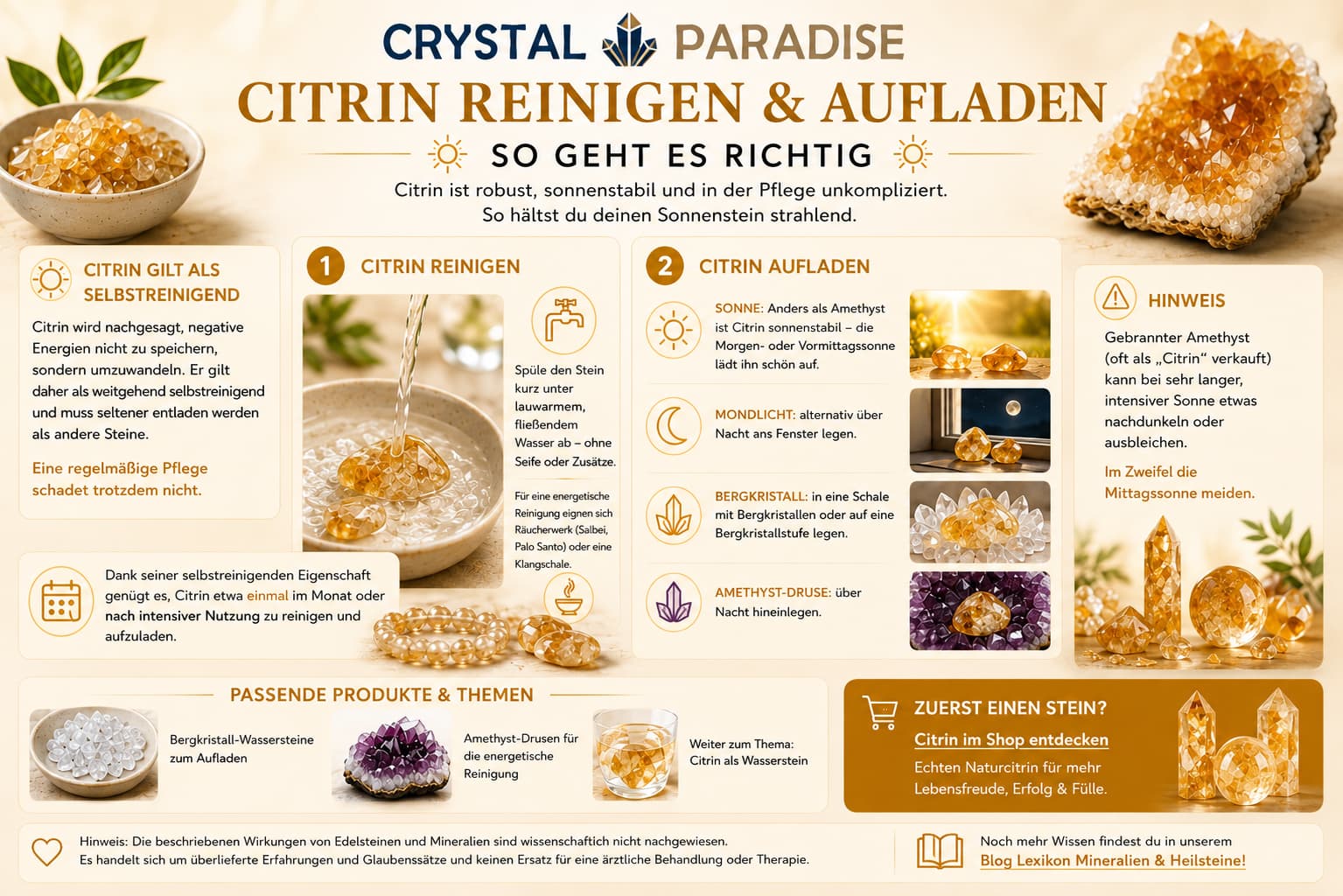
- Water: A brief rinse under lukewarm water is possible. Genuine citrine tolerates brief water contact well.
- Sunlight: Caution! Prolonged direct sunlight can fade citrine's color. No more than 1 to 2 hours daily is recommended.
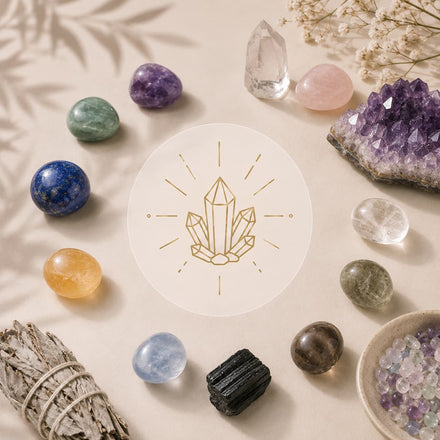
- Energetic cleansing: Smudging with sage or palo santo is a gentle method. Selenite plates or singing bowls are also suitable.
- Storage: Citrine should be stored separately from other stones to avoid scratches.
Natural citrine from the Congo or Brazil often has a particularly vivid transparency. This is best preserved when the stone is cleaned regularly and protected from intense sun exposure.
Buying Citrine: What Should I Look For?
The market for healing stones is confusing. Quality differences are often hard for laypeople to recognize. Based on our years of experience in the mineral trade, we recommend the following purchasing criteria:
- Transparent origin information (country and ideally region)
- Clear distinction between natural and treated citrine
- Visual inspection: Natural citrine appears more organic and less "perfect"
- Purchase from specialized dealers with demonstrable expertise
- Reviews and advisory services as a trust signal
In our showroom in Feldkirchen near Munich, you can directly compare citrine and many other minerals. Our team will advise you personally and help you find the right stone. Of course, all our pieces are also conveniently available in our online shop – with free shipping above certain order values and free returns.
For further information on other healing stones, it's also worth taking a look at our healing stones effects table with more than 30 stones at a glance.
Frequently Asked Questions

What is the most important citrine effect in crystal healing?
In crystal healing, citrine is traditionally described as a stone of joy and positive energy. It is said to promote self-confidence, motivation, and inner clarity. According to traditional lore, it is said to transform negative energies rather than storing them. These attributes make it one of the most popular healing stones overall.

Written by Christian Neumayer

Leave a comment
This site is protected by hCaptcha and the hCaptcha Privacy Policy and Terms of Service apply.