







Healing Stones Effect Table: 30+ Stones at a Glance
Healing Crystal Properties Chart: 30+ Stones at a Glance – Your Compact Guide

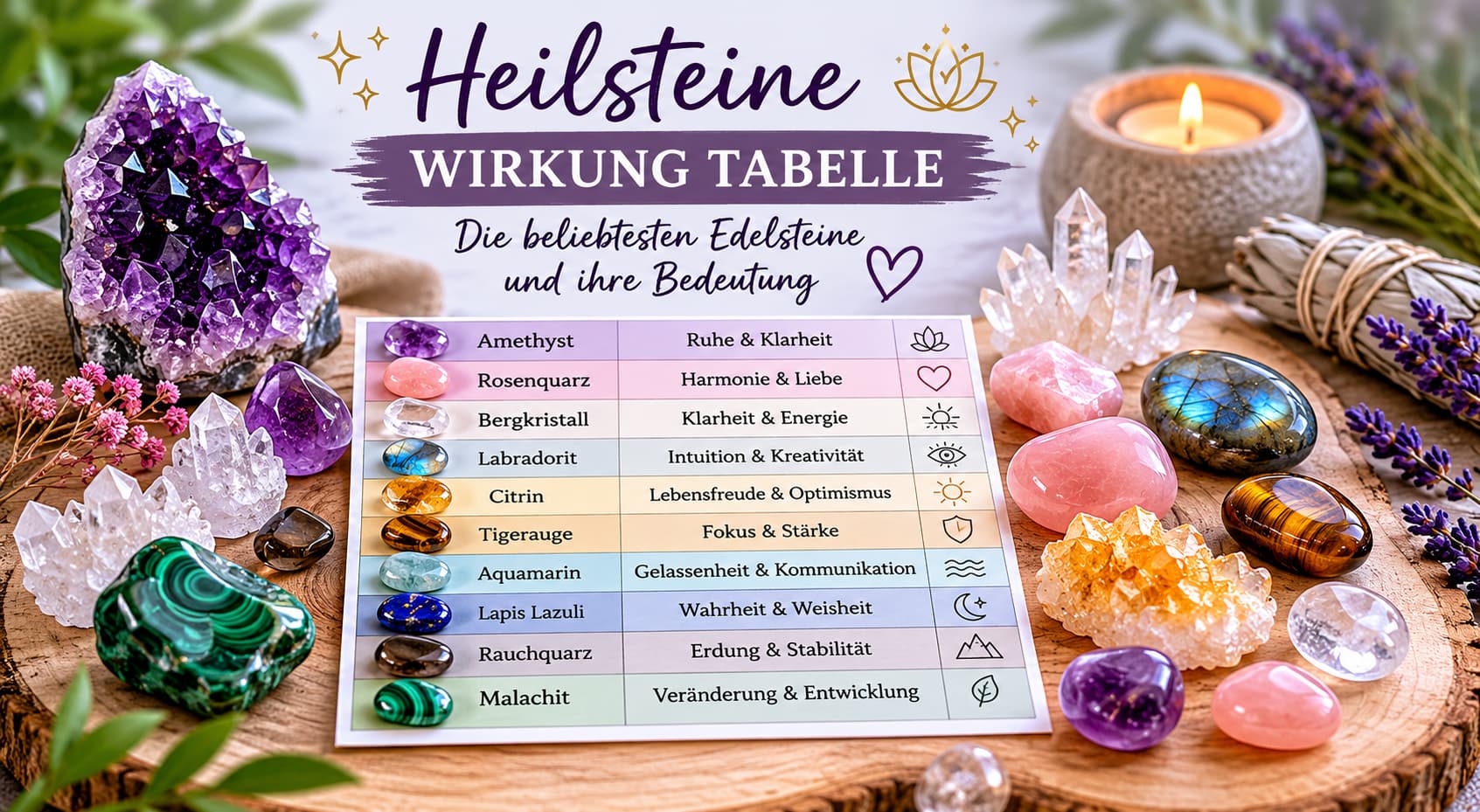
A healing crystal properties chart gives you an overview of which properties are traditionally attributed to various crystals in crystal healing lore. Whether you're interested in calm, clarity, or inner strength – this overview presents over 30 stones and explains what crystal lore traditionally attributes to them. At Crystal Paradise, we draw on years of experience in the mineral trade to help you choose the right stone for you.
Important note upfront: The properties mentioned are based on spiritual tradition and personal experience. They do not replace medical treatment. Nevertheless, millions of people worldwide appreciate healing stones as symbolic companions in everyday life.
What Are Healing Stones? Mineralogical Basics Explained Briefly
Healing stones are natural minerals, rocks, or crystals. They form under high pressure and at temperatures sometimes exceeding 1,000 °C deep within the Earth's crust. Many minerals take millions of years to form. Their crystalline structure, color, and mineralogical composition make each piece unique.
In crystal healing lore, which draws on traditions from various cultures, each stone is attributed its own energy. This tradition goes back thousands of years. The ancient Egyptians already used lapis lazuli and carnelian as protective and ritual stones. In medieval Europe too, gemstones were considered carriers of power and protection.
Mineralogically, healing stones can be classified into:
- Silicates (e.g., quartz, amethyst, rose quartz) – with a Mohs hardness of 7
- Carbonates (e.g., malachite, calcite) – usually softer, hardness 3–4
- Oxides (e.g., hematite, ruby) – particularly dense minerals
- Phosphates (e.g., turquoise, lazulite) – often opaque and richly colored
- Organic materials (e.g., amber, petrified wood) – strictly speaking not minerals, but an integral part of crystal healing lore
If you'd like to dive deeper, you'll find all the basic terms explained clearly in our Healing Stones Glossary for Beginners. The Mohs hardness scale itself ranges from 1 (talc) to 10 (diamond) and is an important tool for stone care. More on mineral classification can be found at the Mindat.org mineral database, one of the world's largest scientific references for mineralogy.
The Comprehensive Overview: 30+ Healing Stones and Their Traditional Attributes

The following overview summarizes the traditionally attributed properties of over 30 well-known healing stones. All information reflects spiritual tradition. No stone has been clinically tested. The Mohs hardness helps you properly care for your stones.
The Quartz Family: The Most Popular Healing Stones
- Clear quartz (hardness 7) – Considered a universal energy stone in crystal healing lore. Traditionally associated with clarity, focus, and cleansing. Sources: Brazil, the Alps, Madagascar.
- Amethyst (hardness 7) – Purple quartz colored by iron traces and irradiation. Traditionally associated with inner calm, sleep, and intuition. Main sources: Brazil, Uruguay. Discover our Amethyst Collection.
- Rose quartz (hardness 7) – Soft pink quartz colored by titanium and manganese traces. According to tradition, considered a stone associated with the heart chakra and linked to feelings of warmth.
- Smoky quartz (hardness 7) – Dark brown to black quartz. Traditionally regarded as a grounding stone. Said to offer protection from negative influences.
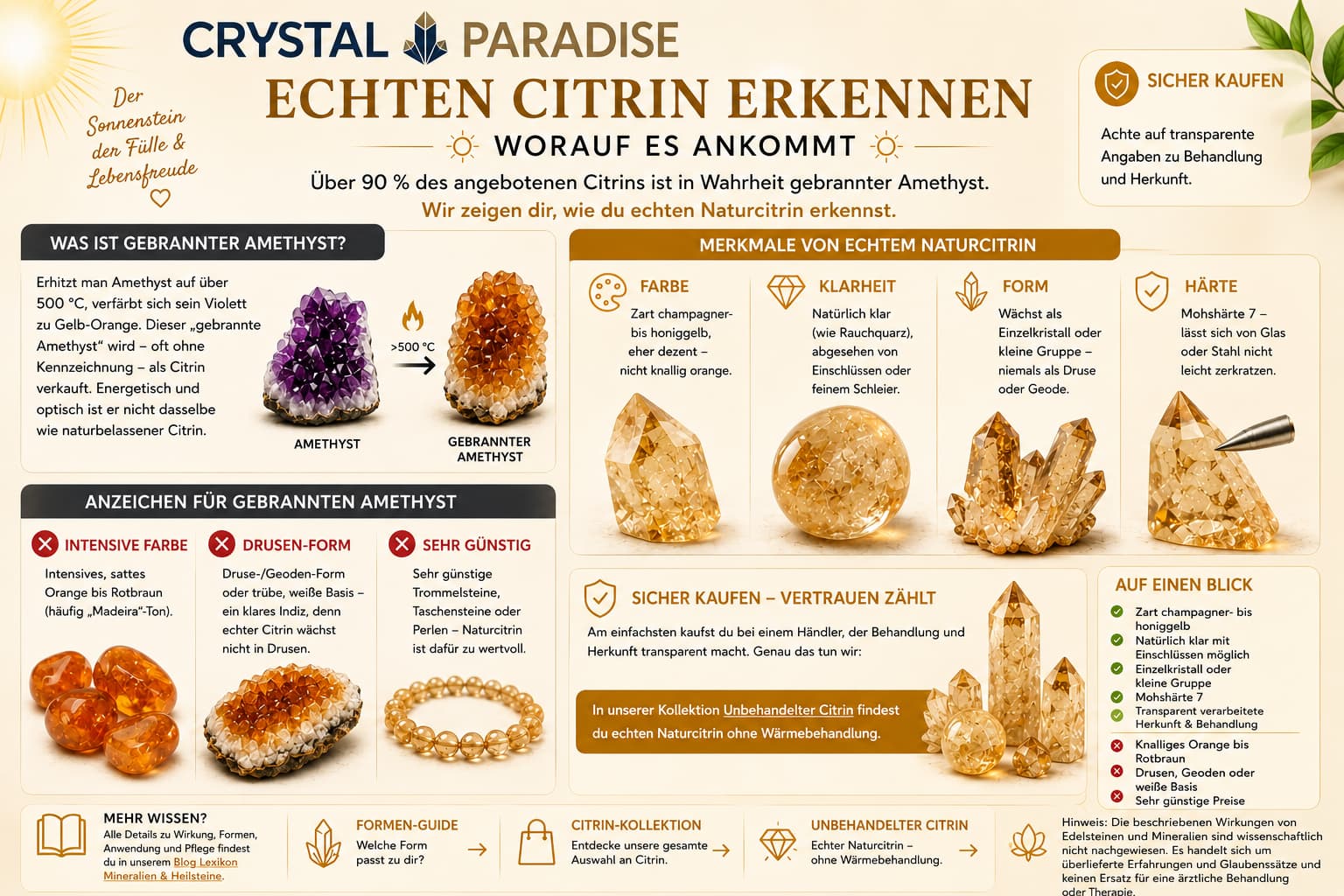
- Citrine (hardness 7) – Yellow quartz formed by natural heat exposure. Considered a stone of joy and creativity. Genuine citrine is comparatively rare.
- Aventurine (hardness 6.5–7) – Green quartz with mica inclusions. Traditionally associated with luck and balance.
- Chalcedony (hardness 6.5–7) – Fine-crystalline quartz in many colors. Said according to tradition to have a harmonizing effect.
- Agate (hardness 6.5–7) – Banded chalcedony. Found on every continent. Considered a protective and stabilizing stone.
- Jasper (hardness 6.5–7) – Opaque chalcedony in red, yellow, or green. Traditionally referred to as a power stone of the earth.
- Ametrine (hardness 7) – A natural combination of amethyst and citrine. Found almost exclusively in Bolivia.
Other Important Healing Stones at a Glance
- Malachite (hardness 3.5–4) – Intensely green copper carbonate. Very sensitive to acids and heat. Associated with protection and transformation.
- Lapis lazuli (hardness 5–6) – Deep blue due to lazurite content, usually with golden pyrite inclusions. One of humanity's oldest cultural stones. Main source: Afghanistan.
- Turquoise (hardness 5–6) – Copper-bearing, typically sky blue to greenish. Considered a sacred protective stone in Navajo and Tibetan tradition.
- Hematite (hardness 5.5–6.5) – Iron oxide with a metallic gray luster. Traditionally associated with grounding, focus, and inner strength.
- Obsidian (hardness 5–5.5) – Volcanic natural glass. Forms through extremely rapid cooling of lava. Considered a protective stone and mirror of the soul.
- Tiger's eye (hardness 7) – Silky shimmering quartz with crocidolite inclusions. Associated with courage, self-confidence, and decisiveness.
- Sodalite (hardness 5.5–6) – Dark blue with white calcite veins. Said according to tradition to support communication and self-expression.
- Moonstone (hardness 6–6.5) – Adularescent feldspar. Shimmers blue-white when light hits it. Traditionally considered a stone of intuition and femininity.
- Labradorite (hardness 6–6.5) – Feldspar with a colorful labradorescence effect. Main sources: Canada, Madagascar. Associated with protection and transformation.
- Fluorite (hardness 4) – Calcium fluoride in many colors. Considered an order stone said to promote structure and mental clarity.
- Pyrite (hardness 6–6.5) – Iron sulfide with a golden luster, also called "fool's gold." Said to strengthen willpower and drive.
- Selenite gypsum (hardness 2) – Very soft, not water-resistant. Considered a cleansing stone. Caution: never place in water.
- Carnelian (hardness 6.5–7) – Red-orange chalcedony. Traditionally associated with vitality, motivation, and joie de vivre.
- Chrysocolla (hardness 2–4) – Blue-green copper silicate. Said according to tradition to support communication and inner stillness.
- Onyx (hardness 7) – Black chalcedony. Considered a protective stone and anchor in stressful times.
- Amazonite (hardness 6–6.5) – Blue-green feldspar. Said to promote harmony and communication. Sources: Brazil, Russia, USA.
- Kyanite (hardness 4.5–7, depending on direction) – Blue silicate stone. Considered one of the few stones said not to require regular cleansing.
- Dumortierite (hardness 7–8) – Intensely blue, comparatively rare. Associated with patience and intellectual focus.
- Prehnite (hardness 6–6.5) – Pale green to yellow. Said according to tradition to support intuitive insight and deep relaxation.
- Petrified wood – Organic material turned to stone through silicification. Age: often over 100 million years. Considered an anchor stone of stability. Learn more in our Petrified Wood Collection.
- Amber (hardness 2–2.5) – Fossilized tree resin, not a mineral. Up to 50 million years old. Traditionally associated with warmth, protection, and joie de vivre.
- Red jasper (hardness 6.5–7) – Vivid red due to iron oxide. Considered in crystal healing lore to be a stone of grounding and physical vitality.
- Prasiolite (hardness 7) – Green quartz, rare in nature. Traditionally associated with heart opening and spiritual growth.
Practical Tips: Properly Caring for and Using Healing Stones

So you can enjoy your stones for a long time, we recommend the following basic rules from our daily practice in our shop:
- Cleansing before first use: Many stones are touched by various people before purchase. An energetic cleansing is advisable. Learn more in our guide on Cleansing Healing Stones.
- Charging with intention: Hold the stone consciously in both hands and formulate a clear intention. Charging under moonlight or sunlight is a widespread practice. You'll find everything about this in our Charging Healing Stones section.
- Check water sensitivity: Stones with a hardness below 5 (e.g., selenite gypsum, chrysocolla, calcite) should not be placed in water. They will dissolve or permanently lose their luster.
- Mind light sensitivity: Amethyst and rose quartz fade under prolonged sunlight exposure. Store them in a cool, light-protected place.
- Regular care: We recommend an energetic cleansing every 4 weeks. With intensive daily use, a weekly clean

Written by Christian Neumayer

Leave a comment
This site is protected by hCaptcha and the hCaptcha Privacy Policy and Terms of Service apply.