







Recognizing Real Citrine
How to Identify Real Citrine – Distinguishing Natural from Fake

Real citrine is a natural, yellow to orange-brown quartz with the chemical formula SiO₂. Its color develops through iron ions in the crystal lattice – completely without artificial treatment. Anyone wanting to identify real citrine must know above all: About 95% of the "citrine" offered worldwide is actually heated amethyst or smoky quartz. This makes identifying genuine pieces a real challenge. This article shows you what matters – from color and cloudiness to origin.
What Is Real Citrine Anyway?
Citrine belongs to the large quartz family. It forms when iron (Fe³⁺) is incorporated into the SiO₂ lattice during crystal formation. The name derives from the Latin citrus – lemon. Natural citrine has a Mohs hardness of 7. This makes it scratch-resistant and well suited for jewelry.
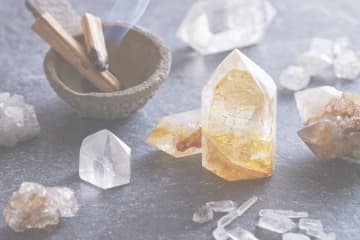
Real, untreated citrine is relatively rare. The best-known deposits are located in Brazil, the Democratic Republic of the Congo, Russia, and Zambia. The colors range from pale lemon yellow to rich honey or cognac tones. Cloudy veils, internal inclusions, or uneven color distribution are not uncommon in natural stones – they are even a sign of authenticity.
Natural Citrine vs. Heated Amethyst
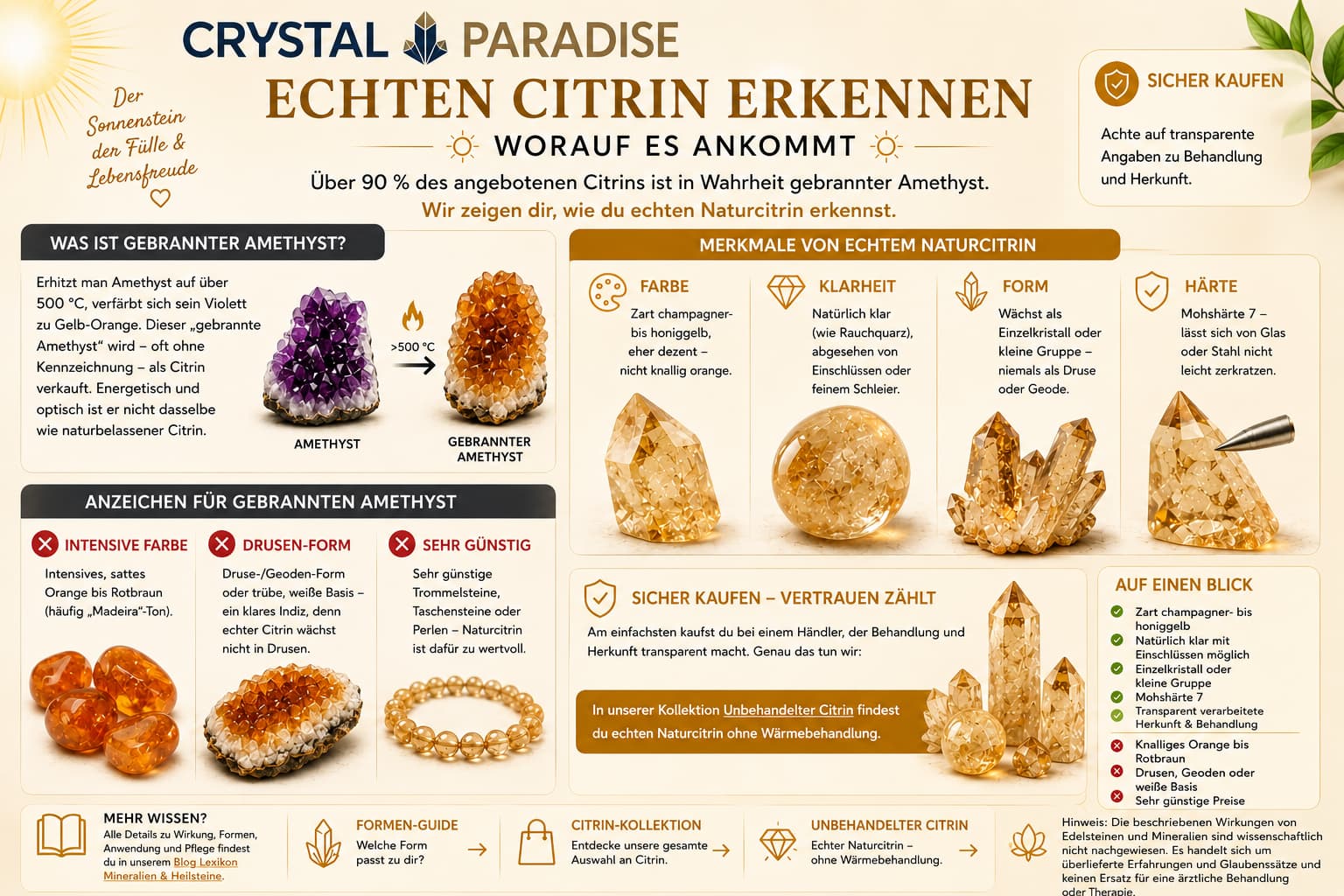
The most common "citrine" on the market is not genuine. Amethyst and smoky quartz are heated at temperatures between 470°C and 560°C. This turns the purple or gray color into an orange to reddish-brown. The result may look beautiful, but mineralogically it's something different. Trade often still calls these stones "citrine" – which is misleading.
Natural citrine forms over millions of years through geothermal processes deep within the earth. Heated quartz forms within a few hours in an oven. The difference may sound small, but for many buyers it is decisive.
How to Identify Real Citrine: The Key Characteristics at a Glance
From our own experience handling thousands of stones from around the world, we at Crystal Paradise know: there are several reliable indicators. No single characteristic alone is sufficient. Only the combination of criteria provides certainty.
Color and Color Distribution
- Real citrine: Delicate, even color from light yellow to cognac brown. Color transitions are smooth. Saturation is usually moderate.
- Heated amethyst: Intense orange-red to red-brown tones, often unnaturally saturated. The color often appears "burnt." The color concentration is often strongly pronounced at the base or tip.
- Colored glass: Uniform, very intense color without any variation. Often a sign of a fake.
Particularly typical for heated amethyst from Brazil are reddish-brown color zones directly at the tip. Real citrine usually shows a natural, light tone there.
Transparency and Inclusions
Natural citrine is often slightly cloudy or contains growth lines, streaks, and fine inclusions. Complete clarity can indicate a glass imitation. Real stones grow in nature – and that shows.
Under a magnifying glass (10x magnification), you can often recognize the following in real citrine:
- Fine cracks and growth lines (so-called "feather inclusions")
- Gas inclusions or liquid inclusions
- Natural color zoning
Perfectly clear, flawless pieces are possible, but at very low prices they are more of a warning sign.
Temperature Test and Density
Real quartz – and therefore real citrine – conducts heat noticeably better than glass. Hold the stone briefly against your cheek: it feels noticeably cooler than a glass imitation. This test is simple, free, and surprisingly reliable.
The density of citrine is approximately 2.65 g/cm³. This corresponds to the typical quartz value. Glass usually has a higher density, depending on its composition. Anyone with a precision scale and a small water container can measure the density themselves using the Archimedes principle.
Origin as a Quality Feature: Where Does Real Citrine Come From?

Origin is one of the most important factors when buying. Real, untreated citrine comes from only a few regions worldwide. We at Crystal Paradise source our stones directly from verified suppliers with clear origin information.
The most important regions of origin:
- Brazil (Minas Gerais, Rio Grande do Sul): The largest supplier worldwide. Here you find both real citrine and a lot of heated amethyst. Caution is important. Discover our citrine collection from Brazil.
- Congo (DRC): Beautiful, deep golden-yellow pieces of rare quality. Mostly untreated. Take a look at our citrine pieces from the Congo.
- Zambia: Clear, light lemon-yellow coloring. Very natural-looking tones. Discover citrine from Zambia in our shop.
- Russia (Ural): Rare deposits with high mineral quality. Pieces from the Ural are considered particularly valuable among collectors.
- Spain (Morion, citrine from the La Rioja region): Historical deposit for natural citrine yellow.
If a dealer cannot or will not provide origin information, caution is advised. Reputable sellers always state the deposit and treatment status. In our range of untreated citrine you will find exclusively pieces with clear origin.
Practical Tips for Buying – How to Protect Yourself from Fakes
Years of experience in mineral trading show us: security when buying comes from knowledge and the right dealer. Here are our most important recommendations:
- Buy from dealers with origin information. A reputable shop states the deposit, processing status, and ideally the supplier.
- Don't trust unnaturally low prices. Real, untreated citrine has its value. Very cheap pieces are almost always heated amethyst or glass.
- Get advice. Our showroom in Feldkirchen near Munich invites you to pick up pieces directly and compare them.
- Check the color critically. Reddish-brown or extremely intense colors indicate heating.
- Use a magnifying glass. Natural inclusions and growth lines are a good sign.
- Ask for certificates. For high-priced pieces, a gemological examination is recommended, e.g., by the German Gemmological Association (DGemG).
- Compare side by side. Real citrine and heated amethyst next to each other – the difference becomes immediately visible.
Anyone wanting to delve deeper into the topic can also find valuable information in the mineralogical database Mindat.org – Citrine, the world's largest mineral reference.
What About Treated Stones – Are They Worthless?
No. Heated amethyst is not automatically bad. Many beautiful minerals are the result of human processing. What matters is the dealer's transparency. A stone correctly labeled as "heated amethyst" has its own value. It becomes problematic when it is sold expensively as "real citrine" – that is simply deception.
Find out more about citrine in all its forms in our detailed Citrine Forms Guide.
Citrine in Crystal Healing – A Brief Overview
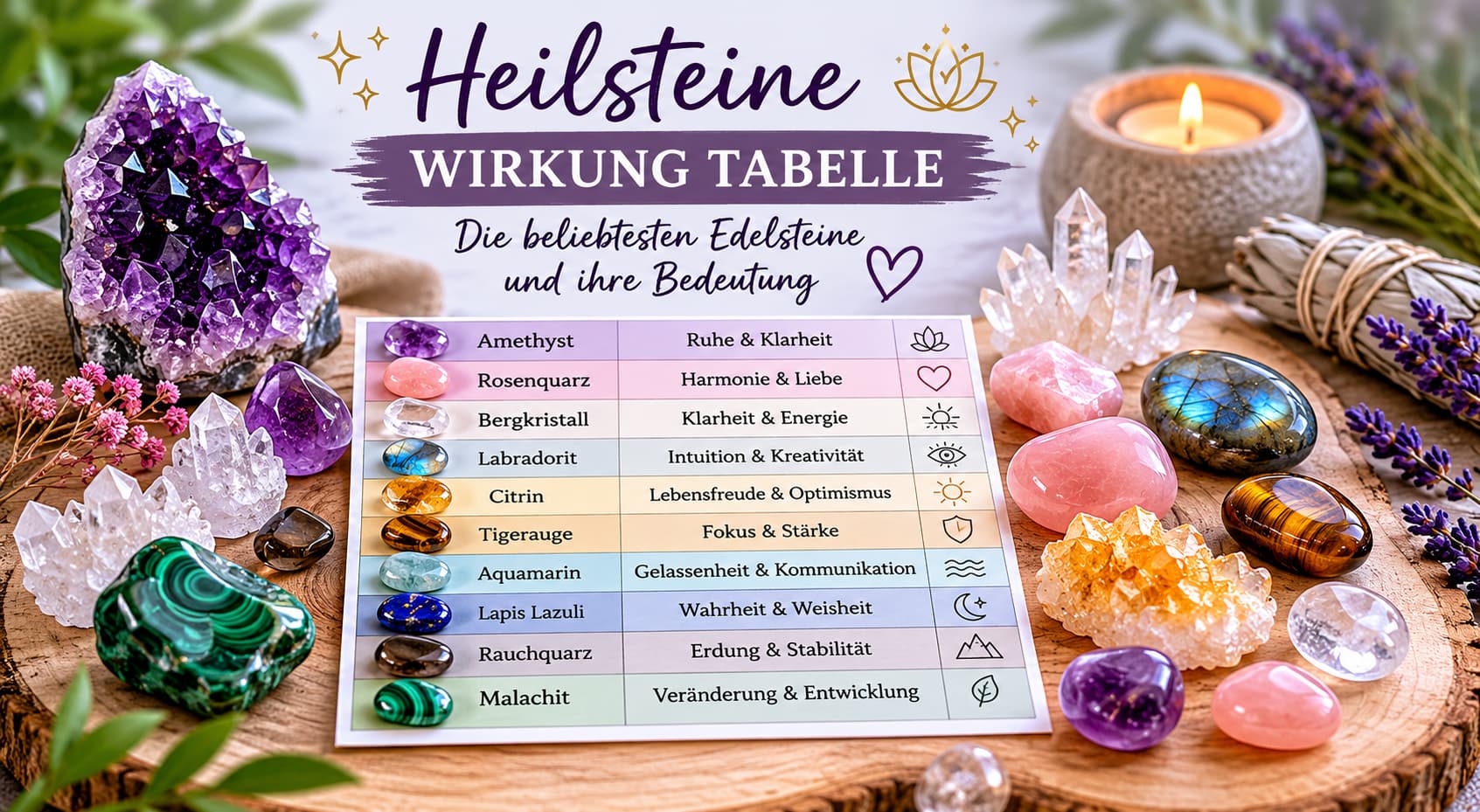
In crystal healing, real citrine is traditionally attributed an energizing effect. According to tradition, it is considered the "stone of light and joy." According to spiritual tradition, the stone is said to have a strengthening effect on self-confidence and creativity. It is often associated with the solar plexus chakra.
More on this in our article: Citrine for Success, Abundance & Self-Confidence.
For collectors and mineral lovers, the energetic attribution is secondary. Here, mineralogical authenticity and the beauty of the stone are what matter most. Both are found in real, untreated citrine to a special degree.
Frequently Asked Questions

How can I recognize real citrine at first glance?
Real citrine usually has a pale to medium yellow coloring – from lemon yellow to cognac. Very intense, reddish-brown tones almost always indicate heated amethyst. Natural inclusions and a slightly cool surface suggest real quartz.
What is the difference between real citrine and heated amethyst?
Real citrine formed over millions of years through natural iron coloring in the quartz lattice. Heated amethyst was artificially heated to 470–560°C. This changes the color, but not the chemical composition – both are SiO₂. The difference lies in the formation history and thus, for many buyers, in the emotional and spiritual value.
Can citrine be cleaned with water?
Yes. Citrine has a hardness of 7 and is water-resistant. It can be briefly cleaned under running, lukewarm water. Find more tips in our article Cleaning & Charging Citrine.
How much does real, untreated citrine cost?
The price depends heavily on size, quality, and origin. Small raw pieces are available from a few euros. High-quality solitaire pieces from the Congo or Uruguay can cost several hundred euros. Very cheap offers under 1–2 € per gram are a warning sign for clear citrine quality.
Is real citrine also available as a water stone?
Yes – according to tradition, real citrine is suitable as a water stone. It is considered water-stable in terms of hardness. What matters is the authenticity of the stone. More

Written by Christian Neumayer

1 comment
Guten Tag. Wegen spiritueller Weise, suche ich 100% echte citrin. Wegen viele enttäuschung, möchte gerne fragen, ob das armband aus citrin bei euch 100% aus Natur citrin wäre? Vielen Dank für Antwort
Gabriella Nemeth
Leave a comment
This site is protected by hCaptcha and the hCaptcha Privacy Policy and Terms of Service apply.