










Tiger's Eye as a Water Stone – Why We Recommend the Indirect Method
Tiger's Eye as a Water Stone – Why We Recommend the Indirect Method

Tiger's Eye as a water stone is one of the most common questions we're asked in the showroom – and one of the few we don't answer with a simple yes. In our own healing stone database, Tiger's Eye is listed as conditionally suitable, while clear quartz, amethyst, rose quartz, citrine, aquamarine, and aventurine are listed there as suitable. This article explains why that is, what's behind it, and how you can still meaningfully combine Tiger's Eye with water.
What Makes Tiger's Eye Mineralogically Special
Tiger's Eye forms from a fibrous mineral: crocidolite, an amphibole from the asbestos group. In the course of rock formation, this fibrous structure is replaced by quartz and silicified – what remains is the silky sheen the stone is known for. This process, known as pseudomorphism, is exactly what gives Tiger's Eye its appearance.
In practice, this means: in the solid, polished stone, the former fibers are tightly enclosed within the quartz. Touching, wearing, or displaying Tiger's Eye is harmless – it has been used this way for centuries. Its Mohs hardness is 7, and the stone is water-insoluble and chemically stable.
Why "Conditional" Rather Than "Suitable" Nonetheless
Our classification has a simple reason: drinking water is a different standard than a palm stone. For a stone that stays in water for extended periods, the integrity of the surface matters. If a stone is chipped, scratched, or cracked, the fibrous structure is, in principle, more exposed than with a closed polish. We are not aware of any documented cases of health impairment from Tiger's Eye in drinking water – but we don't base our assessment on the known frequency of damage cases, but on what we can recommend with a clear conscience.
In addition, there's a clarification we consider important: our water stones are tested by Eurofins according to LFGB standards – sensory testing for odor and taste, as well as for the release of lead and cadmium. This test says nothing about fibers. Anyone advertising with a test report should also state what it does not cover. You can find the background on this testing in the article Dyed Water Stones: Why Color in the Drinking Glass Is a Problem.
The Indirect Method – How to Use Tiger's Eye with Water
With the indirect method, the stone never touches the drinking water. The ritual stays the same, and the issue is off the table:
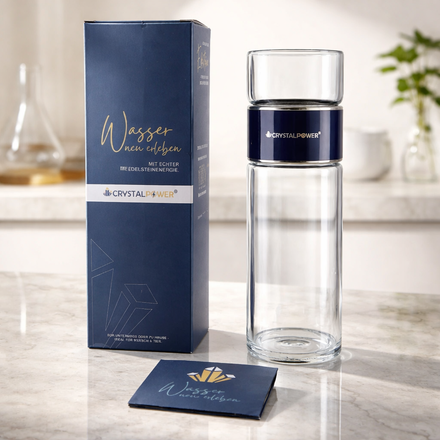
- Carafe with a separate insert. The stone sits in its own glass chamber, while the water flows around it. This design is available with the crystalpower® drinking bottles and carafes.
- Stone in a glass tube. A sealed test tube containing the stone is placed in the carafe – the simplest option if you already have a carafe.
- Stone alongside. Sounds trivial, but it's the form many people already practice: the stone sits next to the glass on the desk and accompanies the drinking process without being in it.
For all three methods, the same applies: the stone stays dry, or at least separated from the drinking water, and the question of the surface no longer arises.
Tiger's Eye in Tradition
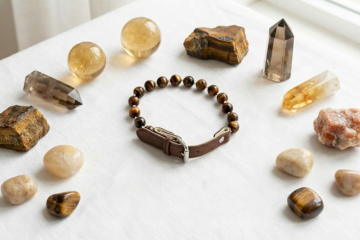
In crystal healing lore, Tiger's Eye is considered a stone of strength, courage, and clear vision and is associated with the solar plexus chakra. In traditional lore, it is considered a stone of clarity and is associated with focused, strategic thinking. It is also said to serve as a protective and luck stone, believed to shield against envy and outside influence.
These attributions come from a long tradition of lore. They are not scientifically proven and do not replace medical treatment.
If You're Looking for a Stone to Place Directly in Water
If focus and clarity are what you're after and you want to place the stone directly in the water, two other stones come to mind:
- Clear Quartz – in tradition, the stone of clarity and a universal amplifier, mineralogically uncomplicated.
- Citrine – the sun stone, traditionally associated with joy of life and motivation.
We list both as suitable, and both are undyed and tested. You can find an overview of all the stones we offer for water at Water Stones for Sale. The Tiger's Eye from the crystal flavours line naturally remains in our range – as a stone to wear, for the desk, and for indirect use.
Frequently Asked Questions
Is Tiger's Eye Dangerous in Drinking Water?
We are not aware of any documented cases of harm, and in the polished stone, the former fibers are tightly enclosed within the quartz. Even so, we classify Tiger's Eye as only conditionally suitable, because for a stone that remains in water long-term, the integrity of the surface is crucial. With the indirect method, this question no longer applies.
Why Do You Sell Tiger's Eye as a Water Stone, Then?
Because it can be used flawlessly with the indirect method – and because we'd rather explain than omit. The stone is part of our crystal flavours line and, like all others, is delivered undyed and uncoated.
Can I Keep Using My Existing Tiger's Eye?
For wearing, displaying, and holding in your hand, without restriction. For water, we recommend the separated method. If you've done things differently so far, there's no reason to worry – just check that the surface is undamaged.
Which Stones Are Clearly Suitable for Water?
Clear quartz, amethyst, rose quartz, citrine, aquamarine, and aventurine. For which stones don't belong in water at all, and why, see our overview Water Stones: Which Gemstones Are Safe.

Leave a comment
This site is protected by hCaptcha and the hCaptcha Privacy Policy and Terms of Service apply.