







Colored Water Stones: Why Color in the Drinking Glass Is a Problem
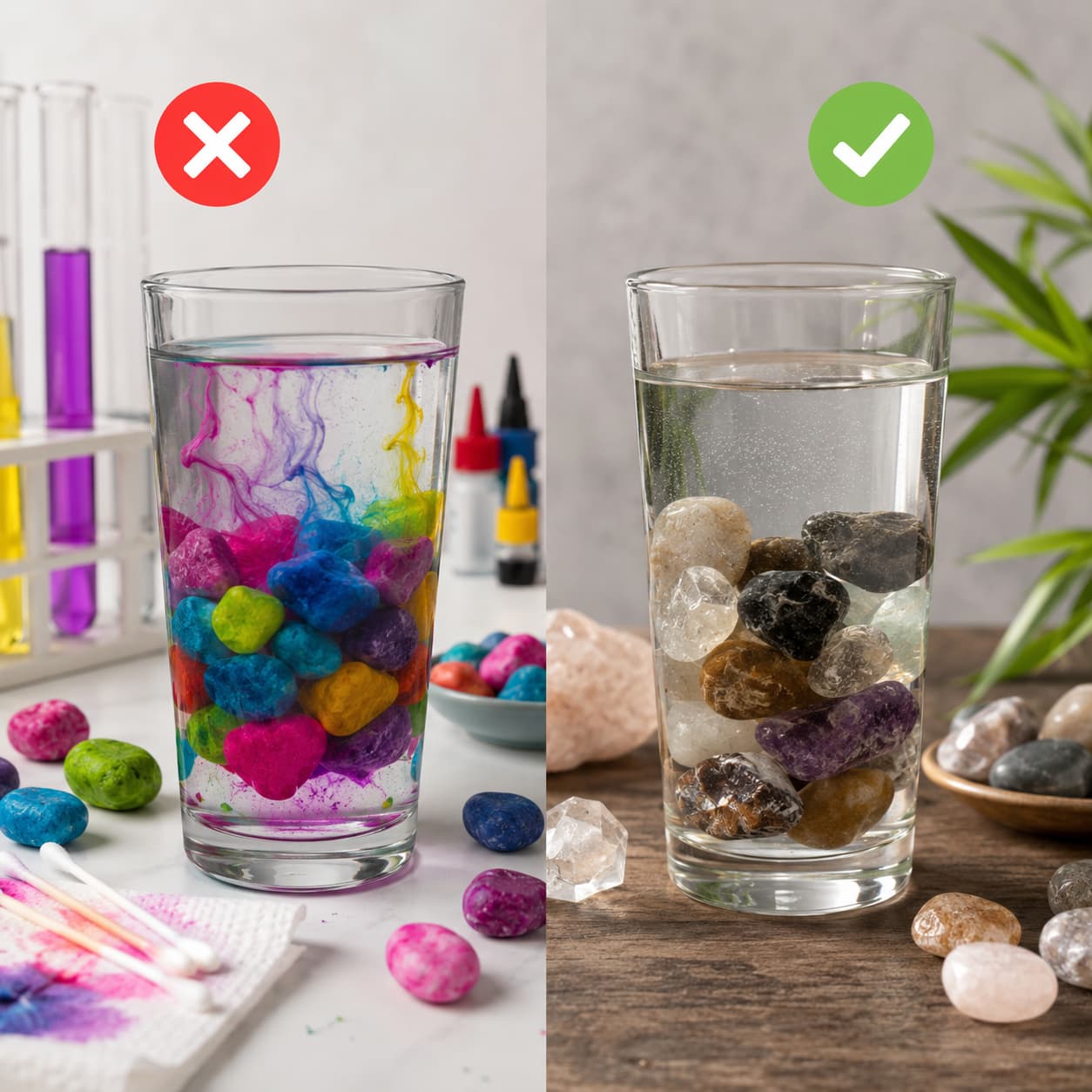
In short: With colorful water stones, coloring in the trade is more the rule than the exception – especially with garish agate slices, with "turquoise" made from howlite, and with aura-coated quartz. If you don't know what was used to color it, you also don't know what might end up in your glass. That's why we had our crystal flavours water stones tested by Eurofins according to LFGB: sensory testing for odor and taste, and for the release of lead and cadmium. Both tests were passed – you can read the complete test report here as a PDF.
Why so many water stones are colored
Nature rarely delivers neon colors. But what sells is what shines on the shelf – and a color bath costs almost nothing. Tumbled stones are traded by the kilo, often through several intermediate stages, and somewhere along the way gray agate becomes turquoise-colored agate. The end customer's bag then says "gemstone mix," and nobody knows anymore which color bath that was.
This doesn't affect all stones equally. These groups are especially frequently treated in the trade:
- Agate slices and agate tumbled stones in turquoise, pink, neon blue, or violet – practically always colored. Agate is porous enough to absorb color, and that's exactly why it's used for it.
- "Turquoise" made from howlite or magnesite – white, soft minerals that are dyed and often additionally stabilized with synthetic resin.
- Aura quartz ("Angel Aura," "Titanium Aura," "Flame Aura") – the rainbow shimmer is a metal layer vapor-deposited in a vacuum, just a few atoms thick and mechanically sensitive.
- "Cherry quartz," "blue quartz," "goldstone" – these are not minerals at all, but artificial glass with inclusions.
- Dyed jasper and dyed howlite as substitutes for more expensive stones like lapis lazuli or sugilite.
The distinction matters: not every treatment is a problem. Citrine formed from heat-treated amethyst remains chemically pure silicon dioxide – nothing has been added, only heat. Critical are treatments where a foreign substance enters or is applied to the stone: color baths, metal coatings, resins, and oils.
How to recognize colored stones
| Feature | What to look for |
|---|---|
| Color intensity | Too garish, too saturated, too uniform. Natural colors are almost always more muted and unevenly distributed. |
| Cracks and pores | Color visibly collects in fine cracks and at transitions – a very reliable sign. |
| Banding | In dyed agate, the bands are colored to different degrees because they have different porosity. |
| Uniformity in a set | Twenty stones in exactly the same color don't come from the same deposit. |
| White cloth | Rub with a damp cloth. If color transfers, the matter is clear. However, no color transfer proves nothing. |
| Price | Hand-sized "turquoise" pieces for a few euros are not turquoise. |
| Origin information | If it's missing entirely, knowledge of what happened to the stone is usually missing too. |
Lead and cadmium – what it's really about
Color has to come from somewhere. Classic inorganic pigments work with exactly the elements you don't want in drinking water: lead chromate delivers strong yellow and orange, cadmium sulfide a bright yellow, cadmium selenide a deep red. Add to that metal salts that serve as mordants in color baths. Whether such substances are present in a particular stone can't be seen from the outside – and that's exactly the point.
A look at the German Drinking Water Ordinance shows how seriously this is taken. There, lead has a limit of 0.010 mg per liter, which will be halved to 0.005 mg/l starting January 12, 2028. For cadmium the limit is 0.003 mg per liter. These are millionths of a gram – the values are so low because both metals accumulate in the body instead of simply being excreted again.
Lead is stored in bone and released again from there over years. The European Food Safety Authority (EFSA) withdrew its previously valid tolerable weekly intake for lead because no threshold could be derived below which no effect is to be expected. Children and pregnant women are especially in focus here.
Cadmium accumulates primarily in the kidney; its biological half-life is measured in decades. EFSA states a tolerable intake of 2.5 micrograms per kilogram of body weight per week – for an adult weighing 70 kg, that's about 175 micrograms per week, from all sources combined. The International Agency for Research on Cancer (IARC) classifies cadmium and cadmium compounds as carcinogenic to humans.
Two everyday factors make matters worse: acid and time. A splash of lemon lowers the pH, and in slightly acidic water many things dissolve that remain stable in neutral water. And a stone that stays permanently in the bottle has significantly more contact time than one that's briefly placed in a carafe in the evening.
So this isn't misunderstood: a single stone in a carafe is not an acute poisoning scenario, and we don't want to scare anyone here. The actual issue is different – it's about a daily habit over years, with a product whose composition nobody knows. That's exactly where gut feeling ends and measurement begins.
What Eurofins tested in our water stones
That's why we sent our water stones to an independent laboratory instead of simply claiming their safety. Eurofins is one of the world's largest testing laboratory networks for food and product safety. Here are the key facts of the report:
| Information | Content |
|---|---|
| Testing laboratory | Eurofins Product Testing Service, accredited according to ISO/IEC 17025 |
| Report number | EFHZ25092644-CG-01 |
| Client | Crystal Paradise, Olympiastraße 32, 85622 Feldkirchen, Germany |
| Test item | Stone (water stone), destination country Germany |
| Sample received | September 12, 2025 |
| Testing period | September 17 to 19, 2025 |

→ Open complete Eurofins test report as PDF
Two points were tested, both with the result passed:
| Test | Basis | What it's about | Result |
|---|---|---|---|
| Sensory test for odor and taste | LFGB §§ 30, 31 and BfR recommendation | A trained panel checks whether the object transfers odor or taste to the food – the classic proof of leachable foreign substances. | Pass |
| Release of lead and cadmium | LFGB §§ 30, 31 and DIN 51032:2017-07 | The object is treated under standardized conditions with an acidic test solution; the amount of lead and cadmium transferred into the solution is then measured. | Pass |
§ 30 LFGB prohibits manufacturing consumer goods in a way that releases health-damaging substances during intended use. § 31 regulates the transfer of substances onto food. DIN 51032 sets the specific maximum values for lead and cadmium release. The acidic test approach is important: it reflects exactly the situation that occurs in everyday life when lemon or acid gets into the water.
What the report says – and what it doesn't say
A test report is not a magic seal, and we don't want to make it out to be more than it is. It refers to the submitted sample and to the two points tested. It states: under standardized, acidic conditions, neither lead nor cadmium is released from these stones in a relevant amount, and they do not alter the odor or taste of the water.
It makes no statement as to whether water stones have any effect on the water or its taste. That's not what this is about at all. It's solely about the question of whether a product that has daily contact with your drinking water remains safe. That question can be measured – and we think it should be measured before anyone puts a stone in their water.
Our seven crystal flavours at a glance
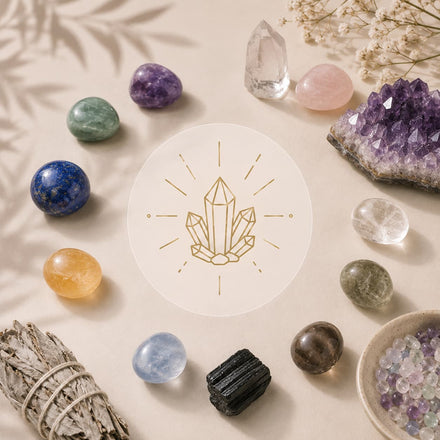
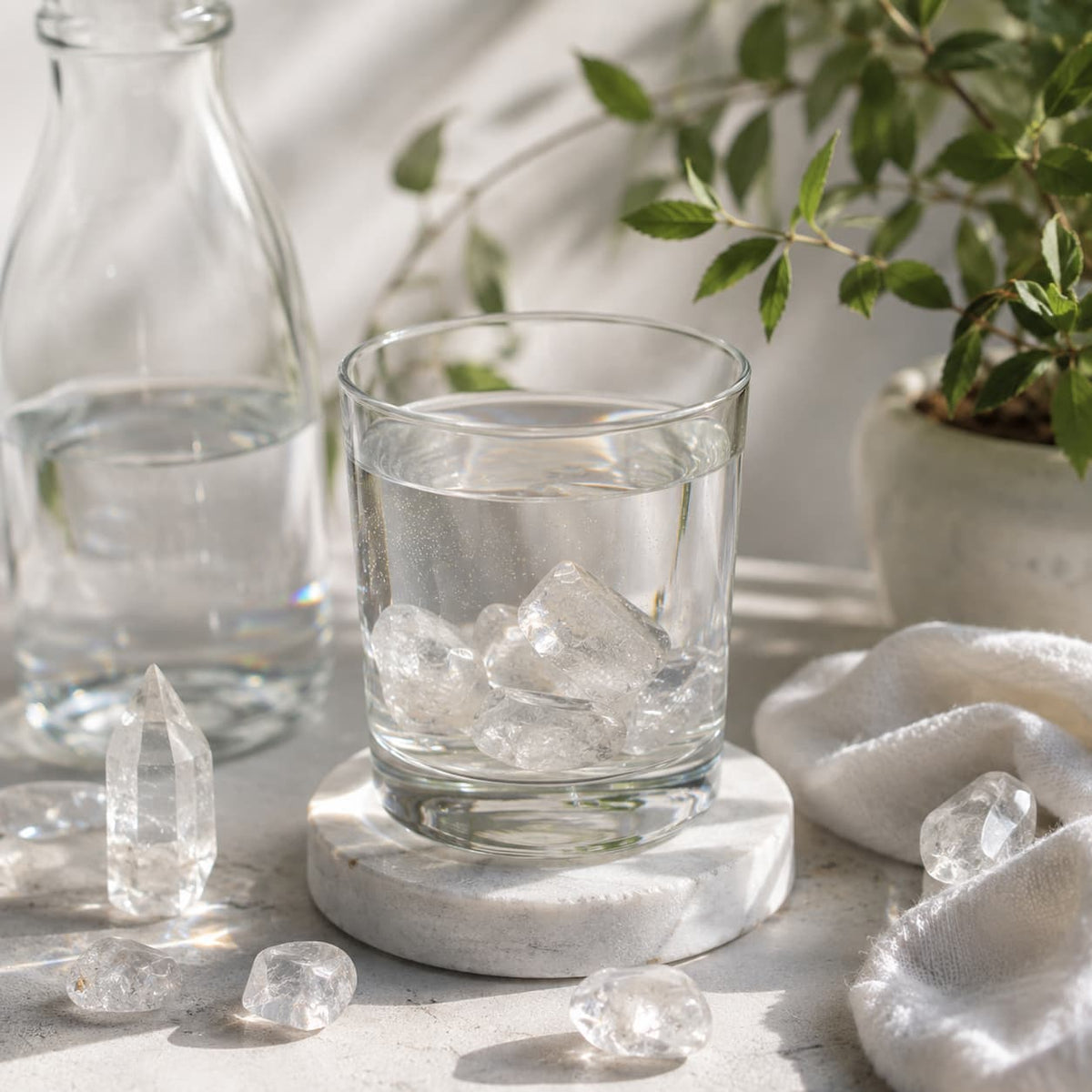
All seven varieties are natural stones without color bath, coating, or resin. Six of them belong to the quartz group and are therefore practically insoluble chemically; aquamarine is a ring silicate with even greater hardness. We explain in detail why this is mineralogically decisive in the article Which gemstones are safe as water stones?.
- Clear Quartz – Clarity & Focus: pure silicon dioxide, Mohs hardness 7, the classic for getting started. Also see the collection Clear Quartz Water Stones.
- Amethyst – Calm & Intuition: quartz whose violet color comes from traces of iron in the crystal lattice – firmly bound, not applied. More on this under Amethyst as a water stone.
- Rose Quartz – Harmony & Heart Opening: delicate pink from trace elements in the quartz, no color bath. See also Rose quartz as a water stone.
- Citrine – Joy of Life & Motivation: quartz in yellow to honey tones. More in depth in the article Citrine as a water stone.
- Aventurine – Serenity & Lightness: quartz with mica inclusions; the inclusions too are silicates.
- Aquamarine – Clarity & Inner Calm: beryl, Mohs hardness 7.5 to 8, not measurably soluble in water.
- Tiger's Eye – Focus & Self-Confidence: silicified quartz with a silky sheen; we supply it exclusively tumbled and polished, never freshly broken.
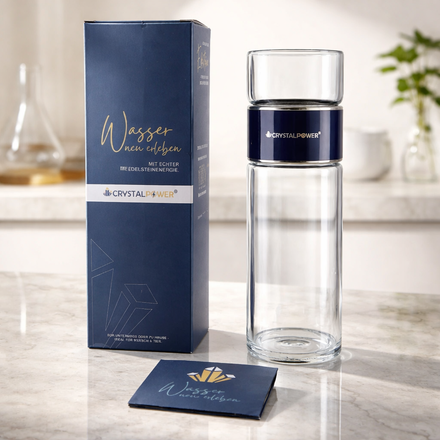
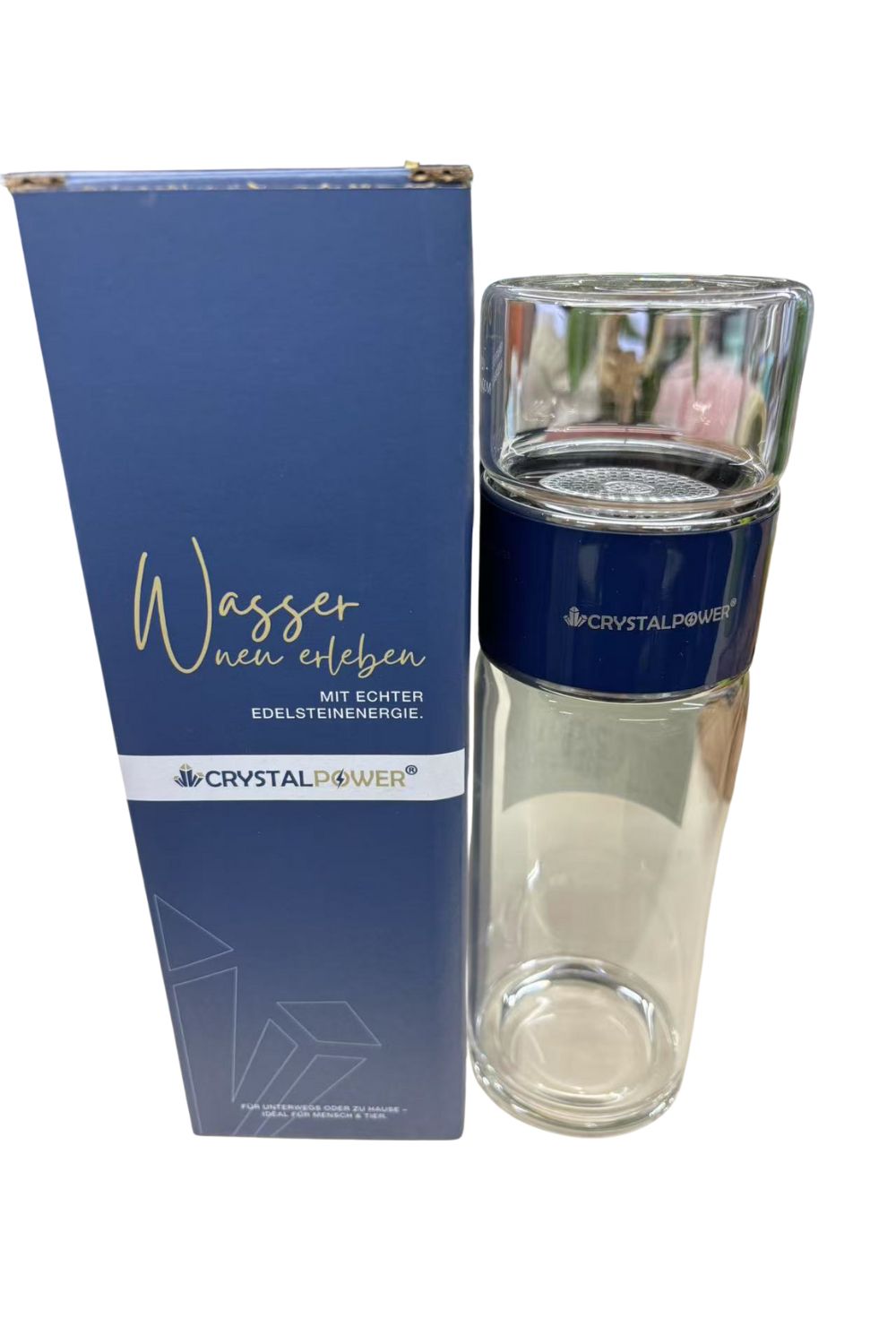
A fitting vessel is our crystalpower® water bottle for water stones – with a glass body and a removable stone insert. You'll find the full selection in the collections Water stones and Water stone bottles, and all other stones from our own brand under CrystalPower® healing stones, protection, water, and energy stones – note that these names follow traditional meanings and do not represent medical claims.
Checklist for buying
- Ask for the mineral, not the trade name. "Blue agate" says nothing, "chalcedony, undyed" does.
- Ask about the origin. Whoever can name the deposit has the supply chain under control.
- Be skeptical of garish colors. The more luminous the set, the more likely the color bath.
- Ask for the test report. A dealer who has products tested for food contact will also show the report.
- Choose tumbled or polished pieces instead of freshly broken splinters.
- When in doubt, go indirect. Put the stone in a sealed glass tube, and the tube in the carafe – then nothing touches the water.
You can find which stone suits your concern in the healing stone finder – it also notes for each stone whether it's suitable as a water stone.
Frequently asked questions
Are most water stones in the trade dyed?
With colorful mixes, this is very often the case. Garish agate slices, "turquoise" made from howlite, and aura-coated quartz are practically always treated. Classic individual stones like clear quartz, amethyst, and rose quartz, on the other hand, are usually natural – also because their coloring can't be sensibly imitated anyway.
Can heavy metals dissolve into the water from dyed stones?
It's possible if the coloring was done with lead- or cadmium-containing pigments, or if the binder isn't stable. Whether and how much actually transfers can only be determined in a laboratory – from the outside, neither the pigment nor its stability can be seen on a stone. That's exactly why LFGB tests exist.
What does food-safe mean for water stones?
The term comes from consumer goods law: an object with food contact must not release health-damaging substances during intended use, and must not alter odor or taste. This is tested according to LFGB §§ 30 and 31 – sensory testing and testing for the release of metals such as lead and cadmium.
How can I recognize a dyed stone at home?
Look at cracks and pores: if color has collected there more intensely than on the surface, it has been dyed. A set of twenty stones in exactly the same color is also a clear sign. The damp white cloth test can prove dyeing – but no color transfer doesn't prove that the stone is natural.
Are aura quartz suitable as water stones?
No. The shimmer is created by a metal layer vapor-deposited in a vacuum, just a few atoms thick. It's mechanically sensitive and not intended for permanent contact with drinking water. For decoration and collecting, aura quartz is beautiful, but it has no place in the glass.
Does lemon in the water make a difference?
Yes. Acid lowers the pH, and in slightly acidic water, substances dissolve that remain stable in neutral water. That's why lead and cadmium release is deliberately measured in the laboratory with an acidic test solution – it reflects the most unfavorable realistic case.
Where can I view the Eurofins test report?
Right here: The complete report is available as a PDF for reading. Resellers and hospitality customers also receive it along with the product documentation.
Note
The testing information refers to the mentioned Eurofins test report and the sample examined there. Traditional attributions to healing stones are based on tradition and are not medical claims. The stated limit values come from the German Drinking Water Ordinance, and the assessments of lead and cadmium come from the European Food Safety Authority (EFSA) and the International Agency for Research on Cancer (IARC).

Written by Christian Neumayer

Leave a comment
This site is protected by hCaptcha and the hCaptcha Privacy Policy and Terms of Service apply.