







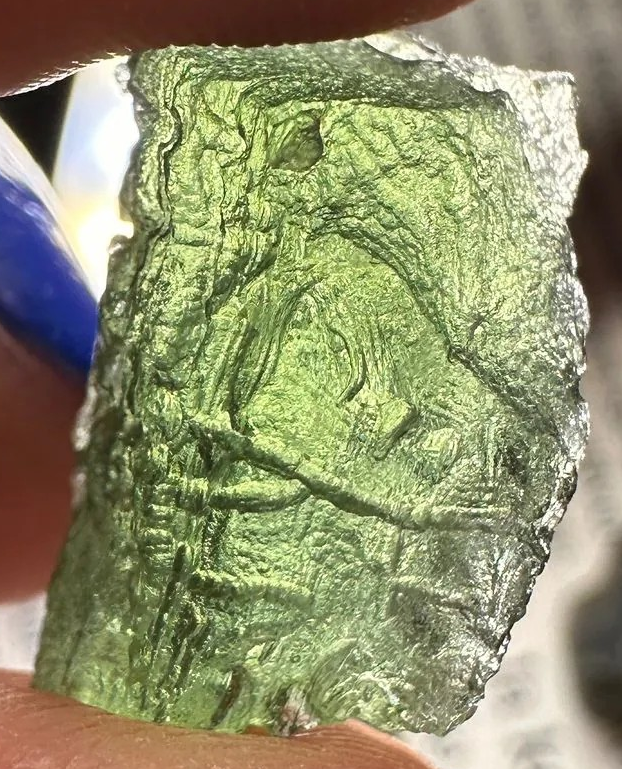
Moldavite stone: created by meteorites
Moldavite Stone: Cosmic Energy from the Bohemian Basin

The moldavite stone is a natural tektite glass that formed approximately 14.7 million years ago from a meteorite impact in what is now Bavaria. Upon impact, terrestrial rock melted, was ejected into the atmosphere, and solidified into green, glass-like moldavite – one of the rarest minerals in the world. Anyone who holds this stone in their hand for the first time immediately understands why it is so fascinating. Its unmistakable surface, its deep bottle-green color, and its extraordinary origin make it a true collector's item.
Formation and Origin: How the Moldavite Stone Was Born
The origin of moldavite is as dramatic as almost no other mineral. About 14.7 million years ago, a meteorite with a diameter of roughly 1.5 kilometers struck the area of what is now the Nördlinger Ries in Bavaria. The energy of the impact was immense. Terrestrial rock was catapulted into the atmosphere and liquefied at temperatures of over 1,500 degrees Celsius. Upon re-entering the atmosphere, the material solidified into glass-like droplets – the so-called tektites.
These tektites fell across large parts of Central Europe. The largest deposit area lies in the South Bohemian Basin in what is now the Czech Republic, especially around the Moldau (Czech: Vltava) and Raab rivers. This is also where the name "moldavite" comes from. Other deposits can be found in Moravia and in Lusatia. The scientific classification as a tektite is internationally recognized and well documented – the mineral reference portal Mindat.org lists moldavite with all mineralogical characteristics and deposits worldwide.
Scientific Classification
Mineralogically, moldavite is not a mineral in the classic sense, but a natural silicate glass. Its chemical composition resembles that of quartz glass, but it also contains aluminum, iron, and magnesium oxides. The silicon dioxide content is about 79 percent. The Mohs hardness is around 5.5, which makes it comparatively delicate. Moldavite is thus softer than quartz (hardness 7) and should be handled with corresponding care. Further geological information about the Nördlinger Ries and its formation is available at the Geopark Ries – official information page of the impact crater.
For further classification of various stones, we recommend our Healing Stone Encyclopedia: Meaning of Stones.
Visual Characteristics: Why Moldavite Is So Distinctive
No moldavite is like another. This is what makes it so highly sought-after. The color ranges from light gray-green to deep bottle-green to nearly black-green olive tones. Transparency varies greatly: some pieces are nearly clear and can be seen through, others are almost opaque.
The surface is its true trademark. Typical are the so-called sculptures – pitted, furrowed, or wrinkled patterns that formed from the rapid flight and cooling in the atmosphere. These surface structures are a reliable indicator of authenticity. Many fakes made of simple green glass exist on the market – genuine moldavites, however, can be clearly identified under a magnifying glass by their characteristic bubble inclusions and flow textures.
- Color: Light transparent to dark green, rarely yellowish-green
- Surface: Sculptured, pitted, furrowed – each piece unique
- Inclusions: Typical gas bubbles and flow structures inside
- Shape: Droplets, discs, lumps, or irregular fragments
- Weight: Individual pieces mostly between 1 gram and several hundred grams
Moldavite Stone in Crystal Healing: Tradition and Lore
Moldavite is one of the stones with the strongest mythical charge. People have valued this stone for thousands of years. Archaeological finds show that moldavite was already used as jewelry and a talisman more than 25,000 years ago – for example, in excavations of the Willendorf culture in Austria.
In crystal healing, the moldavite stone is considered one of the most powerful transformation stones. Tradition attributes to it the ability to trigger profound inner change processes and expand consciousness. According to traditional lore, it is said to support letting go of old patterns and finding new paths. Some traditions associate moldavite with the heart chakra and the third eye and describe it as a link between cosmic and earthly energy.
Some people report intense sensations upon first contact with the stone – a tingling, a feeling of warmth, or a rising emotion. In crystal healing, this phenomenon is known as the "moldavite flush." Whether this experience is due to the stone or has psychological causes is not scientifically proven. Anyone looking for a healing stone from our bestseller collection will find moldavite there alongside many other special stones.
Chakra Association and Combination
Traditionally, moldavite is associated with the heart chakra (4th chakra) and the brow chakra (6th chakra, third eye). In traditional practice, it is often combined with grounding stones to balance its intense energy. Black tourmaline, hematite, or obsidian are considered classic companions. Our article on Obsidian – Created by Volcanoes gives a good overview of this grounding stone.
Recognizing Authenticity: How to Distinguish Real Moldavite from Fakes

The demand for moldavite is high, and unfortunately so is the supply of fakes. Since it is a rare natural material with a limited occurrence, it is worth taking a close look. In our showroom in Feldkirchen near Munich, customers can experience and touch moldavites up close. We recommend this direct contact to anyone interested – because a genuine moldavite stone speaks for itself.
- Check for bubble inclusions: Genuine moldavites show typical gas bubbles and flow lines under a magnifying glass.
- Note the surface structure: The sculptured, pitted surface is hard to fake – smooth glass is suspicious.
- Weight and feel: Genuine moldavite glass feels slightly cool and heavy for its size.
- Transparency in light: Held up to the light, genuine pieces show characteristic internal structures.
- Certificate of origin: Reputable dealers offer certificates or proof of origin.
Years of experience in the mineral trade have shown us at Crystal Paradise: anyone who buys cheap moldavites without proof of origin risks acquiring a glass imitation. Quality and authenticity have their price – and their value.
Care and Storage of the Moldavite Stone
Despite its cosmic origin, moldavite is a delicate material. With a hardness of only 5.5 on the Mohs scale, it scratches easily when in contact with harder stones. You should follow these care instructions:
- Store separately: Never store together with quartz, rock crystal, or other stones with a hardness of 6 or higher.
- Clean gently: Only wipe with a soft, slightly damp cloth – do not use aggressive cleaning agents.
- No ultrasonic cleaning: The delicate glass structure cannot withstand mechanical vibrations from ultrasound.
- Avoid direct sunlight: Long-term UV exposure can affect the color.
- Energetic cleansing: In crystal healing, moonlight or smudging is traditionally recommended – soaking in water is harmless due to the glass structure, but not strictly necessary.
Anyone also interested in the energetic use of stones in water will find exciting alternatives among our CrystalPower® healing, protection, water, and energy stones. Moldavite itself, due to its glass nature, is less suited as a permanent water stone.
Buying Moldavite: What You Should Look For
The market for moldavite is international and growing steadily. Good to know: the mining area in Bohemia is limited. The Czech government has strictly regulated extraction, as the deposits are nearing depletion. This makes genuine moldavites a finite resource – and correspondingly valuable.
When buying, you should pay attention to the following quality features:
- Clear indication of origin (South Bohemia, Moravia, or Lusatia)
- Visible original sculpting of the surface
- Transparency and recognizable internal structures
- Trustworthy dealer with a return policy
In our shop you'll find hand-selected specimens directly in the Stone Type Collection – Moldavite. Each piece is individually inspected and checked for authenticity. Moldavite is also an exceptional gift. Its history, rarity, and appearance delight experienced collectors and people who are just beginning to take an interest in minerals alike. For more extraordinary stones with special symbolism, we also recommend a look at our Healing Stones Properties Table: 30+ Stones at a Glance.
Frequently Asked Questions

What exactly is a moldavite stone?
A moldavite stone is a natural silicate glass that formed about 14.7 million years ago from the impact of a meteorite in the Nördlinger Ries. The terrestrial rock liquefied in the process flew into the atmosphere and solidified into the characteristic green tektites we know today as moldavite. It is not a mineral in the classic sense, but a naturally formed glass with a silicon dioxide content of about 79 percent and a Mohs hardness of 5.5.
How can I recognize genuine moldavite?
Genuine moldavite is recognizable by its sculptured, pitted surface. Under a magnifying glass, it shows typical gas bubbles and flow structures inside. The color varies from light green to dark green. Fakes made of simple green g

Written by Christian Neumayer

Leave a comment
This site is protected by hCaptcha and the hCaptcha Privacy Policy and Terms of Service apply.