







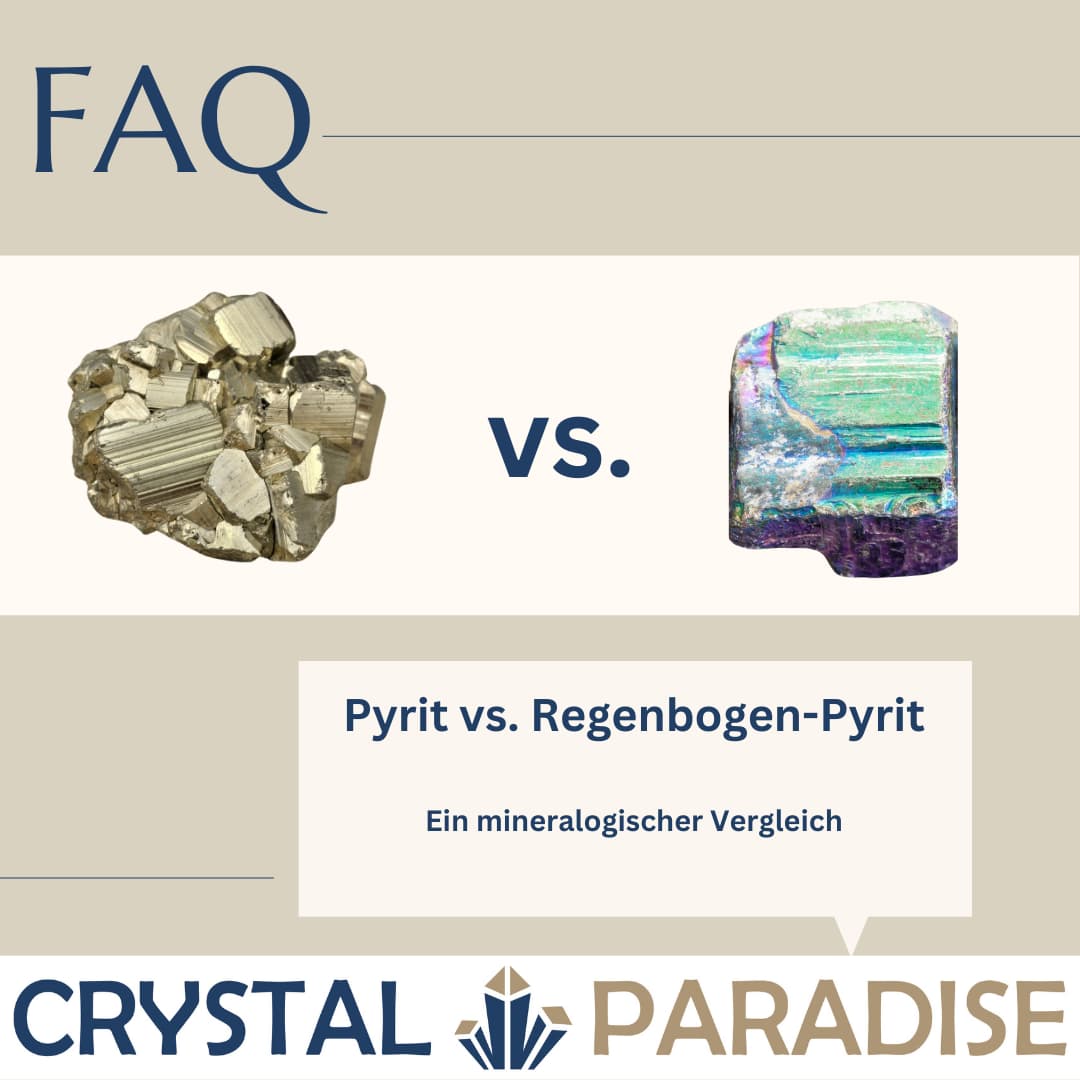
Pyrite vs. Rainbow Pyrite – A Mineralogical Comparison
Pyrite and Rainbow Pyrite: What's Behind These Fascinating Minerals?

Pyrite and Rainbow Pyrite are, mineralogically speaking, the same mineral – iron sulfide with the chemical formula FeS₂. The key difference: Rainbow Pyrite shows an iridescent coloring in blue, violet, gold, and green. This is caused by interference on extremely thin oxide layers on the mineral's surface. In this comparison, we explain the mineralogical basics, show the most important differences, and help you find the right stone to buy.
In our showroom in Feldkirchen near Munich, we keep both varieties in stock. From years of experience in the mineral trade, we know: no other stone confuses beginners as often as Rainbow Pyrite. Hence this detailed comparison.
Mineralogical Basics: What Is Pyrite?
Pyrite belongs to the sulfide mineral class. It crystallizes in the cubic crystal system. Its characteristic cube and pentagonal dodecahedron shapes make it especially popular among collectors.
Chemical and Physical Properties
- Chemical formula: FeS₂ (iron disulfide)
- Crystal system: Cubic
- Mohs hardness: 6 to 6.5
- Density: 4.9 to 5.2 g/cm³
- Color: Brass-yellow to gold-yellow, metallic luster
- Streak color: Greenish black
- Cleavage: Indistinct, conchoidal fracture
The name "Pyrite" comes from the Greek: pyros means fire. Since antiquity, people used pyrite for striking fire. Its folk name "Fool's Gold" comes from the fact that it deceived gold prospectors. You can find more in our detailed Pyrite encyclopedia entry.
Origin Regions Worldwide
Pyrite occurs on every continent. The most significant deposits are located in Spain (Rio Tinto), Peru, Bolivia, the United States (Illinois, Colorado), and Russia. Particularly high-quality specimens with perfect cubic crystals come from the province of Navarra in Spain. Pyrites from Peru often show massive, glossy clusters.
Since around 2020, a new locality has grown greatly in importance: West Kalimantan on Borneo, Indonesia. The coveted Rainbow Pyrite is also mined there. Learn more about our current finds from this region in our article New Treasures from Indonesia: Pyrite and Rainbow Pyrite from West Kalimantan.
Rainbow Pyrite: Same Base, Spectacular Appearance
Rainbow Pyrite is mineralogically identical to ordinary Pyrite. What sets it apart is exclusively its surface. On it, extremely thin oxide layers have formed over time or through targeted natural processes. These layers are often only a few nanometers thick.
How Does the Rainbow Effect Occur?
This phenomenon is called interference or also iridescence. Light hits the thin oxide layer and is reflected at two boundary surfaces. The reflected light waves overlap. Depending on layer thickness and angle of incidence, different colors emerge. This principle is also known from soap bubbles or gasoline stains on a wet street.
The color palette of Rainbow Pyrite includes:
- Vibrant blue and violet
- Warm gold and copper
- Delicate green and turquoise
- Pink to rosé tones under certain lighting conditions
This iridescence is entirely of natural origin in genuine pieces from Kalimantan. However, there are also treated specimens on the market where the layer has been artificially vapor-deposited. In our shop at Crystal Paradise, we pay strict attention to the authenticity and natural condition of every piece.
Origin Kalimantan: A Special Source
The Indonesian province of West Kalimantan on Borneo has been supplying the world's most beautiful Rainbow Pyrites for about 5 years. The geological conditions there are unique. High humidity, specific mineral solutions in the groundwater, and particular pressure conditions at depths of roughly 30 to 80 meters favor the formation of oxide layers directly on the host rock.
Pieces from Kalimantan often show more intense and more even color play than Rainbow Pyrites of other origins. This makes them equally sought after by collectors and mineral lovers.
Pyrite vs. Rainbow Pyrite: The Direct Comparison
Both varieties share the same mineralogical identity. The differences lie in appearance, origin, price, and spiritual attribution.
Differences at a Glance
- Appearance: Classic Pyrite shines in brass-yellow. Rainbow Pyrite shimmers in multiple colors simultaneously.
- Origin of the effect: Ordinary Pyrite shines through metallic reflection. Rainbow Pyrite through light interference on oxide layers.
- Origin: Classic Pyrite comes from Spain, Peru, Bolivia, and many other countries. Rainbow Pyrite comes mainly from Kalimantan, Indonesia.
- Price: Rainbow Pyrite is generally more expensive. Beautiful pieces with intense color play often cost 2 to 4 times as much as comparable classic Pyrites.
- Rarity: High-quality Rainbow Pyrite is rare. Not every piece shows even iridescence.
- Hardness and care: Both have a Mohs hardness of 6 to 6.5 – identical and equally demanding in terms of care.
Browse through our curated collection and discover handpicked specimens: Buy Pyrite at Crystal Paradise.
Spiritual Meaning and Traditions

In stone lore, strong properties are attributed to both varieties. We emphasize explicitly: these attributions are based on spiritual tradition, not on scientific findings.
Classic Pyrite in Tradition
Pyrite is traditionally described as a stone of willpower and endurance. In stone lore, it is regarded as a symbol of strength, manifestation, and protection. It is said, according to tradition, to support determination and help with setting goals. Spiritual seekers value it as a companion for times when energy and focus are needed.
In the Healing Stone Encyclopedia by Crystal Paradise you will find further spiritual traditions about minerals from around the world.
Rainbow Pyrite in Tradition
Rainbow Pyrite is additionally associated in stone lore with creativity, joy, and a broad spectrum of energy. Its color play is traditionally said to address several energy levels simultaneously. According to tradition, it is said to promote joy of life and inspiration. These properties are considered a complement to the classic Pyrite attributions, not a replacement.
Care and Cleaning: Important Notes for Both Varieties
Pyrite and Rainbow Pyrite require the same careful care. Improper handling can cause irreparable damage.
What Absolutely Must Be Observed
- No water: Pyrite contains sulfur. Moisture can lead to oxidation. The mineral can turn into sulfuric acid and disintegrate.
- No direct sunlight: Prolonged UV exposure can make the surface dull.
- No acidic cleaning agents: These attack the surface.
- Clean only dry: Use a soft brush or dry, soft cloth.
- Special caution with Rainbow Pyrite: The extremely thin oxide layer that creates the rainbow effect can be damaged by mechanical action. Do not rub, only dab.
- Storage: Store separately from other stones, as Pyrite, due to its hardness of 6 to 6.5, can scratch softer minerals.
Similar care instructions also apply, incidentally, to more delicate minerals like Apophyllite. Our article Cleaning, Charging, and Caring for Apophyllite provides a good overview.
Energetic Cleansing According to Tradition
Since Pyrite cannot tolerate water, stone healers traditionally recommend alternative methods: smudging with sage or Palo Santo, placing on Selenite, or brief moon energy (without dew or rain). This information stems from spiritual tradition without scientific basis.
Buying Guide: How Do I Recognize Quality?
In our showroom in Feldkirchen near Munich, our customers can pick up pieces directly and compare them. We especially recommend this for Rainbow Pyrite, as the color play varies considerably depending on the light source and viewing angle.
When buying online, you should pay attention to the following features:
- Photos from various lighting angles, ideally also a short video
- Clear statement of origin (for Rainbow Pyrite: Kalimantan, Indonesia)
- Transparent information about treatment (natural vs. coated)
- Weight and size details in concrete measurements (grams, centimeters)
- Dealers with recognizable expertise and consultation services
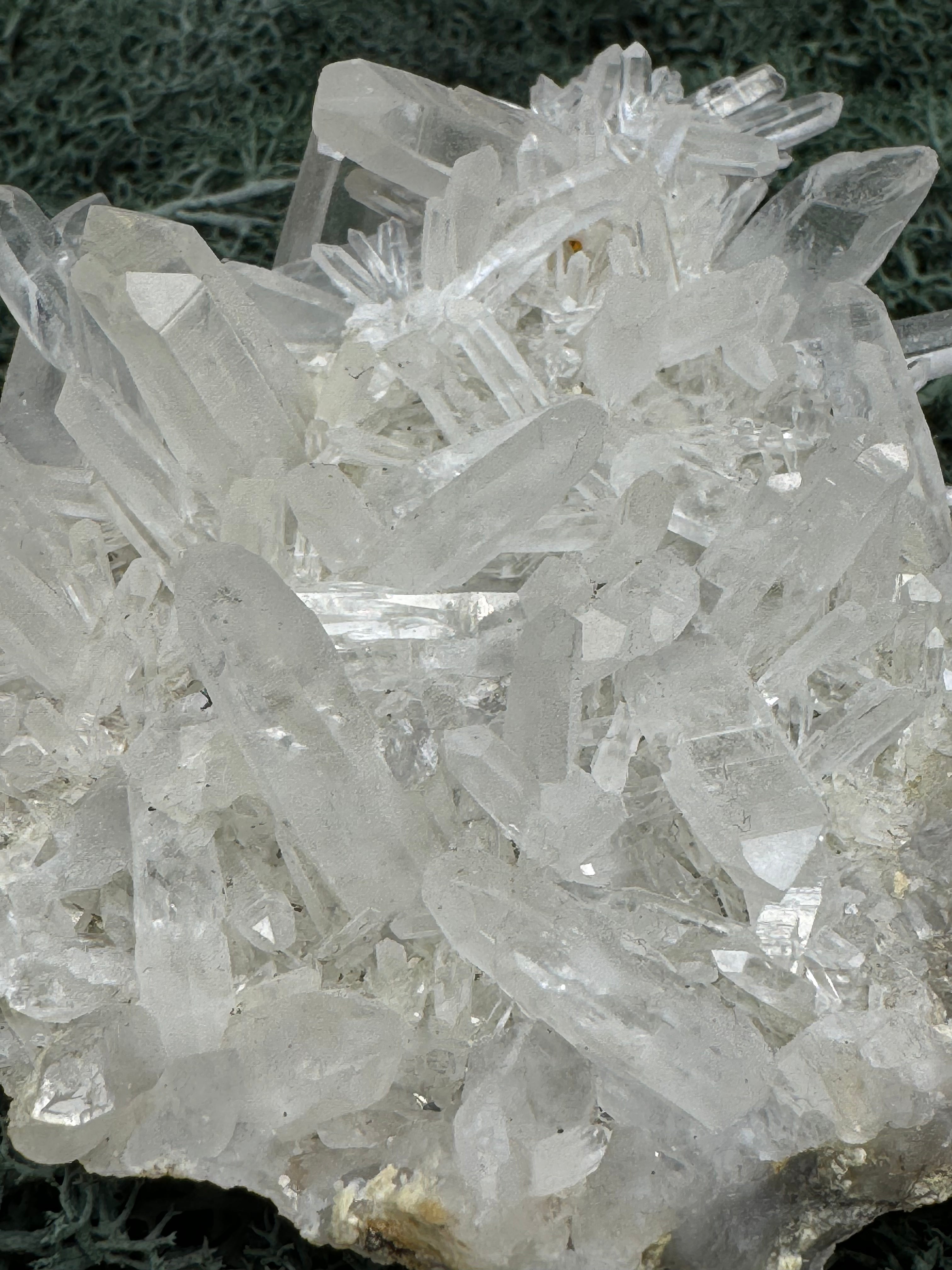
For collectors who appreciate both, it's also worth taking a look at Clear Quartz with Pyrite. This combination unites two of the most visually impressive minerals in a single piece.
Scientific information on the mineralogy of Pyrite is available from the Mineral Atlas Mindat.org. Further sound mineralogical fundamentals can be found at the German Mineralogical Society e. V..
Frequently Asked Questions

Is Rainbow Pyrite a Different Mineral Than Regular Pyrite?
No. Rainbow Pyrite and classic Pyrite are mineralogically identical. Both consist of iron disulfide (FeS₂) with a Mohs hardness of 6 to 6.5.

Written by Christian Neumayer

Leave a comment
This site is protected by hCaptcha and the hCaptcha Privacy Policy and Terms of Service apply.