







Identify genuine Apophyllite & Associated Minerals
Recognizing Apophyllite: Characteristics, Confusions, and Associated Minerals at a Glance

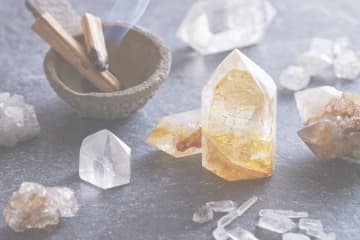
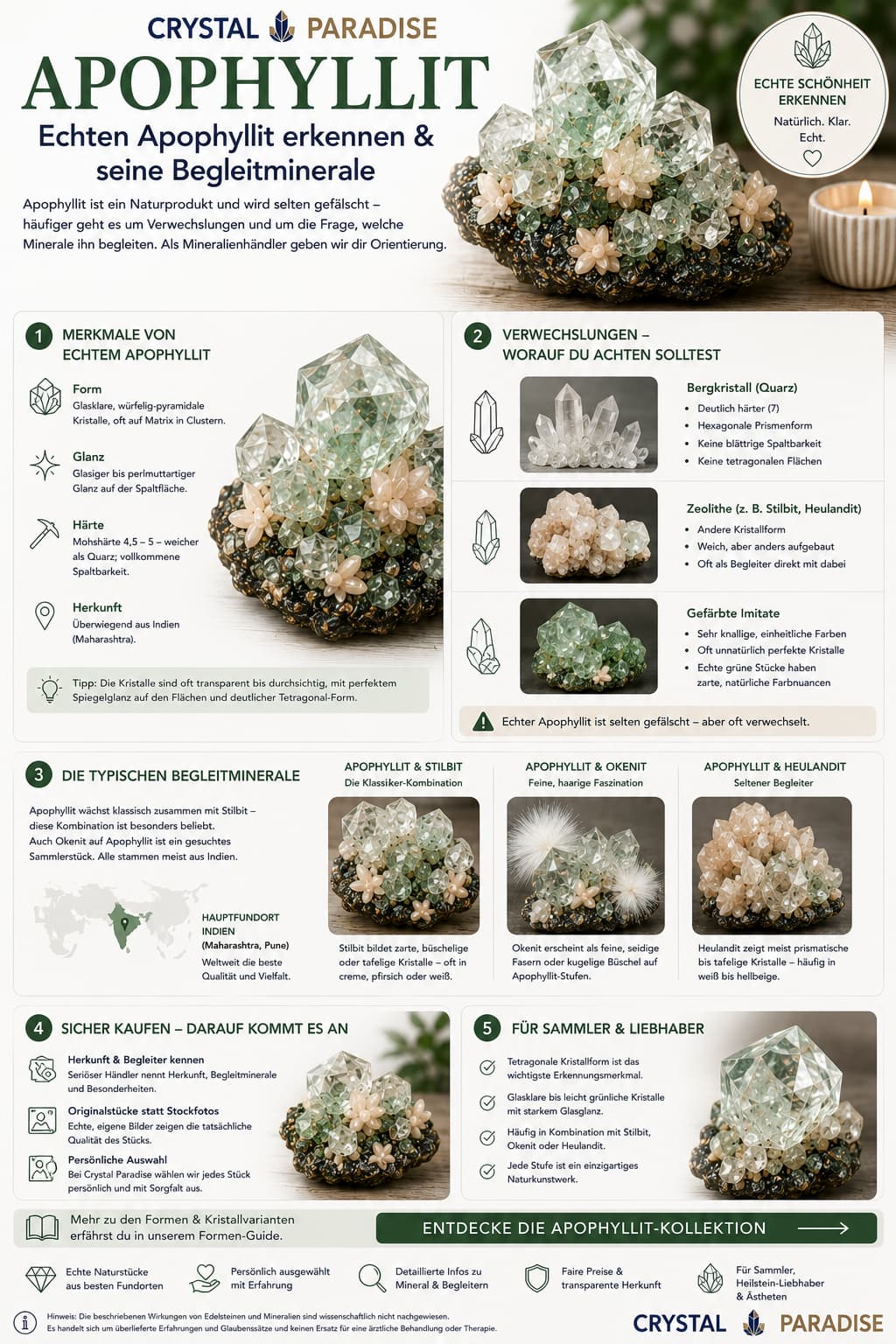
Recognizing Apophyllite is easier than with many other minerals – once you know what to look for. Genuine Apophyllite forms characteristic, glass-clear to white crystals with a cubic-pyramidal shape and an unmistakable pearly luster on the cleavage surfaces. It has a Mohs hardness of 4.5 to 5, making it noticeably softer than quartz, and shows perfect cleavage in one direction. Fakes are rare with Apophyllite – confusion with similar-looking minerals is far more common. In this article, we'll show you how to reliably identify genuine Apophyllite, which associated minerals are typical, and what to look for when buying.
The Most Important Characteristics of Genuine Apophyllite
Apophyllite belongs to the phyllosilicate group and is mineralogically closely related to the zeolites. It forms in cavities of volcanic rocks – especially in the famous basalt formations of the Deccan Plateau in the Indian state of Maharashtra. This locality has been considered the world's most significant source of high-quality collector's specimens for decades.
Crystal Shape and Appearance
Typical Apophyllite crystals are prismatic to pyramidal in structure. The crystal ends taper into a characteristic double pyramid. The color ranges from completely colorless and glass-like to white and even a delicate pink. Green Apophyllite – so-called Fluorapophyllite – contains trace amounts of vanadium and is especially sought after. For more, read our detailed article on Green Apophyllite.
Luster and Cleavage
On fresh fracture surfaces, Apophyllite shows a characteristic pearly to silky luster. The crystal faces themselves appear glassy and transparent. This combination of glassy crystal luster and pearly cleavage-surface luster is a reliable identifying feature. The perfect cleavage along the basal plane makes the crystals sensitive to pressure – something to keep in mind when handling them.
Hardness and Density
With a Mohs hardness of 4.5 to 5, Apophyllite does not scratch a window pane (hardness 5.5). A steel knife, on the other hand, easily leaves marks on the crystal face. The density is about 2.3 to 2.4 g/cm³. Compared to quartz (density 2.65 g/cm³), Apophyllite therefore feels somewhat lighter for a similar size.
- Mohs hardness: 4.5–5
- Density: 2.3–2.4 g/cm³
- Crystal system: tetragonal
- Luster: glassy on crystal faces, pearly on cleavage surfaces
- Cleavage: perfect in one direction (basal)
- Main origin: Maharashtra, India
- Chemical formula: KCa₄Si₈O₂₀(F,OH)·8H₂O
Recognizing Apophyllite: Ruling Out Common Confusions
The most common mix-ups don't arise from deliberate fakes, but from visual similarity to other minerals. We recommend keeping an eye on these three frequent candidates in particular:
Rock Crystal (Quartz)
Rock crystal looks similar at first glance – both are colorless and transparent. The decisive difference lies in the hardness. Quartz has a Mohs hardness of 7 and therefore scratches glass easily. Apophyllite, with a hardness of 4.5–5, does not. Rock crystal also doesn't show a flaky, pearly cleavage. The crystal shape also differs: quartz forms hexagonal prisms with typical rhombohedral faces. Apophyllite, on the other hand, has tetragonal prisms with a more pronounced double pyramid. You can learn more about authenticity testing of related minerals in our article Recognizing Genuine Amethyst.
Stilbite and Other Zeolites
Stilbite and Heulandite also belong to the zeolite group and often grow directly alongside Apophyllite. Stilbite forms sheaf-like, orange to peach-colored aggregates. Heulandite tends to show coffin-shaped crystals. Both have a somewhat duller luster than Apophyllite. These minerals are typical companions – not to be confused with Apophyllite itself, but often found on the same matrix.
Dyed Imitations in Green Specimens
Genuine green Apophyllite (Fluorapophyllite) shows a subtle, uneven green coloration caused by natural vanadium traces. Extremely intense green or evenly colored specimens should be viewed critically. In rare cases, lower-quality colorless minerals are treated with dyes. Look out for uniform, overly saturated colors and a lack of natural color distribution. In our showroom in Feldkirchen near Munich, you can compare specimens in person and get advice – from our own experience, we know that hands-on comparison on site can't be replaced by anything else.
The Typical Associated Minerals of Apophyllite

Apophyllite rarely grows alone. In the basalt cavities of the Deccan Plateau, fascinating mineral parageneses form over millions of years. These combinations make many specimens especially valuable to collectors.
Stilbite on Apophyllite
The combination of colorless Apophyllite crystals and peach-colored Stilbite rosettes is one of the most popular of all. Stilbite (Mohs hardness 3.5–4) forms sheaf-like aggregates that stand out warmly in color against the glass-clear Apophyllite. These specimens come almost exclusively from Pune and Nasik in Maharashtra.
Okenite on Apophyllite
Okenite is a rare calcium silicate mineral that forms fine, white, cotton-like balls. On an Apophyllite cluster, these globular aggregates look like tiny snowflakes. Okenite-Apophyllite combinations are among the sought-after collector's specimens. Okenite is very fragile (Mohs hardness 4.5–5) and should never get wet or be subjected to mechanical stress.
Other Associated Minerals
- Heulandite: coffin-shaped, transparent to reddish crystals on the matrix
- Cavansite: intense blue, rare, but spectacular on Apophyllite specimens
- Chalcedony: as a base layer or crust formation in the cavity
- Prehnite: light green, grape-like aggregates as a matrix former
- Natrolite: needle-like, fibrous white crystals, occasionally on Apophyllite
You can find more mineralogical background on Apophyllite on the Mineralienatlas page of the University of Hamburg as well as in the Mindat database, the world's most comprehensive mineral directory.
Buying Apophyllite Safely: What to Look For
The safest way to buy genuine Apophyllite is to choose a dealer who has personally selected the piece and transparently communicates origin as well as associated minerals. Generic bulk goods without individual photos are a warning sign.
Checklist for Buying
- Is the exact piece you're buying shown in the photo? No stock photos!
- Is the origin (locality, region) stated?
- Are associated minerals named and explained?
- Is there a verified dealer with a return option?
- Does the price match the described quality? Very cheap bulk offers point to lower-quality or mislabeled goods.
At Crystal Paradise, we personally select every piece in our Apophyllite Collection. Every photo shows the actual specimen. Origin and associated minerals are stated in each case. Anyone who wants to can also pick up and compare pieces directly in our showroom in Feldkirchen near Munich.
Care and Fragility
With a Mohs hardness of 4.5–5, Apophyllite is relatively soft and sensitive to mechanical pressure. The perfect cleavage means: a knock in the wrong direction can chip off crystal tips. Never clean Apophyllite with hard cloths or ultrasonic cleaners. A damp, soft cloth is enough. Learn more in our article Cleaning, Charging & Caring for Apophyllite. Also, don't store your pieces in direct sunlight – temperatures above 60°C can drive the water out of the crystal lattice and permanently alter its appearance.
Spiritual Meaning in Tradition
In crystal healing lore, Apophyllite is traditionally associated with clarity, calm, and inner reflection. It is said to be supportive during meditation and is traditionally assigned to the crown chakra and the third eye. Learn more in our article Apophyllite for Meditation, Spirituality & Chakra. There is no scientific evidence for these effects – these are spiritual traditions.
For a well-founded overview of mineral identification, it's also worth taking a look at the Lexikon der Geowissenschaften from Spektrum.de, which explains mineralogical basics in an accessible way.
Frequently Asked Questions

How can I tell Apophyllite apart from rock crystal at home?
The simplest test is the hardness test. Try scratching a glass pane with the stone. Rock crystal (hardness 7) does this easily. Apophyllite (hardness 4.5–5) leaves no mark on glass. Apophyllite also shows a typical pearly luster on cleavage surfaces, which quartz lacks. The crystal shape also differs: Apophyllite is tetragonal (4-fold symmetry), quartz is hexagonal (6-fold symmetry).
Is green Apophyllite rare, and how can I tell if it's genuine?
Yes, genuine green Apophyllite (Fluorapophyllite with vanadium traces) is rarer than colorless varieties and correspondingly more valuable. Genuine specimens show an uneven green coloration, usually concentrated at the crystal tips. The color is subtle to moderately intense. Extremely uniform and intensely green crystals may indicate dyeing. Therefore, only buy green Apophyllite from dealers who show individual specimen photos and state the origin.
Which associated minerals increase the collector's value of Apophyllite?
Most notably Okenite and Cavansite: Okenite forms white, cotton-like balls on the crystals, while Cavansite forms bright blue rosettes – both are rare and visually spectacular. Peach-colored Stilbite sheaves on colorless Apophyllite are also among the sought-after combinations. What matters isn't just which mineral is present, but how it sits: intact, clearly visible aggregates on a stable matrix make the difference compared to a piece where the companion mineral is half-hidden at the edge.

Written by Christian Neumayer

Leave a comment
This site is protected by hCaptcha and the hCaptcha Privacy Policy and Terms of Service apply.