








Cleanse, Charge & Care for Apophyllite
Cleaning Apophyllite – why this crystal deserves special care

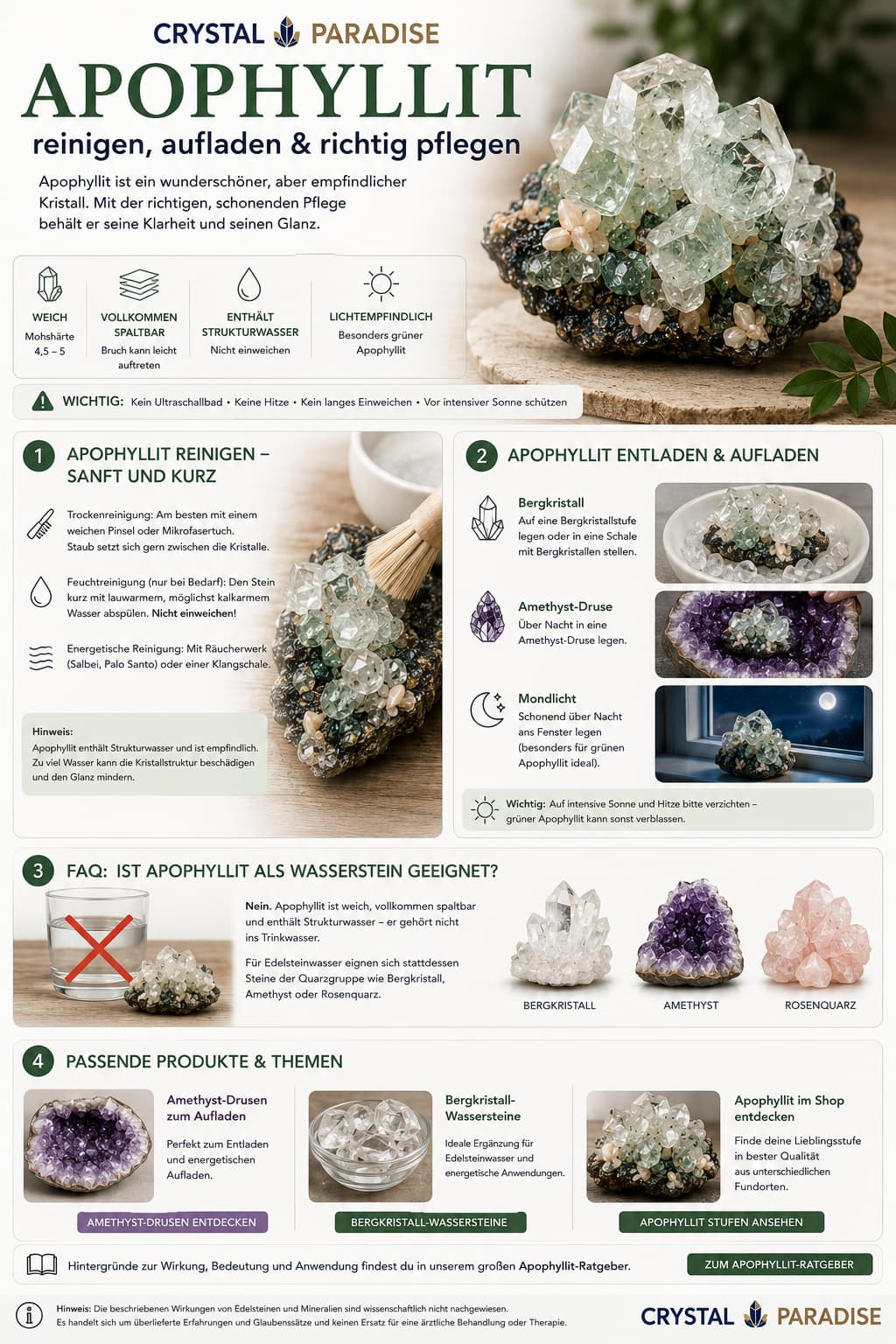
Cleaning apophyllite is easier than many people think – once you know its mineralogical peculiarities. In short: apophyllite belongs to the group of sheet silicates, has a Mohs hardness of only 4.5 to 5, and is perfectly cleavable. This means that water, heat, or mechanical pressure can permanently damage it. Anyone who knows the three golden rules – clean dry, discharge gently, never soak in water – takes proper care of their apophyllite.
In our showroom in Feldkirchen near Munich, we see every day how fascinated customers are by the glass-clear apophyllite specimens from India. Based on years of experience, we recommend the same care routine: gentle, brief, deliberate. This article explains step by step how it's done.
What is apophyllite? Mineralogical basics in brief
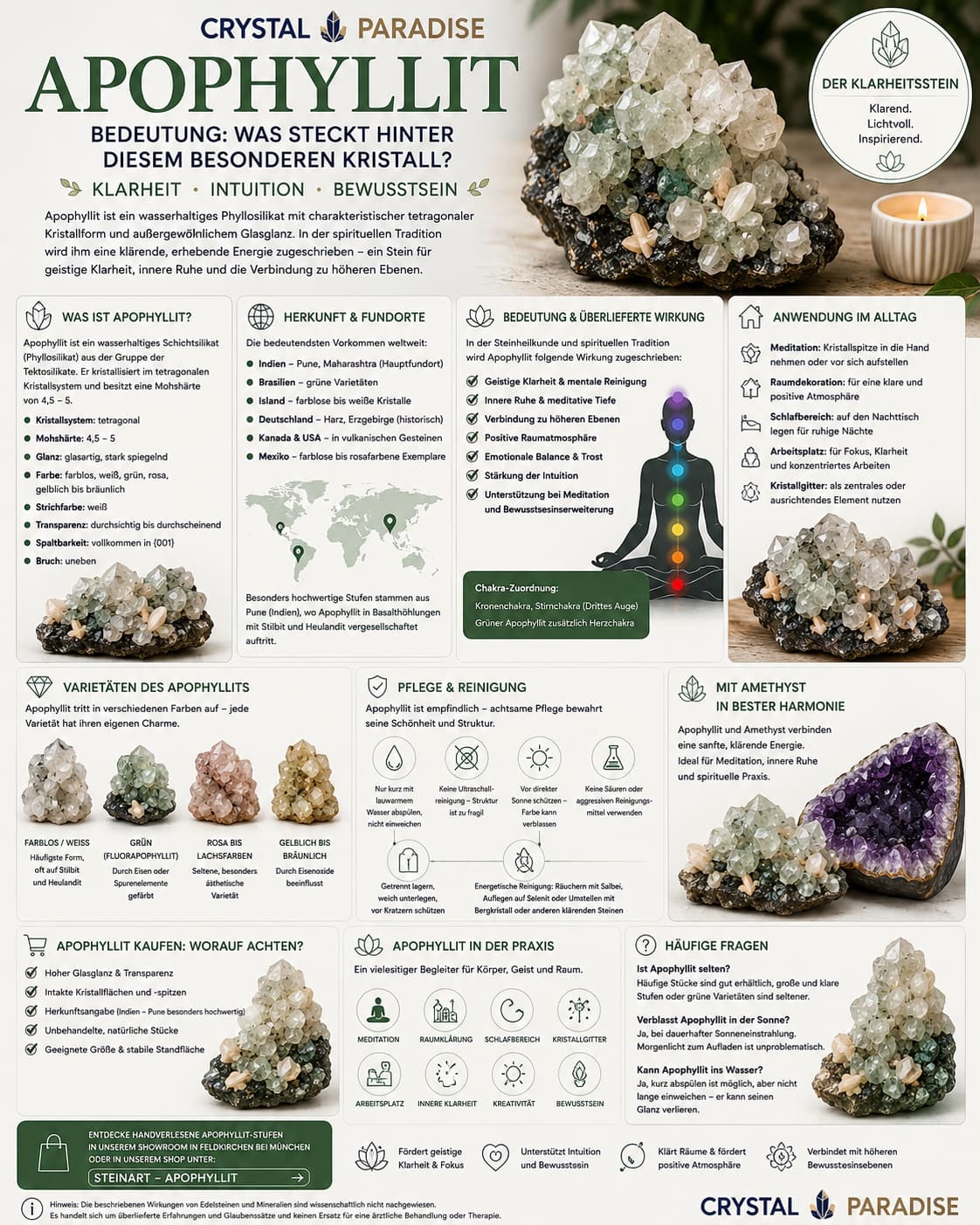
Apophyllite is a hydrous potassium-calcium fluorosilicate. The name comes from the Greek apo (away) and phyllon (leaf) – a reference to its perfect leafy cleavage. Chemically, it belongs to the phyllosilicate group. According to the mineral database Mindat.org, apophyllite is among the more common zeolite-associated minerals found in basaltic cavities.
The most important mineralogical facts at a glance:
- Mohs hardness: 4.5 to 5 (for comparison: quartz has 7)
- Crystal system: tetragonal
- Luster: glassy to pearly on cleavage surfaces
- Colors: colorless, white, pink, yellowish – and the rare green apophyllite variety
- Most important localities: India (Pune/Poona), Brazil, Mexico, Canada, Germany (Ore Mountains)
- Special feature: the stone contains structurally bound water within its crystal lattice
The Indian specimens from the Pune region in particular, known and documented since the 19th century, are among the most beautiful apophyllite specimens in the world. They often form pyramidal crystals up to 10 centimeters in size on a basalt host rock. The German Mineralogical Society lists apophyllite as a mineralogically well-researched silicate mineral – further specialist information is available from the German Mineralogical Society (DMG).
You can find more on the energetic meaning of this fascinating mineral in our detailed apophyllite guide: meaning, properties & use.
Cleaning apophyllite – the right method step by step
Physical cleaning comes before any energetic care. Dust, fingerprints, and deposits diminish the shine. At the same time, the stone must not be overtaxed.
Dry cleaning: the safest method
Dust particularly likes to settle between the closely spaced crystal tips. A soft brush – for example, a watercolor brush with fine bristles – is excellent for gently loosening dust pockets. Afterward, briefly polish with a soft, lint-free cloth.
- Use only soft materials – no scouring sponge, no hard brush
- Work from the inside out so as not to break off crystal tips
- For delicate specimens, a small rubber air blower from the photography field is also suitable
- Never use an ultrasonic cleaner – the vibrations can destroy the crystal
Wet cleaning: only if truly necessary
If dry cleaning isn't enough, a brief wet cleaning can be done – but with clear rules:
- Use lukewarm water – maximum 30 °C
- Use lime-free or filtered water if possible
- Rinse the stone briefly for a maximum of 30 to 60 seconds
- Do not soak – the structural water in the crystal lattice is sensitive to this
- Immediately pat dry gently with a cloth, don't rub
- Let it air dry completely at room temperature – no hair dryer heat
Green apophyllite deserves special attention here. Water can affect its characteristic color tone. You can learn more about this rare variety in our article on green apophyllite.
What to definitely avoid when cleaning apophyllite
Unfortunately, we keep seeing these mistakes:
- No long soaking – not even for a few minutes
- No cleaning agents, soap, or chemicals – they attack the surface
- No hot temperatures – neither boiling nor direct sunlight above 40 °C
- No ultrasonic bath – the crystal is too cleavable
- No mechanical friction – scratches on cleavage surfaces are irreversible
Discharging and charging apophyllite energetically

In addition to physical care, energetic cleansing plays an important role in crystal healing lore. Apophyllite is traditionally said to absorb and store vibrations. Those who believe in this should discharge and recharge their stone regularly – roughly every 4 weeks or after intensive use.
Energetic cleansing: these methods are suitable
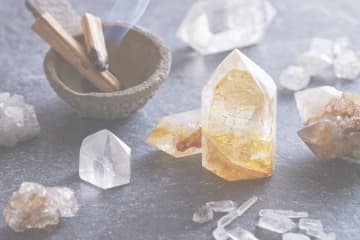
Incense: White sage, Palo Santo, or mugwort produce a smoke in which the apophyllite can be waved for about 1 to 2 minutes. This method is completely waterless and gentle.
Singing bowl: The sound waves of a Tibetan singing bowl or a sound frame are considered cleansing in crystal healing lore. Simply place the apophyllite nearby – not directly in the bowl.
Moonlight: Moonlight is considered a particularly gentle source of charging. Place the stone on a windowsill overnight – possible during both full moon and new moon. For green apophyllite, this is the preferred method, since no harmful UV light is involved.
Clear quartz cluster: A clear quartz cluster or clear quartz specimen can be used as a charging station. Place the apophyllite on it for 12 to 24 hours.
Amethyst geode: An amethyst geode is considered a powerful energy storage in crystal healing lore. Placing apophyllite in the geode overnight – for at least 8 hours – is said, according to tradition, to gently discharge and recharge it.
What to avoid when charging
Green apophyllite is light-sensitive. Intense sunlight can permanently fade the green color within a few hours. The green comes from minimal traces of vanadium. It reacts very sensitively to light. Moonlight or indirect, subdued daylight are the only light-based charging sources suitable for green apophyllite.
Colorless and white apophyllite can tolerate brief, indirect morning light. However, it shouldn't be more than 15 to 20 minutes.
For a comprehensive overview of all common methods, see our guide Cleaning and charging crystals properly.
Storing and caring for apophyllite properly long-term
Care doesn't stop at cleaning. Proper storage protects this delicate crystal permanently.
Store separately: Apophyllite should never be stored together with harder stones such as clear quartz (hardness 7) or amethyst. Contact with these stones can cause scratches or chipped crystal tips.
Soft padding: A velvet pouch or a softly padded box protects the delicate crystal tips. Special mineral storage boxes with foam inserts are available in stores.
Dry and cool: High humidity can attack the surface over the long term. A dry, cool room with stable temperatures between 15 and 22 °C is ideal.
No constant light: Green apophyllite in particular should not be permanently displayed in cases exposed to daylight or halogen light. Indirect, subdued light preserves the color for years.
If you don't yet own your own apophyllite or want to expand your collection, you'll find handpicked specimens in our shop: Discover apophyllite now at Crystal Paradise.
Frequently asked questions

Can I clean apophyllite with water?
Yes, but only briefly and gently. Wet cleaning is possible if you rinse the stone under lukewarm water (no more than 30 °C) for a maximum of 30 to 60 seconds. Soaking must be strictly avoided. Apophyllite contains structurally bound water in its crystal lattice and is also very soft (hardness 4.5–5) as well as perfectly cleavable. Prolonged contact with water can make the surface dull or destabilize the crystal. The safest method remains dry cleaning with a soft brush.
Is apophyllite suitable as a water stone for gem water?
No. Apophyllite is not suitable for making gem water. The low hardness, the perfect cleavage, and the structurally bound water in the crystal make its use in drinking water problematic. For gem water, we recommend stones from the quartz group such as clear quartz, amethyst, or rose quartz – all with a Mohs hardness of 7 and without structural water.
How often should I cleanse apophyllite energetically?
In crystal healing lore, it is recommended to cleanse apophyllite energetically about every 3 to 4 weeks. After particularly intensive use – for example, in meditation or after emotionally taxing situations – more frequent cleansing may be appropriate. Suitable methods include incense smoke (1 to 2 minutes), the sound waves of a Tibetan singing bowl, or placing it in an amethyst geode overnight (at least 8 hours).
Can green apophyllite lose its color?
Yes. Green apophyllite is light-sensitive. Direct sunlight or strong UV sources can permanently fade the color within a few hours. The green comes from minimal traces of vanadium. Moonlight or indirect, subdued daylight are the only light-based charging sources that are safe for green apophyllite.
Which stones can I store together with apophyllite?
Best are those with similar or lower hardness. Apophyllite is at Mohs hardness 4.5 to 5 and can easily be scratched by quartz varieties such as amethyst, clear quartz, or citrine (hardness 7). Therefore, store it separately or with distance on a soft surface. With the typical companion minerals from the same locality – stilbite, heulandite, or okenite – proximity is unproblematic, as they are similarly soft. More important than proximity, in any case, is protection from pressure: the perfect cleavage makes the crystal tips delicate.

Written by Christian Neumayer


Leave a comment
This site is protected by hCaptcha and the hCaptcha Privacy Policy and Terms of Service apply.