







Recognizing Real Amethyst
How to Identify Real Amethyst – How to Protect Yourself from Amethyst Fakes

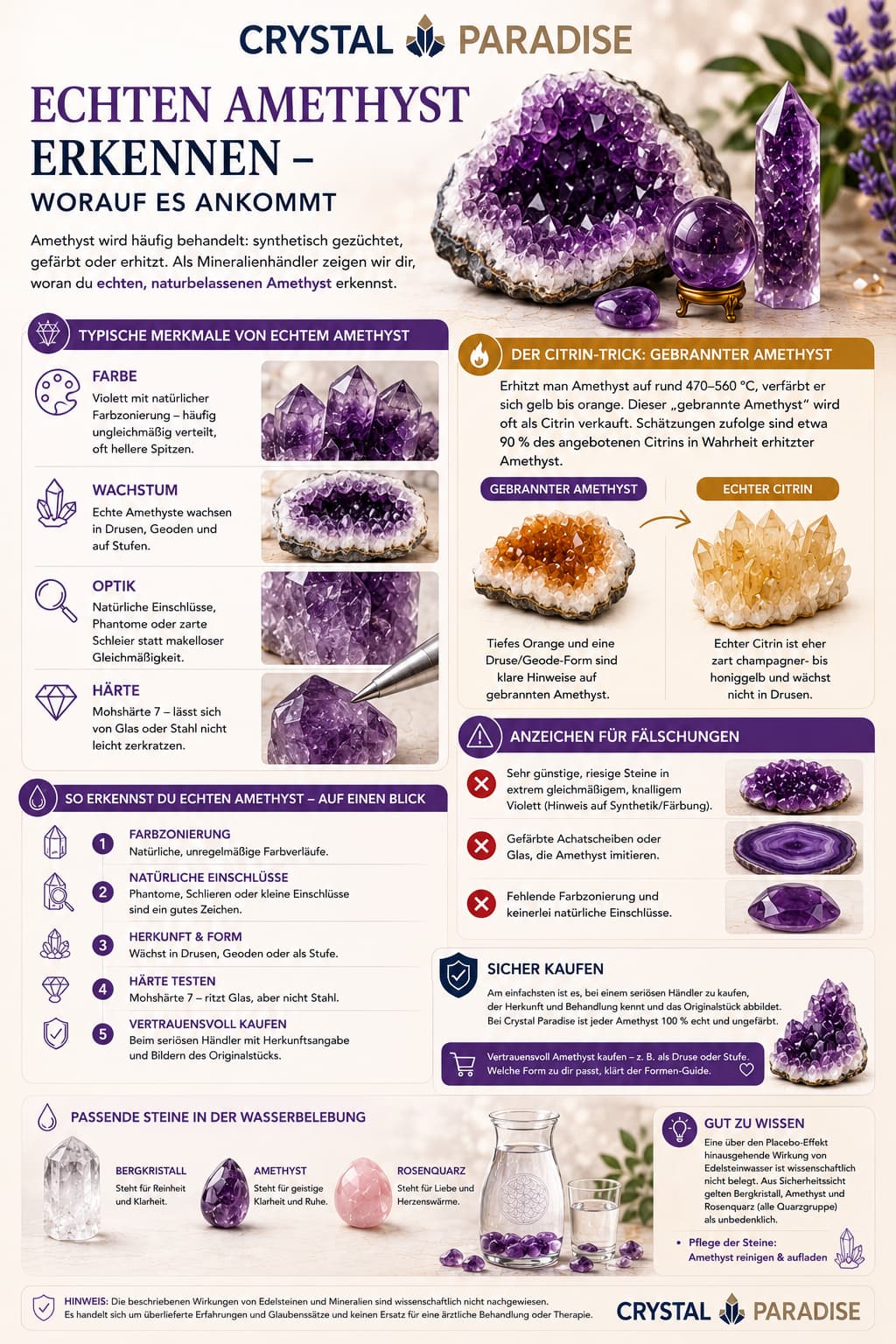
An amethyst fake can be recognized by several reliable characteristics: unnaturally uniform color, complete absence of inclusions, a very low price, and often a glassy, too-smooth appearance. Real amethyst is a violet quartz with a Mohs hardness of 7. It forms in volcanic rocks and shows natural color zoning as well as mineral inclusions. Anyone who knows these characteristics can reliably distinguish fakes, colored glass, and inferior substitutes from the original. In this article, we show you – from years of experience in the mineral trade – how to do just that.
What Is Real Amethyst? Mineralogical Basics
Amethyst belongs to the quartz family. Its chemical formula is SiO₂. The violet color is caused by iron ions and natural gamma radiation inside the earth. This process takes millions of years.
The most important mineralogical characteristics at a glance:
- Mohs hardness: 7 – amethyst scratches glass without difficulty
- Density: approx. 2.65 g/cm³
- Crystal system: trigonal
- Refractive index: 1.544–1.553
- Melting point: approx. 1,650 °C
The most significant deposits worldwide are located in Brazil, Uruguay, Zambia, Madagascar, and Russia. Uruguayan amethysts are considered especially rich violet and deep in color. Zambian specimens often show a reddish-violet tint. These differences in origin are a first indicator of authenticity – an amethyst fake has no natural history of origin.
If you want to learn more about the different forms of real amethyst, we recommend our Amethyst Forms Guide.
The Most Common Amethyst Fakes – What's Circulating on the Market
Unfortunately, fakes and inferior substitutes are widespread in the crystal market. We see this time and again in our shop: customers bring in pieces they bought elsewhere that turn out to be glass or colored material. Here are the most common types of amethyst fakes:
Colored Glass
Colored glass is the most common fake. It has a hardness of only 5 to 5.5 on the Mohs scale. Real amethyst with a hardness of 7 scratches glass – not the other way around. Glass feels warmer, shows no inclusions, and has a color that's too perfect.
Synthetic Amethyst
Synthetic amethyst is grown in a lab. It has the same chemical composition as natural amethyst. Without lab tests, it is hardly distinguishable from the original. One clue: synthetic stones show no natural inclusions or growth zones under 10x magnification.
Colored Quartz or Chalcedony
Clear quartz or chalcedony is treated with a violet color. The color is often only on the surface. On closer inspection, you can see uneven color distribution along cracks or pores.
Prasiolite – the So-Called "Green Amethyst"
Prasiolite is often sold as "green amethyst." This is mineralogically incorrect. Real amethyst is violet. Prasiolite is created by heating amethyst to temperatures above 500 °C. It is a distinct stone with an altered crystal structure.
Citrine from Heated Amethyst
Many stones sold as citrine are actually heated amethyst. By heating to 470–550 °C, amethyst changes color from violet to yellowish-orange. This is not real citrine – another case of misleading labeling in the trade.
How to Identify Real Amethyst – 7 Reliable Testing Methods
You can apply these tests at home or when buying. They don't require expensive equipment.
- Hardness test: Try to scratch glass with the amethyst. Real amethyst (hardness 7) scratches ordinary window glass (hardness approx. 5.5) effortlessly.
- Temperature test: Real quartz feels cold – colder than glass at room temperature. Glass warms up faster in your hand.
- Color under light: Real amethyst shows color zoning. The color is not uniform. Fakes made of glass often appear too homogeneous and too bright.
- Loupe inspection: At 10x magnification, natural inclusions, growth lines, or veil-like traces are visible. Stones that are too perfect are suspicious.
- Weight: Real quartz with a density of 2.65 g/cm³ is noticeably heavier than glass (approx. 2.5 g/cm³) at the same volume.
- Bubble test: Glass often contains tiny air bubbles. These can be seen under a loupe in fakes. Real amethyst shows no air bubbles.
- UV light: Real amethyst shows little to no fluorescence under UV light. Some colored glasses fluoresce visibly.
Color Zoning – the Most Important Authenticity Feature Against Amethyst Fakes

The most reliable identifying feature of real amethyst is its natural color zoning. In nature, quartz grows in layers. The iron ions are distributed unevenly in the process. The result: lighter and darker violet tones alternate. This is especially visible at the tip of amethyst crystals.
An amethyst fake made of colored glass has no such zoning. The color is identical from the inside out – a clear warning sign.
Geodes and clusters also show this pattern. Take a look at our Amethyst Clusters and Amethyst Geodes – you'll immediately recognize the natural color zoning.
Special Features of Treated Amethysts
Tumbled Stones and Polished Forms
Tumbled stones are polished amethysts. The surface is smooth and glossy. This makes the hardness test more difficult. Pay special attention to the color zoning inside. With Amethyst Tumbled Stones, you can often see it as light and dark stripes in translucent light.
Amethyst Spheres and Points
Spheres and points are cut from raw material. Look for natural inclusions. Perfectly clear spheres without any veils or clouding may indicate glass or synthetic material.
Agatized Amethysts
A special natural combination is agatized amethysts from Uruguay. Here, agate envelops the amethyst. This combination is a clear sign of natural formation – no fake can imitate this grown structure.
How to Recognize a Reputable Dealer
We recommend paying attention to the following points when buying:
- Transparent origin information: Reputable dealers name the country of origin and ideally the specific mining region.
- Authenticity assurance: Dealers should confirm that the pieces are natural stones.
- No prices that are too low: High-quality amethyst clusters from Uruguay cost from 20–30 euros upward for smaller pieces. Prices significantly below this are a warning sign.
- Return policy and advice: Reputable shops offer returns and personal consultation.
- Physical presence: Dealers with a showroom or presence at trade fairs are generally more trustworthy than anonymous online sellers.
At Crystal Paradise, every piece is carefully selected. Our showroom in Feldkirchen near Munich invites you to experience and touch the stones in person. That's the opposite of an amethyst fake – transparency and authenticity come first with us.
You can learn more about the spiritual aspects and energetic use of real stones in our article on Amethyst for Sleep, Meditation & Chakra.
Amethyst in Crystal Healing Lore – Traditional Attributions
In crystal healing lore, amethyst has been valued for centuries. It is traditionally attributed a calming, clarifying effect. According to tradition, it is said to promote inner peace and clear the mind. As early as antiquity – documented since approximately 3000 BC – amethysts were worn as protective and healing stones.
These attributions are spiritual traditions without scientific basis. However, they have a long cultural tradition. This makes it all the more important that the stone you use is truly genuine. Also learn about proper care: Our article Cleaning & Charging Amethyst shows you how to protect your stone in the long term.
Anyone wanting to delve deeper into gemology and mineral identification will find well-founded expert information and certification offerings at the German Gemmological Association (DGemG). An international overview of mineral species and their properties is offered by the mineral database Mindat.org – one of the world's largest mineralogical databases with over 5,000 described mineral species.
Frequently Asked Questions

How can I spot an amethyst fake at first glance?
An amethyst fake often shows an overly uniform, intense color without natural zoning. Real amethyst has noticeable color differences from the inside out. Additionally, glass feels warmer than real quartz. A simple hardness test – amethyst scratches glass – quickly and reliably provides clarity.
Can synthetic amethyst be identified without a lab test?
Synthetic amethyst is chemically identical to natural amethyst. It is very difficult to identify without a lab test. Indicators include the complete absence of any inclusions and noticeably low prices. If you have serious doubts, we recommend testing by a certified gemologist from the German Gemmological Association.

Written by Christian Neumayer

Leave a comment
This site is protected by hCaptcha and the hCaptcha Privacy Policy and Terms of Service apply.