







Amethyst Shape Guide
The Ultimate Amethyst Shapes Guide – All Available Forms at a Glance

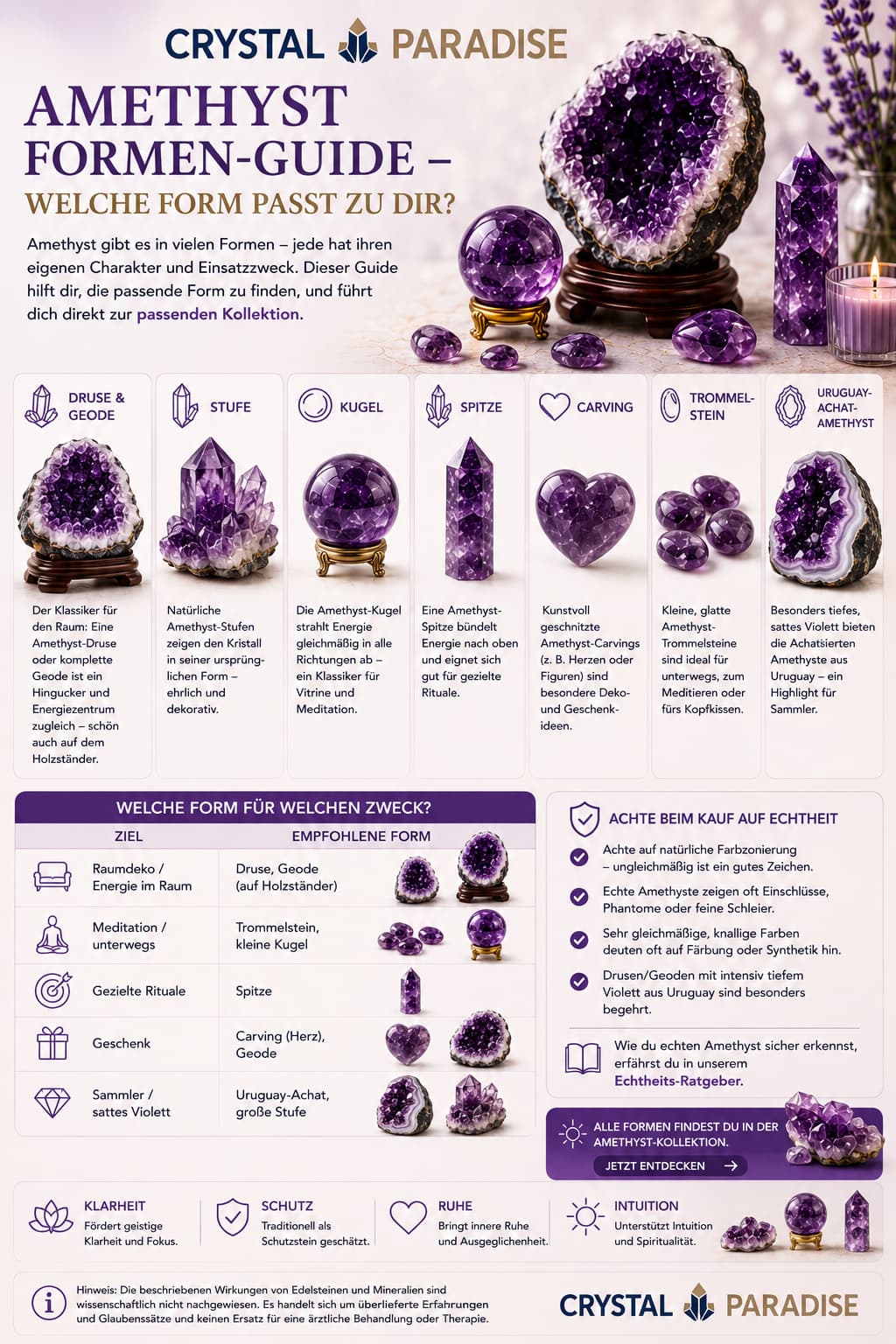
This Amethyst Shapes Guide shows you at a glance which forms are available for the purple quartz – and which form best suits your needs. Amethyst is a purple variety of quartz (SiO₂) with a Mohs hardness of 7. It forms through iron ions and natural gamma radiation in rock cavities. The most popular forms range from raw geodes to polished spheres to finely carved sculptures. Each form has its own character, its own look, and its own purpose.
What Makes Amethyst Mineralogically Special?
Amethyst has been one of the most coveted gemstones in the world for thousands of years. Back in ancient Greece – over 2,500 years ago – it was considered a protective and lucky stone. Its name derives from the Greek "amethystos," meaning "not drunk." The characteristic purple color is created by traces of iron (Fe³⁺) in the quartz lattice combined with natural gamma radiation.
Mineralogically, amethyst crystallizes in the trigonal crystal system. The color intensity varies from soft lavender to deep purple. Particularly intensely colored pieces often come from Uruguay and Brazil, where the geodes grow in basalt cavities. According to the Mindat.org mineral database, amethyst belongs to the quartz group and can be found in over 100 countries worldwide – a remarkable distribution for a semi-precious stone.
At Crystal Paradise, we have worked for years with hand-selected pieces from the world's most important deposit regions. We recommend always paying attention to natural origin and untreated quality when buying. From years of experience in the mineral trade, we know: the form often matters just as much as the color.
Amethyst Shapes Guide: All Forms from A to Z
Amethyst Geodes – Pure Nature for Your Home
Amethyst geodes are open rock cavities lined with hundreds of small crystal points. They are probably the best-known available form. Geodes are often displayed as natural room décor. Their rough exterior contrasts beautifully with the shiny, purple crystals inside.
Geodes from Uruguay are characterized by particularly deep, rich colors. Brazilian geodes, on the other hand, are often larger and lighter in color. Quality pieces can reach weights of several kilograms – large display pieces sometimes weigh over 50 kg.
Amethyst Geodes – The Hollow Wonder Chamber
Amethyst geodes are fully closed or halved hollow spheres made of basalt or limestone. Inside, the crystals grow inward, forming a fascinating sight. Geodes are especially popular as decorative objects, as they appear inconspicuous from the outside and spectacular on the inside.
The best-known geodes come from the southern Brazilian state of Rio Grande do Sul as well as from Uruguay. Some geodes grow over periods of up to 130 million years – a silent witness to geological history.
Amethyst Hand Specimens – The Classic Collector's Piece
Amethyst hand specimens are cut geode sections with a flat base. They stand stably and show off the full splendor of the crystal formation from the front. Hand specimens are excellent as living room and desk décor. They are also widely used as energy stones in meditation spaces.
Amethyst Geodes on Wooden Stands – Nature Meets Design
Amethyst geodes on wooden stands combine the natural quality of the stone with the warmth of wood. This variant is especially popular as a gift. The wooden stand gives the geode stability and an aesthetic finish. This turns minerals into true interior highlights.
Amethyst Points – Directing Energy
Amethyst points are crystals either cut to a point or naturally grown that way. In crystal healing, they are traditionally said to focus and direct energy. Points are very popular as meditation objects or altar accessories. They are available in both raw and polished form.
Amethyst Spheres – The Perfect Form
Amethyst spheres are carved from a solid piece of amethyst and precisely polished to a diameter of usually 4 to 12 cm. The sphere is considered a symbol of perfection and harmony. According to tradition, spheres radiate their energy evenly in all directions. As a decorative object on a metal stand, they are a real eye-catcher.
Amethyst Tumbled Stones – For On the Go and For Touching
Amethyst tumbled stones are small, smoothly polished stones of a handy size between about 2 and 5 cm. They are created by processing raw fragments in a rotating drum with abrasive – sometimes over 4 to 6 weeks. The result is a pleasantly smooth stone that can comfortably be carried in a pocket. Tumbled stones are beginner-friendly, affordable, and versatile.
Amethyst Carvings – Sculpture Meets Mineral
Amethyst carvings are hand-carved figures, animal shapes, or abstract objects made from amethyst. Experienced stone carvers often spend many hours working on a single piece. The combination of natural material and craftsmanship precision makes carvings sought-after collector's items and one-of-a-kind pieces. Popular shapes include elephants, butterflies, hearts, or angels.
Agatized Amethysts from Uruguay – A Mineralogical Highlight
Agatized amethysts from Uruguay are a special variant. Here, amethyst crystals grow on an agate base. The outer agate layer shows the typical banding in gray, white, and brown tones, while the interior is filled with purple amethyst points. This combination of two minerals in one piece makes them mineralogical rarities with high collector's value.
Which Amethyst Form Suits You? A Practical Decision Guide

Choosing the right form depends on your personal purpose. Here's a quick overview:
- For home décor: Geodes, hand specimens, cavity geodes, or geodes on wooden stands are the first choice.
- For meditation and energy work: Points and spheres are considered particularly suitable according to tradition.
- For beginners and small budgets: Tumbled stones are ideal – affordable, handy, and authentic.
- For collectors and connoisseurs: Carvings, agatized pieces from Uruguay, and special geodes appeal to advanced enthusiasts.
- As a gift: Geodes on wooden stands or spheres are always well received – they combine aesthetics with meaning.
- For on the go: Tumbled stones and small points fit into any bag.
Care and Cleaning of Your Amethyst Form
Amethyst, with a Mohs hardness of 7, is robust enough for everyday use. Nevertheless, there are some important care notes:
- Light protection: Amethyst fades under prolonged sunlight exposure. Direct UV radiation can noticeably bleach the color within a few weeks. Therefore, do not place geodes and hand specimens permanently in direct sunlight.
- Cleaning with water: A brief rinse under lukewarm water is generally fine. Use water below 60 °C to avoid thermal stress in the crystal.
- No aggressive cleaning agents: Avoid acids, chemicals, or ultrasonic cleaners – they can damage the surface.
- Energetic charging: Many enthusiasts place amethyst outside during a full moon or on a clear quartz cluster. You'll find all the details in our article Cleansing & Charging Amethyst.
According to the Gemological Institute of America (GIA), amethyst is among the gemstones that are particularly sensitive to strong heat and intense light exposure. From about 470 °C, the purple color can permanently change to yellow or gray – which, incidentally, is how citrine is created through heat treatment.
Amethyst in Crystal Healing – Tradition and Spiritual Meaning
In crystal healing, amethyst is traditionally referred to as the "stone of calm and clarity." It has been said for centuries to promote inner balance and calm the mind. The crown chakra (Sahasrara) is traditionally assigned to it in chakra teachings. Especially with regard to sleep and meditation, it is considered, according to spiritual tradition, a valuable companion.
These attributions are based on spiritual tradition – not on scientific studies. Those who want to dive deeper into the world of amethyst's effects will find more in the article Amethyst for Sleep, Meditation & Chakra.
The form in which you use amethyst can influence your subjective experience. A large geode in the living room has a different presence than a small tumbled stone in the hand. Those unsure which stone is right for them will find guidance in the article Amethyst or Clear Quartz – Which Suits You Better?.
Frequently Asked Questions

Which amethyst form is the most popular?
Amethyst geodes and hand specimens are the best-selling forms. They combine natural beauty with decorative use. Tumbled stones are the most popular entry-level form for newcomers, as they are affordable and versatile.
Does the form of an amethyst make a mineralogical difference?
Mineralogically speaking, it is always the same substance: purple quartz (SiO₂) with a Mohs hardness of 7. The difference lies in the processing and presentation – not in the chemical composition. Raw geodes are unprocessed, while spheres and tumbled stones are shaped either by machine or by hand.
Which form is best suited as a gift?
Geodes on wooden stands are a particularly popular gift. They look high-quality and require no prior knowledge. Alternatively, amethyst spheres on a metal stand make an elegant present. Tumbled stones make a nice, personal small gift.

Leave a comment
This site is protected by hCaptcha and the hCaptcha Privacy Policy and Terms of Service apply.