









Cleansing & Charging Amethyst: How to Make Your Purple Treasure Shine
In short: Amethyst is quartz with a Mohs hardness of 7 and tolerates a brief rinse under lukewarm water (not above 30 °C). Smudging, moonlight, and burying in soil are also gentle methods. You should avoid salt water and prolonged direct sunlight: salt can cloud the shine, UV light bleaches out the violet color. For subsequent charging, moonlight, a clear quartz geode, sound, or intention are traditionally used – time-honored practices without scientific proof.
Charging Amethyst – the most important methods at a glance

Charging amethyst means supplying the violet quartz with fresh energy again after cleansing – just like recharging an empty battery. Anyone who works with crystals regularly knows: a stone that has absorbed a lot of energy is eventually considered duller and heavier in stone lore. This can be changed. In this article, we show you the most proven methods, explain the mineralogical background, and give you practical tips from our everyday life at Crystal Paradise. Your purple treasure deserves the best care – and that starts right here.
What does charging amethyst actually mean?
Amethyst is a violet quartz with the chemical formula SiO₂. Its characteristic color is created by traces of iron and natural radiation during its formation inside the earth. The stone belongs to the oxide mineral class and reaches a Mohs hardness of 7. This makes it robust enough for many cleansing methods.
In stone healing lore, amethyst has been considered an especially powerful companion for thousands of years. The earliest written mentions can be traced back to ancient Greece – more than 2,500 years ago. Tradition says the stone is said to promote calm, clarity, and balance.
When you charge your amethyst, you energetically give it new strength, so to speak. Whether you interpret this spiritually or simply as a conscious moment of mindfulness – the effect on yourself is real: you take time for your stone and thereby also strengthen your own connection to it.
Important: You should always cleanse your amethyst before charging it. You can find more on this in our article Cleansing & Charging Amethyst.
Cleansing amethyst – the best methods at a glance
Before charging your amethyst, you should cleanse it. This means: releasing accumulated energies, removing dust particles, and putting the stone on a fresh foundation. There are several proven methods – each with its own particularities.
Cleansing with running water
Amethyst tolerates clear, cool water well. Hold the stone under running tap water for 1 to 3 minutes. Important: the water should not be warmer than 30 °C. Strong temperature fluctuations can create microcracks over time. Afterward, gently dry the stone with a soft cloth. This method is especially suitable for polished tumbled stones or spheres.
Caution: You should not soak amethyst geodes or delicate points for too long. Fine inclusions or accompanying minerals such as calcite can react more sensitively.
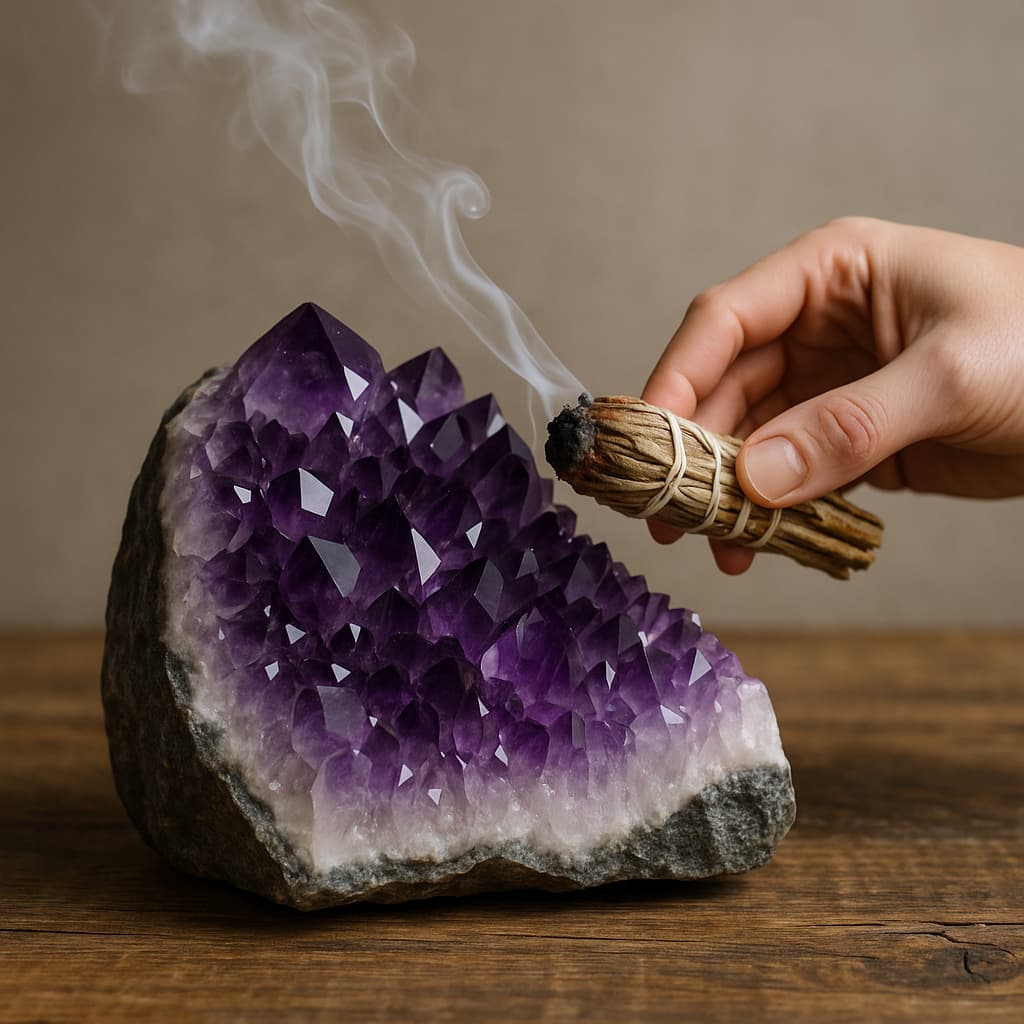
Cleansing with smudging smoke
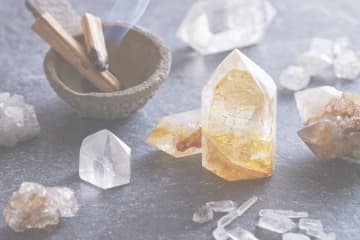
So-called smudging is a time-honored method. Light a smudge stick made of white sage, palo santo, or frankincense. Hold the amethyst through the smoke for about 30 to 60 seconds. Make sure the room is well ventilated. This method is gentle and suitable for all amethyst forms – even for delicate geodes or druzes.
Cleansing with moonlight
One of the gentlest methods: place your amethyst on a windowsill or outside in the evening. Let it rest overnight in the moonlight – ideally around the full moon. This method is especially popular because it involves no physical stress for the stone and is considered symbolically powerful at the same time.
Cleansing with soil
You can bury your amethyst in the ground for 24 to 48 hours – either in the garden or in a flowerpot with natural soil. In many traditional practices, soil is considered a neutralizing force. Wrap the stone in a thin cloth beforehand, so that no particles get into fine cracks.
Cleansing with salt – with caution
Dry sea salt is often recommended. But caution: salt water can attack the surface of amethyst and cloud its shine. If you want to use salt, place the stone in dry salt for a maximum of 12 hours – not in salt water. Polished surfaces and geodes are especially vulnerable in this regard.
- Running water: Quick, easy, suitable for polished stones
- Smudging smoke: Gentle, suitable for all forms
- Moonlight: Gentle, symbolically powerful, no physical stress
- Earthing: Intensive, time-honored, recommended for robust pieces
- Dry salt: Effective, but only briefly and without polished surfaces
The 5 best methods to charge amethyst
1. Moonlight – the classic way
Moonlight is considered the gentlest and at the same time most effective charging method for amethyst. Place your stone on a windowsill or outside during the night of the full moon for at least 4 to 6 hours. The soft, cool energy of the full moon is described in tradition as ideal for sensitive stones.
Amethyst reacts sensitively to direct sunlight. At the temperatures and UV radiation that sunny midday hours bring, the violet color can fade permanently. This is mineralogically documented: the color-giving iron content reacts to intense photon radiation. Moonlight, on the other hand, contains no UV – your stone stays radiantly purple.
2. Soil – grounding and renewal
The soil method is especially powerful for stones that have absorbed a lot of energy. Bury your amethyst for 24 to 48 hours in the ground – either outside in the garden or in a flowerpot with untreated soil. The soil absorbs old energies and gives the stone fresh earth energy in return.
Wrap the stone in a thin cloth beforehand so it doesn't get dirty. Mark the spot well – that sounds obvious, but it isn't always.
3. Clear quartz cluster – stone charges stone
Place your amethyst on a clear quartz cluster or in an amethyst geode for 12 to 24 hours. Crystals of this kind are considered natural sources of energy. Tradition says they are said to be able to charge and harmonize other stones. This method is convenient, safe, and also works for more delicate stone forms.
4. Sound cleansing and charging
Sound is vibration. A Tibetan singing bowl played for 2 to 3 minutes near your amethyst is said, according to traditional practice, to cleanse energetically and charge it at the same time. Hold the stone in your hand or place it directly in the bowl. The vibrating energy transfers to the crystal lattice of the stone.
5. Intention and visualization
This method costs nothing and always works. Hold your amethyst in both hands. Close your eyes. Imagine white or violet light flowing through the stone. Formulate a clear intention – what should your stone carry for you? Take 3 to 5 minutes for this exercise. Many people who work with crystals regularly describe this conscious connection as especially valuable.
Which method is right for my amethyst?
The choice depends on the shape of your stone. Not every method suits every amethyst. Here's a quick overview:
- Amethyst geode or hand specimen: Moonlight, sound, or the cluster method are recommended. Avoid water, since the geode consists of many small points that can come loose.
- Amethyst tumbled stone: All methods possible. Especially well suited for the soil and moonlight methods.
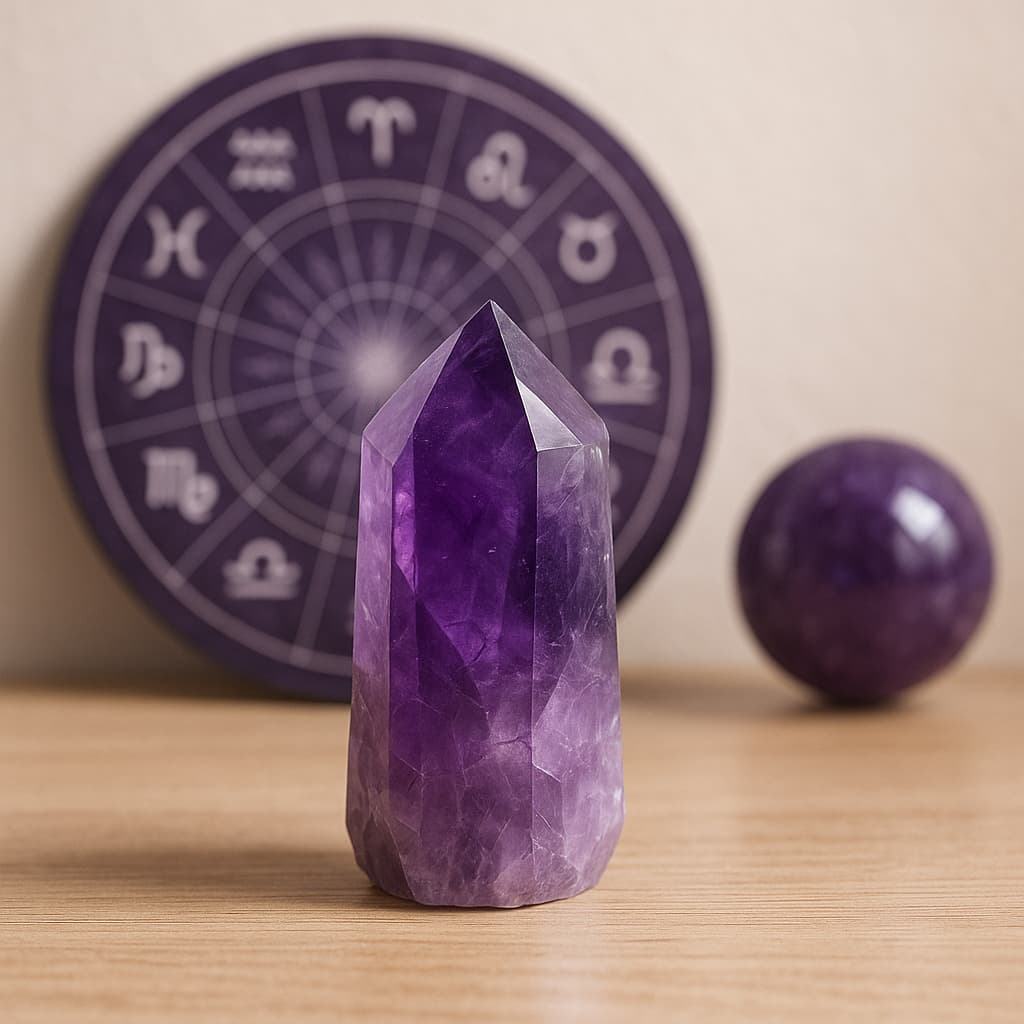
- Amethyst point: Ideal for moonlight and cluster. According to tradition, the point especially amplifies and focuses the energy.
- Amethyst sphere: Moonlight and intention work suit the round, balanced shape excellently.
- Amethyst jewelry: Moonlight or sound – no burying, since metal settings can rust.
You can find out what shape your amethyst has in our Amethyst Shapes Guide. There we explain the differences between geodes, points, spheres, and more.
How often should you charge amethyst?

Based on our years of experience at the Crystal Paradise team, we recommend: charge your amethyst at least once a month – ideally on the night of the full moon. If you wear the stone daily or work with it during intense phases, every 2 weeks is fine too.
Watch for these signs that indicate your stone needs energy:
- The stone feels energetically empty or heavy.
- You haven't held the amethyst in your hand for a long time.
- The stone has been present during intense emotions or stressful situations.
- It visually shines less – even though it is mineralogically clean.
- You've just received it and want to build your own connection with it.
Charging amethyst – what you should absolutely avoid
Direct sunlight
As mentioned before: amethyst fades in direct sunlight. After just a few hours of intense sun exposure, the violet color can become irreversibly paler. This effect is mineralogically documented and especially affects natural, untreated amethysts.
Salt water
Salt is indeed considered a classic cleansing agent for many stones. For amethyst, however, you should avoid salt water. Salt crystals can settle into fine cracks and damage the stone over time. The risk is especially increased with geodes, due to their many small crystal points.
Too long burial in soil
More than 72 hours in the ground can make the surface dull, especially with polished stones. Stick to the recommended 24 to 48 hours.
Amethyst in your everyday life – inspiration from Crystal Paradise
At Crystal Paradise, we have been trading hand-selected amethysts from the world's most well-known deposit regions for years. The deep violet agatized amethysts from Uruguay are among our most popular pieces. The dark violet coloring of these stones is created by an especially high iron concentration – which makes them something special both mineralogically and energetically.
If you want to use an amethyst not just as a single stone but as a room-filling element, we recommend our amethyst geodes on wooden stands. They are decoration and a source of energy in one – and a true eye-catcher in moonlight.
If you want to learn more about the spiritual background, feel free to read our article Amethyst for Sleep, Meditation & Chakra. There we explain the role attributed to amethyst in meditation practice.
For further mineralogical information on amethyst as a quartz variety, we recommend the database of the Mindat Mineral Atlas, one of the world's leading sources for mineralogical facts. General information on quartz and its varieties is also offered by the Wikipedia page on amethyst as an initial point of reference.
Frequently Asked Questions

How long should I leave my amethyst in moonlight?
At least 4 to 6 hours is recommended. The entire full moon night – so about 8 to 10 hours – is ideal. According to tradition, the effect is strongest on the night of the full moon. You can put the stone out in the evening and bring it back in in the morning.
Can I charge my amethyst in the sun?
We explicitly advise against this. Direct sunlight can permanently bleach the violet color of the amethyst. Just a few hours of intense UV radiation can cause irreversible damage. Moonlight, soil, or sound are the better alternatives.
Do I need to cleanse my amethyst before charging it?
Yes, absolutely. Cleansing and charging are two different steps. When cleansing, you remove energetically absorbed external influences. When charging, you give the stone new, fresh energy. Anyone who charges first without cleansing is, figuratively speaking, working with a full container instead of an empty one.
How do I know if my amethyst is charged?
There is no objective measuring method. However, many people report that a charged stone feels warmer, more alive, or somehow more present. Trust your perception. If you feel a connection to your stone, that's a good sign.
Can I charge amethyst together with other stones?
Yes. Charging together works especially well on a clear quartz cluster or an amethyst geode. Place the stones next to each other and let them sit overnight. Make sure that harder stones don't press into softer ones – amethyst with a hardness of 7 is robust, but not indestructible.
Note: The effects mentioned are spiritual traditions without scientific proof. Crystals are not a substitute for medical or therapeutic treatment.

Written by Christian Neumayer

.%20Smudging,%20moonlight,%20and%20burying%20in%20soil%20are%20also%20gentle%20methods.%20You%20shou...)
Leave a comment
This site is protected by hCaptcha and the hCaptcha Privacy Policy and Terms of Service apply.