







Apophyllite for Meditation, Spirituality & Chakra
Apophyllite Meditation: Stillness, Clarity, and Spiritual Depth with the Light Stone

Apophyllite meditation refers to the conscious practice of integrating this extraordinary phyllosilicate crystal as an energetic companion into your own meditation routine. Apophyllite belongs to the mineral class of sheet silicates, has a characteristic tetragonal or orthorhombic crystal structure, and reaches a Mohs hardness of 4.5 to 5. Its glassy, almost liquid-looking luster and its natural transparency make it one of the most fascinating stones for spiritual practice. In crystal healing lore, it is traditionally attributed a particularly fine, light-filled energy – ideal for anyone who wants to arrive more deeply in stillness.
What makes Apophyllite so special as a meditation stone?
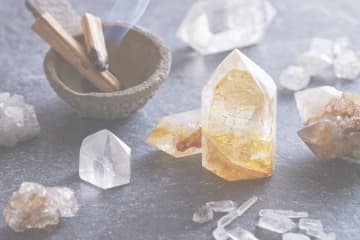
Apophyllite is no ordinary stone. Its natural transparency and strong pearly luster on the cleavage faces create an optical play that alone invites inner reflection. Mineralogically speaking, apophyllite contains potassium, calcium, fluorine, and silicon dioxide – a combination that gives it its characteristic character.
The best-known deposits of high-quality specimens are found in India, particularly in the region around Pune in the state of Maharashtra. Many of the large, clear specimens prized in the mineral trade worldwide come from there. Further deposits are found in Brazil, Canada, Germany, and the Czech Republic. According to the mineralogical reference database Mindat.org, more than 300 localities for apophyllite are documented worldwide – evidence of its wide distribution and geological significance.
In our showroom in Feldkirchen near Munich, we regularly experience this firsthand: customers who pick up apophyllite for the first time describe an immediate feeling of spaciousness and lightness. This resonance is what makes this stone such a popular companion for meditation and mindfulness practice.
Mineralogical Basics at a Glance
- Mineral class: Phyllosilicates (sheet silicates)
- Mohs hardness: 4.5 to 5
- Crystal system: Tetragonal (KF-apophyllite) or orthorhombic (KOH-apophyllite)
- Main localities: India (Pune), Brazil, Canada, Germany, Czech Republic
- Colors: Colorless, white, green (fluorapophyllite), yellowish, pink
- Luster: Vitreous to pearly on cleavage faces
Our detailed Apophyllite Forms Guide explains the exact differences between the various apophyllite varieties and shapes – a great starting point for anyone who wants to dive deeper into the world of this stone.
Apophyllite Meditation: How to Use the Stone in Practice
The practical application of apophyllite in meditation is remarkably simple. At the same time, a few targeted steps can lead to significantly more intense experiences. We recommend the following approach, which has proven effective in our years of consulting experience:
- Preparation: Clean your apophyllite before meditating. A quick brushing with a soft brush or placing it on a bed of amethyst for about 2 to 4 hours is usually sufficient. More on this in our article Cleaning, Charging, and Caring for Apophyllite.
- Positioning: Hold a smaller apophyllite crystal in your non-dominant hand or place it about 20 to 30 cm in front of you on a quiet surface.
- Eye contact: Direct your soft gaze at the stone. The stone's natural transparency invites focus almost on its own.
- Breathing: Inhale for 4 seconds, hold for 4 seconds, exhale for 6 seconds. Many people find this technique to be especially deepening.
- Setting an intention: Formulate a clear, positive intention internally for your meditation session. Apophyllite is traditionally described in crystal healing lore as an amplifier of inner clarity.
- Duration: Many practitioners describe just 15 to 20 minutes daily as sufficient to establish a calm daily routine.
If you're curious about other stones that are ideal for meditating at home, you'll find a comprehensive overview in our article The Best Crystals for Meditation at Home.
Apophyllite and the Chakras: Connection to Higher Energy Centers
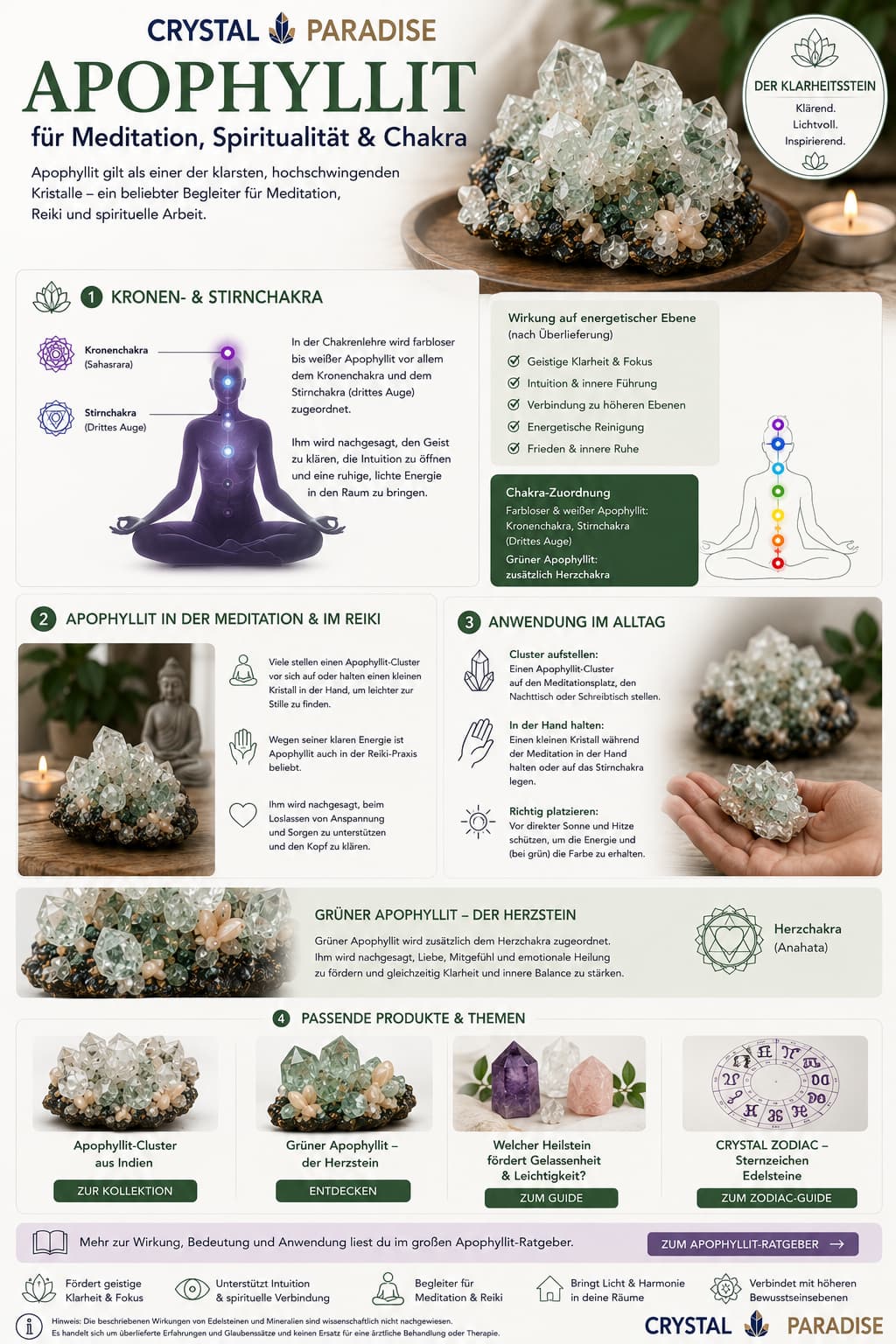
In traditional chakra teachings, apophyllite is primarily associated with the third eye chakra (Ajna, the 6th chakra) and the crown chakra (Sahasrara, the 7th chakra). This association is no coincidence: the transparency and light-filled radiance of the stone symbolically mirror the qualities of these upper energy centers. The concept of chakras originates from Indian yoga philosophy and has been passed down through spiritual traditions for centuries. A well-founded cultural overview is offered by the Britannica encyclopedia entry on chakra.
Third Eye Chakra (Ajna) – Clarity and Inner Vision
The third eye chakra is traditionally considered the seat of intuition and inner vision. According to tradition, apophyllite is said to help dissolve mental confusion and sharpen the gaze inward. In chakra work, the stone is often placed on the forehead – for sessions of 10 to 15 minutes.
Crown Chakra (Sahasrara) – Connection and Expansiveness
The crown chakra represents the connection to something greater, to the stillness beyond thought. Clear, colorless apophyllite has been described in crystal healing lore for decades as the classic stone for this work. According to spiritual tradition, it is said to open awareness and foster a quality of inner expansiveness.
For a deeper look at the spiritual meaning of the stone, we recommend our article Apophyllite: Effects, Meaning, and Application.
Spiritual Properties: What Apophyllite Means in Tradition

Apophyllite accompanies spiritual practice in many cultures. In Western crystal healing lore, which developed strongly in the 20th century, it is considered one of the most powerful stones for meditation work. Its properties are traditionally described as follows:
- Inner clarity: Apophyllite is traditionally attributed with calming the mind and easing mental restlessness.
- Spiritual connection: In crystal healing lore, it is considered a bridge between physical and subtle perception.
- Letting go: According to tradition, it is said to help release held tension and inner resistance.
- Awareness of truth: In many traditional descriptions, apophyllite stands for honesty toward oneself.
- Room energy: Apophyllite specimens are traditionally associated with meditation rooms in crystal lore and are often displayed there as mood-setting elements.
Anyone wanting to know which other crystals can support spirituality will find valuable additions in the article Healing Stones and Spirituality: What Crystal Lore Attributes to Different Crystals.
Apophyllite in Room Design: Meditation Begins Before Meditation
Apophyllite is used in crystal lore not only for active meditation sessions. Many people use large apophyllite specimens as permanent parts of their meditation corner or living room. The natural beauty of these crystal specimens – with their individual pyramidal crystals reaching several centimeters in size – makes them extraordinary decorative pieces.
Particularly impressive specimens with crystals 3 to 8 centimeters tall can be found in our collection Large Crystal Geodes for Exclusive Room Design. A piece like this noticeably changes the atmosphere of a room – and serves as a daily reminder to pause.
For the full apophyllite range, visit our collection Stone Type – Apophyllite and discover hand-selected specimens, individual crystals, and rough pieces in various sizes and qualities.
Combining Apophyllite: Synergies with Other Meditation Stones
Apophyllite harmonizes especially well in spiritual practice with other stones that carry similar energetic qualities. Proven combinations from our customer consulting experience include:
- Apophyllite and Amethyst: A classic pairing. According to tradition, amethyst deepens the calming of the mind, while apophyllite opens perception. Read more in the article Amethyst for Sleep, Meditation, and Chakra.
- Apophyllite and Celestine: Both stones are traditionally associated with higher chakras and complement each other in silent contemplation.
- Apophyllite and Stilbite: Stilbite frequently occurs as an accompanying mineral on apophyllite specimens. This natural pairing is described in crystal healing lore as especially harmonious.
- Apophyllite and Rose Quartz: Clarity combined with heart-opening – a combination for emotional meditation work.
Anyone wanting to dive deeper into choosing the right stones for meditation will find a well-founded guide in the article Choosing the Right Healing Stones for Meditation.
Frequently Asked Questions

How do I specifically use apophyllite in meditation?
Hold a smaller apophyllite crystal in your non-dominant hand or place a specimen about 20 to 30 cm in front of you. Direct your soft gaze at the stone, breathe consciously, and set a clear inner intention. Just 15 to 20 minutes daily can significantly deepen the subjective experience of a meditation session.
Which chakra is apophyllite associated with?
In traditional chakra teachings, apophyllite is traditionally associated with the third eye chakra (6th chakra) and the crown chakra (7th chakra). Clear, colorless apophyllite is considered especially suited for work with the crown chakra, while green fluorapophyllite is also associated with the heart chak

Written by Christian Neumayer


Leave a comment
This site is protected by hCaptcha and the hCaptcha Privacy Policy and Terms of Service apply.