







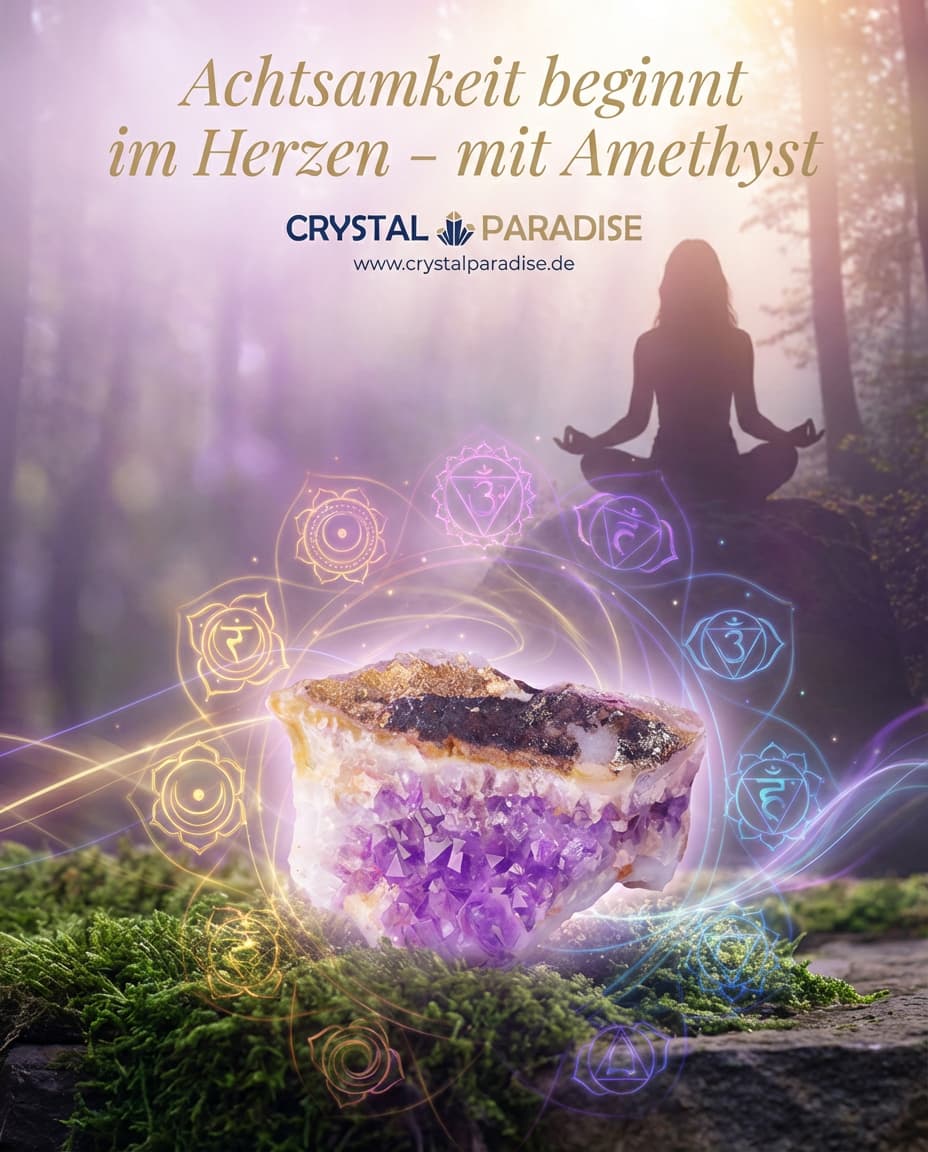
Mindfulness begins in the heart – with Amethyst
Amethyst Mindfulness: Why This Purple Stone Is So Special

Amethyst mindfulness – this connection is no coincidence. Amethyst is a purple variety of the mineral quartz (SiO₂) with a hardness of 7 on the Mohs scale. Its color arises from iron ions and natural radiation in the rock. In crystal healing lore, it has been regarded for millennia as a stone of contemplation, inner calm, and a clear mind. Anyone who wants to practice mindfulness in everyday life finds in amethyst a quiet companion – whether as a geode on the desk, a tumbled stone in the pocket, or a sphere on the meditation cushion.
Origin and Mineralogy: Where Does This Purple Companion Come From?
Amethyst grows in volcanic rock cavities. The largest and finest deposits are located in Brazil and Uruguay. Especially the geodes from the Uruguayan region of Artigas are considered world-class. Their crystal tips are deep purple to blue-violet – more intense than many Brazilian pieces.
Other significant sources include:
- Zambia (Zambian amethyst): Intensely blue-violet, often with red inclusions
- Russia (Ural): Historically significant, rarely found in trade today
- South Korea and India: Frequently processed into tumbled stones
- Austria (Maissau): The only notable deposit in Central Europe
The crystals form over periods of several million years. Temperatures between about 50 °C and 200 °C in the surrounding rock play an essential role in this process. If amethyst is permanently heated above 300 °C, its color fades – and it transforms into yellow citrine. This explains why genuine amethyst should never be exposed to direct sunlight.
In our showroom in Feldkirchen bei München, we regularly keep hand-selected pieces from Uruguay and Zambia in stock. We recommend always viewing amethyst in person – photos only partially capture the depth of these stones.
You can learn more about the various forms of amethyst in our Amethyst Forms Guide.
Amethyst Mindfulness: How the Stone Enriches Your Practice
Mindfulness means being present in the current moment. Amethyst can serve as a sensory anchor for this. It gives your practice something tangible, something you can feel and see.
In crystal healing lore, amethyst is traditionally associated with the crown chakra and the third eye chakra. It is said to promote calm observation – a core ability of any mindfulness practice. According to traditional lore, it is said to help interrupt circling thoughts and clear the mind.
These traditions go back a long way. Already in ancient Greece, the stone was considered a symbol of sobriety and a clear mind. Its name comes from the Greek amethystos – "not drunk." This meaning points to its traditional role as a guardian of a wakeful, clear state of mind.
Amethyst in Meditation
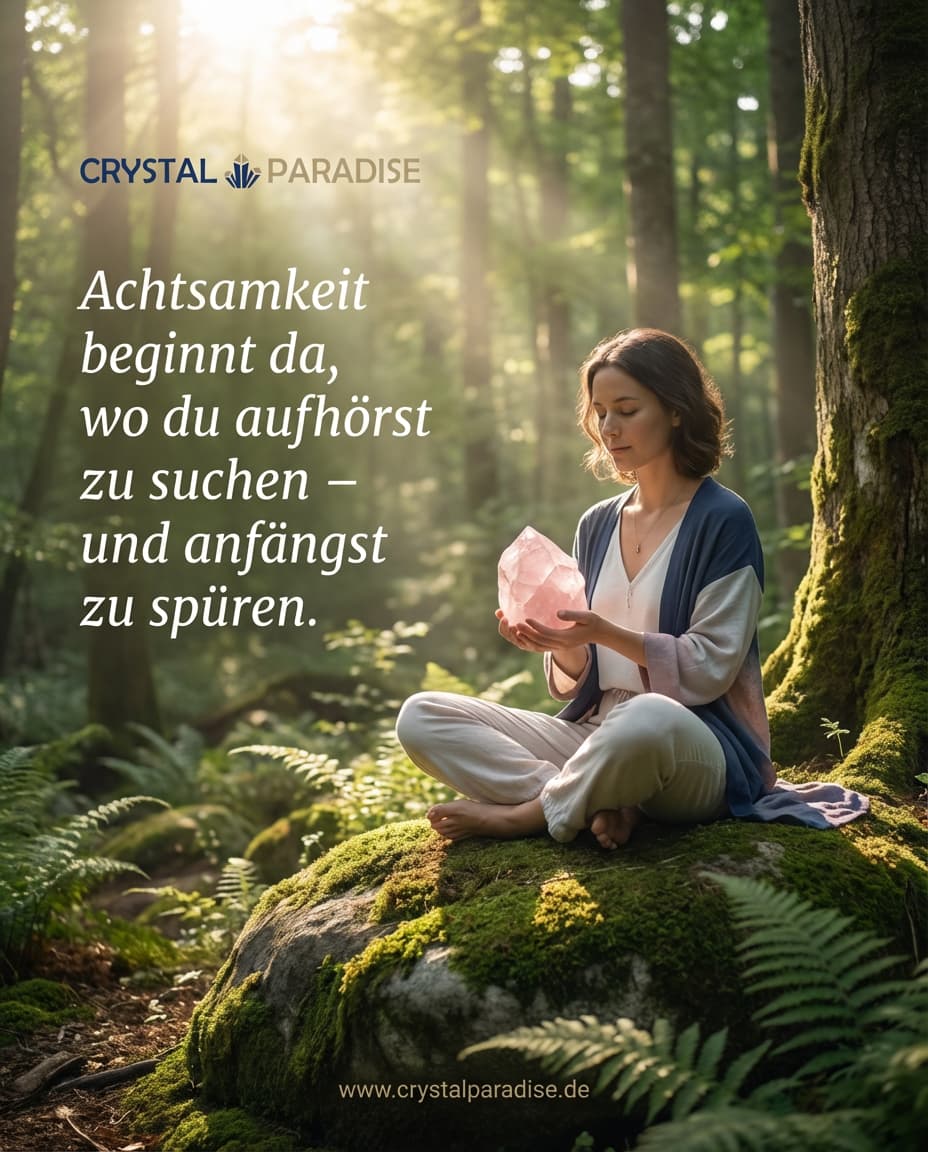
An amethyst sphere or point on the meditation cushion can make it easier to enter stillness. The purple color has a visually calming effect. The cool weight of a tumbled stone in the hand gives the mind something to orient itself around – without being distracting.
From years of experience in the mineral trade, we know that many customers report placing their amethyst deliberately in a fixed spot – as a daily reminder of their mindfulness practice. The stone thus becomes a ritual anchor.
Find out more about meditation and chakra work with amethyst in our article Amethyst for Sleep, Meditation & Chakra.
Amethyst in Everyday Life
Mindfulness doesn't end on the meditation cushion. A small tumbled stone in a jacket pocket or purse can serve as a quiet companion. Whenever you feel it, you remember: Now. Here. Breathe.
An amethyst geode in the living room or at the workplace creates a deliberate accent. It combines interior decoration with a personal layer of meaning. That's modern living with depth.
Forms and Products: Which Amethyst Suits You?

Amethyst is available in many forms. The choice depends on personal use:
- Geodes and hand specimens: Ideal for living spaces and meditation corners. Great visual impact, natural origin visible. Discover our Amethyst Geodes and Amethyst Hand Specimens.
- Spheres: Even energy in all directions. Beautiful for altars and desks. Our Amethyst Spheres can be found directly in the shop.
- Points: Direct energy in a specific direction. Popular in chakra therapy. Browse our Amethyst Points.
- Tumbled stones: Compact, easy to hold, suitable for everyday use. Perfect for on the go.
- Geodes (closed): Closed cavities – full of crystals inside. Symbolically meaningful: beauty is often hidden within.
For beginners, we recommend a tumbled stone or a small hand specimen. Collectors gladly reach for extraordinary agatized amethysts from Uruguay – a true natural spectacle of purple amethyst and beige agate in a single piece.
Caring for Amethyst Properly: How It Stays Radiant
To keep your amethyst beautiful in the long run, you should follow a few basic rules:
- No direct sunlight: UV radiation causes the color to fade after about 8 hours of continuous exposure.
- Gentle cleaning: Lukewarm (max. 30 °C) with clear water and a soft brush. No ultrasonic cleaner, no steam jet.
- Charging: In moonlight or on a clear quartz slab. Probably one of the nicest evening routines there is.
- Separate storage: A hardness of 7 means softer stones can be scratched. Amethyst itself is damaged by sapphire, ruby, or diamond.
You can find detailed care instructions in our article Cleaning & Charging Amethyst.
Science and Spirituality: A Fair Perspective
It's important to be honest: the spiritual properties of amethyst are not scientifically proven. No scientific studies exist on the attributions that tradition has given it.
What can be observed: the deliberate ritual – a stone in the hand, a calm breath, a moment of stillness – creates a pause in everyday life. Not because of the stone, but because of the pausing itself. Amethyst is a tool in this, not a miracle.
On the question of what crystals can offer in a mindfulness practice, we also recommend the informative article Spektrum der Wissenschaft: Mindfulness and Meditation as well as a look at the mineralogical database Mindat.org on amethyst.
This honest approach is what defines Crystal Paradise: we sell beautiful natural stones of genuine origin. What you make of them – whether decoration, ritual, or keepsake – is entirely up to you.
Frequently Asked Questions

Which amethyst is best suited for mindfulness and meditation?
Polished spheres and points are especially suited for meditation. Spheres radiate evenly in all directions and sit comfortably in the hand. Points can be positioned intentionally. For everyday use, tumbled stones are ideal – compact and always with you. In crystal healing lore, deep purple amethyst from Uruguay or Zambia is traditionally attributed a particularly intense effect.
Can amethyst be damaged by sunlight?
Yes. Amethyst contains iron ions that lose their color under UV radiation. After just a few hours of direct sunlight exposure, the stone can become noticeably lighter. Therefore, place your amethyst in shaded spots – a north-facing window or a shelf away from window surfaces is ideal.
How do I recognize genuine amethyst?
Genuine amethyst has an uneven color distribution with lighter and darker zones. Synthetic or treated amethyst often appears too uniform and too intense. With a magnifying glass, you can identify natural inclusions and growth lines. Our article Recognizing Genuine Amethyst shows you all the important characteristics in detail.
How do I combine amethyst with my mindfulness practice?
The simplest way is as a ritual anchor: deliberately place your amethyst in front of you before meditating. Pick it up after your practice. This small act of placing and picking up can frame a meditation session and give it depth. In crystal healing lore, this practice has been regarded for centuries as a way to cultivate inner stillness – with no effort and no prior knowledge required.
Note: The effects mentioned are spiritual traditions without scientific evidence. Amethyst is not a substitute for medical or therapeutic treatment.

Written by Christian Neumayer
%20with%20a%20hardness%20of%207...)
Leave a comment
This site is protected by hCaptcha and the hCaptcha Privacy Policy and Terms of Service apply.