







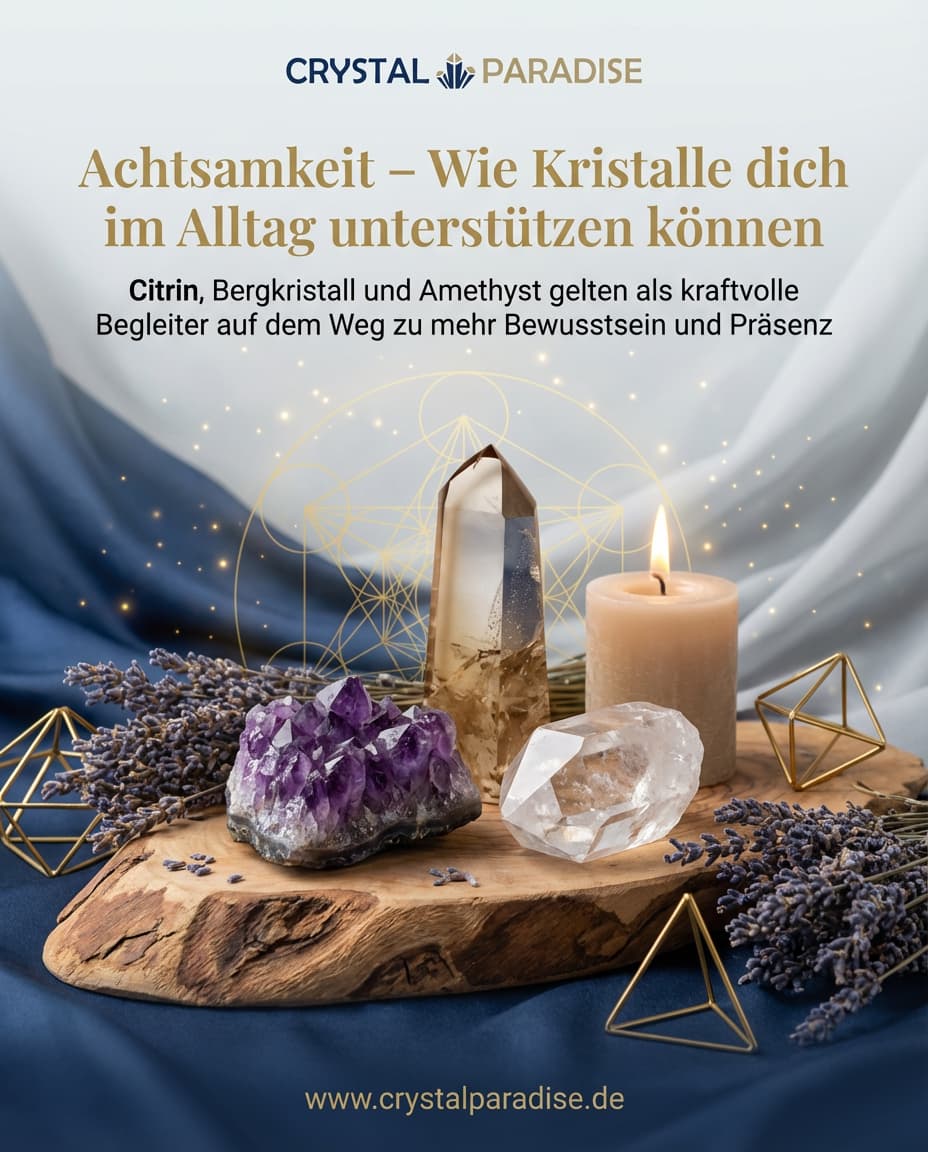
Mindfulness – How Crystals Can Support You in Everyday Life
Crystal Mindfulness – How Unique Natural Pieces Can Make Your Everyday Life More Conscious

Crystal mindfulness – this term describes a practice in which natural minerals are used as conscious anchors in everyday life. Specifically, it works like this: a stone held in your hand, placed on your desk, or worn on your body can serve as a quiet reminder. It reminds you to pause for a moment, breathe, and notice the present moment. Crystals don't replace a meditation practice – but they can complement it. They are physical objects from nature that have grown over millions of years. This depth of origin makes them special companions on the path to greater inner calm.
What Is Mindfulness – and What Role Do Crystals Play in It?
Mindfulness means being present in the current moment. Without judgment, without distraction. The term originates from the Buddhist meditation tradition and was introduced into Western contexts starting in the 1970s by psychologist Jon Kabat-Zinn. Today, mindfulness is a fixed part of many wellness and self-care routines.
Crystals play a special role in this context as so-called anchor objects. The idea behind this is simple: a particular stone is consciously linked to an intention or a feeling. Every time you touch or see it, your attention returns to that intention. This isn't a promise of magic – it's classic psychology of focus.
In stone healing lore, certain minerals are also said to support particular qualities on a subtle level. These attributions are spiritual traditions. We at Crystal Paradise share them transparently – always with the clear note: these are experiences and traditions, not medical claims.
The 5 Best Crystals for More Mindfulness in Everyday Life
Which stones are especially suited if you want to bring crystal mindfulness into your daily life? Here are our 5 recommendations from years of experience in the mineral trade:
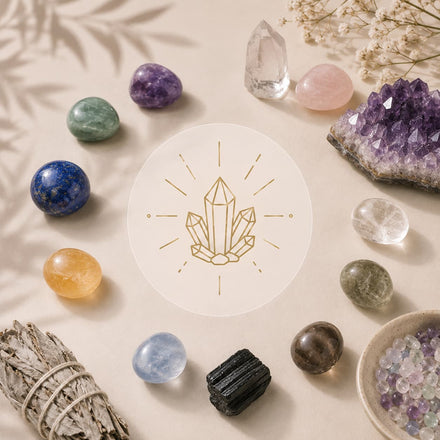
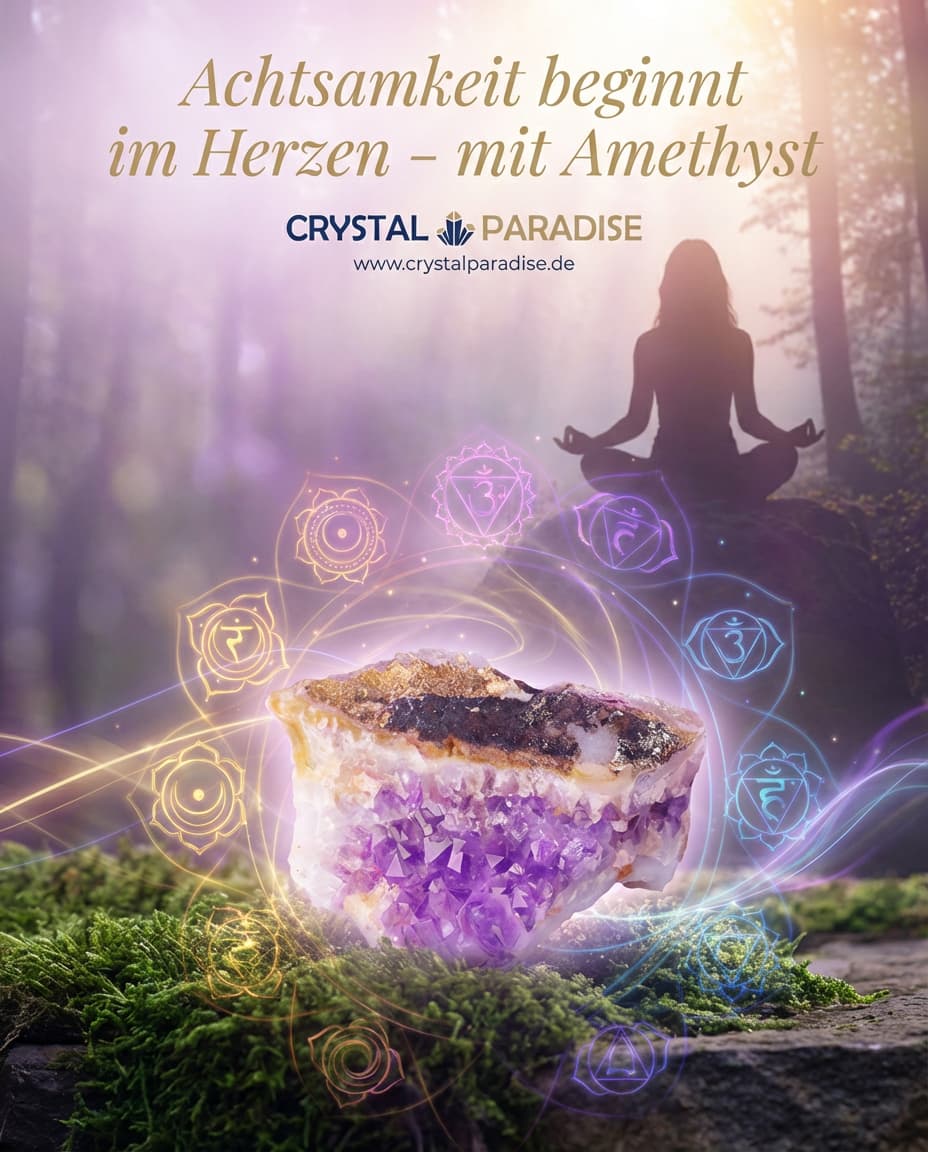
- Amethyst: A purple quartz with a Mohs hardness of 7. Amethyst is traditionally associated with calm, clarity, and inner peace. In stone healing lore, it is considered supportive of concentration and meditative stillness. Learn more in our article Mindfulness Begins in the Heart – with Amethyst.
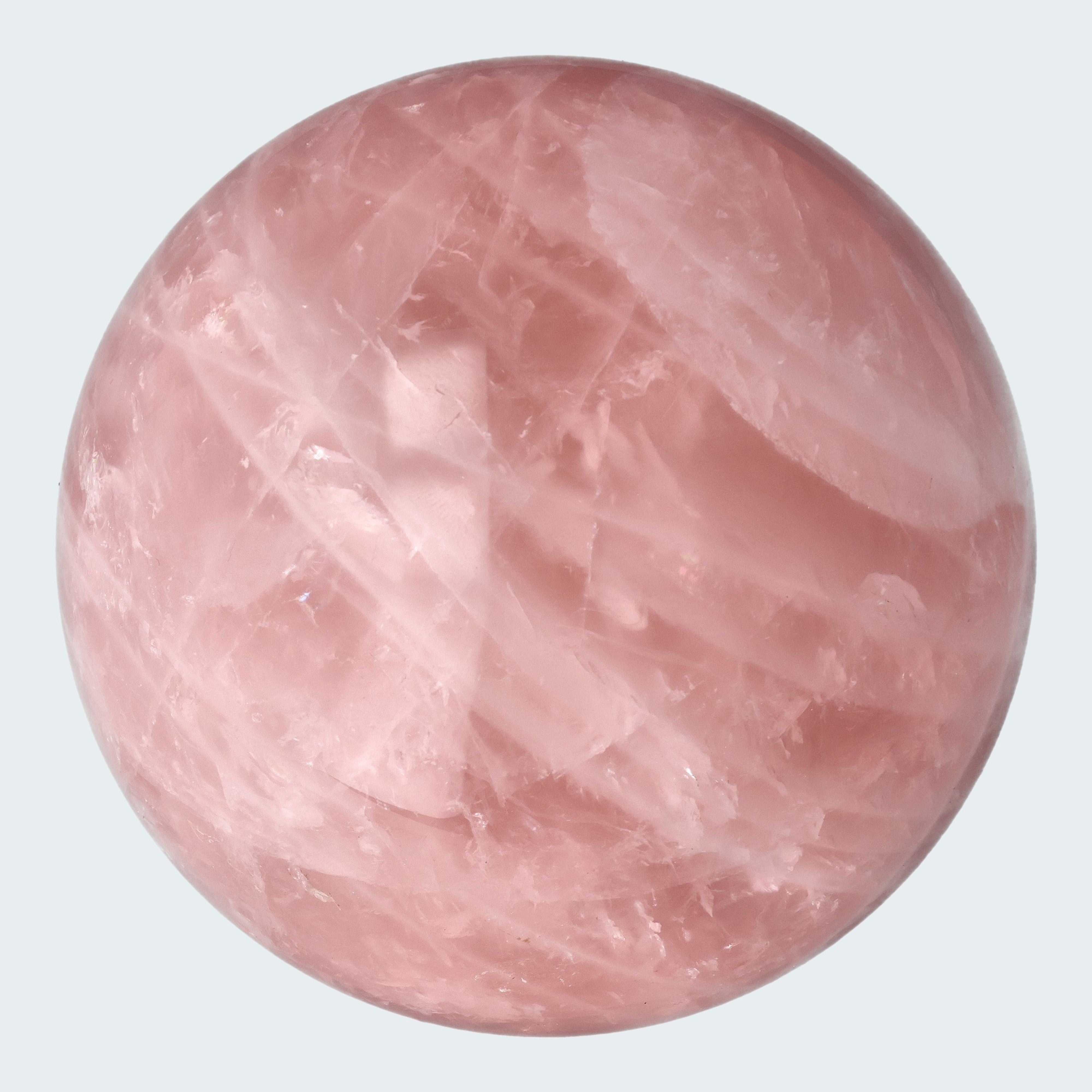
- Rose Quartz: Also a quartz with a hardness of 7. In traditional stone healing lore, it is considered the stone of the heart and self-love. It is often used in mindfulness exercises focused on self-compassion.
- Clear Quartz: The "clearest" of the quartzes. Transparent clear quartz is traditionally associated with focus, purity, and energetic clarity. It is a classic companion for meditation.
- Black Tourmaline: A borosilicate mineral with a hardness of 7 to 7.5. In tradition, it is considered a protective stone. Many people use it to feel grounded and secure – an important foundation for mindful experience.
- Moonstone: A feldspar mineral with a hardness group of 6 to 6.5. Moonstone is, according to tradition, associated with intuition, sensitivity, and emotional balance. It is especially popular for evening rituals and sleep preparation.
You can find all these stones in our curated selection of Bestseller Crystals at Crystal Paradise.
Crystal Mindfulness – 5 Concrete Exercises for Your Everyday Life
Theory is good – practice is better. Here we show you how to really integrate crystals into your everyday life. These exercises work for beginners as well as for advanced practitioners.
1. The Morning Anchor
Every morning, hold your chosen crystal in both hands for 3 minutes. Close your eyes. Breathe deeply. Set an intention for the day. This brief practice creates a conscious transition from sleep into the active day.
2. The Desk Reminder
Place a crystal in clear view at your workspace. Every time your gaze falls on it, pause briefly. 3 deep breaths are enough. This way, many small moments of mindfulness arise over the course of an 8-hour workday.
3. The Evening Reflection
Before sleep, hold your stone in your hand for 5 minutes. Ask yourself: What am I grateful for today? What do I want to let go of? This evening anchor helps you consciously close out the day. Learn more about crystals and sleep in our article Crystals for Better Sleep: The 6 Best Healing Stones.
4. The Stone in Your Pocket
Carry a small rough stone or tumbled stone in your pocket. In stressful situations – for example, on the subway or before a meeting – reach for it. The physical contact grounds you and reminds you of your intention.
5. The Meditation Corner at Home
Set up a small space in your home: a hand specimen, a cluster, or several stones on a tray. This spot naturally invites you to pause. It becomes the physical manifestation of your mindfulness practice. For inspiration, see our article The Best Crystals for Meditation at Home.
Cleansing and Charging Crystals Properly – Essential for Your Mindfulness Practice

If you use crystals regularly for mindfulness exercises, regular care is important. In spiritual practice, the goal is to energetically clear and realign the stone.
Cleansing
Many stones can be briefly rinsed under running, lukewarm water at 15 to 20 degrees Celsius. Note: softer minerals such as selenite (hardness 2) or malachite (hardness 3.5 to 4) should not come into contact with water. A safe alternative is smudging with sage or Palo Santo. Detailed information can be found in our guide Cleansing Healing Stones – How to Properly Discharge and Clear Crystals.
Charging
Stones can be reactivated through moonlight (especially during a full moon), sunlight, or by placing them on clear quartz clusters. However, some stones should not be placed in direct sunlight – amethyst, for example, loses its characteristic violet color with too much UV exposure. Therefore, limit sun exposure to a maximum of 1 to 2 hours. Learn more on our collection page Charging & Cleansing Healing Stones – Guide.
Scientific Perspective: What We Know – and What We Leave Open
Crystals consist of ordered, crystalline mineral structures. Quartz, for example, is made of silicon dioxide (SiO₂) and crystallizes in the trigonal system. This structure makes it piezoelectric – meaning: under pressure, it generates a measurable electrical voltage. This phenomenon has been used in technology since the early 20th century, for example in clocks, microphones, and sensors.
What goes beyond this – namely the spiritual-energetic effect of crystals on humans – is not scientifically proven. Many people nevertheless experience a subjectively noticeable effect. Whether this is based on placebo effects, on the powerful symbolic effect of natural materials, or on something science cannot yet measure, cannot be answered definitively today.
We at Crystal Paradise consider this an honest way of dealing with the topic: we share what people report and what traditions hand down. We make no promises of healing. And we're glad about every person who has their own experience.
For further reading, we recommend the scientific engagement with mindfulness on the website of the MBSR Association Germany, which has established Mindfulness-Based Stress Reduction, based on the work of Jon Kabat-Zinn, in German-speaking countries. Mineralogical background on quartz and related minerals can be found on the Mindat.org database, the world's most extensive mineral database.
Why High-Quality Crystals Are Better Suited for Mindfulness Practice
Not every stone is the same. In our showroom in Feldkirchen near Munich as well as in our online shop at Crystal Paradise, we place special emphasis on hand-selected, unique natural pieces. Every stone is checked for authenticity and comes with a clear statement of origin.
Why is this relevant for mindfulness practice? Because the intention with which you choose a stone matters. A genuine natural piece – with its unique growth, texture, and weight – creates a different tactile experience than a fake or industrially treated object. From years of experience in the mineral trade, we know: people feel the difference. Not always immediately – but once they begin to perceive consciously, authenticity becomes part of the experience.
Consider the following quality criteria when buying:
- Statement of origin: Where does the stone come from? Reputable dealers name the country and ideally the region or mine.
- Treatment disclosure: Has the stone been heated, dyed, or otherwise treated? Transparency is crucial here.
- Mineralogical designation: Is the stone correctly named? Mix-ups such as "Blue Quartz" for dyed glass imitations occur in the cheap mass market.
- Feel and energy: If possible – hold the stone in your hand. Choose the one you feel drawn to.
Frequently Asked Questions

How does crystal mindfulness work for beginners?
You don't need any prior knowledge. Choose a crystal that appeals to you visually or intuitively. Hold it in your hand for 3 to 5 minutes daily. Breathe consciously. That's enough as a start. Over time, you can specifically look for stones to which certain properties are attributed in stone healing lore that match your intentions – for example, amethyst for calm or rose quartz for self-compassion.
Which crystal is best suited for mindfulness and meditation?
There is no universally "best" stone – it depends on you and your intention. Particularly commonly used are amethyst (calm, clarity), clear quartz (focus, neutrality), and rose quartz (heart-opening, self-love). All 3 belong to the quartz family, have a Mohs hardness

Written by Christian Neumayer

Leave a comment
This site is protected by hCaptcha and the hCaptcha Privacy Policy and Terms of Service apply.