









Article: Why the tourmaline stone has been fascinating for centuries
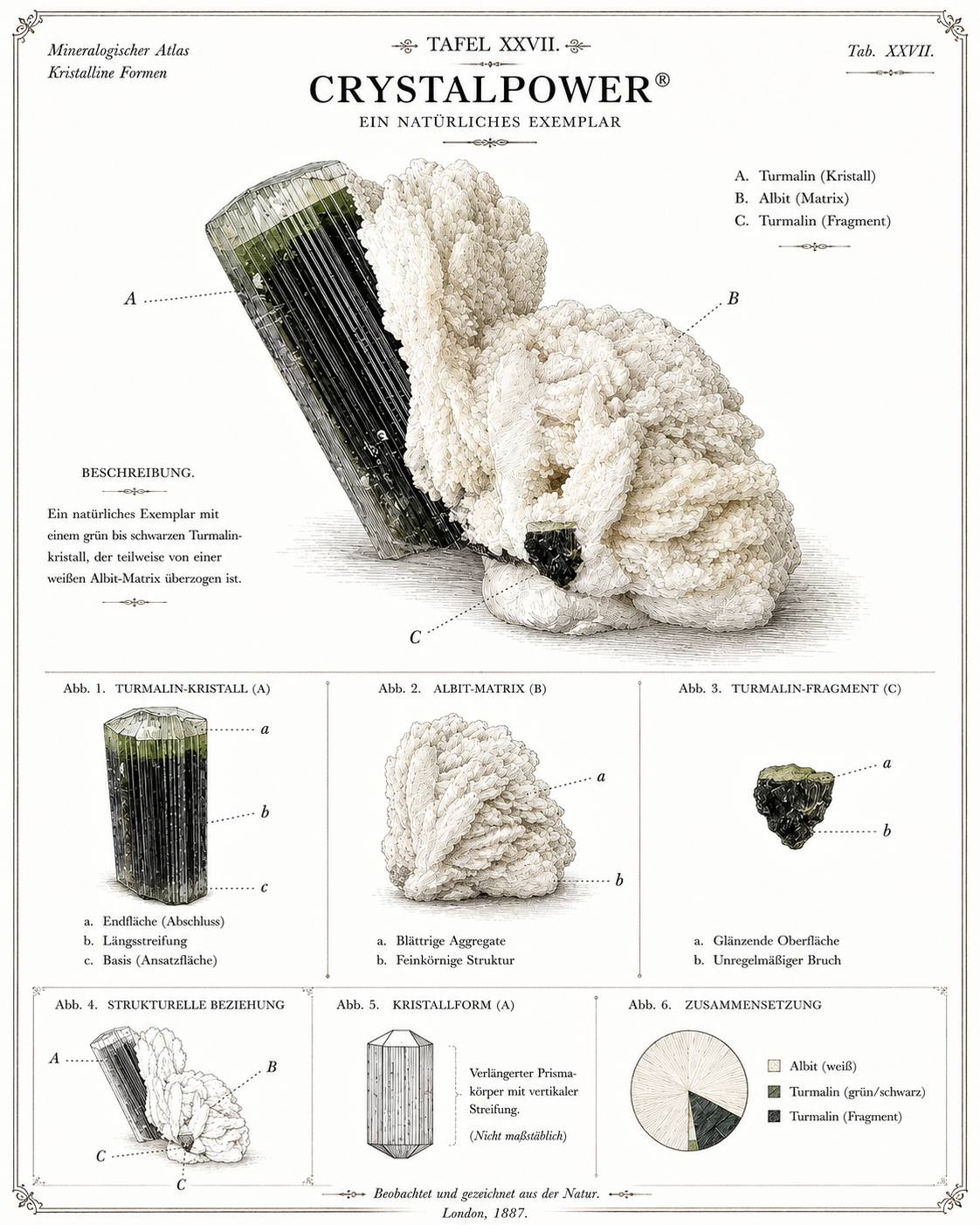
Why the tourmaline stone has been fascinating for centuries
The Tourmaline Stone – A Mineral Legend with Centuries of History

The Tourmaline Stone is one of the most fascinating minerals on Earth. It is not a single mineral, but an entire group of related silicates with one of the broadest color palettes in the entire mineral kingdom. From deep black to brilliant green to radiant pink – no other gemstone offers such diversity within a single crystal system. Tourmaline was first brought to Europe by Dutch traders from Sri Lanka around 1703. Since then, it has fascinated collectors, gemstone lovers, and spiritually interested people alike. In this article, you'll learn everything about the origin, properties, care, and traditional meanings of this extraordinary stone.
What Is the Tourmaline Stone Mineralogically?
Tourmaline is not a simple stone. It is a complex group of boron-containing ring silicates with the general chemical formula XY₃Z₆(T₆O₁₈)(BO₃)₃V₃W. That sounds complicated – and it is. This chemical complexity is the reason for its incredible variety of colors.
Mineralogically, the following facts are especially important:
- Hardness: 7 to 7.5 on the Mohs scale – making tourmaline very suitable for everyday wear.
- Crystal system: Trigonal
- Luster: Vitreous to resinous
- Density: Approx. 3.0 to 3.2 g/cm³
- Piezoelectric and pyroelectric: Tourmaline generates an electrical charge under pressure or heating – a unique physical phenomenon.
The most important tourmaline varieties are Schorl (black), Rubellite (red-pink), Verdelite (green), Indicolite (blue), and the coveted Paraíba Tourmaline (neon turquoise-blue). The best-known variety among collectors is Watermelon Tourmaline: it shows red on the inside and green on the outside – just like a sliced watermelon.
You'll find a detailed overview of all available varieties in our Tourmaline Collection at Crystal Paradise.
Origin and Localities: Where Does the Tourmaline Stone Grow?
Tourmaline is found on every continent. Nevertheless, there are some regions known for particularly high-quality specimens.
Brazil – The Heart of the Tourmaline World
Brazil is the world's most significant supplier. The state of Minas Gerais has been one of the most productive mining regions since the 18th century. The state became particularly well known in the late 1980s through the discovery of the brilliant Paraíba Tourmaline. This turquoise-blue variety was first discovered in 1989 and revolutionized the gemstone market. Today, a fine Paraíba Tourmaline costs several thousand euros per carat.
Africa – A Rising Continent for Tourmalines
Tanzania, Mozambique, and Nigeria also produce excellent tourmalines today. Rubellite from Mozambique in particular has gained significant importance over the past 15 years. Namibia is known for elegant black schorl crystals in matrix.
Afghanistan and Pakistan – World-Class Rough Specimens
The pegmatite deposits in the Hindu Kush produce impressive rough crystals. Tourmalines from these regions often show multi-axis color gradients and are highly sought after by mineral collectors. In our showroom in Feldkirchen near Munich, we've also noticed from our own experience: customers are particularly fascinated by the raw, untreated specimens from this region. The natural prism structure of these crystals is simply breathtaking.
Tourmaline in Cultural History
The history of tourmaline goes back a long way. It is said to have already been valued as a protective stone in ancient Egypt. A legend from Sri Lanka says that on its way to the Earth's surface, tourmaline collects all the colors of the rainbow – hence its Sinhalese name Turmali, meaning "stone with mixed colors."
In the 16th century, Spanish conquistadors mistook green tourmaline from Colombia for emeralds. This confusion shows just how impressive the quality of some tourmalines is. Even gemologists needed centuries to classify tourmaline as its own mineral group. That was only achieved in the early 19th century.
Particularly interesting: Empress Catherine the Great is said to have had a passion for red tourmaline. Many pieces from the Russian crown treasury were initially cataloged as rubies and only later identified as rubellite tourmalines.
You can learn more about the fascinating red tourmaline and its history in our detailed blog article.
Tourmaline Stone: Traditional Meanings and Spiritual Properties

In the world of healing stones, tourmaline holds a special place. Note that all of the following properties are spiritual traditions – they do not replace medical treatment.
Black Tourmaline (Schorl)
In traditional stone healing, schorl is described as a protective stone. According to tradition, it is said to have the property of shielding against negative energies. It is said to help promote grounding and inner stability.
Green Tourmaline (Verdelite)
Green tourmaline is traditionally regarded as the stone of the heart. In stone healing, it is associated with renewal, vitality, and balance. According to traditional teaching, it is said to be especially supportive during times of inner change.
Pink and Red Tourmaline (Rubellite)
Rubellite is traditionally associated with opening the heart and emotional warmth. In spiritual circles, it is considered a stone said to strengthen compassion and affection. It is often described as an energetic companion for personal transformation processes.
Watermelon Tourmaline
This bicolor tourmaline traditionally combines the qualities of pink and green. In traditional interpretation, it is considered a stone that in stone lore is associated with balance and inner clarity, and to which a harmonizing meaning has long been attributed.
If you'd like to wear tourmaline as part of your everyday energy companion, we recommend our crystalpower® bracelets with healing stones – handcrafted companions made from genuine gemstones.
Caring for and Cleaning Tourmaline – Practical Tips
A Tourmaline Stone is durable. With a Mohs hardness of 7 to 7.5, it's suitable for everyday wear. Still, there are a few things to keep in mind to keep it beautiful in the long run.
- Cleaning with lukewarm water: A soft cloth and lukewarm water are sufficient for most tourmalines. Temperature fluctuations above 50 °C should be avoided.
- Avoid ultrasonic cleaners: Treated or included tourmalines can be damaged in an ultrasonic bath.
- No aggressive chemicals: Acids and alkalis attack the surface – even on durable stones.
- Light storage: Intense sunlight can fade the color of some tourmalines over months.
- Energetic cleansing: In crystal work, tourmaline is traditionally cleansed with smoking herbs or placed on clear quartz. Read more about this in the article Why You Should Properly Discharge Your Clear Quartz Healing Stone.
Buying Tourmaline – What to Look For
The gemstone market is large. And unfortunately not always transparent. We recommend paying attention to the following points when buying a Tourmaline Stone:
- Origin information: Reputable dealers state the country of origin and, if possible, the specific mining region.
- Treatment disclosure: Many tourmalines are heated or oiled. This is common but should be communicated.
- Rough stones vs. cut stones: Raw crystals are often untreated and authentic. Cut stones are preferred for jewelry.
- Price vs. quality: Very cheap tourmalines under 2 euros are often synthetic or dyed.
In our showroom in Feldkirchen near Munich, you can hold tourmalines in your hand, compare them, and receive personal advice. Years of experience in selecting hand-picked minerals make the difference. Online, you'll find our curated selection in the Tourmaline Collection.
Are you also interested in other fascinating minerals? Then discover our selection of Garnet gemstones – another mineral group with an impressive variety of colors.
We also recommend the article Which Healing Stone Is Traditionally Associated with Serenity?
For further reading, take a look at the external resource of the Mindat database for tourmaline – the most comprehensive mineralogical reference database in the world. More scientific background information on the piezoelectric properties of tourmaline can be found at Gemological Research Switzerland (GRS).
Frequently Asked Questions

What is the difference between tourmaline and other black stones like obsidian?
Black tourmaline (schorl) is a silicate mineral with a Mohs hardness of 7 to 7.5. Obsidian, on the other hand, is a volcanic glass with a hardness of only 5 to 5.5. Tourmaline shows a distinct prismatic and striated structure. Obsidian is glassy-smooth and breaks with a conchoidal fracture. Both are described as protective stones in spiritual contexts – mineralogically, they are completely different.
Can tourmaline be placed in water?
Generally, yes – tourmaline has good water resistance due to its hardness of 7 to 7.5. It is suitable for brief cleaning in lukewarm water. For gem water applications (e.g., gemstone-infused water), however, you should use specially designed products. Learn more in the article Why the Meaning of Gem Water Can Change Your Drinking Ritual.

Written by Christian Neumayer


Leave a comment
This site is protected by hCaptcha and the hCaptcha Privacy Policy and Terms of Service apply.