







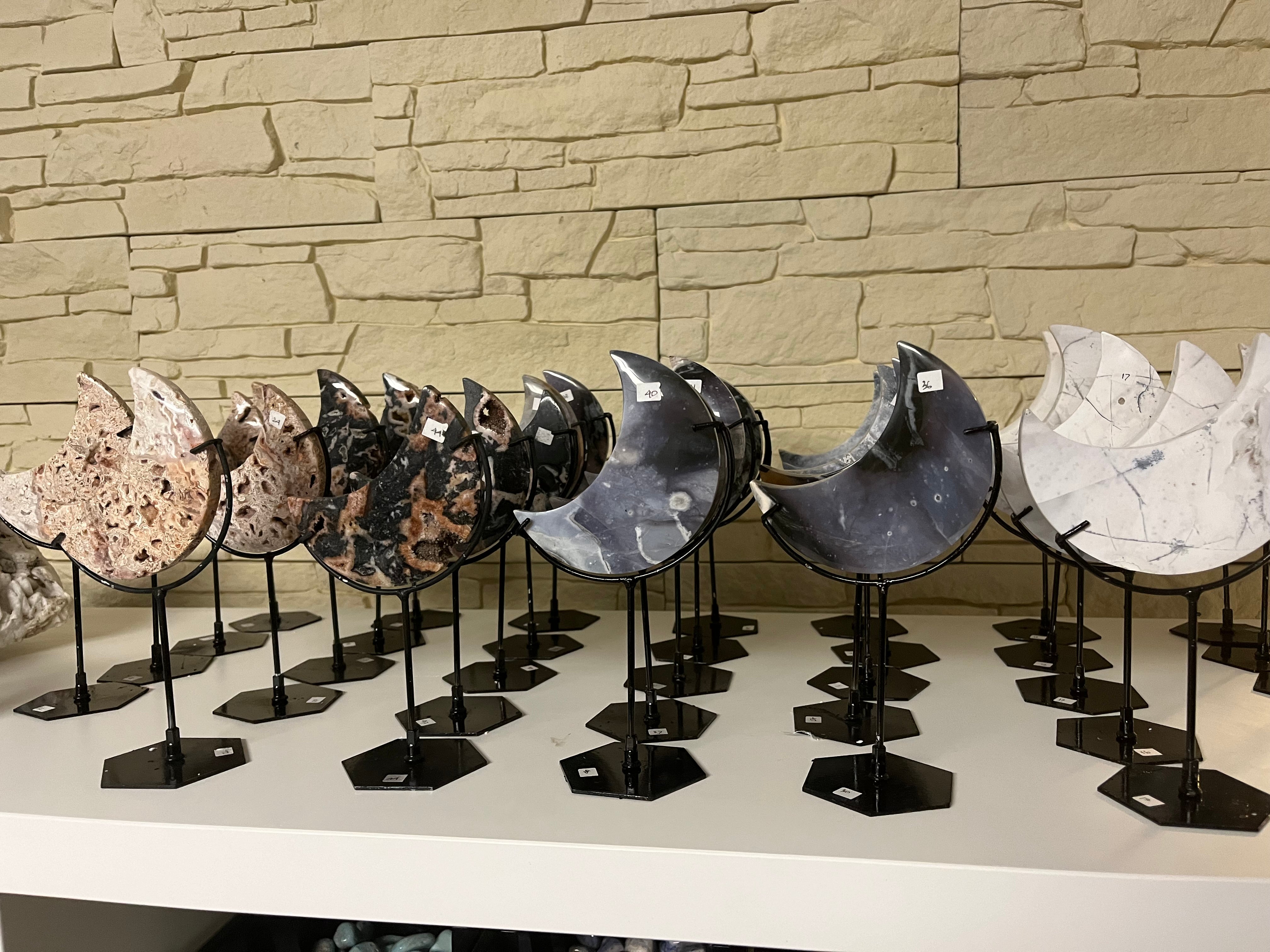
Beautiful moons arrived on stands in different colors
Moon on Stand: Natural Moonstone Sculptures for Your Home

A moon on stand is a decorative crystal sculpture in moon shape, presented on a separate holder – usually made of metal or wood. This combination of natural stone and elegant base makes every moon a true eye-catcher. At Crystal Paradise, beautiful new pieces in various colors and stone types have just arrived – handpicked, natural, and of impressive quality. Whether as atmospheric home decor, a personal companion, or a special gift: The moon on stand unites natural aesthetics, symbolism, and craftsmanship in one piece.
New Moons on Stands – Fresh Variety of Colors Just Arrived
We are very pleased to inform our customers about a special new arrival. Beautiful moons on stands have arrived in our shop in a wide variety of colors and stones. From our own experience, we know: No moon is like another. Each piece is a one-of-a-kind creation of nature.
The current collection includes, among others, the following stone types:
- Amethyst – in rich violet, often from Brazilian or Uruguayan sources
- Rose Quartz – delicate pink, mostly from Minas Gerais (Brazil) or Madagascar
- Obsidian – deep black, of volcanic origin, e.g. from Mexico or Iceland
- Clear Quartz – clear and transparent, among others from the Alps or Brazil
- Labradorite – with shimmering play of colors, known as labradorescence
- Opalite – in soft milky white with a delicate shimmer, ideal for calm living atmospheres
- Turquoise-dyed Howlite – in vibrant blue-green, decorative and expressive
All moons are mounted on high-quality stands. The stands are mostly made of black or gold metal. They lend stability to the piece and emphasize the natural shape of the stone.
Discover our entire collection in the Decor – Moons on Stands overview. There you'll find new one-of-a-kind pieces on an ongoing basis – sourced directly from around the world, handpicked for you.
Mineralogy and Origin: What's Behind the Moon on Stand?
The moon shape is no accident. It is created through precise stone cutting and grinding – a craft with a long tradition. The characteristic crescent shape with its pointed tip requires experience and a fine touch. Mineralogically speaking, depending on the stone type, these belong to entirely different mineral groups.
Amethyst: The Royal Violet
Amethyst is a variety of quartz (SiO₂) with a hardness of 7 on the Mohs scale. The violet color is created by natural iron inclusions and gamma radiation in the ground. Important sources are located in Brazil, Uruguay, and Zambia. Brazilian amethysts often come from the state of Rio Grande do Sul. Uruguayan specimens are considered especially sought-after due to their deep color saturation.
In lithotherapy, amethyst is traditionally associated with calm and inner clarity. According to tradition, it is said to support meditative stillness. More information on care can be found in our article Charging Amethyst.
Those who want to learn more about the scientific classification of quartz can find a well-founded overview at the Mindat.org mineral database, one of the world's leading reference sources for mineralogy.
Rose Quartz: Gentle Elegance in Pink
Rose quartz also belongs to the quartz group and reaches the same hardness of 7. The delicate coloring is created by tiny inclusions of dumortierite or rutile. Madagascar and Brazil are the most important supply regions for high-quality rose quartz. It is considered one of the most popular stones for home decor and gifts.
According to tradition, rose quartz is associated with opening the heart, compassion, and harmonizing energy. Learn more about care in our article Cleaning & Charging Rose Quartz.
Labradorite: Nature's Play of Colors
Labradorite is a feldspar mineral with a hardness of 6 to 6.5. Its best-known feature is the so-called labradorescence – an optical phenomenon created by light refraction at internal layer boundaries. The colors range from blue to green to gold. Main sources are Madagascar, Canada, and Norway. The mineral was first discovered in 1770 on the Labrador Peninsula in Canada. A detailed mineralogical description is offered by the Mineralienatlas database, an established German-language reference for mineral enthusiasts.
Obsidian: Volcanic Natural Glass
Obsidian is not a mineral in the classic sense, but volcanic natural glass. Its hardness is 5 to 5.5. It forms when lava cools extremely quickly and is unable to develop a crystal structure. Sources include Mexico, Iceland, and the USA. In lithotherapy, obsidian is traditionally considered a protective stone, which according to tradition is attributed a grounding effect.
Moon on Stand as Decoration: How to Integrate It Stylishly

A moon on stand is versatile. It works well in both modern interiors and natural, boho-inspired living spaces. Here are our most popular placement ideas:
- Sideboard or Dresser: Alone or combined with other natural stones, moons on stands create clear accents.
- Bedroom Nightstand: A rose quartz or amethyst moon creates a calm, harmonious atmosphere.
- Home Office or Desk: Clear quartz and labradorite are considered in lithotherapy to be stones said to support clarity and concentration, and are popular as a focal point on the desk.
- Windowsill: In the light, a labradorite or clear quartz moon unfolds its full optical splendor.
- Meditation Corner: Moons on stands are popular companions for mindful rituals and quiet moments.
We recommend not placing moons on stands permanently in direct sunlight. Intense UV radiation can cause some stone colors – especially amethyst – to fade over time. A bright, indirect location is ideal.
Would you like to discover more decorative stone objects? Our Heart Carvings on Stand collection perfectly complements the moon stand to create a cohesive ensemble of natural stone and design.
Care and Cleaning: How to Keep Your Moon on Stand Radiant
Physical Cleaning
Most moon pieces made of quartz can be cleaned well with a soft, slightly damp cloth. Avoid aggressive cleaning agents. For delicate metal stands, dry wiping is sufficient.
- Quartz-based stones (amethyst, rose quartz, clear quartz): Wipe damp, dry with a cloth
- Labradorite (hardness 6–6.5): Only treat with a dry cloth, water not recommended
- Obsidian (hardness 5–5.5): Handle with particular care – it is more brittle than quartz
- Metal stands: Polish with a dry cloth, no contact with abrasive cleaners
Energetic Cleansing According to Tradition
In lithotherapy, it is recommended to cleanse crystals energetically on a regular basis. According to tradition, these methods include:
- Moonlight: Place stones in moonlight overnight – especially during the full moon, which appears every 29.5 days
- Smudging: Briefly smudge the stone with sage or palo santo
- Singing Bowls: Vibration through sound is said, according to tradition, to renew the stone's energy
- Earth: Bury the stone in the earth for 24 hours – an old, nature-connected method
These methods are purely spiritual practice. There is no scientific evidence for their effectiveness.
Crystal Paradise in Feldkirchen: Experience Moons on Stands in Person
Our showroom in Feldkirchen near Munich is regularly open. There you can personally examine many specimens from our moon collection. We are happy to advise you – whether you are a beginner or a passionate collector with years of experience in the mineral trade. The texture, weight, and play of colors of a stone are simply better experienced in person than in photos.
We are also regularly present at mineral and crystal fairs. You can get an impression of our trade fair presence in 2024 in our report on the successful trade fair appearances in Landshut and Nuremberg in November 2024.
For those interested in comprehensive crystal decor, we also recommend our guide: Buying Crystal Decor: Elegance for Your Home with Crystals, Figures & Natural Art.
Frequently Asked Questions

What exactly is a moon on stand?
A moon on stand is a sculpture made of natural stone in moon shape, presented on a holder made of metal or wood. It serves as a decorative object for living spaces, meditation corners, or as a gift. Depending on the stone type, it combines aesthetic elegance with symbolic meaning. In lithotherapy, it is traditionally attributed a special energetic effect – without scientific evidence.
What stone types are available for moons on stands?
The selection is large. Among the most popular stone types are amethyst, rose quartz, clear quartz, obsidian, labradorite, and opalite. Each stone type brings individual color, texture, and characteristics. At Crystal Paradise, the moons are handpicked and come from well-known source regions worldwide – from Brazil to Madagascar to Canada.

Written by Christian Neumayer


Leave a comment
This site is protected by hCaptcha and the hCaptcha Privacy Policy and Terms of Service apply.