







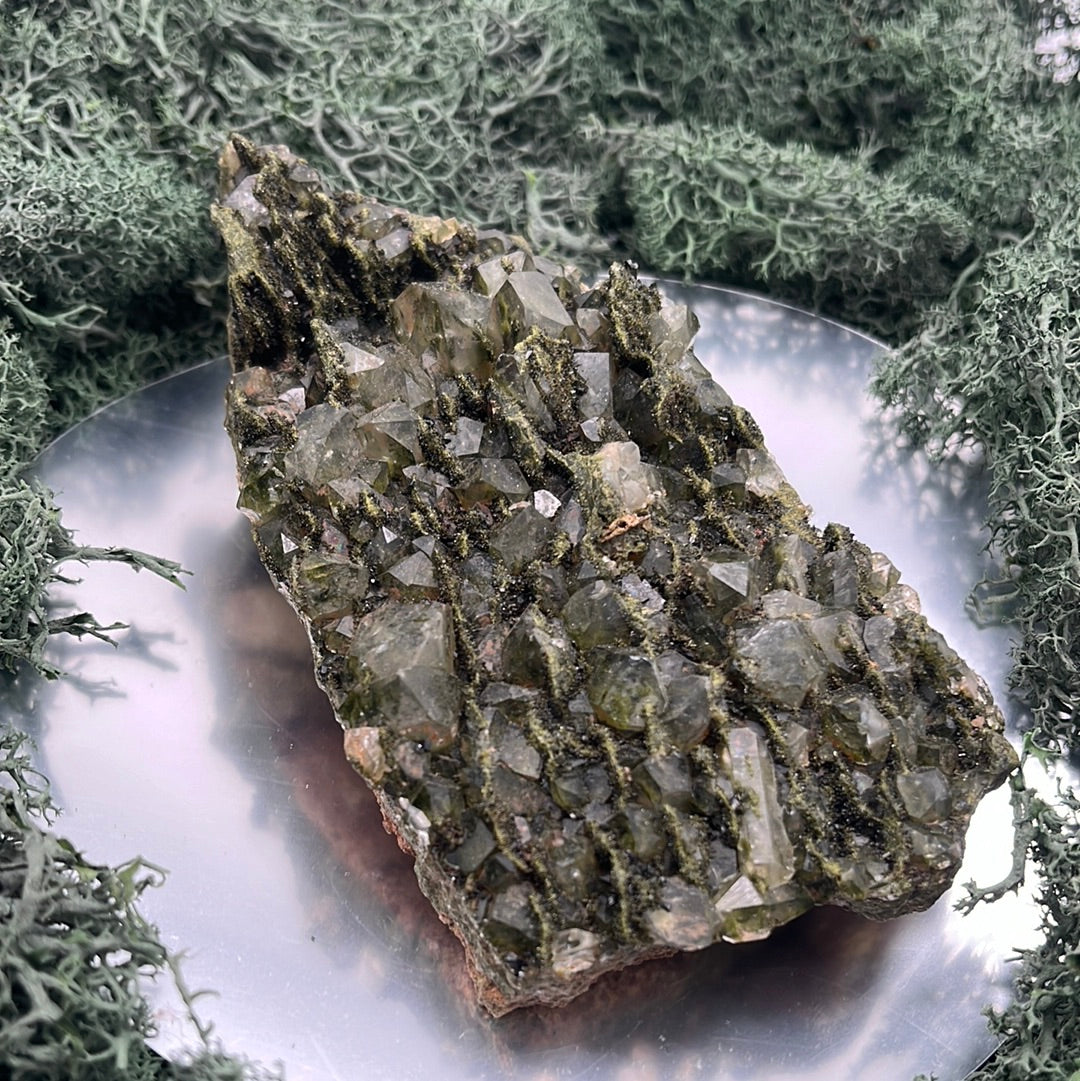
Epidote with rock crystal from Türkiye in the shop
Epidote Rock Crystal from Turkey – an Extraordinary Mineral Pair

Epidote Rock Crystal refers to a natural mineral combination in which green to yellowish-green epidote crystals have grown on or together with transparent rock crystal (SiO₂). These specimens form through hydrothermal processes, in which both minerals grow simultaneously or successively in fissures and cavities. The result is a geological one-of-a-kind – contrast-rich, colorful, and mineralogically highly interesting. Crystal Paradise offers hand-selected specimens of this combination directly from Turkey.
Turkey is among the most significant source countries for epidote–rock crystal specimens worldwide. In particular, the Anatolian mountain regions have supplied remarkable pieces to the international mineral trade for decades. In our shop you will find a curated selection of these natural treasures – from compact collector's pieces to large decorative specimens.
Mineralogical Classification: What Is Epidote?
Epidote belongs to the group of sorosilicates. The chemical formula is Ca₂(Al,Fe)₃(SiO₄)₃(OH). The characteristic color – a distinctive pistachio green to yellowish green – results from the iron content in the crystal lattice. The higher the iron content, the darker and richer the green color.
Physical Properties of Epidote
- Mohs hardness: 6 to 7 – making epidote comparatively robust
- Crystal system: Monoclinic, often tabular or columnar crystals
- Luster: Vitreous to resinous luster
- Cleavage: Perfect in one direction
- Density: approx. 3.3–3.5 g/cm³
- Transparency: Translucent to opaque
Rock crystal, on the other hand, is pure, colorless quartz with a Mohs hardness of 7 and a hexagonal crystal system. The intergrowth of both minerals creates a fascinating visual contrast: the deep green of the epidote stands out brilliantly against the clear, transparent rock crystal. You can learn more about the diverse properties of rock crystal in our detailed Encyclopedia Article on Rock Crystal.
Origin: Epidote Rock Crystal from Turkey
Turkey is geologically extraordinarily diverse. The country lies at the intersection of several tectonic plates. As a result, highly complex geological structures have formed over millions of years. In particular, the regions of Central Anatolia and the Taurus mountain ranges produce high-quality epidote specimens.
Turkish epidote–rock crystal specimens stand out due to several quality characteristics:
- Intense, rich green color of the epidote due to high iron content
- Pronounced, well-developed crystal faces and terminations
- Natural intergrowths with clear rock crystal points
- Pieces available in sizes ranging from a few centimeters to over 30 cm in width
- Predominantly untreated – no dyeing or coatings
Years of experience in the mineral trade have taught us at Crystal Paradise: Turkish localities deliver a consistency in quality and aesthetics that delights European collectors. We source our pieces directly through verified supply chains and consistently ensure authenticity and proof of origin. You can find the entire collection of Minerals from Turkey in our shop.
Distinction from Other Epidote Localities
Epidote occurs worldwide – including in Austria (Knappenwand in the Untersulzbach Valley), Pakistan, Brazil, and the USA. Austrian specimens from the Tauern Window are considered mineralogical treasures. Turkish pieces, on the other hand, stand out for their size, color intensity, and excellent value for money. Equally appealing for beginners and experienced collectors alike. On the website of Mindat.org, the world's largest mineral database, you will find detailed information on epidote localities and varieties.
Epidote Rock Crystal in Crystal Healing and Energy Work

In crystal healing, epidote has long been associated with themes such as growth, regeneration, and transformation. According to traditional lore, it is considered a stone said to dissolve inner blockages and encourage the courage to change.
Rock crystal is traditionally referred to as a "universal stone." In the holistic teaching of crystal energy work, it is said, according to traditional lore, to amplify the effects of other stones and to have a clarifying effect on mind and spirit. Learn more about the spiritual traditions surrounding rock crystal in our article Rock Crystal: Meaning & Lore.
The combination of epidote and rock crystal is described in crystal healing as particularly intense:
- Epidote is said, according to traditional lore, to support growth and personal development
- Rock crystal is traditionally regarded as an amplifier and clarifying stone
- The combination is considered a "catalyst for change" in crystal work
- Both stones together are said, according to spiritual tradition, to promote clarity of mind
If you would like to use rock crystal in meditation, we recommend our article on Rock Crystal Meditation & Use for practical tips.
Care and Cleaning of Epidote–Rock Crystal Specimens
To keep your epidote–rock crystal specimen looking beautiful for a long time, a few care tips are important:
Cleaning
Epidote is light-sensitive. Direct sunlight can cause fading with intense and prolonged exposure (more than 2–3 hours daily over weeks). It is best to clean the specimen with a soft, dry or slightly damp cloth. Avoid chemical cleaning agents. A brief rinse with lukewarm water (under 30 °C) is fine for stable pieces. Let the specimen dry thoroughly afterward.
Placement and Storage
Do not place the specimen in permanently damp rooms. Epidote can tarnish slightly with prolonged water contact. A dry environment at room temperature between 18 and 22 °C is ideal. For cleansing and charging rock crystal in the energetic sense, we have a detailed guide of our own: Cleansing & Charging Rock Crystal.
Transport and Handling
Epidote crystals are hard, but due to their perfect cleavage in one direction, they are sensitive to localized impacts. Transport specimens wrapped in a soft cloth or foam. Large pieces (from approx. 1 kg) should be placed on stable surfaces.
Buy Epidote Rock Crystal at Crystal Paradise
In our showroom in Feldkirchen near Munich, you can personally examine epidote–rock crystal specimens from Turkey. We warmly invite you to pick up the pieces, admire the colors in daylight, and receive individual advice. This is an experience that no product photo can replace.
Online, you can find our entire selection at any time in the collection Rock Crystal with Epidote. Each piece is a one-of-a-kind natural specimen – with individual dimensions, weights, and color intensities. Our product photos are taken under natural light to represent the true coloring as accurately as possible.
If you're also interested in other rock crystal combinations, feel free to check out our collection Rock Crystal with Schorl Tourmaline – another fascinating mineral combination from our rock crystal range.
For external mineralogical references and scientific background on epidote, we also recommend a look at the Mineralienatlas Database, one of the most extensive German-language mineral references.
Frequently Asked Questions

What is the difference between epidote and prehnite?
Both minerals display a characteristic green color, but differ significantly in mineralogical terms. Epidote is a silicate of the sorosilicate group with a monoclinic crystal system and a hardness of 6 to 7. Prehnite, on the other hand, belongs to the phyllosilicates and has a hardness of only 6 to 6.5. Epidote also shows a more intense, rich green hue due to its iron content, while prehnite often appears paler and more translucent.
Is Turkish epidote rock crystal natural or treated?
The epidote–rock crystal specimens from Turkey offered by Crystal Paradise are, as a rule, untreated. No dyeing, coatings, or artificial enhancements are applied. We place great importance on transparency regarding origin and condition. If in doubt, our product descriptions and our advisory team at the showroom in Feldkirchen near Munich will be happy to provide detailed information.
How can I recognize genuine epidote?
Genuine epidote displays a characteristic vitreous luster and a typical pistachio green color. Under a magnifying glass, the monoclinic, tabular-columnar crystal forms are visible. With a glass cutter (Mohs hardness approx. 5.5), epidote can be scratched, while conversely it does not easily scratch glass. Dyed imitations lack the mineralogically typical color zoning and the characteristic luster. If in doubt, a mineral expert or a gemological laboratory can help.
What sizes are available for epidote–rock crystal specimens?
In our range you will find pieces in a wide variety of sizes: from small collector's pieces about 5 cm wide to medium-sized decorative specimens, all the way to impressive showpieces over 25 to 30 cm wide. The weight varies accordingly, from a few hundred grams to over 3 kg. There's something for every budget and purpose – whether for display cases, home décor, or gifts.
Does epidote rock crystal make a good gift?
Absolutely. The combination of intense green and clear rock crystal makes these specimens visually impressive gifts. They are suitable for mineral enthusiasts, wellness fans, and anyone who appreciates natural décor. Crystal Paradise also offers careful packaging and, upon request, personal advice to make sure the gift is just right.

Written by Christian Neumayer


Leave a comment
This site is protected by hCaptcha and the hCaptcha Privacy Policy and Terms of Service apply.