








The Best Crystals Against Radiation: How to Protect Yourself Naturally & Stylishly at Work
Crystals Against Radiation: What's Behind the Trend?

More and more people are interested in crystals against radiation – especially at workplaces with screens, WiFi routers, and smartphones. In short: certain minerals like shungite, tourmaline, and amethyst have traditionally been associated with protective properties for centuries. In crystal healing, they are regarded as companions that are said to help maintain inner balance in everyday life – regardless of whether there is scientific proof for this effect.
In this article, we introduce you to the most popular stones, explain their mineralogical background, and show you how to use them stylishly at your desk, in your home office, or at work.
Why do people turn to crystals against radiation?
Modern working life is permeated by electromagnetic fields. Routers transmit at 2.4 GHz and 5 GHz. Monitors, smartphones, and laptops sometimes run 8 to 10 hours a day. Many people report feeling inner unrest or exhaustion after long hours in front of a screen.
Crystals offer a dual promise here: aesthetic beauty and a traditional symbolic protective function. In our shop, we experience daily how customers specifically search for stones that not only decorate their workplace but are also meant to "charge" it energetically.
Crystal healing is not a new invention. Shungite was already used in Russia for water purification in the 18th century. Black tourmaline has been known in European mineralogy for over 300 years. This historical heritage is part of what makes these stones appealing.
The 5 best crystals against radiation for the workplace

1. Shungite – the classic from Karelia
Shungite is probably the best-known stone in the field of radiation protection. It comes from the Russian Republic of Karelia and is around 2 billion years old – one of the oldest carbon-containing stones on Earth. Mineralogically, it consists of up to 98% carbon and contains natural fullerenes (C60 molecules), which have been the subject of scientific research since the 1980s.
In crystal healing, shungite is traditionally regarded as a protective and grounding stone and has been used accordingly for a long time. It works well as a raw stone on the desk, as a polished pyramid, or as a small plate next to the laptop.
Care note: shungite has a Mohs hardness of 3.5 to 4. It should therefore not be stored together with harder minerals. Clean it every 4 weeks with lukewarm water.
2. Black tourmaline (schorl) – protective stone with a long tradition
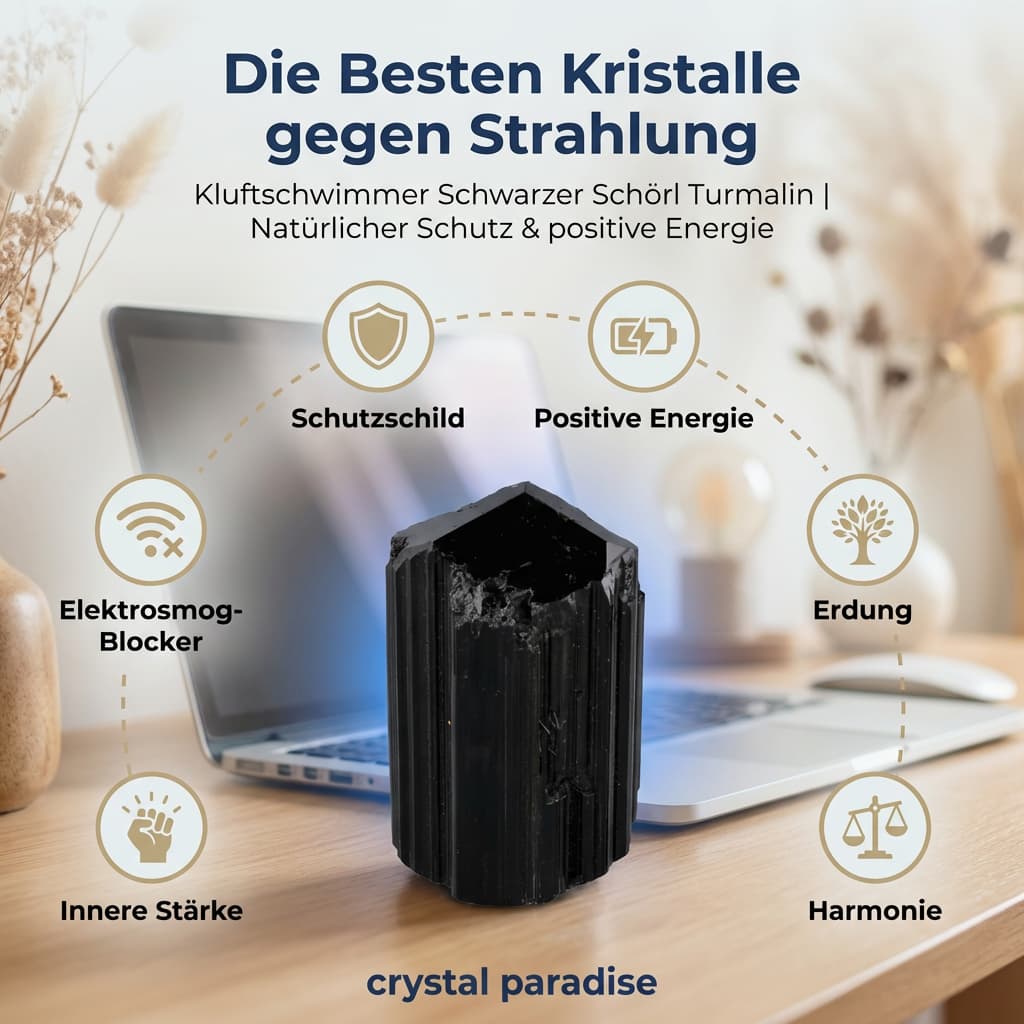
Black tourmaline, mineralogically known as schorl, belongs to the tourmaline group with a Mohs hardness of 7 to 7.5. It comes from countries such as Brazil, Madagascar, and Namibia. Schorl accounts for over 95% of all tourmaline deposits worldwide by quantity.
In traditional lore, black tourmaline is considered a powerful protective stone. It is said to buffer negative energies and strengthen inner stability. It also cuts a fine figure visually on the desk – whether as a raw rod, polished column, or sphere.
From years of experience with our customers, we recommend placing it directly next to the monitor or router. Many of our customers combine it with a light rose quartz for an appealing visual contrast.
3. Amethyst – calm and focus in one stone
Amethyst is a purple variety of the quartz mineral SiO₂ with a Mohs hardness of 7. Its color is caused by iron ions in the crystal lattice as well as natural gamma radiation within the Earth. Particularly well-known localities include Uruguay, Brazil, and Zambia.
In crystal healing, amethyst is traditionally said to calm and clear the mind. Our agatized amethysts from Uruguay are especially popular – they combine the depth of amethyst with the earthiness of agate in a unique natural piece.
A geode or specimen on the desk also acts as a natural work of art. Amethyst should not be left in direct sunlight permanently, as UV radiation can cause the color to fade after a few months.
4. Obsidian – volcanic glass with a protective promise
Obsidian is not a mineral in the strict sense, but a natural volcanic glass. It forms through the extremely rapid cooling of lava and has an amorphous structure. Significant deposits are found in Mexico, Iceland, and the United States.
According to traditional lore, obsidian is considered a powerful protective stone said to reflect negative energies and strengthen boundaries. Black obsidian or rainbow obsidian are popular variants for the workplace.
5. Hematite – earth and focus
Hematite (Fe₂O₃) is an iron oxide mineral with a Mohs hardness of 5.5 to 6.5. It occurs worldwide, with especially fine qualities coming from Brazil, England (Cumbria), and Germany. Its characteristic metallic luster makes it unmistakable.
In crystal healing, hematite is traditionally said to have a grounding effect and to help focus the mind. As a polished stone on the desk, it makes a simple, elegant accessory. In an exciting combination, it also appears as hematite-stilbite – a rare collector's piece from India.
Practical tips: placing and caring for crystals against radiation correctly
Placement at the workplace
- Directly next to the monitor or laptop: Shungite and black tourmaline are particularly well suited close to the source of radiation.
- By the router: Small polished stones or shungite plates (from about 3 cm in diameter) are often placed directly on or next to the router.
- As table decor: Amethyst geodes and freeforms combine protective intention with genuine decorative quality. Find more inspiration in our article on buying crystal decor.
- As jewelry on the body: Bracelets or pendants made of tourmaline or hematite keep the stone close to the body throughout the workday.
Cleansing and charging – how to keep the energy fresh
Crystals should be cleansed and charged regularly. We recommend a cleansing rhythm of 2 to 4 weeks, depending on how intensively they are used. You can find out more in our guides: cleansing healing stones and charging healing stones.
- Water care: Hard stones (hardness ≥ 6) such as amethyst, tourmaline, and hematite can be briefly cleaned under running water. Shungite as well, but always let it dry.
- Smudging: Frankincense or palo santo are suitable for all stones that are not water-sensitive.
- Moonlight: Placing stones outside overnight (6 to 8 hours) under the full moon is considered a classic method of energetic renewal.
- Selenite plate: Storing stones on a selenite plate gently charges them according to traditional lore – without water or light.
Showroom tip: Crystal Paradise in Feldkirchen near Munich
Want to hold the stones in your hands before buying? At our showroom in Feldkirchen near Munich, you can experience hundreds of minerals and crystals in person. Our consultation is free of charge. Many customers report that they only truly feel "their" stone once they've held it.
Our page minerals for beginners also gives you a first overview of our range.
Anyone wanting to dive deeper into the topic of spiritual companionship will find valuable inspiration in the blog article Mindfulness – How Crystals Can Support You in Everyday Life.
For those who also wish for support from stones at night, we recommend our article on crystals for better sleep.
For further information on electromagnetic radiation in everyday life and the current state of research, visit the Federal Office for Radiation Protection (BfS) as well as the World Health Organization (WHO).
Frequently Asked Questions

Which crystal is best against radiation at the workplace?
In crystal healing, shungite is considered the most commonly recommended stone in connection with the topic of radiation in the workplace. It comes from Karelia, is around 2 billion years old, and contains natural fullerenes. Black tourmaline (schorl) is also traditionally used as a strong protective stone. Which stone "feels" right for you is ultimately a personal decision.
Can crystals against radiation be scientifically proven?
No. There is currently no scientifically recognized proof that crystals neutralize or absorb electromagnetic radiation. The effects described are based solely on spiritual traditions and personal accounts. Anyone wishing to protect themselves from electromagnetic fields should follow the official recommendations of the Federal Office for Radiation Protection.
How do I care for shungite properly?
Shungite has a Mohs hardness of 3.5 to 4 and is relatively sensitive. Clean it every 3 to 4 weeks briefly under lukewarm water and dry it thoroughly. Avoid prolonged soaking and direct sunlight for several hours. Store it separately from harder stones such as amethyst or tourmaline to avoid scratches.
How many crystals do I need on my desk?
There is no rule. Many people start with 1 to 2 stones and gradually expand their collection. A shungite or black tourmaline next to the monitor is entirely sufficient as a starting point. More important than the quantity is the conscious intention with which you design your workplace.

Written by Christian Neumayer


Leave a comment
This site is protected by hCaptcha and the hCaptcha Privacy Policy and Terms of Service apply.