

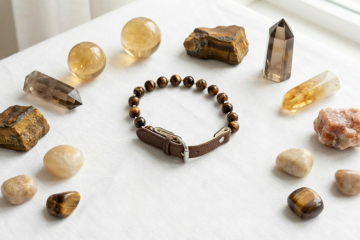











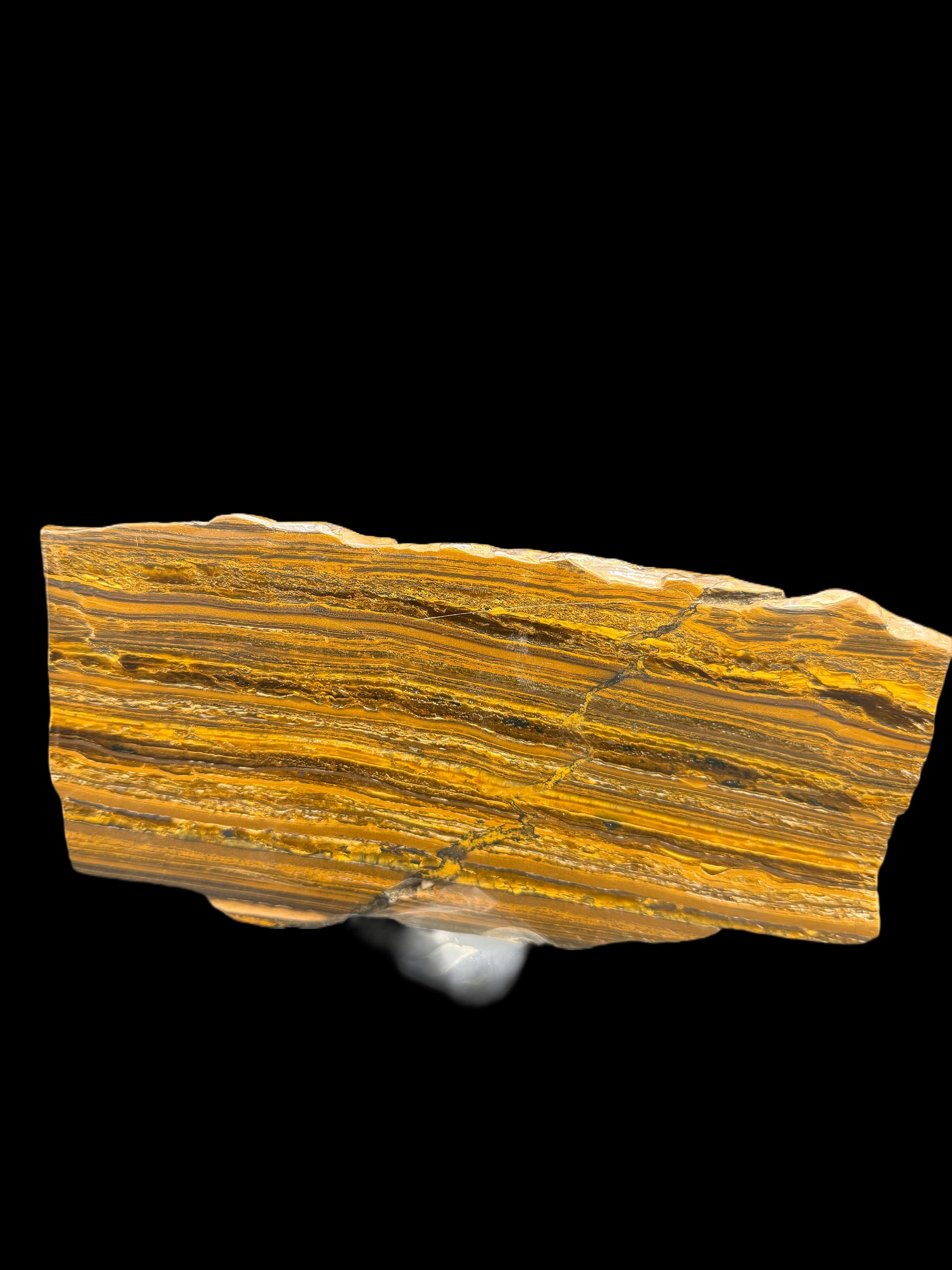
Tiger's Eye – A fascinating gemstone with powerful charisma
In short: Tiger's Eye is a golden-brown quartz whose silky band of light is created by silicified fibers. In lithotherapy, it is traditionally regarded as a stone of inner strength, clarity, and grounding – a cultural attribution from thousands of years of tradition, not a scientifically proven effect. Mineralogically, it is pure silicon dioxide with a Mohs hardness of 6.5 to 7.
| Property | Tiger's Eye |
|---|---|
| Mineral | Quartz, microcrystalline |
| Chemical formula | SiO2 |
| Mohs hardness | 6.5 – 7 |
| Color | golden brown to honey-colored, silky sheen |
| Optical effect | Chatoyance (cat's eye effect) |
| Formation | Silicification of crocidolite fibers – the fiber structure is preserved, the material is replaced by quartz |
| Main deposit | South Africa, Northern Cape Province (Griquatown) |
| Other deposits | Australia (Western Australia), India (Rajasthan), Namibia, Myanmar |
| Related varieties | Hawk's Eye (blue), Bull's Eye (reddish-brown) |
| Traditional attribution | Focus, determination, protection, grounding – traditional attribution without scientific evidence |
| As a water stone | only polished and well cleaned – why, is explained here |
Tiger's Eye – Mineralogical Basics and Powerful Radiance

Tiger's Eye is a golden-brown quartz with a silky sheen, which is created by an optical phenomenon called chatoyance (cat's eye effect). The mineral belongs to the quartzite group and forms when crocidolite fibers (a blue variety of asbestos) are replaced by silicon dioxide – while the parallel fiber structure is preserved at the same time. The result is a stone that glows in the light like a tiger's eye. Tiger's Eye has fascinated people all over the world for thousands of years. At Crystal Paradise, we encounter this fascination in our shop every day.
The Mohs hardness of Tiger's Eye is 6.5 to 7. This makes it suitable for everyday use and ideal for jewelry, decoration, and collector's pieces. Its density is approximately 2.64 to 2.71 g/cm³ – a solid, high-quality stone.
Origin and Occurrence of Tiger's Eye Worldwide
The most significant deposit of Tiger's Eye is located in the Northern Cape Province of South Africa, particularly in the region around Griquatown. The stone has been mined here since the 19th century. South Africa still supplies the majority of the world's production of high-quality Tiger's Eye.
Other notable deposits include:
- Australia – particularly Western Australia, known for deep brown, especially glossy specimens
- India – the state of Rajasthan, often processed into polished spheres
- Namibia and Burma (Myanmar) – smaller deposits with individual color nuances
- USA (Arizona and California) – rarer deposits with local character
Depending on the region of origin, color depth, luster, and fiber structure vary noticeably. At Crystal Paradise, we have paid close attention to careful selection directly at purchase for years – so that only genuine, untreated Tiger's Eye makes it into our range. Anyone who visits our showroom in Feldkirchen near Munich can compare the different quality origins directly side by side.
Tiger's Eye, Hawk's Eye, and Bull's Eye – What's the Difference?
Tiger's Eye has two mineralogical relatives that are often confused with it:
- Hawk's Eye: The blue or blue-gray counterpart. Here, the crocidolite fibers were only partially replaced by quartz. Hawk's Eye appears cooler and more mysterious.
- Bull's Eye: A dark red to brownish-red variety, created by heating or natural oxidation of Tiger's Eye.
- Tiger's Eye itself: The golden-brown standard variety with the characteristic silky sheen.
All three belong to the same mineralogical group, but differ significantly in appearance.
Tiger's Eye in Lithotherapy – Traditional Lore
In lithotherapy, Tiger's Eye is considered a stone of inner strength and clarity. These attributions are based on thousands of years of tradition from various cultures – not on scientific evidence.
According to traditional lore, Tiger's Eye is attributed the following symbolic meaning:
- Focus and determination: Traditionally associated with mental clarity and goal-orientation.
- Protection: In many cultures, Tiger's Eye was regarded as an amulet against negative energies. Roman soldiers are said to have incorporated it into armor about 2000 years ago.
- Grounding: In lithotherapy, it is considered a grounding stone that is said to support inner balance.
- Self-confidence: Traditionally attributed to people facing decisions.
In lithotherapy, Tiger's Eye is assigned to the solar plexus chakra. This energy center symbolically stands for willpower and personal strength. In our Crystal Zodiac zodiac sign gemstone collection, Tiger's Eye is a sought-after companion – especially for the signs Capricorn, Gemini, and Leo.
As a birthstone, Tiger's Eye is also assigned to the month of November in various traditions. Anyone looking for a personal protective stone will make a strong choice with Tiger's Eye.
Tiger's Eye as a Gemstone – A Long History
Tiger's Eye was already valued as a gemstone in antiquity. In ancient Egypt, it symbolized the eyes of the gods. During the Victorian era (from around 1837), it experienced a revival as a stone for men's brooches. Today it is popular in bracelets, pendants, rings, and spheres – both among collectors and lifestyle enthusiasts.
Our crystalpower® bracelets with healing stones are a modern example: natural Tiger's Eye beads as an elegant everyday companion, crafted with genuine craftsmanship.
Caring for and Cleaning Tiger's Eye – Practical Tips

Tiger's Eye is robust – but it too deserves careful care. With a Mohs value of 6.5 to 7, it withstands normal scratches well. Nevertheless, a few important notes apply:
- Cleaning with lukewarm water: Tiger's Eye tolerates gentle washing with clear, lukewarm water (max. 30–35 °C). Never soak in hot water.
- Mild soap allowed: A drop of pH-neutral soap gently removes dirt. Then rinse thoroughly and dry softly.
- No ultrasonic cleaners: The fiber structure of the stone can be permanently damaged by intense vibrations.
- Light bath with care: Prolonged sunlight can slightly fade the color of Tiger's Eye. A brief morning sunbath of 15–20 minutes is considered a symbolic energizing ritual in lithotherapy – but direct continuous exposure should be avoided.
- Separate storage: Tiger's Eye should not be stored openly together with harder stones (e.g., topaz, sapphire) to avoid scratches.
For energetic cleansing – in a spiritual sense – many lithotherapy followers recommend brushing with a soft brush or briefly placing it on an amethyst bed. You can find more on this in our article on Amethyst as a water stone.
Wearing and Displaying Tiger's Eye in Everyday Life
Tiger's Eye unfolds its optical appeal best in direct light. As a sphere on the desk, as a polished tumbler on the windowsill, or as a pendant around the neck – it draws attention. In our showroom in Feldkirchen, we're happy to advise you personally. From our own experience, we know: anyone who once holds Tiger's Eye in their hand is immediately fascinated by its weight and silky sheen.
For couples, Tiger's Eye is also suitable as a shared symbol of mutual protection. You can find more on this in our collection Gemstones for Couples.
Anyone who wants to discover the entire range of our Tiger's Eye products will find them directly in our Tiger's Eye Collection at Crystal Paradise – from raw specimens to polished spheres to jewelry pieces.
Scientific Classification – What Mineralogists Say
From a mineralogical point of view, Tiger's Eye is a pseudomorph mineral. This means: one mineral takes on the outer form of another. In this case, quartz (SiO₂) replaces the blue amphibole mineral crocidolite – but so slowly and precisely that the original fiber alignment is preserved. Mineralogy calls this process silicification.
The result is optically unique: the parallel fibers refract light in such a way that a shimmering line of light is created that moves as the stone is turned. This effect – chatoyance – is also known from other stones such as chrysoberyl cat's eye, but is particularly pronounced and accessible in Tiger's Eye.
For a deeper mineralogical perspective, take a look at the resources of the Mindat.org database on Tiger's Eye or the descriptions in the Mineralienatlas Encyclopedia.
Frequently Asked Questions

How can I recognize genuine Tiger's Eye?
Genuine Tiger's Eye shows a clearly recognizable, moving line of light when turned in the light – the chatoyance. The color is a warm golden brown to honey yellow. The surface feels smooth and silky, and the weight feels heavy for its size. Resin imitations often appear too uniform, too light, and don't show a convincing silky sheen. If in doubt, visit our showroom in Feldkirchen near Munich.
Which zodiac sign is Tiger's Eye associated with?
In lithotherapy, Tiger's Eye is traditionally attributed to the zodiac signs Capricorn, Gemini, and Leo. This association is spiritual in nature and based on traditional correspondences between minerals and astrological energies. Our Crystal Zodiac Collection shows all zodiac sign associations at a glance.
Can Tiger's Eye be cleaned in water?
Yes – briefly this is possible. Tiger's Eye tolerates lukewarm water (max. 30–35 °C) without damage. However, prolonged soaking or hot water should be avoided. For symbolic energetic cleansing, many prefer placing it on crystal clusters or a brief sunbath of up to 20 minutes.
Where is Tiger's Eye mainly mined?
The world's most significant deposit is located in the Northern Cape Province in South Africa. Tiger's Eye has been mined industrially there since the 19th century. Other deposits exist in Australia, India, Namibia, and Burma.
How does Tiger's Eye differ from Hawk's Eye?
Hawk's Eye is blue-gray and forms when crocidolite fibers are only incompletely silicified. Tiger's Eye is golden-brown due to complete silicification with oxidation of the iron compounds. Both varieties show the chatoyance effect

Written by Christian Neumayer

Leave a comment
This site is protected by hCaptcha and the hCaptcha Privacy Policy and Terms of Service apply.