







Labradorescence & Spectrolite: Recognizing Real Labradorite
Understanding the Labradorite Color Play: What's Behind Labradorescence?

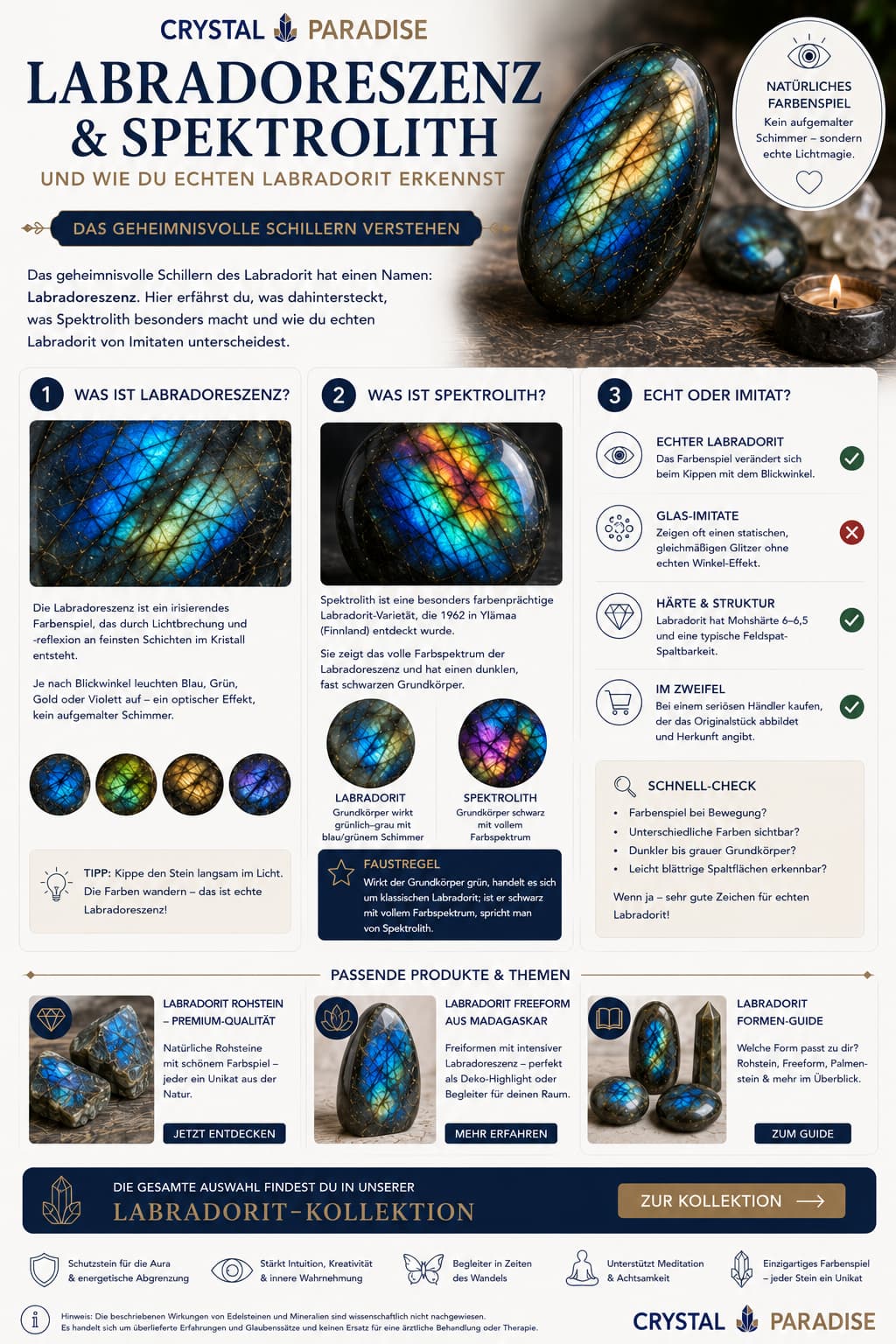
The Labradorite color play – scientifically known as labradorescence – is one of the most impressive optical phenomena in the mineral world. You can recognize genuine labradorite by the way it lights up in blue, green, gold, orange, or violet as it's turned and tilted. This color effect is not caused by pigments, but by the interference of light on microscopically fine layered structures inside the stone. Anyone who wants to know if their stone is genuine needs to understand this physical principle – and know a few simple testing methods.
The Physics Behind the Labradorite Color Play
Labradorite belongs to the feldspar group, more specifically to the plagioclase series. Its chemical composition falls between albite (NaAlSi₃O₈) and anorthite (CaAl₂Si₂O₈). The anorthite content in genuine labradorite typically ranges between 50 and 70 percent.
Labradorescence is caused by optical interference. Inside the stone are extremely thin, parallel-arranged layers of two different feldspar phases. These layers have a thickness of about 100 to 300 nanometers. When light hits these structures, it is reflected and refracted at the layer boundaries. The reflected light waves overlap – some reinforce each other, others cancel out. The result is a glowing, angle-dependent color play.
More on the mineralogical classification and the physical background can be found at the Mindat.org mineral database with its extensive labradorite entry. Further scientific background on the feldspar group is provided by the Mineralienatlas encyclopedia entry on labradorite.
The Mohs hardness of labradorite is 6 to 6.5. This makes it more robust than many softer minerals, though it is still not immune to mechanical impact.
What Colors Does the Labradorite Color Play Show?
The most common color in the labradorite color play is a deep midnight blue. In addition, the following color tones are possible:
- Emerald green and turquoise
- Golden yellow and orange
- Copper red and bronze
- Violet and magenta (rare, especially valuable)
- Silver-white as a base tone without pronounced labradorescence
Depending on the angle of light and viewing angle, the color changes abruptly. This is a key identifying feature of genuine labradorescence. With colored glass or plastic imitations, the color remains constant – no matter how you turn the stone.
Spectrolite: The Labradorite Color Play in Its Purest Form
A special variety of labradorite is spectrolite. This term was coined in the 1940s, when an unusually color-intense labradorite variety was discovered in Ylämaa, Finland. Spectrolite displays the entire spectrum of visible light – hence the name.
The difference from normal labradorite lies mainly in the intensity and completeness of the color spectrum. While many labradorites show only 2 to 3 colors, a genuine spectrolite often presents 5 or more clearly distinguishable color tones in a single stone. High-quality spectrolites from Finland are considered first-class collector's items.
From our own experience, we at Crystal Paradise can say: no two spectrolites are alike. The color intensity varies considerably even within a single region of origin – and that's exactly what makes every stone a true one-of-a-kind piece.
Spectrolite vs. Normal Labradorite: The Differences at a Glance
- Origin: Spectrolite classically from Finland (Ylämaa region); labradorite worldwide, including Canada, Madagascar, Norway, Ukraine
- Color intensity: Spectrolite shows the full spectrum; normal labradorite often only blue-green tones
- Background color: Spectrolite usually dark to black; normal labradorite often gray-beige
- Number of colors: Spectrolite 5 or more tones; normal labradorite often 2 to 3 tones
- Price: High-quality spectrolite significantly more valuable than standard labradorite
Recognizing Genuine Labradorite: 7 Reliable Testing Methods

Unfortunately, the market also offers colored glass imitations, synthetic stones, and cheap replicas. Anyone wanting to buy genuine labradorite should know the following testing methods.
1. The Light Test – The Most Important First Step
Hold the stone under a good light source and slowly tilt it in different directions. Genuine labradorite shows the characteristic color play only from certain angles. It flashes up and disappears again. With glass or plastic, the shimmer appears uniform and remains constantly visible across a wide range of angles.
2. Temperature Test
Genuine labradorite initially feels cool to the touch – similar to other minerals. Glass and plastic take on body temperature within about 30 seconds. A genuine stone stays noticeably cool longer.
3. Hardness Test
A steel knife (hardness approx. 5.5) cannot scratch labradorite – it has a hardness of 6 to 6.5. Glass has a hardness of about 5.5 and can be scratched. Only perform this test on an inconspicuous spot.
4. Density and Weight
The density of labradorite is approximately 2.69 to 2.72 g/cm³. A genuine labradorite feels heavier compared to plastic imitations of the same size.
5. Surface Structure and Cleavage Planes
Genuine labradorite often shows so-called cleavage planes – smooth, glossy fracture edges in two directions. These result from the crystalline structure. In glass, fracture edges are conchoidal and irregular.
6. Natural Inclusions
Natural stones are rarely flawless. Genuine labradorite frequently shows natural inclusions, small cracks, or slight cloudiness. A stone that shimmers too perfectly and evenly should be viewed critically.
7. Buying from a Trustworthy Dealer
The safest way to genuine labradorite is to buy from a specialized dealer with transparent information about origin. We recommend always asking about the location, country of origin, and degree of processing. At Crystal Paradise, this transparency is part of our core promise – years of experience in the mineral trade make the difference.
Discover our hand-selected range: Buy labradorite at Crystal Paradise.
The Labradorite Color Play in Different Stone Forms
The color play comes across differently depending on the processing form. Polished freeforms with flat surfaces are particularly suited to showing the full potential of labradorescence. Spheres offer a 360-degree view of the color play – a new perspective from every angle.
For collectors and enthusiasts, we recommend:
- Labradorite freeforms – ideal for decoration and close observation of the color play
- Labradorite spheres – even shimmer from all directions
- Labradorite jewelry – wear the color play on your body at all times
Spiritual Meaning and Traditions
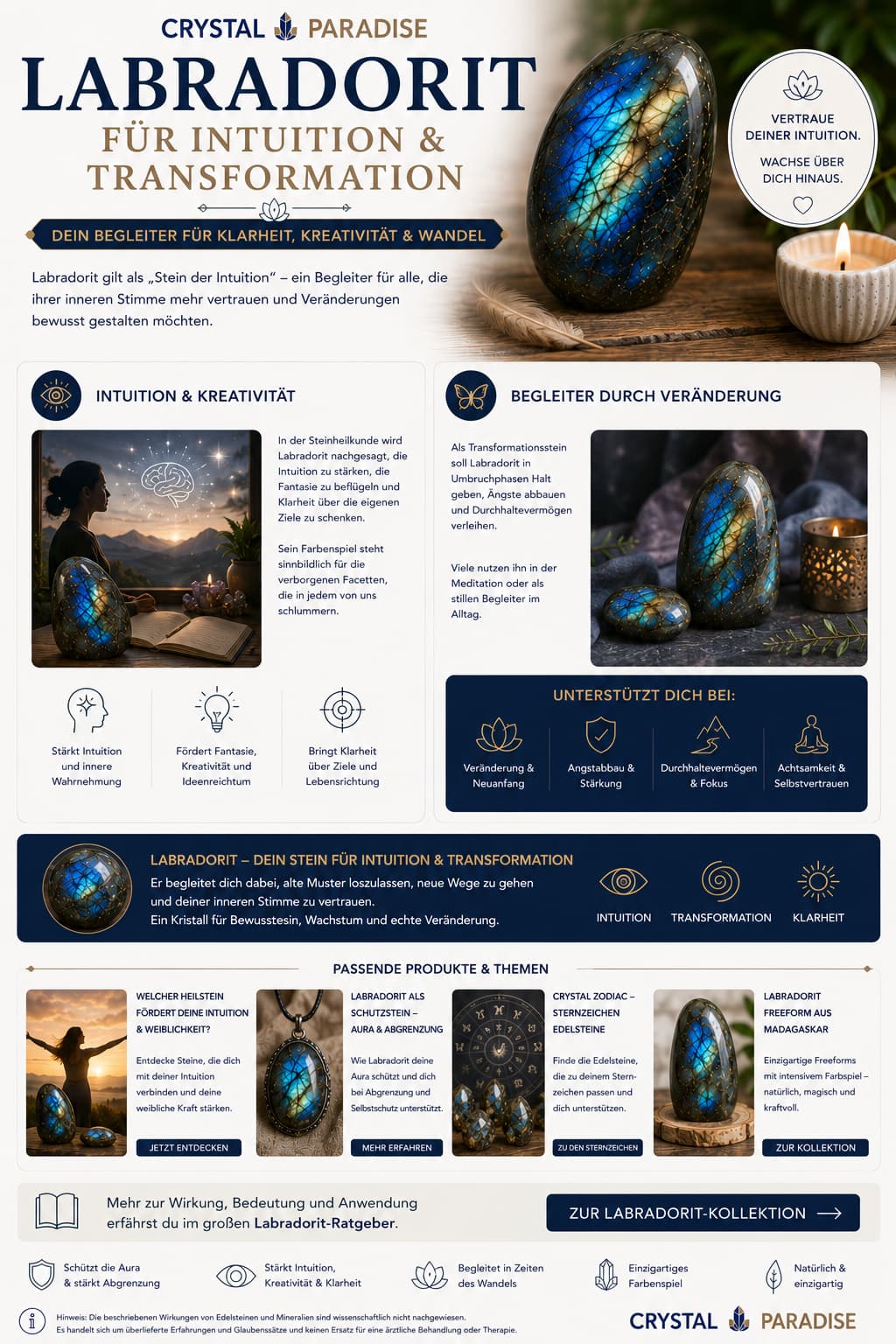
Beyond mineralogy, labradorite carries deep symbolic meaning in many cultures. In stone healing traditions, it is said to promote inner strength and clarity. According to tradition, it is regarded as a stone of transformation and protection.
Legend has it that the indigenous peoples of the Labrador Peninsula believed the northern lights were trapped inside these stones. This poetic idea fits perfectly with the color play that appears when observing a genuine labradorite.
In stone healing traditions, labradorite is said to strengthen intuition and support inner processes of change. You can find out more in our article Labradorite for Intuition & Transformation.
You can find information on properly caring for your stone in our article Cleaning, Charging & Caring for Labradorite.
Frequently Asked Questions

Why Doesn't My Labradorite Shimmer?
Not every surface of a labradorite shows the color play. Labradorescence is tied to specific layer planes inside the stone. Slowly turn the stone in all directions under a bright light source. Often an angle change of just 10 to 20 degrees is enough to reveal the color play. Some stones only have small zones with pronounced labradorescence – this is completely normal for genuine natural stones.
What Is the Difference Between Labradorite and Moonstone?
Both belong to the feldspar group and show an optical shimmer. Moonstone (adularia), however, shows a whitish-bluish shimmer known as adularescence. In moonstone, the interference colors arise from different layer structures and appear softer and more diffuse. Labradorite, on the other hand, shows the characteristic, intense color play in bold color tones. Both stones have a Mohs hardness of around 6 to 6.5 and are mineralogically related, but clearly distinguishable visually.
Can Labradorite Be Dyed or Treated?
Yes, there are stones on the market that have been artificially made to shimmer more through coating or treatment. In coated stones, the shimmer is uniform and looks like an applied film. Genuine labradorite shows the color play from within – it appears deep, three-dimensional, and changes with the viewing angle. Genuine labradorescence is never evenly distributed across the entire surface.
How Do I Recognize Spectrolite Compared to Normal Labradorite?
Genuine spectrolite from Finland shows a particularly dark base rock and a broad color spectrum with at least 4 to 5 different color tones – often including red, orange, and violet. The price for qual

Written by Christian Neumayer


Leave a comment
This site is protected by hCaptcha and the hCaptcha Privacy Policy and Terms of Service apply.