







Labradorite for Intuition & Transformation
Labradorite as the Healing Stone for Intuition: The Stone of Hidden Lights

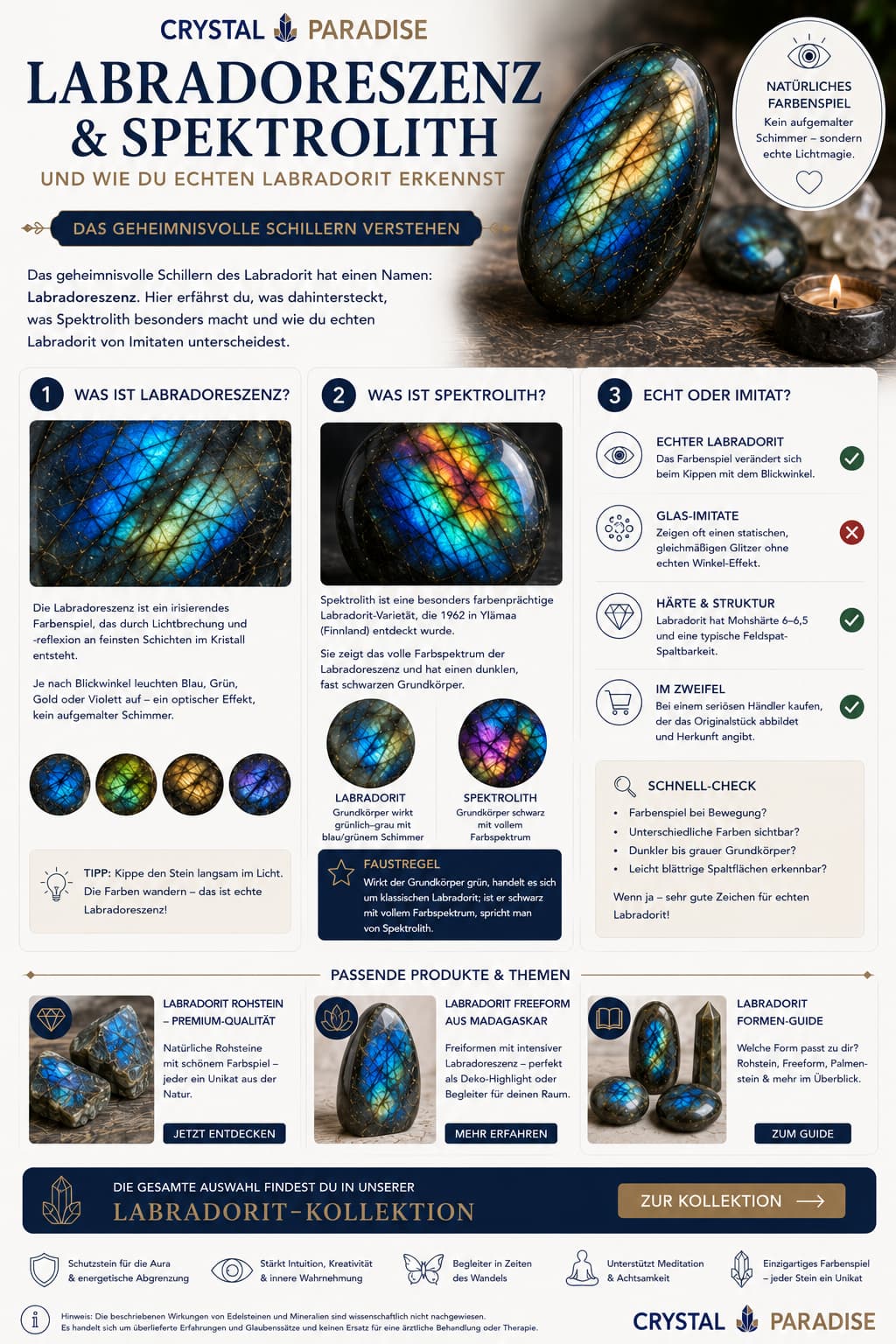
Labradorite is regarded in stone healing lore as the healing stone for intuition par excellence. It is a feldspar mineral with a Mohs hardness of 6 to 6.5 and belongs to the plagioclase group. Its best-known feature is the so-called labradorescence – a fascinating play of colors in blue, green, gold, and violet, created by light refraction in thin layer structures. Anyone holding this stone for the first time immediately understands why it has been regarded as a mystical companion for centuries. At Crystal Paradise, we select labradorites with particularly vivid labradorescence – hand-picked and curated directly for our customers.
Mineralogical Basics: What Labradorite Really Is
Labradorite is a calcium-sodium feldspar with the chemical composition (Ca,Na)(Al,Si)₄O₈. It crystallizes in the triclinic system and forms tabular to platy crystals. The stone was first discovered in 1770 on the Labrador Peninsula in Canada – hence its name.
Important mineralogical facts at a glance:
- Mohs hardness: 6 to 6.5
- Crystal system: Triclinic
- Deposits: Canada, Madagascar, Finland, Russia, Ukraine
- Melting point: approx. 1,550 °C
- First description: 1770, Labrador Peninsula, Canada
- Specific gravity: 2.69 to 2.72 g/cm³
The special optical appearance arises from thin-film interference at lamellar intergrowths of two feldspar phases. This effect makes every labradorite a unique work of natural art. Particularly high-quality specimens from Madagascar show an exceptionally wide color spectrum – from deep ocean blue to bright golden yellow.
Labradorite as the Healing Stone for Intuition: Traditional Meanings and Spiritual Heritage
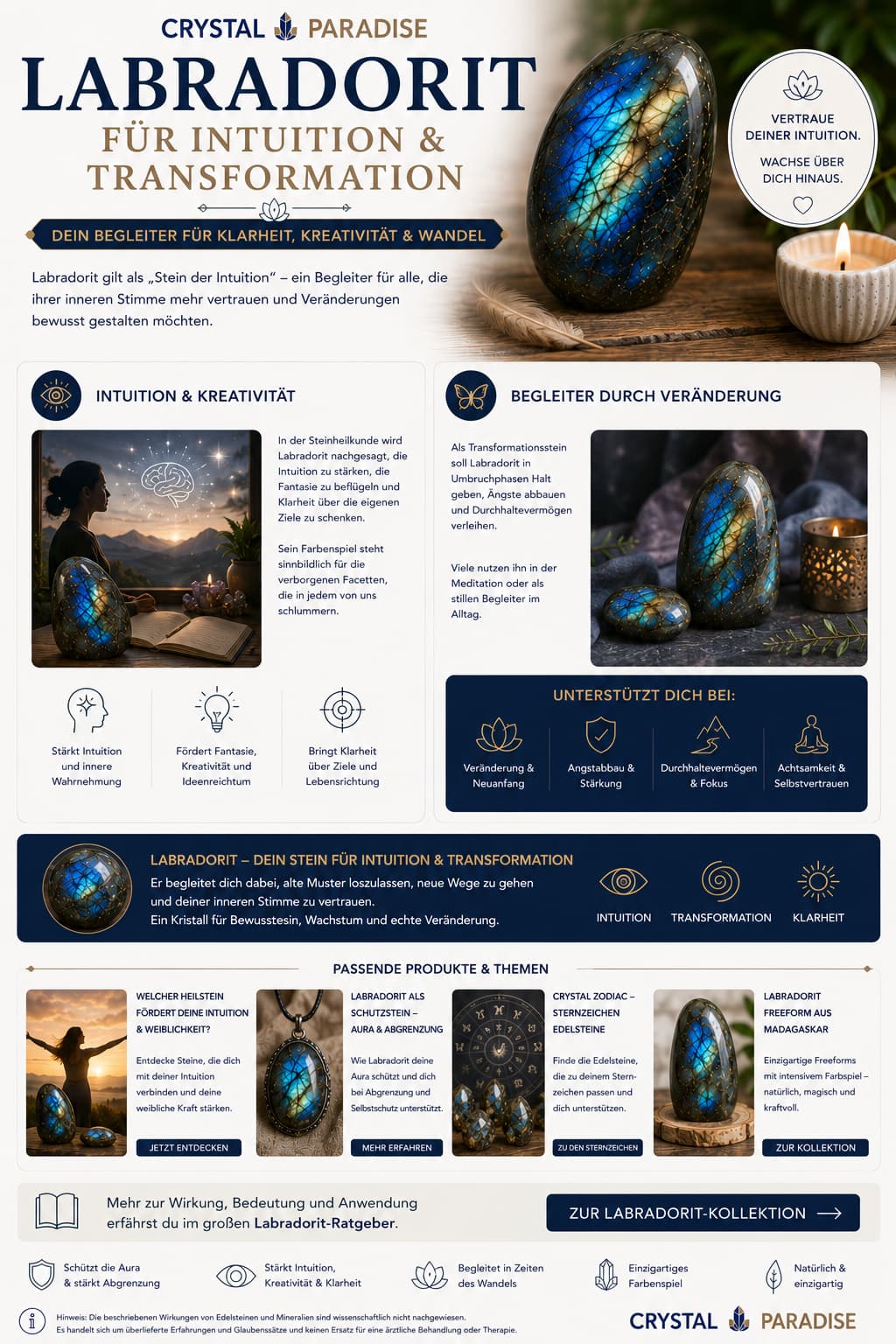
In stone healing lore, labradorite has been associated with intuition, inner knowledge, and personal transformation for generations. It is traditionally described as a stone believed to help sharpen one's own inner compass. It is clear that these properties stem from spiritual tradition – not scientific research.
What labradorite is attributed with in holistic practice:
- Strengthening intuition: According to traditional lore, it is said to make it easier to access one's own gut feeling.
- Accompanying transformation: In stone healing lore, it is regarded as a companion during phases of change and new beginnings.
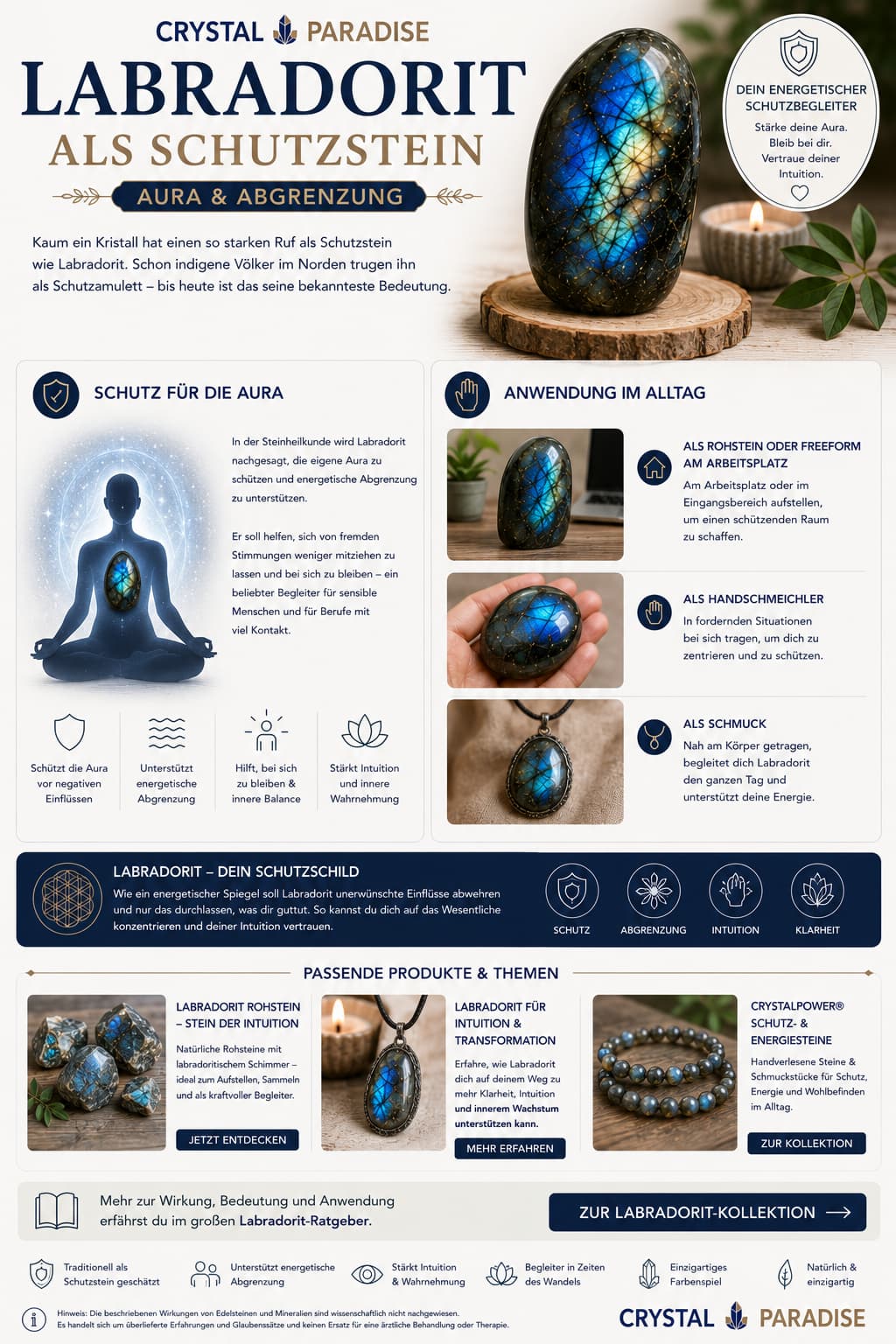
- Protection from the outside: In many traditions, it is regarded as a companion believed to help shield one's own energy from outside influences.
- Stimulating creativity: It is said to foster creative processes and open up new perspectives.
- Deepening self-reflection: In meditative contexts, it is traditionally used to promote inner clarity.
Even the Inuit peoples of Canada told of the dancing northern lights said to be captured within labradorite. This legend still accompanies the stone today. Anyone wanting to learn more about healing stones for the inner journey can find further inspiring insights in our article Which Healing Stone Is Associated with Intuition and Femininity?
Labradorite and Transformation: A Stone for Turning Points
Hardly any other healing stone is so clearly associated with the theme of change as labradorite. In stone healing lore, it is regarded as a companion during life transitions – whether a job change, a new relationship, or an inner developmental process. We especially recommend it during phases when you're seeking orientation and wish to trust your inner self.
From our years of experience working with healing stones, we know that people in transformation phases often reach for labradorite intuitively. Its shimmering depths of color symbolize the hidden that still wants to become visible. In our showroom in Feldkirchen near Munich, visitors experience this effect firsthand – when light brings a labradorite in their hands to life, it often creates genuine wonder.
Labradorite in Meditation
In meditative practice, labradorite is traditionally used to calm the mind and open inner space. It is recommended to hold the stone in the non-dominant hand or place it on the forehead (third eye). A quiet environment and 10 to 20 minutes of silent focus are considered a good starting point. Anyone wishing to dive deeper into this topic can find practical tips and further recommendations in our article Choosing the Right Healing Stones for Meditation.
Labradorite as Everyday Jewelry
Labradorite is also very popular as a gemstone for jewelry. Its hardness of 6 to 6.5 makes it sturdy enough for necklaces, pendants, and rings – provided it is not subjected to excessive mechanical stress. Worn on the body as a talisman, it is said, according to traditional lore, to continuously accompany its wearer with its transformative energy.
Caring for and Charging Labradorite: Practical Tips

To keep your labradorite beautiful and energetically fresh in the long run, a few care tips are important:
- Cleaning: Labradorite can be gently rinsed under lukewarm water. Avoid aggressive cleaning agents.
- Energetic charging: It regenerates well in moonlight – especially during the full moon. Over 24 hours on the windowsill is already enough.
- Storage: Store separately from other stones, as it can be scratched by harder minerals.
- Avoid heat: No direct sunlight for extended periods – heat can affect the color layers over the long term.
- Smudging: It is traditionally also energetically cleansed with sage or Palo Santo.
For more on charging and caring for healing stones, see our overview: Charging & Cleansing Healing Stones – Guide.
Buying Labradorite: What to Look For
Not every labradorite shows pronounced labradorescence. High-quality pieces are distinguished by a vivid, multicolored shimmer that becomes visible when the stone is turned at different angles. When buying, pay attention to the following points:
- Intensity and breadth of the color spectrum (blue, green, gold, violet)
- Origin information (Madagascar, Finland, and Canada are considered high-quality deposits)
- Transparency regarding treatment – untreated natural pieces are preferred
- Certificate of authenticity or a trustworthy dealer
In our shop you'll find hand-picked labradorites in various forms: as raw natural pieces, polished freeforms, spheres, and pendants. Also browse our Bestseller Healing Stones – there you'll find our customers' most popular pieces.
For those still at the beginning of their journey of discovery, we recommend our collection Discover the Fascinating World of Minerals for Beginners – ideal for getting to know different types of stones and their traditional meanings.
Labradorite and Science: What Research Says
Mineralogically, labradorite is well researched. Labradorescence has been scientifically explained through interference optics – thin-film phases at the nanometer scale create the play of color. The mineralogical database Mindat.org documents detailed locality data, composition analyses, and crystallographic data. The Mineralienatlas database also lists over 300 known deposits worldwide. Spiritual or healing effects are neither proven nor investigated by mineral science – they stem exclusively from cultural and spiritual traditions.
Frequently Asked Questions

What makes labradorite the healing stone for intuition?
In stone healing lore, labradorite is traditionally associated with intuition, inner knowledge, and access to hidden abilities. These attributions are based on spiritual tradition, not scientific findings. Its fascinating play of color is symbolically regarded as a mirror of the hidden inner world.
Which zodiac signs are especially compatible with labradorite?
In traditional stone healing lore, labradorite is often associated with the zodiac signs Scorpio, Aquarius, and Sagittarius. This association is part of spiritual tradition and has no scientific basis. Ultimately, anyone, regardless of zodiac sign, can develop a personal connection to a stone.
How can I recognize a genuine labradorite?
A genuine labradorite shows a characteristic shimmer when turned under light – the so-called labradorescence. The colors change depending on the viewing angle. Quality features include intensity, color variety, and evenness of the shimmer. Fake stones or lower-quality pieces often show only a dull, one-sided shimmer or are treated with coatings. It is best to buy from a dealer who communicates origin and authenticity transparently.
How do I best charge labradorite?
Labradorite regenerates well energetically in moonlight – ideally during the full moon for at least 6 to 12 hours. Alternatively, smudging methods with Palo Santo or sage are considered common practice in spiritual work. Direct sunlight for more than 2 to 3 hours should be avoided.
Can I use labradorite together with other healing stones?
Yes, labradorite can be well combined with other stones in holistic practice. It is traditionally often used together with moonstone, amethyst, or obsidian. The combination depends on personal intention and what feels right.
Note: The effects mentioned are spiritual traditions without scientific evidence. Labradorite and other healing stones do not replace medical or therapeutic treatment.

Written by Christian Neumayer

Leave a comment
This site is protected by hCaptcha and the hCaptcha Privacy Policy and Terms of Service apply.