









Fossils: A Window to Earth's History
Fossils: What they are and why they fascinate

Buying fossils means holding a piece of genuine Earth history in your own hands. A fossil is a petrified remnant of a living organism that lived at least 10,000 years ago. Bones, shells, imprints, or teeth are transformed into rock through geological processes. This process is called fossilization and takes thousands to millions of years. The result is a unique natural testimony – unrepeatable, authentic, and of timeless beauty. At Crystal Paradise, you'll find hand-picked fossils from all over the world: for collectors, nature lovers, and anyone who wants to feel history.
Discover our selection now in the collection Fascinating Fossils to Buy – Earth History to Touch and be inspired by the diversity.
How Fossils are Formed: The Science Behind It
The formation of a fossil is a rare event. Only a small fraction of all organisms that ever lived become fossils. This requires the right conditions.
The Process of Fossilization
After an organism dies, its body must be quickly covered by sediment. Water, sand, or mud protect it from complete decomposition. Over thousands of years, the sediment solidifies into rock. Minerals penetrate the organic structures. They gradually replace the original material. The result is a stony image of the original.
There are different types of fossilization:
- Permineralization: Minerals fill the cavities in the tissue. This process creates particularly detailed fossils.
- Replacement: The original material is completely replaced by minerals. Often observed in petrified wood.
- Impression fossils: The organism only leaves its imprint in the rock. No original substance remains.
- Inclusions in amber: Insects or plant parts are enclosed in tree resin. The resin petrifies over millions of years.
- Mummification: In ice or very dry environments, organic material is preserved. Well-known examples include woolly mammoths from Siberia.
What minerals are contained in fossils?
Depending on the rock environment, different minerals can drive fossilization. Calcite, pyrite, silicates, or phosphates are frequently present. Ammonites often show shimmering iridescent surfaces of aragonite. Petrified wood often consists of quartz. This mineralogical diversity also makes fossils interesting for mineral collectors.
The most popular fossil types – and where they come from
The world of fossils is enormously diverse. Here are some of the most sought-after types, which are also wonderfully suited for a private collection or as decoration.
Ammonites
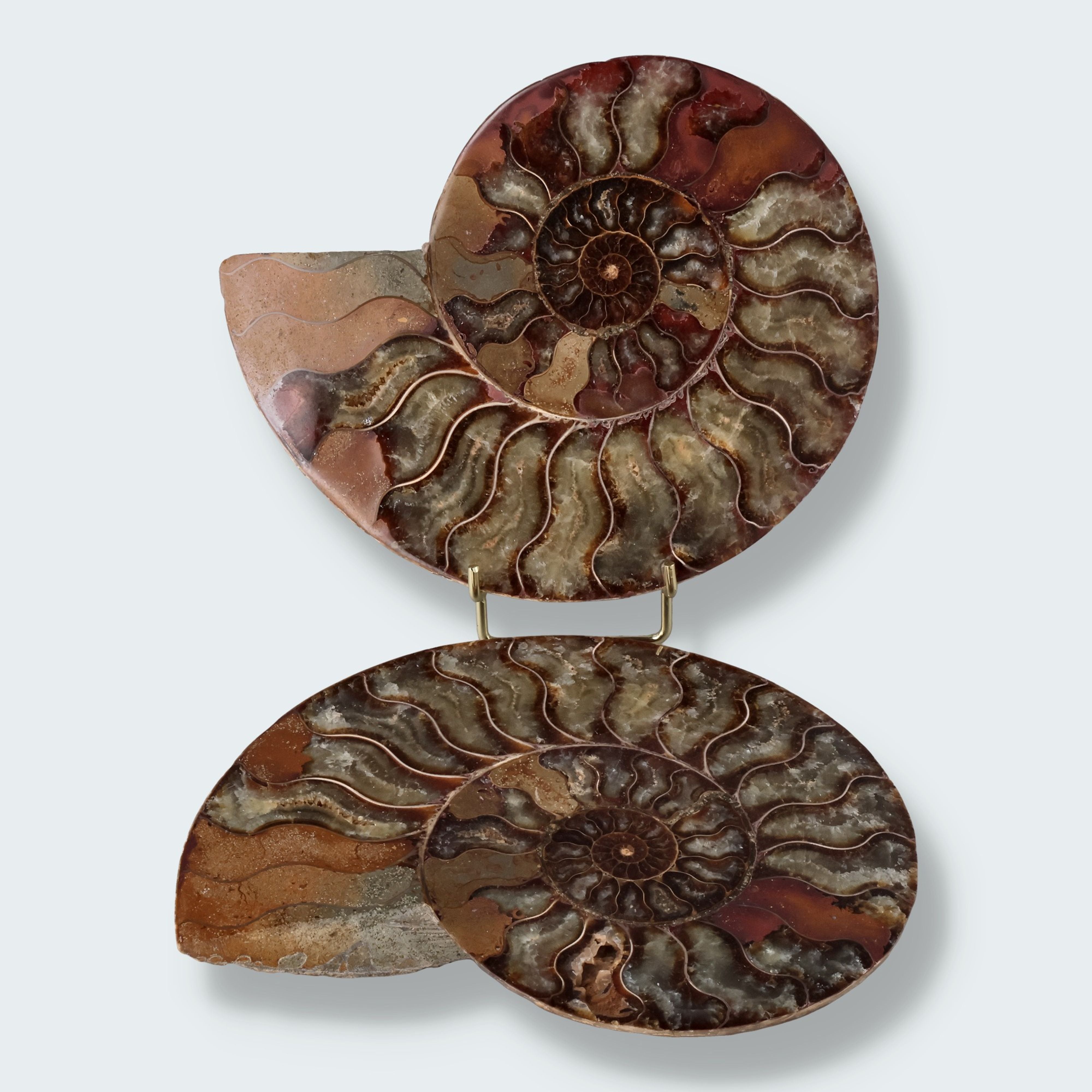
Ammonites are extinct cephalopods. They lived approximately 240 to 66 million years ago. Their spiral shells are known worldwide. Particularly beautiful specimens come from Morocco, Madagascar, and Germany. Moroccan ammonites from the Atlas Mountains are polished and show intricate chamber structures. Madagascan ammonites can reach diameters of over 30 centimeters.
Trilobites
Trilobites are marine creatures from the Paleozoic Era. They lived around 520 million years ago and became extinct about 252 million years ago. Their three-lobed body structure is characteristic. Finds are located in Morocco, Russia, and the USA. Trilobites are considered classic collector's fossils – precise, detailed, and of high aesthetic value.
Shark teeth
Fossil shark teeth are widespread worldwide. The Megalodon, an extinct giant shark, is particularly well-known. Its teeth can be over 15 centimeters long. Find locations are in North Africa, the USA, and Europe. Such teeth are not only fascinating but also affordably priced.
Petrified Wood
Petrified wood forms when trees are permeated by mineral-rich water. Silicon dioxide replaces the wood tissue cell by cell. The result is a stony image with preserved wood structure. Famous find sites are in Arizona (USA), Egypt, and the Czech Republic. Petrified wood has a Mohs hardness of 6.5 to 7 – making it similar in hardness to quartz.
Mosasaur and Dinosaur Bones
For true enthusiasts, there are fossilized bones of large reptiles. These often come from Morocco, the USA, or Mongolia. They are rarer and often accordingly high-priced. In our showroom in Feldkirchen near Munich, we have experienced firsthand how much these extraordinary pieces thrill visitors – they are the absolute eye-catchers of any collection.
Buying fossils: What to look for when choosing

When buying fossils, there are a few important points to consider. Not every offer on the market delivers what it promises.
Authenticity and Origin
Always look for clear origin information. Reputable dealers will state the discovery site, geological formation, and age. Some fossils are supplemented or repaired. This is not inherently negative, but should be transparently disclosed. At Crystal Paradise, we place the highest value on transparency. Every fossil in our assortment is carefully inspected and provided with correct information.
Quality and Condition
The state of preservation is crucial for the value. Pay attention to the following points:
- Completeness: Is the fossil complete or only fragmentary?
- Surface detail: Are fine structures such as sutures or texture visible?
- Matrix: Is the fossil still embedded in the original rock? This increases scientific value.
- Repairs: Have fractures been glued or supplemented? Transparent information is mandatory here.
- Size and presentation: Is the piece suitable for the intended use – display case, shelf, or decoration?
Legal Aspects of Buying Fossils
In Germany, trading in fossils is generally permitted. However, there are exceptions. Fossils from certain countries are subject to export restrictions. Dinosaur bones from Mongolia, for example, may not be legally exported. Therefore, only buy from reputable dealers with clear proof of origin. Further information on legal regulations can be found at the Federal Agency for Nature Conservation.
Fossils as Decoration and Spiritual Companion
Fossils are long more than just collector's items. They have found their place in modern home aesthetics. Ammonites on the coffee table, petrified wood as bookends, shark teeth in the display case – fossils bring depth and character to any room. They are also unique as gifts: they combine beauty, history, and personal meaning.
In lithotherapy, fossils are traditionally attributed a connecting property. It is said that, according to traditional beliefs, they are meant to provide stability and establish a connection to the roots of life. In spiritual circles, ammonites are said to symbolize perfection and the eternal cycle. These beliefs are spiritual in nature and have no scientific basis.
If you are also interested in other extraordinary natural stones for decoration, you will find many inspirations in our article Buying Crystal Decor: Elegance for Your Home with Crystals, Figures & Natural Art.
Care and Storage of Your Fossils
Fossils are robust – but not indestructible. With proper care, they will remain in excellent condition for decades.
Cleaning
Dry fossils can be dusted with a soft brush. For stubborn dirt, light moist cleaning with a soft cloth is suitable. Avoid aggressive cleaning agents. Fossils with pyrite content are particularly sensitive: pyrite can chemically decompose when exposed to moisture and oxygen – a phenomenon known as "pyrite disease." Therefore, store such fossils in a dry and light-protected place.
Storage
Fossils prefer cool, dry, and dust-free conditions. A glass display case is ideal. Direct sunlight can fade some minerals. Heavy pieces should be placed securely on a non-slip surface. For transport, cushioning material that protects the fossil on all sides is recommended.
Additional Reading Material
Would you like to learn more about raw natural stones? Then we recommend our article Buying Raw Healing Stones – What Matters. There you will find valuable tips on quality assessment and choosing genuine natural products.
For scientifically sound information on paleontology and fossil studies, we also recommend the resources of the State Museum of Natural History Stuttgart – one of Europe's most important collections.
Frequently Asked Questions

What does "buying fossils" mean – and what should I look out for as a beginner?
Buying fossils means acquiring genuine petrified remains or imprints of organisms that lived at least 10,000 years ago. As a beginner, you should look for clear origin information, transparent quality descriptions, and reputable dealers. It's best to start with robust, well-preserved classics like ammonites or shark teeth – they are affordable, easy to care for, and aesthetically appealing.
Is it legal to buy and own fossils in Germany?
Yes, buying and owning fossils is generally legal in Germany. However, there are restrictions on fossils from certain exporting countries. Therefore, always buy from dealers who can provide proof of origin and acquisition documentation. Crystal Paradise works exclusively with reliable suppliers who comply with all legal requirements.
How do I recognize a real fossil?
Real fossils have a characteristic weight and density that you immediately feel when you touch them. Their surface shows natural irregularities, textures, and occasionally matrix remnants. Synthetic copies made of resin or plaster are often too smooth, too light, and too perfect. When in doubt, compare it with known reference pieces or consult an expert. In our showroom in Feldkirchen near Munich, we will advise you personally and show you the difference directly on the object.
What is the age of the oldest fossils?
The oldest known fossils are microscopic traces of bacteria from the Pilbara Craton in Western Australia. They are approximately 3.5 billion years old.

Written by Christian Neumayer


Leave a comment
This site is protected by hCaptcha and the hCaptcha Privacy Policy and Terms of Service apply.