








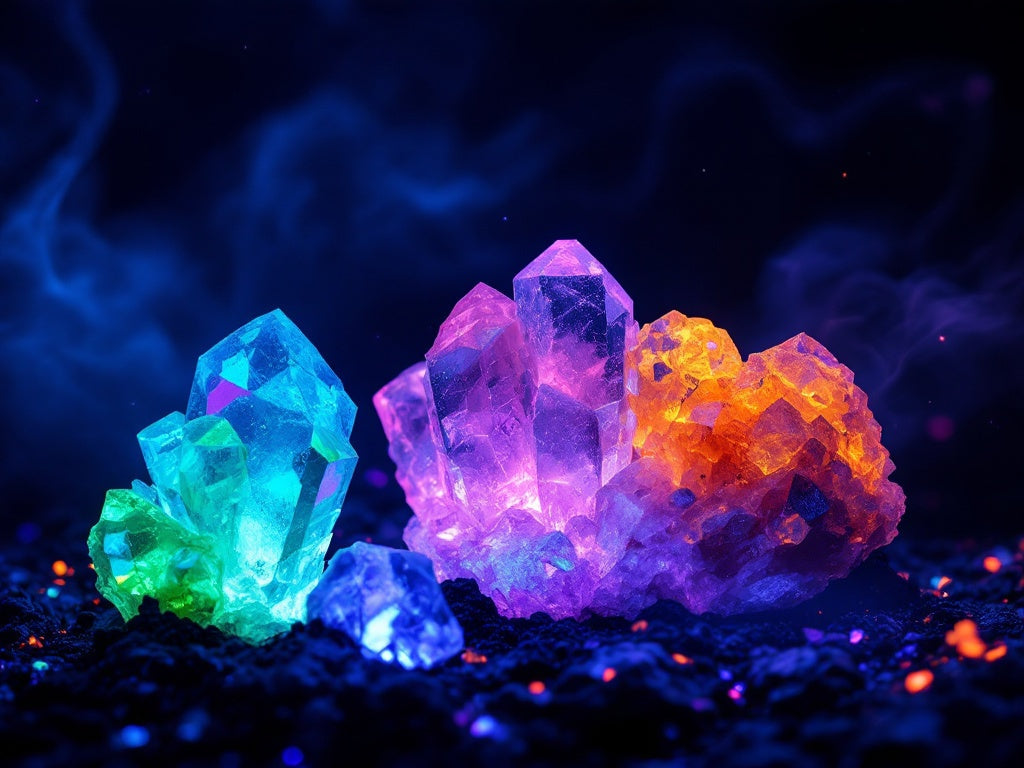
The magic of UV minerals: Glowing treasures of nature
In short: Some minerals glow under UV light because trace elements in the crystal lattice – so-called activators – absorb UV radiation and re-emit it as visible light. The effect is called fluorescence, named after fluorite. Whether a piece glows depends not only on the mineral type, but also on the locality.
| Mineral | Glow Color Under UV | Wavelength | Known Locality |
|---|---|---|---|
| Fluorite | blue to purple, often very intense | LW | Coahuila, Mexico |
| Calcite | orange to red, sometimes banded | SW | Chihuahua, Mexico |
| Hyalite Opal | green ("uranium glow") | LW | – |
| Scheelite | blue-white to golden yellow | SW | – |
| Hackmanite | photochromic – changes color after exposure to light | LW/SW | – |
| Willemite | green | SW | – |
The two wavelengths differ significantly. Long-wave UV (LW, around 365 nanometers) is safer to handle and recommended for beginners. Short-wave UV (SW, around 254 nanometers) often shows more intense reactions – especially in calcite and scheelite. Test each mineral separately under both lamps: the results often differ.
UV Fluorescent Minerals: What's Behind the Glow?

UV fluorescent minerals – this term describes minerals that glow in luminous colors under ultraviolet light. The phenomenon occurs when certain trace elements in the crystal lattice absorb short-wave UV light and re-emit it as visible light. Scientifically, this is called photoluminescence. In normal daylight, these stones often appear unremarkable – under a UV lamp, they transform into glowing natural wonders. This article explains the physics behind it, presents the most beautiful fluorescent minerals, and offers practical tips for collectors.
The Physics of Fluorescence: Why Minerals Glow
The word fluorescence comes directly from the mineral fluorite. The Scottish physicist George Gabriel Stokes first described the phenomenon scientifically in 1852. He observed that fluorite glowed brightly under UV light – ever since, the effect has carried its name.
So-called activators are responsible for the glow. These are trace elements or structural defects in the crystal lattice. Manganese, europium, dysprosium, or uranyl ions are among the most common natural activators. Not every specimen of a mineral type necessarily fluoresces. Even two fluorites from the same locality can differ greatly.
You can find more about the science of mineralogy and luminescence at the Mineralogical Glossary at Mindat.org, one of the world's largest mineral databases.
Short-Wave vs. Long-Wave UV
Two UV wavelengths are especially relevant for collectors:
- Short-wave UV (SW-UV): approx. 254 nanometers – often shows more intense reactions, especially in calcite and scheelite.
- Long-wave UV (LW-UV): approx. 365 nanometers – safer to handle, more commonly recommended for beginners.
Some minerals react to only one of the two wavelengths. Others glow under both – but in different colors. This is what makes experimenting so exciting.
The Most Beautiful UV Fluorescent Minerals at a Glance
In our showroom in Feldkirchen near Munich, we regularly display UV pieces under black light. The visitors' enthusiasm is palpable every time. From our own experience, we know: once you've seen a gray stone suddenly glow neon red, you're captivated forever.
Fluorite – the Classic Glower
Fluorite (calcium fluoride, CaF₂) gave fluorescence its name. Well-known localities are found in Mexico, China, and England (Derbyshire). Its Mohs hardness is 4. Under SW-UV, fluorites often glow in vivid blue or violet. Some specimens even show phosphorescence – they continue to glow briefly after the UV light is switched off.
Calcite – the Surprise Artist
Calcite is the second most common mineral in the Earth's crust after quartz. Under UV, it can glow orange, red, blue, or pink – depending on the trace element. Calcites from Mexico and the USA are especially impressive. Calcite has a Mohs hardness of only 3 and should therefore be stored carefully.
Hyalite Opal – the Uranium Glow
Hyalite is a colorless to glass-clear opal variety. It often contains small amounts of uranium, which produce an intense neon green under LW-UV. Localities are found in Mexico (Zacatecas) and Saxony (Germany). The uranium content is so low that hyalite opals are safe for normal handling – however, they should not be held in the hand for extended periods.
Scheelite – Rare Golden Glow
Scheelite (calcium tungstate) glows under SW-UV in a striking blue-white to cream tone. It is a tungsten ore and comes from China, Portugal, and Austria, among other places. Scheelite is especially sought after by collectors because beautiful fluorescent specimens are rare.
Hackmanite – the Photochromic Mineral
Hackmanite is a rare variety of sodalite. It shows not only fluorescence but also tenebrescence: it changes color from white to pink or violet under UV light and returns to its original color in the dark. Localities are found in Afghanistan, Canada, and Greenland.
Willemite – the Zinc Ore Glower
Willemite from Franklin, New Jersey (USA) is considered one of the most famous UV minerals worldwide. This zinc silicate glows in intense bright green under SW-UV. The Franklin deposit was already being mined in the 19th century and provided the textbook example for UV fluorescence par excellence.
Collecting UV Fluorescent Minerals: Tips for Beginners and Advanced Collectors
Anyone wanting to start collecting should keep the following points in mind:
- Start with a good UV lamp: A combined LW/SW UV lamp with at least 6 watts is recommended. Affordable models start at around 30 euros.
- Buy from trustworthy dealers: Genuine fluorescent minerals need no artificial treatment. Look for information on locality and mineral type.
- Compare different wavelengths: Test each mineral separately under LW and SW UV – the results can differ significantly.
- Document your collection: Note the mineral type, locality, reaction under LW-UV and SW-UV, and the intensity of the glow.
- Visit mineral shows: There you can find UV minerals in person and test them directly under the lamp.
Crystal Paradise regularly attends mineral shows. Learn more in our report: Crystal Paradise at the 25th Rosenheim Mineral and Fossil Show 2026.
Origin and Mineralogical Classification of Selected UV Minerals

A mineral's region of origin strongly influences its fluorescence behavior. Here is an overview of the most important deposits:
- Fluorite from Mexico (Coahuila): Mostly blue to purple fluorescence, often very high intensity.
- Calcite from Mexico (Chihuahua): Orange to red under SW-UV, sometimes with striking banding.
- Hyalite opal from Zacatecas: Neon green under LW-UV, one of the most intensely glowing opals worldwide.
- Scheelite from Portugal (Panasqueira): Blue-white under SW-UV, often combined with quartz.
- Willemite from Franklin, New Jersey: Bright green under SW-UV, accompanied by red calcite and black franklinite.
Anyone wanting to deepen their knowledge of minerals in general can find a specially curated beginner collection with handpicked minerals from around the world at Crystal Paradise.
The Smithsonian Institution in Washington also maintains an extensive digital collection on fluorescent minerals: Geology Collections of the National Museum of Natural History.
Care and Storage of UV Minerals
UV-active minerals are often delicate. These care tips will help preserve your pieces long-term:
- Fluorite (hardness 4): Do not store with quartz or metal objects. Best kept in individual boxes with a foam lining.
- Calcite (hardness 3): Very soft and sensitive to acid. Never clean with acidic cleaning agents. Remove dust only with a soft brush.
- Hyalite opal: Opals can develop cracks if they dry out excessively. Do not expose to direct sunlight for extended periods.
- Scheelite: Stable, but has good cleavage. Avoid impacts at all costs.
- UV lamps: SW-UV lamps emit hazardous radiation. Never look directly into the light. Always wear protective goggles.
In general: prolonged direct sunlight can cause some minerals to fade. Store your UV pieces in a cool, dry place away from light.
Spiritual Traditions Surrounding Fluorescent Minerals
In crystal healing lore, fluorescent minerals are attributed a special symbolic power. For thousands of years, light has been a symbol of knowledge, protection, and transformation. The fact that a stone glows in hidden places touches on this imagery in an immediate way.
Fluorite is traditionally referred to as the "stone of order." According to tradition, it is said to have a clarifying effect on the mind. Calcite is regarded in spiritual circles as a stone of cleansing and new beginnings. Opal – and thus also hyalite – has been associated with creativity and intuition since antiquity.
These traditions are part of a long cultural history of engaging with minerals. They make stones more than mere collector's items – they become personal companions with their own character.
If you'd like to learn more about the spiritual dimension of crystals, we recommend our article: Crystals in the Sauna: Which Stones Are Traditionally Chosen for Sauna Rituals?.
Anyone interested in minerals from special regions of origin can also find unique minerals from the DR Congo at Crystal Paradise – including pieces with remarkable optical properties time and again.
Frequently Asked Questions

Why don't all minerals of a certain type glow under UV light?
Fluorescence depends on trace elements and structural defects in the crystal lattice. Even within a single mineral type such as fluorite or calcite, the concentration of activators varies greatly depending on locality and formation conditions. A fluorite from Mexico may glow intensely, while a chemically similar specimen from China barely reacts.
Is UV light dangerous for minerals or for me?
UV light does not permanently damage most minerals. Exception: some colored or treated stones can fade under intense UV exposure. For people: short-wave UV (254 nm) is dangerous to eyes and skin. Always wear protective goggles and never look directly into the lamp. Long-wave UV (365 nm) is significantly safer, but caution is still advised.
Are UV fluorescent minerals more expensive than regular pieces?
Not automatically. Calcite and fluorite are affordable even in fluorescent specimens. Rarer UV minerals such as hackmanite, scheelite, or special Franklin willemite specimens can command significantly higher

Written by Christian Neumayer

Leave a comment
This site is protected by hCaptcha and the hCaptcha Privacy Policy and Terms of Service apply.