










Recognizing Genuine Celestite & Avoiding Mix-ups
Recognizing Genuine Celestine: How to Tell the Original from a Fake

Celestine is one of the most beautiful minerals there is. Its delicate sky blue fascinates collectors and crystal enthusiasts alike. But this very popularity also attracts counterfeiters. Dyed stones or mislabeled minerals keep turning up. If you want to recognize genuine celestine, you need the right knowledge. This guide shows you step by step what to look for.
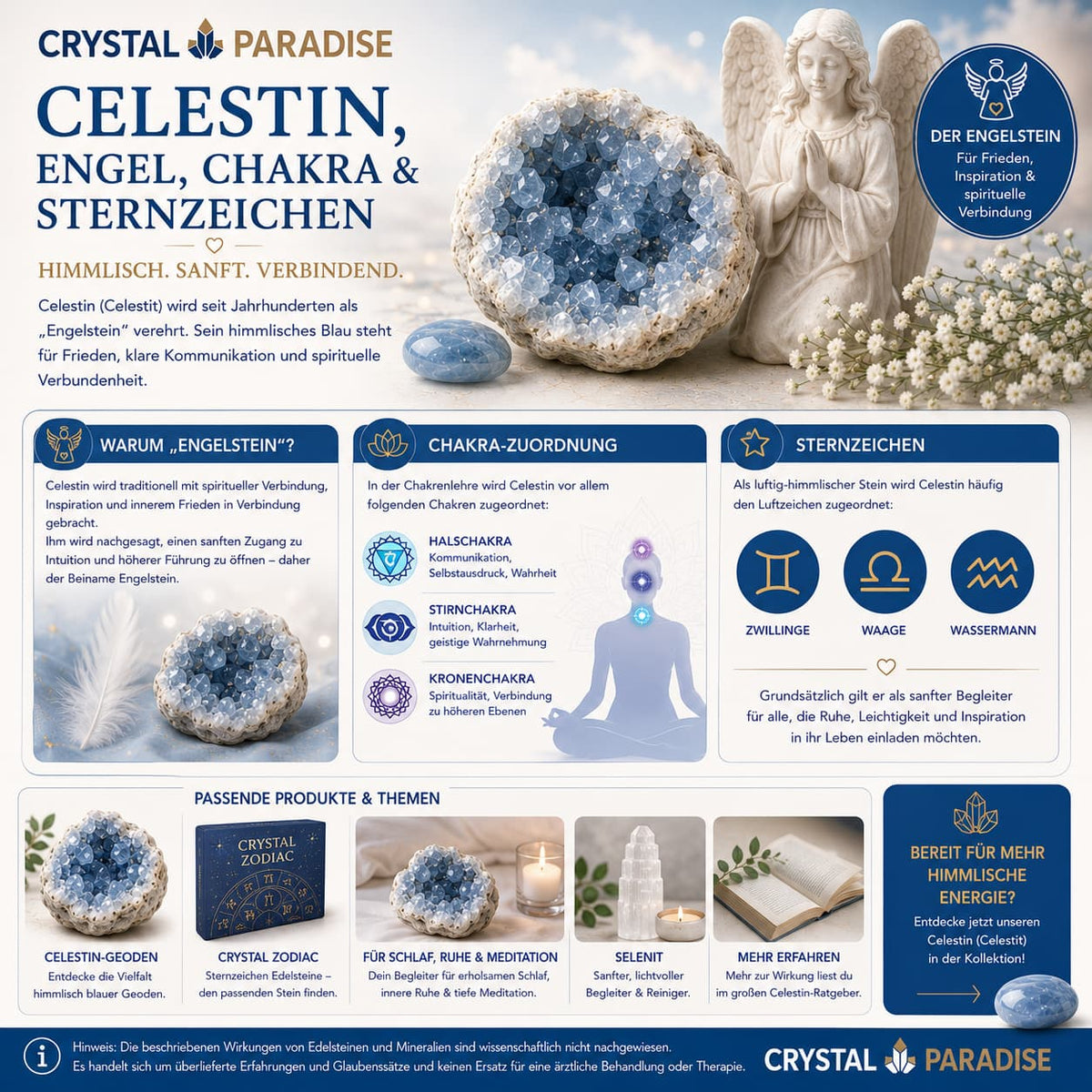
Celestine, Celestite, Coelestine – what's the difference?
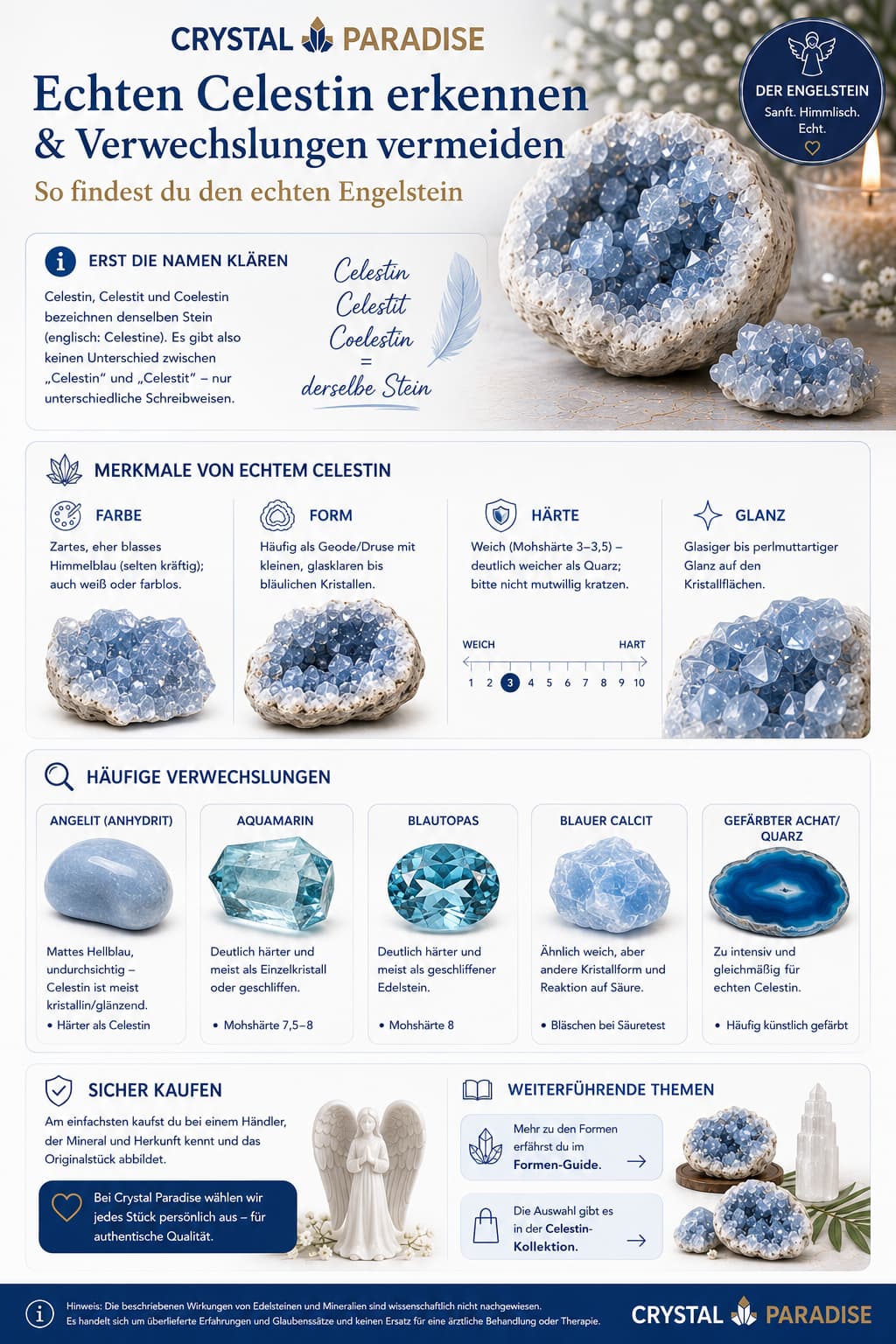
First, let's clear up the confusion around the names. The terms Celestine, Celestite, and Coelestine all refer to the same mineral. There are no mineralogical differences between these designations. They are simply different spellings and regional variants of the same term.
The mineral belongs to the sulfate mineral class. It is a strontium sulfate with the chemical formula SrSO₄. Important deposits are located in Madagascar, the United States, Mexico, Austria, and Poland. Madagascan celestine geodes are considered particularly sought-after worldwide.
The most important characteristics of genuine celestine
Recognizing genuine celestine works most reliably when you evaluate several properties together. No single characteristic is sufficient on its own. The following overview shows the characteristic properties:
Color
Genuine celestine shows a delicate, pale sky blue. The color appears almost soft and watery. Strong, saturated blue tones are atypical. Many genuine pieces are even almost colorless or whitish. Uniformly intense bright blue is an initial warning sign.
Crystal shape and surface
Celestine typically occurs as a geode or druse. The crystals are tabular to prismatic. Their surfaces show a glassy to pearly luster. This luster is characteristic and difficult to imitate. Processed or polished pieces such as celestine eggs or celestine hearts retain this typical shimmer.
Mohs hardness
Celestine is a comparatively soft mineral. Its Mohs hardness is only 3 to 3.5. By comparison: quartz has a hardness of 7. This means celestine can be scratched with a copper coin test. Please use this test responsibly, however. Never scratch a decorative collector's piece wantonly.
Transparency
Genuine celestine crystals are often transparent to translucent. Light refracts within the crystal faces. This effect gives the stone its typically luminous, ethereal appearance. Fully opaque specimens in intense blue should be examined more closely.
Common mix-ups and how to recognize them
Several minerals resemble celestine in appearance. However, the differences are quite recognizable with a bit of practice. Here are the most common mix-ups at a glance:
- Angelite (Anhydrite): Angelite has a matte, waxy light blue. It is opaque and shows no glassy luster. Celestine appears more crystalline and lively. Both minerals are similarly soft, but visually clearly distinguishable.
- Aquamarine: Aquamarine has a significantly higher hardness (7.5–8). It usually occurs as a single crystal. Its color is more intense and clearer. Aquamarines from Pakistan, for example, show typical hexagonal crystal shapes that celestine does not exhibit.
- Blue topaz: Topaz is significantly harder with a Mohs hardness of 8. It is also heavier than celestine. Polished blue topaz shines differently and feels colder.
- Blue calcite: Calcite is similarly soft as celestine. However, it reacts to hydrochloric acid by foaming. Calcite also shows different cleavage planes and a duller surface.
- Dyed agate or quartz slices: These are sometimes offered as celestine. However, their color is unnaturally uniform and often far too intense. Genuine celestine never shows this artificial blue.
- Labradorite: Labradorite shows the typical labradorescence effect with shimmers of green, blue, and gold. This effect is completely absent in celestine.
Recognizing dyed celestine pieces

It's not just mislabeled stones that are a problem. Sometimes genuine celestine pieces are dyed afterward. In doing so, the color is intensified through chemical treatment. Here's how to recognize dyed specimens:
- Check the color: Is the blue unusually strong and uniform? Genuine celestine is pale and shows color variations within the crystal.
- Observe the surface: With dyed pieces, color often accumulates in cracks and crevices. The pattern looks unnatural.
- Test with a damp surface: Carefully wipe the piece with a damp white cloth. Genuine mineral color does not come off. Artificial dye can leave traces.
- Request proof of origin: Reputable dealers state the deposit location and can provide information about treatment.
Buying safely: What to look for in a dealer
The safest way to buy genuine celestine is to purchase from a trustworthy mineral dealer. Pay attention to the following points:
- The dealer shows an individual photo of each piece. You see exactly what you're buying.
- The country of origin and deposit are stated.
- Information about treatment (dyed, heated, untreated) is communicated transparently.
- Return and exchange options are clearly regulated.
- The dealer answers questions about the merchandise competently and personally.
At Crystal Paradise, we personally select every celestine. Our celestine geodes come predominantly from Madagascar and are offered with origin information. Our celestine specimens are also hand-selected and checked for authenticity.
Want to learn more about the spiritual properties and meaning of celestine? Our blog article Celestine: Effects, Meaning & Uses gives you a comprehensive overview.
Recognizing genuine celestine in direct comparison
A direct comparison is the best learning tool. If you have the opportunity to place various blue stones side by side, the differences become immediately apparent. Celestine appears more lively and crystalline next to angelite. Next to aquamarine, it appears softer and gentler in color tone. This comparison is the easiest way to develop a feel for the mineral.
If you'd also like to reliably recognize other minerals, take a look at our other identification guides: Recognizing genuine amethyst or Recognizing genuine healing stones – here's how.
Care and handling of genuine celestine
Genuine celestine is delicate. Its low hardness makes it prone to scratches. It also reacts sensitively to water and moisture. Therefore, store celestine in a dry place and separately from harder minerals. Direct sunlight can bleach the color. With proper care, your celestine will retain its luster permanently.
You can find everything about proper care in our article Cleaning, charging & properly caring for celestine.
Note: The described energetic properties of gemstones and minerals are not scientifically proven. They are traditional experiences and beliefs. They do not replace medical treatment or therapy.
Frequently Asked Questions

How do I recognize genuine celestine by its color?
Genuine celestine shows a delicate, pale sky blue. The color is never uniformly intense or bright. It appears almost watery and soft. Many pieces are even almost white or colorless. A strong, uniform blue suggests dyeing or a different stone.
What is the difference between celestine and angelite?
Celestine is crystalline and shows a glassy luster. Angelite, on the other hand, is opaque and has a matte, waxy surface. Celestine frequently occurs as a geode or druse. Angelite is compact and opaque. Both stones are similarly soft, but visually well distinguishable.
Can celestine be dyed?
Yes, that happens. Dyed celestine pieces have an unnaturally strong and uniform color. Often the color accumulates in cracks and crevices. A damp cloth can provide clues: genuine mineral color leaves no traces. It's best to buy from a dealer who offers transparency about treatment and origin.
Why is celestine so soft, and what should I watch out for?
Celestine has a Mohs hardness of only 3 to 3.5. This makes it prone to scratches. Store it separately from harder minerals such as quartz or amethyst. Celestine should also not be permanently exposed to water. Direct sunlight can cause the color to fade over the long term.
Where can I safely buy genuine celestine?
The safest way to buy is from a dealer who offers individual photos, origin information, and transparent product details. Crystal Paradise photographs every stone and states the deposit location. You can find the entire selection of hand-selected pieces in our Celestine Collection.

Leave a comment
This site is protected by hCaptcha and the hCaptcha Privacy Policy and Terms of Service apply.