










Cleaning, Charging & Proper Care of Celestite
Cleaning Celestite – How to Properly Care for Your Sky Stone

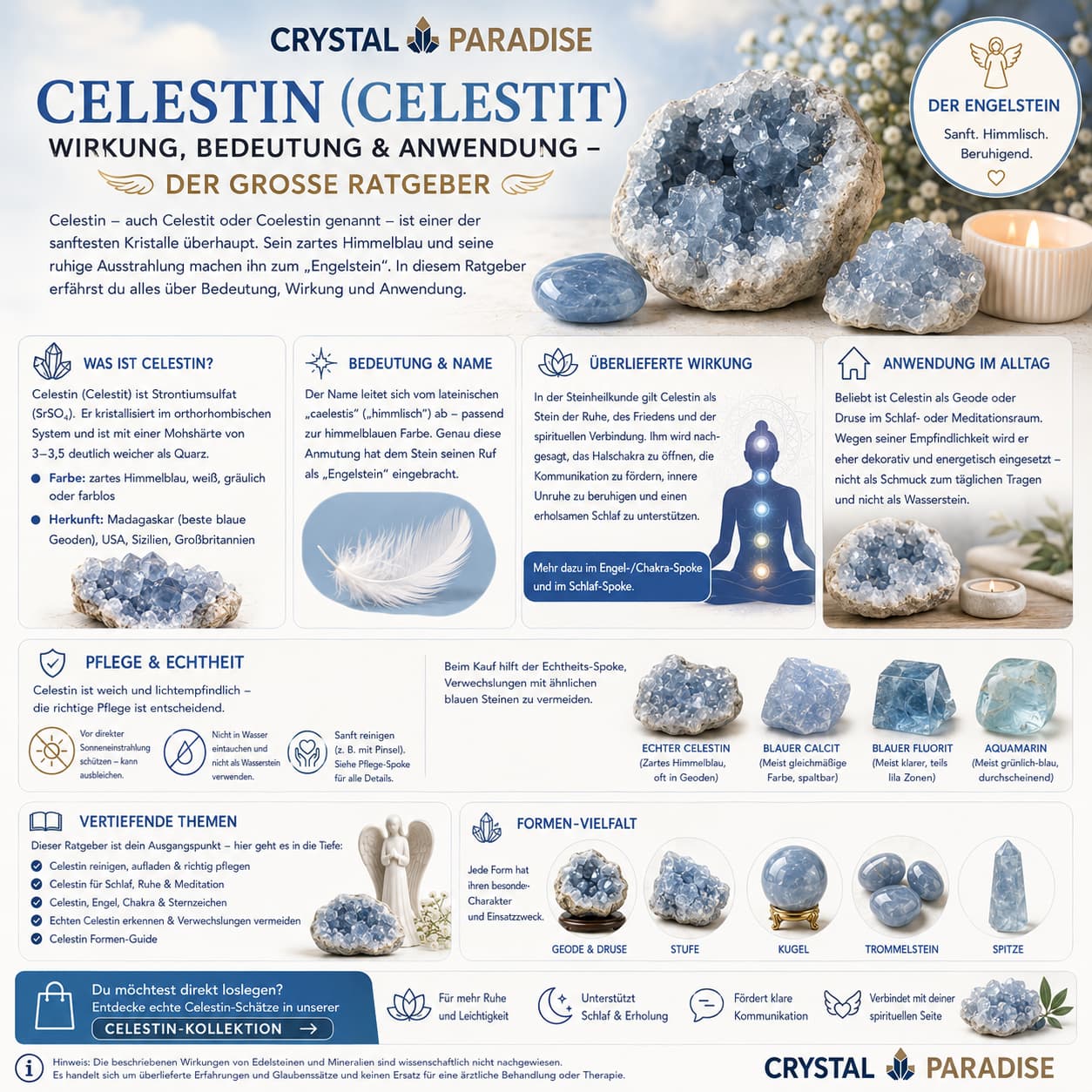
Cleaning celestite isn't witchcraft – but it does require a bit of finesse. This delicate sky stone is one of the most sensitive minerals of all. If you care for it incorrectly, you risk scratches, breaks, or faded colors. In this guide, you'll learn everything you need to know. You'll learn how to safely clean, properly discharge, and gently charge celestite – without damaging it.
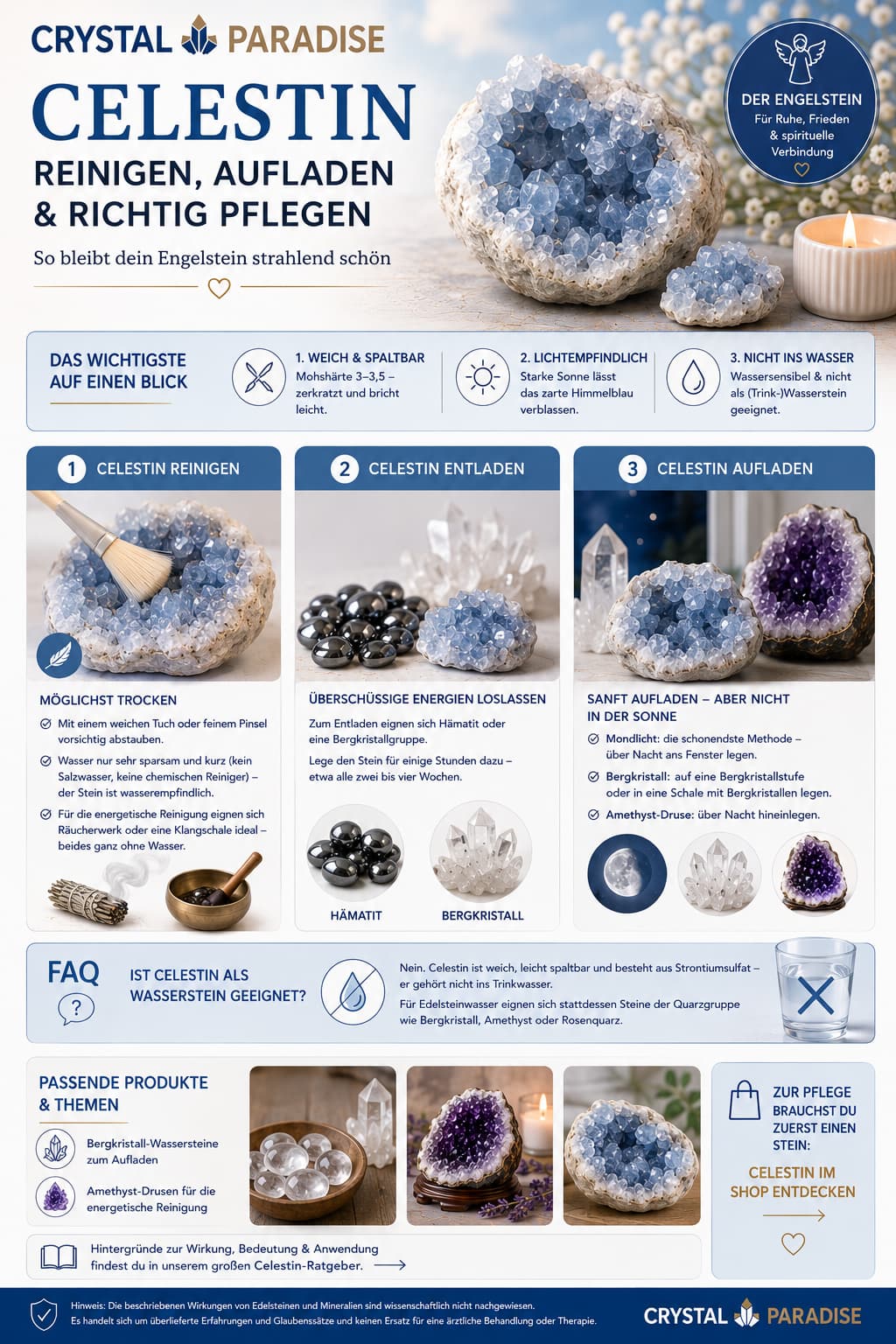
Celestite (also called celestine) impresses with its unique sky-blue color. In crystal healing lore, it is traditionally said to have a calming effect. But its beauty is fragile. Three properties make it especially demanding to care for: it is soft, light-sensitive, and water-sensitive. Once you understand this, you can enjoy its full splendor for decades.
Celestite and Its Special Characteristics – What You Need to Know
Before you begin caring for it, you should understand the stone. Chemically, celestite is strontium sulfate. It crystallizes in orthorhombic forms and has a Mohs hardness of only 3 to 3.5. For comparison: a fingernail has a hardness of about 2.5. Celestite is barely harder.
This means it scratches very easily. It is also easily cleaved and breaks quickly under pressure. Strong light causes the typical blue color to fade. Water can attack the surface. You should always keep these three points in mind:
- Soft and cleavable: Mohs hardness 3–3.5, keep hard objects away
- Light-sensitive: UV radiation and direct sunlight cause the blue color to fade
- Water-sensitive: No drinking water, no saltwater, no gemstone water applications
If you want to learn more about the meaning and properties, you'll find detailed background information in our comprehensive Celestite guide on properties, meaning, and use.
Cleaning Celestite – The Best Methods at a Glance
When cleaning celestite, one clear principle applies: as little water as possible. Dry cleaning is always the first choice. It protects the stone and preserves its surface.
Dry Cleaning – The Gentlest Method
Take a soft, lint-free cloth. Gently wipe the stone down. Be careful not to apply pressure. For hard-to-reach spots, a fine brush with soft bristles works well. A paintbrush or a makeup brush works well. This removes dust from cavities and between crystals – without leaving scratches.
Cleaning with Water – Only in Emergencies
Sometimes dry dusting isn't enough. In that case, you can use water carefully. Follow these rules:
- Only dampen briefly and very sparingly
- No saltwater – salt attacks the surface
- No chemical cleaners or soap
- Dry the stone immediately afterward with a soft cloth
- Do not soak or leave in water for extended periods
Keep in mind: celestite is fundamentally unsuitable as a water stone. It does not belong in drinking water. More on this in the FAQ section below.
Energetic Cleaning with Incense or a Singing Bowl
Energetic cleaning doesn't require water. Incense is an elegant alternative. White sage, palo santo, or frankincense work particularly well. Pass the celestite through the smoke three times. Set a clear intention while doing so. A singing bowl is also ideal. The sound is said to dissolve energetic residue and realign the stone.
For a comprehensive overview of all cleaning methods for healing stones, we recommend our article Cleaning Healing Stones – How to Do It Right.
Discharging Celestite – How to Free It from Old Energy

Stones absorb energies from their environment. This is especially true for celestite, which is said to have a high sensitivity. Regular discharging helps release stored vibrations and keep the stone fresh.
The recommended frequency: every two to four weeks. Or whenever you feel the stone could use a cleansing.
Discharging with Hematite
Hematite is considered a powerful discharger. Place the celestite next to a hematite for a few hours. The hematite is said to absorb and neutralize excess energy. This method is simple and effective.
Discharging on a Clear Quartz Cluster
A clear quartz cluster or group is a classic tool. Place the celestite on it. Let it sit for a few hours or overnight. Clear quartz is said to have a cleansing and clarifying effect. Our article Why You Should Properly Discharge Your Clear Quartz Healing Stone explains more about this method.
Charging Celestite – Gently and Effectively
After cleaning and discharging, charging is the final step. Celestite is sensitive to incorrect charging methods. Sunlight is off-limits. There are several gentle alternatives instead.
Moonlight – The Gentlest Method
Moonlight is the gentlest way to charge celestite. Place the stone on a windowsill overnight. The soft moonlight is said to gently activate the stone. The full moon is considered especially powerful. But regular moonlight is also effective, according to many crystal enthusiasts. This method is ideal for celestite – no risk from UV radiation, no water.
Clear Quartz – Energy Through Synergy
Place the celestite on a clear quartz cluster or in a bowl of clear quartz crystals. In crystal healing lore, clear quartz is traditionally considered a stone said to amplify the effects of other stones. Let the stone sit there for a few hours. This method also works during the day and regardless of weather or season.
Amethyst Geode – Gentle Activation
An amethyst geode is also an excellent choice. Place the celestite inside it overnight. Amethyst energy is said to have a harmonizing and invigorating effect. Our article Cleaning and Charging Amethyst explains how to properly care for your amethyst as well.
What to Avoid When Charging
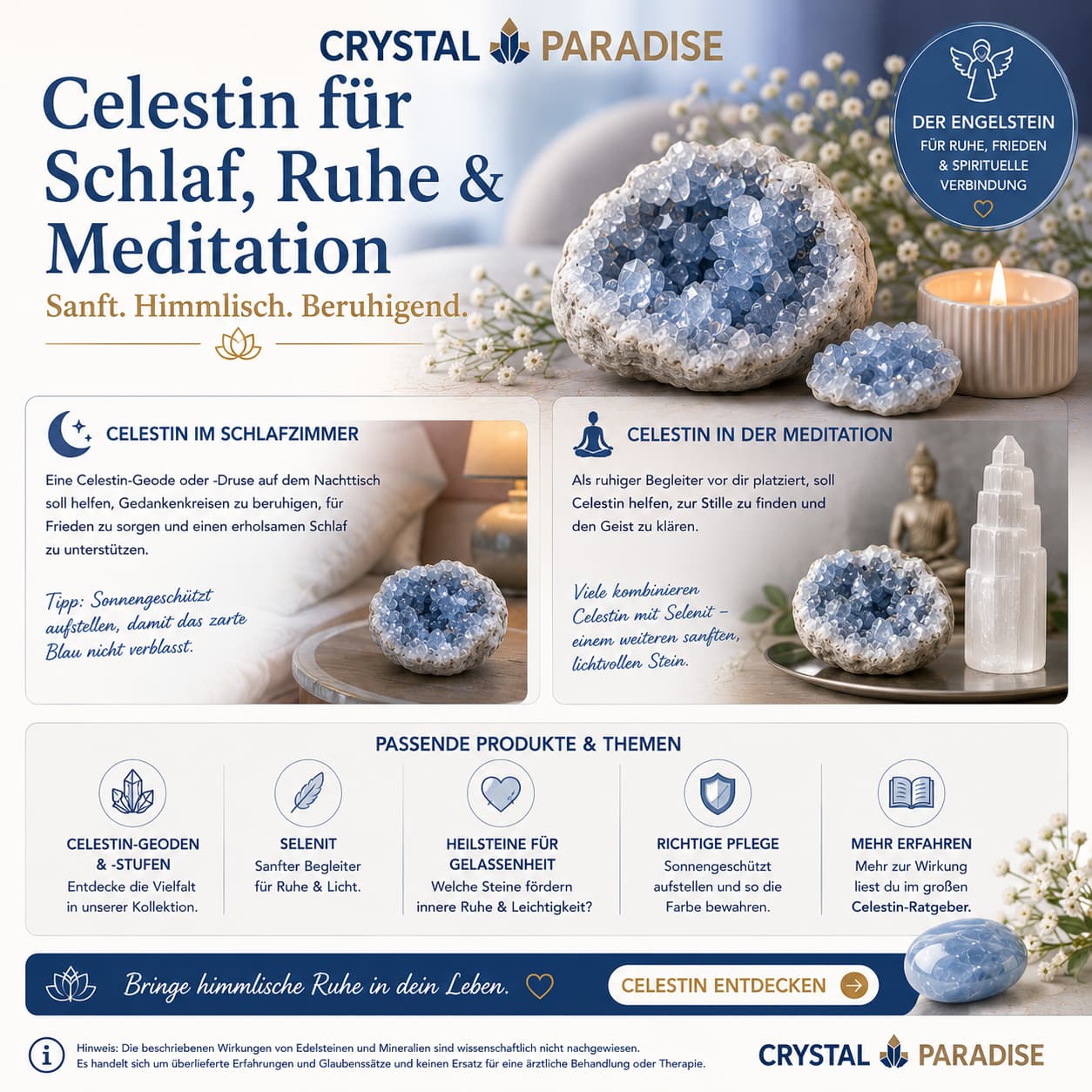
Direct sunlight is dangerous for celestite. UV radiation breaks down the color pigments. The delicate blue fades irreversibly. For permanent display as well, the rule applies: choose a sun-protected spot. A shelf away from the window or a display case protects the stone long-term.
Storing and Caring for Celestite – Practical Everyday Tips
Proper storage is just as important as cleaning. These tips will help you protect your celestite long-term:
- Store separately: Don't store it together with harder stones – they leave scratches
- Soft lining material: Place the stone on velvet or a soft cloth
- No direct sunlight: Always place it in a shaded, UV-protected spot
- Keep it dry: No humid environments, no contact with water for extended periods
- Be careful during transport: Wrap it in cotton wool or soft paper
Celestite comes in many beautiful forms. As a celestite specimen, it shows off its natural crystal structure particularly impressively. As a celestite geode, it looks almost like a window into another world.
Frequently Asked Questions

Can I clean celestite with water?
Briefly and sparingly – yes. Prolonged soaking or saltwater – no. Celestite is water-sensitive. The surface can dissolve slightly or become dull from water. Dry cleaning with a soft cloth or brush is always the better choice. Energetically, you can clean it without any issue using incense or a singing bowl – no water needed at all.
Is celestite suitable as a water stone for gemstone water?
No. Celestite is made of strontium sulfate and is not suitable as a water stone. It does not belong in drinking water. For gemstone water, stones from the quartz group are suitable instead: clear quartz, amethyst, or rose quartz. These are hard, water-resistant, and have long been known as water stones. Our guides on Cleaning and Charging Clear Quartz and Cleaning and Charging Rose Quartz provide further guidance.
How often should I clean and charge celestite?
There's no exact rule. As a general guideline: discharge and charge every two to four weeks. If you use or wear the stone daily, you should clean it more often. Trust your intuition as well. If the stone feels dull or heavy, it's time for cleaning and charging.
Does celestite really fade in sunlight?
Yes. This is one of the most important characteristics of celestite. UV radiation attacks the color pigments. The typical sky-blue color can fade permanently. This process is not reversible. Always keep your celestite away from direct sunlight – both while charging and during permanent display.
Which charging method is best suited for celestite?
Moonlight is the recommended method. It is gentle, does not damage the color, and is said to harmoniously activate the stone. Alternatively, a clear quartz cluster or an amethyst geode works excellently. Important: never place it in the sun.
Note: The described effects and properties of gemstones and minerals are not scientifically proven. They are based on traditional beliefs, spiritual traditions, and personal convictions. They do not replace medical treatment or therapy.

Written by Christian Neumayer

Leave a comment
This site is protected by hCaptcha and the hCaptcha Privacy Policy and Terms of Service apply.