











Celestin Mold Guide
Celestine Form Guide – Which Shape Suits You?

Celestine forms come in an impressive variety. Each form has its own character and its own place in everyday life. This guide will help you make the right choice. Whether you want to create a calm retreat, expand your collection, or find a special gift – you'll find the right answer here. Celestine (also called celestite) is a sensitive stone. It should always be handled gently and placed away from sunlight.
What Makes Celestine Special as a Mineral?
Celestine is a strontium sulfate mineral. Its pale blue color is distinctive and has an instantly calming effect. The stone belongs to the sulfate class and has a Mohs hardness of only 3 to 3.5. This means it is sensitive to pressure, heat, and moisture. Special care is therefore required with all celestine forms.
Most pieces come from Madagascar. That's where the typical cavity geodes grow, which Crystal Paradise offers as hand-selected one-of-a-kind pieces. Celestine occurs almost exclusively in natural forms. Heavily polished or cut variants are rare – and for good reason.
You can find out more about the meaning, effect, and history of the stone in the main article: Celestine: Effect, Meaning & Use.
Celestine Forms at a Glance
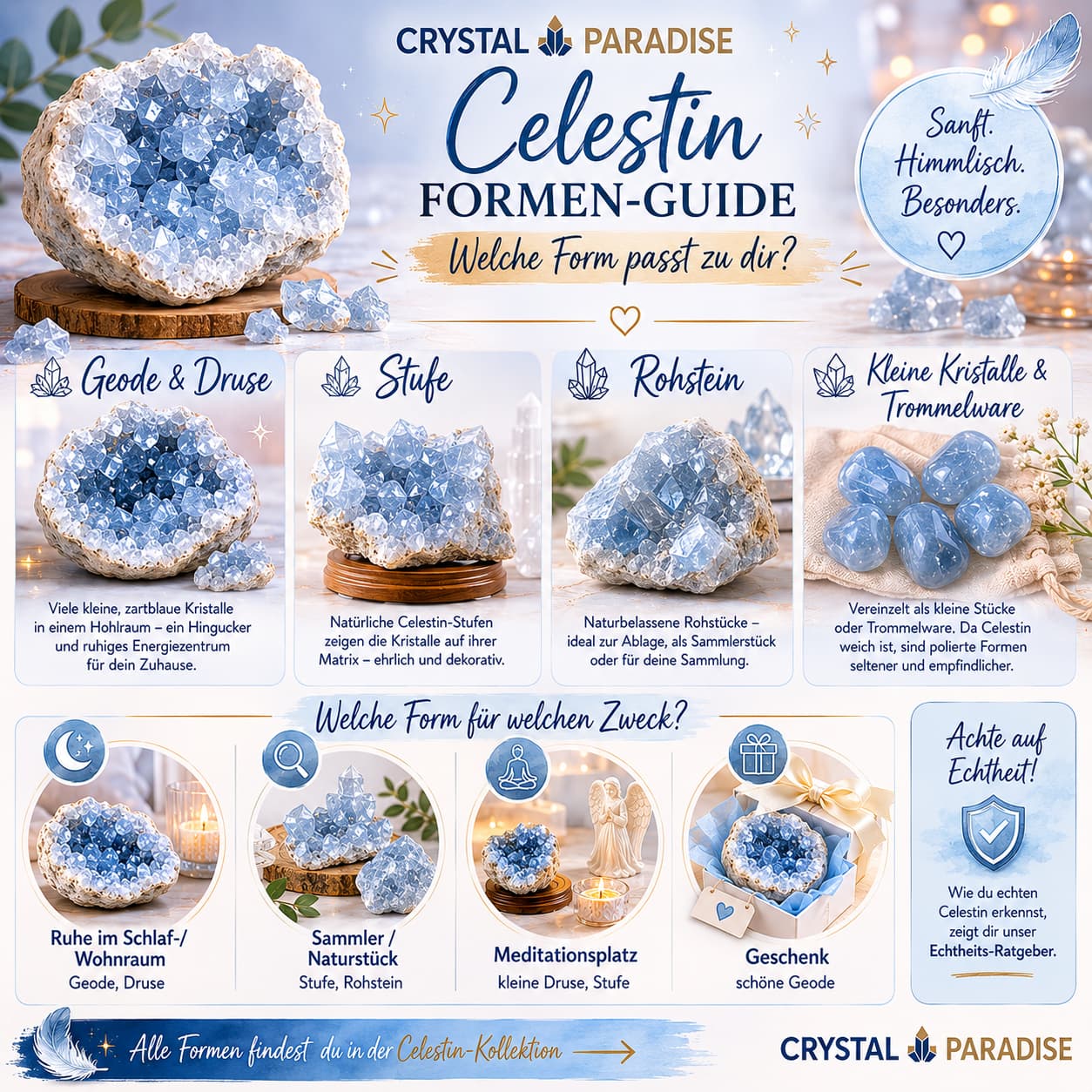
The most important celestine forms at a glance: geode, cluster, specimen, and rough stone. Each form tells a different story. Each has its place. Below we present all the variants to you.
Geode
The celestine geode is the best-known and most popular form. Inside it hides a cavity full of small, pale blue crystal points. This cavity forms over millions of years through geological processes. The result is breathtaking.
Geodes look like a natural treasure chest. They catch the eye and create a calm atmosphere in the room. Many people place them in the bedroom, the living room, or on the desk. In stone lore, it is traditionally attributed a calming and clarifying quality.
Celestine geodes also make wonderful gifts. They look elegant, are unique, and have high decorative value. You can find our hand-selected pieces in the Celestine Geodes Collection.
Cluster
A cluster is similar to a geode, but flatter and more open. The crystals sit on a stone base and are fully visible. Celestine clusters are decorative and make excellent meditation companions. They are easier to place than closed geodes.
Clusters are also ideal for beginners. They offer a direct view into the fascinating crystal structure of celestine. The color palette ranges from almost white-blue to intense sky blue.
Specimen
In a celestine specimen, the crystals grow on their natural matrix. The underside is unworked and shows the original mother rock. The top displays the crystals in their full beauty. This makes specimens honest, original natural pieces.
Specimens are particularly well suited for collectors. They tell the story of the stone. You can see how celestine actually forms in the earth. A celestine specimen is an authentic piece of nature. Discover our selection in the Celestine Specimens Collection.
Rough Stone
Rough pieces are completely untouched by nature. They have neither been cut nor processed. Rough stones often have irregular shapes and a rough surface. That's exactly what makes them authentic and special.
For collectors who value originality, rough stones are the first choice. They can be nicely arranged on shelves or trays. With celestine, one thing applies: rough stones are more sensitive than those of other minerals. Gentle storage is essential.
Small Crystals and Tumbled Stones
Polished celestine variants are rare. The stone is too soft for intensive polishing. Tumbled stones made from celestine can be produced, but they are more fragile than comparable quartz variants. Small individual crystals occasionally occur and are very popular among collectors.
These pieces are more suited for advanced enthusiasts. They require especially careful handling. Still, they can be beautifully used as pocket companions or on the meditation cushion.
Choosing Celestine Forms by Purpose
Not every form fits every goal. This overview will help you decide.
- Calm in the bedroom or living space: geode or cluster – large-scale presence, calm appearance
- Collector or nature lover: specimen or rough stone – maximum authenticity and originality
- Meditation and mindfulness: small cluster or specimen – direct contact, compact size
- Special gift: beautiful geode – unique, elegant, unforgettable
- Decoration with wow effect: large geode or specimen – natural eye-catcher for any room
Tip: In stone lore, celestine is traditionally regarded as a stone of calm and inner stillness. Many people especially appreciate it as a pleasant presence in the bedroom. More on this in the article: Celestine for Sleep, Calm & Meditation.
Important Care Instructions for All Celestine Forms

Celestine needs special attention. The following points apply equally to all forms.
- No direct sunlight: UV radiation causes the color to fade. Always place celestine in shade.
- No water: Celestine dissolves with prolonged water contact. Never soak or wipe it wet.
- No pressure: The stone is prone to breaking. Choose stable surfaces, don't place anything on top.
- No salt: Dry salt can damage the surface. Do not use salt baths.
- Cleaning: Best cleaned dry with a soft brush or cloth.
You can find all the details on proper care in our comprehensive guide: Cleaning, Charging & Caring for Celestine Properly.
Recognizing Authenticity – What to Look Out For
On the market, there are dyed or synthetic stones that resemble real celestine. Pay attention to the following characteristics when buying.
- Color: Real celestine has a soft, uneven blue. Colors that are too intense or too uniform may indicate dyeing.
- Transparency: Celestine crystals are often translucent to slightly transparent.
- Surface: Natural crystal faces show characteristic growth structures.
- Origin information: Reputable dealers state the site of discovery. Madagascar is the most common source.
Detailed information on distinguishing real from fake celestine can be found in the article: Recognizing Real Celestine & Avoiding Confusion.
Celestine Compared to Other Minerals
Anyone familiar with celestine often also thinks of amethyst or rose quartz. Both also occur as geodes and specimens. The difference lies in hardness and color effect. Amethyst is significantly more robust. Celestine, on the other hand, is more fragile, but also more delicate in its appearance.
If you're interested in other form guides, feel free to check this one out too: Amethyst Form Guide.
Frequently Asked Questions

Which Celestine Form Is Best Suited for Beginners?
For beginners, we recommend a celestine geode or a celestine specimen. Both are stable to display, decoratively appealing, and immediately show the mineral's typical beauty. Geodes are especially popular because they show an impressive cavity with many crystal points. A specimen, on the other hand, offers an authentic glimpse into the natural growth structure.
Can Celestine Be Cleaned with Water?
No. Celestine is water-soluble and should never be soaked in water or wiped wet. The recommended cleaning method is dry: a soft brush or a dry cloth is completely sufficient. You can find more details in the care article on our blog.
Why Are There So Few Polished Celestine Forms?
Celestine has a Mohs hardness of only 3 to 3.5. This makes it very sensitive to mechanical processing. Tumbled stones or heavily polished variants do occur, but they are rarer and more fragile than comparable quartzes. Natural forms like geodes and specimens therefore remain the most common and most beautiful presentation forms of this mineral.
Where Should I Place Celestine?
Celestine should always be placed in a shady and dry spot. A window location with direct sunlight is unsuitable. Shelves, nightstands, or meditation corners without direct light or moisture exposure are ideal. Many people place it in the bedroom — in stone lore, it is traditionally regarded as a stone of calm.
Does Celestine Also Come in Other Colors?
Yes, celestine can also occur in white, gray, yellow, or colorless. However, the best-known and most sought-after variant is the characteristic sky blue to dove blue. This color results from traces of strontium and minor impurities during crystal growth. Colorless or whitish pieces are rarer in the trade.

Written by Christian Neumayer


Leave a comment
This site is protected by hCaptcha and the hCaptcha Privacy Policy and Terms of Service apply.