








Which gemstones are safe as water stones?
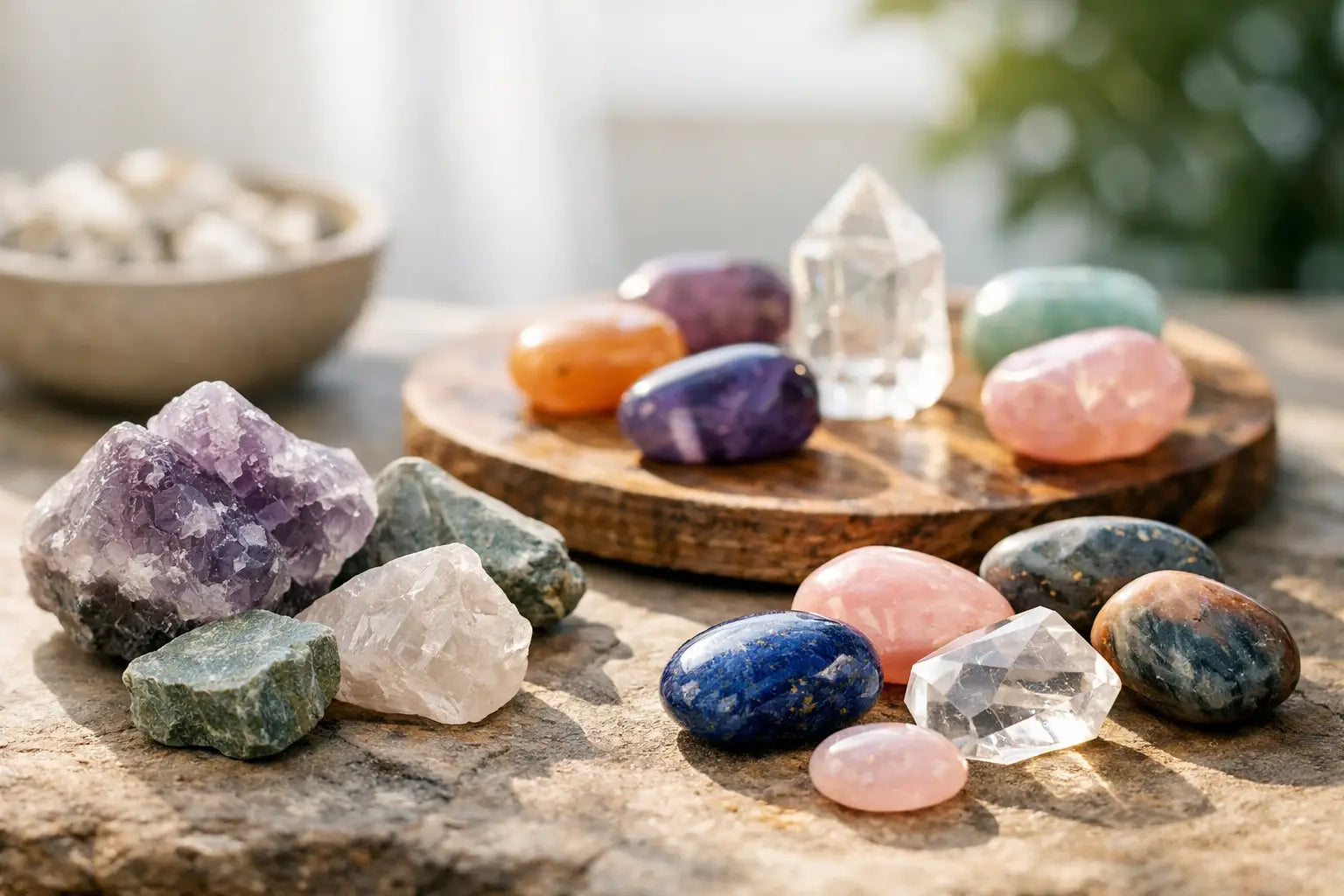
In short: Stones from the quartz group are safe – rock crystal, amethyst, rose quartz, citrine, smoky quartz, aventurine, agate, jasper, and carnelian. They are chemically practically insoluble and release nothing into the water. Soft, soluble, or heavy-metal-containing minerals do not belong in drinking water: malachite, azurite, pyrite, selenite, fluorite, cinnabar, and anything from the sulfide group.
Three questions determine suitability
Whether a stone is suitable for drinking water is not a question of effect, but of mineralogy. Three properties are enough to clarify almost every case.
1. Does the stone dissolve? Sulfates such as gypsum and selenite, halides such as rock salt, and carbonates such as calcite dissolve in water or in weakly acidic water – for selenite that's about two grams per liter. The stone breaks down, and the water absorbs whatever it releases.
2. Does it contain elements you wouldn't want to drink? Copper, lead, mercury, arsenic, cadmium, and fluoride occur regularly in certain mineral classes. What matters is not the element alone, but whether it stays bound: lead in the crystal lattice of a feldspar behaves completely differently from lead in a sulfide that oxidizes on the surface.
3. Is the surface stable? Anything under Mohs hardness 5 gets scratched and worn down in everyday use. Porous stones absorb water and release it again along with whatever has accumulated inside. And dyed, filled, or coated stones bring in substances that don't originate from the mineral itself.
Safe: the quartz group and stable silicates
Quartz is silicon dioxide – the same material drinking glasses are made of. It is hard, chemically inert, and practically insoluble in water. That's why almost all classic water stones are quartz varieties.
| Stone | Mineral | Formula | Mohs hardness | Why it's safe |
|---|---|---|---|---|
| Rock crystal | Quartz | SiO₂ | 7 | chemically inert, no foreign elements |
| Amethyst | Quartz | SiO₂ | 7 | coloring from iron in the lattice, firmly bound |
| Rose quartz | Quartz | SiO₂ | 7 | like rock crystal, just with trace elements |
| Citrine | Quartz | SiO₂ | 7 | even heat-treated amethyst remains pure SiO₂ |
| Smoky quartz | Quartz | SiO₂ | 7 | coloring from lattice defects, nothing soluble |
| Aventurine | Quartz with mica | SiO₂ | 7 | inclusions are also silicates |
| Agate, chalcedony | Quartz, microcrystalline | SiO₂ | 6.5–7 | dense, not porous – as long as undyed |
| Jasper | Quartz, microcrystalline | SiO₂ | 6.5–7 | coloring from iron oxides in the matrix |
| Carnelian | Chalcedony | SiO₂ | 6.5–7 | like agate |
| Aquamarine | Beryl | Be₃Al₂Si₆O₁₈ | 7.5–8 | ring silicate, extremely insoluble; beryllium stays in the lattice |
An honest note on aquamarine: beryllium is toxic as dust or as a soluble salt. In beryl it sits firmly bound in a ring silicate with hardness 8, which does not measurably dissolve in water. That's why aquamarine is considered suitable – if you want to be completely sure, use the indirect method further below.
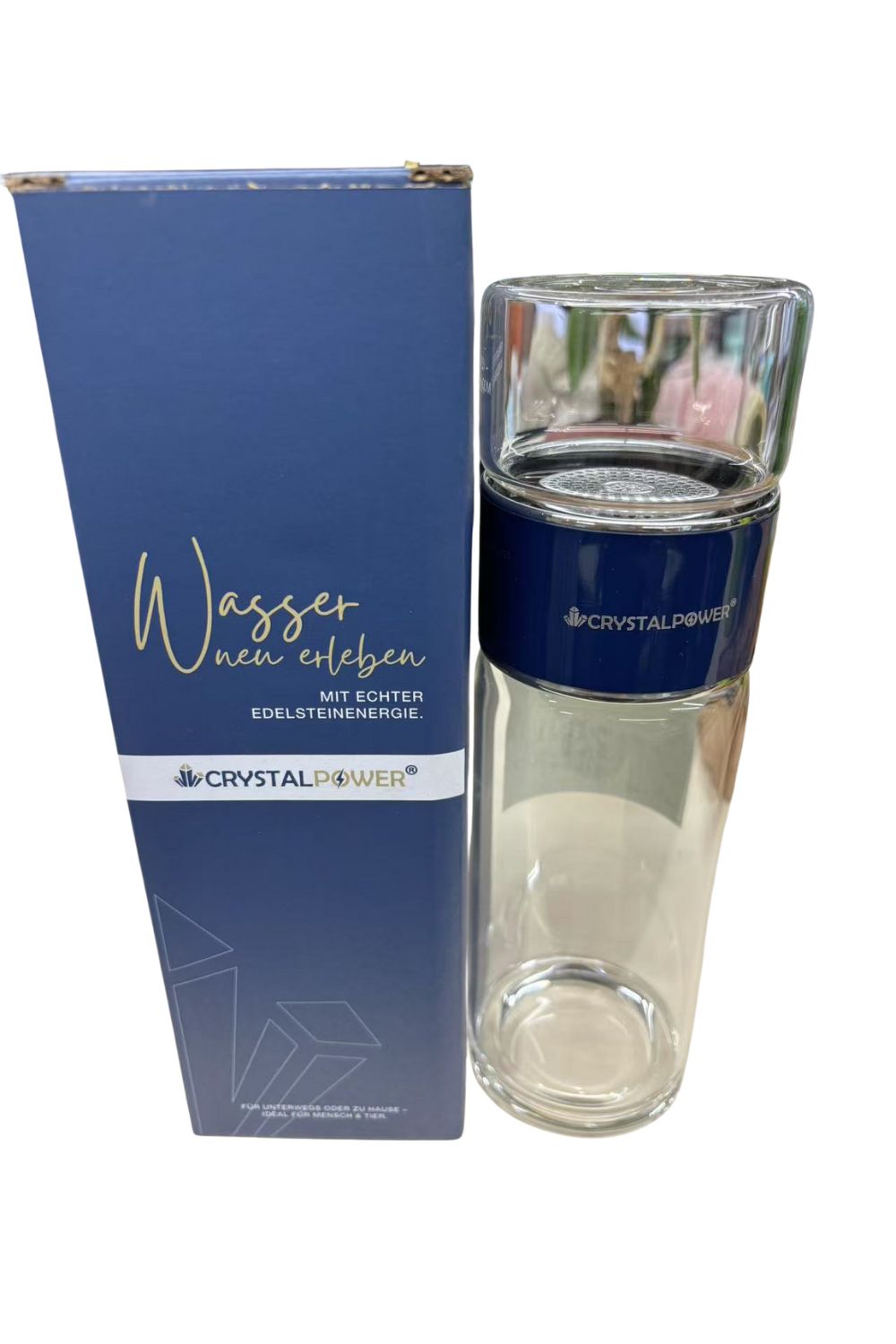
Our own crystalpower® water stones all come exclusively from this group: rock crystal, amethyst, rose quartz, citrine, aventurine, and aquamarine. This isn't a matter of taste, but follows exactly the table above.
Not for drinking water – and why
| Stone | Mineral class | Formula | The problem |
|---|---|---|---|
| Malachite | Carbonate | Cu₂[(OH)₂|CO₃] | copper, soluble in weakly acidic water, hardness only 3.5–4 |
| Azurite | Carbonate | Cu₃[(OH)|CO₃]₂ | like malachite |
| Chrysocolla | Silicate | (Cu,Al)₂H₂Si₂O₅(OH)₄·nH₂O | porous and soft, copper-bearing |
| Pyrite, marcasite | Sulfide | FeS₂ | oxidizes to iron sulfate and sulfuric acid |
| Cinnabar | Sulfide | HgS | mercury mineral – fundamentally does not belong near food |
| Galena | Sulfide | PbS | lead, very soft (2.5) |
| Realgar, orpiment | Sulfide | AsS, As₂S₃ | arsenic |
| Sphalerite (zinc blende) | Sulfide | ZnS | often contains cadmium |
| Selenite, gypsum | Sulfate | CaSO₄·2H₂O | dissolves, hardness 2 |
| Angelite, anhydrite | Sulfate | CaSO₄ | like gypsum |
| Rock salt | Halide | NaCl | dissolves completely |
| Fluorite | Halide | CaF₂ | slightly but measurably soluble – releases fluoride |
| Rhodochrosite | Carbonate | MnCO₃ | acid-soluble, soft |
| Calcite, honey calcite | Carbonate | CaCO₃ | dissolves in weakly acidic water, hardness 3 |
| Lapis lazuli | Rock | – | mixture of lazurite, calcite, and pyrite – the companions are the problem |
| Turquoise | Phosphate | CuAl₆(PO₄)₄(OH)₈·4H₂O | porous, copper-bearing, almost always stabilized or dyed |
| Apatite | Phosphate | Ca₅(PO₄)₃(F,Cl,OH) | fluoride in the lattice, hardness 5 |
The gray zone – stones that are disputed
For some stones, one source says "suitable" and the next says "absolutely not." This is usually because an element is named without checking whether it can even be released. The factual basis here is thin – in both directions. We'd rather say so than claim a certainty that doesn't exist.
The same applies to all stones in this group: Only use cut or tumbled pieces, not freshly broken ones – at a fracture edge, fresh, uncompacted material is exposed, at a polished surface it isn't. And clean the stone thoroughly under running water with a soft brush before each use. If you want to be completely safe, use the indirect method.
| Stone | The objection | What speaks against it | Our recommendation |
|---|---|---|---|
| Amazonite | The blue-green color is due to lead traces | It's a feldspar, hardness 6, practically insoluble; the lead sits in the lattice, not on the surface | polished and well cleaned – or the indirect method |
| Tiger's eye | Forms through silicification of crocidolite, an asbestos mineral | In the finished tiger's eye, the fiber structure has been replaced by quartz; free fibers are not expected in a polished stone | We recommend the indirect method – why is explained in a dedicated article |
| Hematite | "Rusts" | Fe₂O₃ is the final stage of oxidation and is not toxic; however, inclusions can release iron and tint the water | polished and well cleaned; may still tint the water |
| Sodalite | Companion minerals | Sodalite itself is a stable aluminosilicate; the common calcite and pyrite inclusions are not | only inclusion-free, polished, and well-cleaned pieces |
| Shungite | Often sold as a water purifier | Carbon rock, porous, composition varies greatly by source | advise against, as long as the origin is not verified |
| Emerald | Chemically like aquamarine, therefore safe | Emeralds are almost always fractured and are routinely oiled or filled with resin – and that's exactly what gets into the water | not for drinking water |
| Amber | Not a mineral, but fossilized resin | Non-toxic, but with a hardness of 2–2.5 soft and not shape-stable | unsuitable, because it abrades |
The indirect method resolves almost every doubtful case
The stone doesn't need to touch the water. Place it in a sealed glass tube or a small vessel inside the carafe. The water flows around the glass, the stone stays dry, and the whole question of solubility and heavy metals is resolved.
For everything in the gray zone, this is the sensible approach. For malachite, pyrite, or selenite, it's the only one.
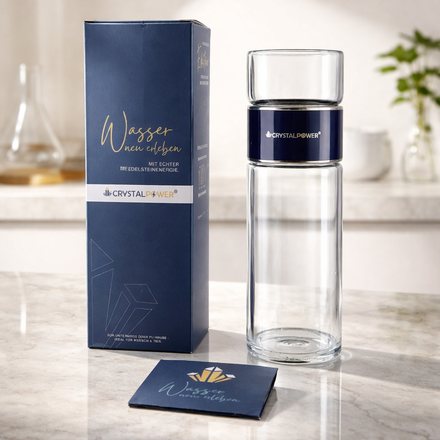
Carafes and water bottles with a separate stone insert, where the stone doesn't touch the water, can be found in our water stone collection.
Dyed, filled, coated
A safe mineral doesn't stay safe once it's been treated. Three cases that are common in retail:
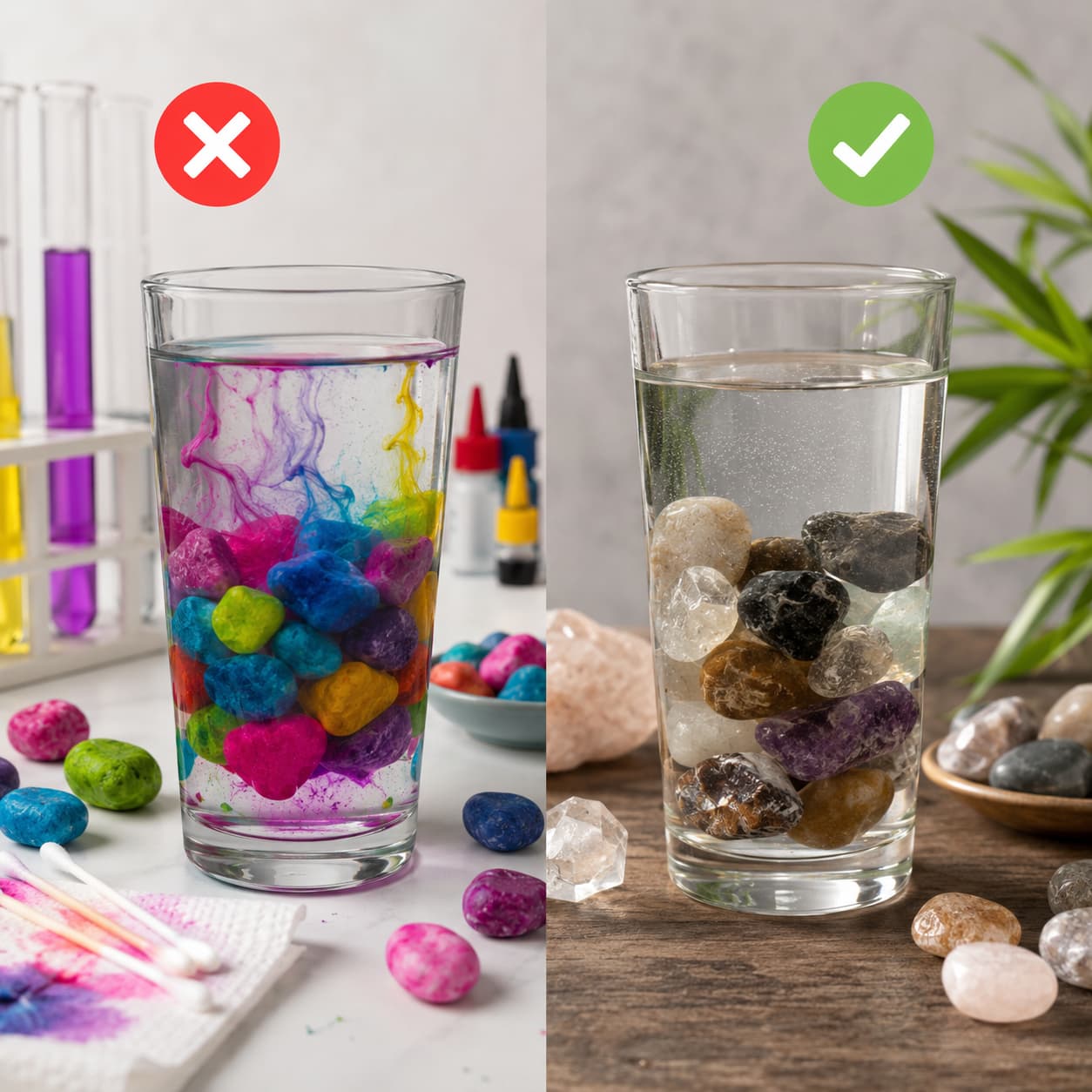
Dyed agates. The bright turquoise, pink, and blue tones come from a dye bath, not from nature. What exactly has soaked in, nobody knows.
Aura stones. The rainbow shimmer comes from a vacuum-deposited metal layer, usually titanium or gold. The layer is a few atoms thick and mechanically sensitive – it does not belong in drinking water.
Stabilized stones. Turquoise and howlite are often reinforced with synthetic resin so they can be cut. The resin has become part of the stone.
In practice
Rinse the stone under running water and brush it with a soft brush before first use. Change the water daily, as you would with any carafe – standing water is an issue regardless of the stone. Clean the stone regularly, and inspect it as you do: if the surface becomes dull, something flakes off, or the water discolors, remove it.
Don't use freshly broken, splintery pieces, but tumbled or polished ones. If you're looking for a vessel for this: Our crystalpower® water bottle is built exactly for that. And don't leave stones permanently in a bottle that sits in the car or in the sun – not because of the stone, but because of the water.
Want to know which other stone fits your intention? In the healing stone finder you'll find for each stone its area of effect, chakra, zodiac sign – and whether it's suitable as a water stone.
Frequently asked questions
Which stones are safest as water stones?
Rock crystal, amethyst, rose quartz, citrine, smoky quartz, and aventurine. All six are quartz varieties, meaning silicon dioxide with Mohs hardness 7 – chemically practically insoluble and without elements that could transfer into the water.
Can you put amethyst in drinking water?
Yes. Amethyst is quartz; its violet color comes from iron traces in the crystal lattice and from natural irradiation. Both are firmly bound. Use a polished or tumbled piece instead of a freshly broken point.
Is aquamarine suitable as a water stone?
Yes. Aquamarine is beryl, a ring silicate with Mohs hardness 7.5 to 8, which does not measurably dissolve in water. The beryllium it contains stays bound in the crystal lattice. If you want to be completely safe, use the indirect method with a glass tube.
Why shouldn't malachite go into water?
Malachite is a copper carbonate with Mohs hardness 3.5 to 4. In weakly acidic water it dissolves slightly and releases copper. The same applies to azurite and chrysocolla. These stones belong exclusively in indirect use.
What is the indirect method for water stones?
The stone goes into a sealed glass tube or a separate vessel placed inside the carafe. It doesn't touch the water. This also allows the use of stones that are unsuitable for direct contact.
Does a gemstone measurably change the water?
No. An insoluble stone like quartz releases nothing that could be chemically detected. The attributions of crystal healing are based on tradition, not on measurements. With soluble or heavy-metal-bearing minerals, however, a change is indeed possible – and that's exactly what you want to avoid.
How do I recognize a dyed stone?
By color that's too uniform, too bright, by color in cracks and pores, and by the price. Agate slices in turquoise, pink, or neon blue are practically always dyed goods. Natural colors are uneven and generally more muted.
Note
The effects of healing stones mentioned here are based on traditional lore and are not medical claims. The information on water suitability refers to the mineralogical properties of the minerals named. Treated, dyed, or not clearly identified stones cannot be assessed on this basis – when in doubt, use the indirect method or ask us.

Written by Christian Neumayer

Leave a comment
This site is protected by hCaptcha and the hCaptcha Privacy Policy and Terms of Service apply.