











Article: Buying Tiger's Eye: Recognizing Quality Features
Buying Tiger's Eye: Recognizing Quality Features
Buying Tiger's Eye: Recognizing Quality Characteristics
Anyone looking to buy tiger's eye quickly faces an overwhelming selection. The market ranges from high-quality collector's pieces with pronounced fiber structure to dull, color-weak specimens that barely show the characteristic silky sheen. Tiger's eye belongs mineralogically to the quartz rock group and forms through the replacement of crocidolite fibers by quartz – a process that creates the typical golden-brown color pattern and fibrous internal structure. This very structure is the decisive quality criterion. This guide shows you what really matters when choosing – whether you're looking for a bracelet, tumbled stones, or a rough stone.
Why Quality Matters When Buying Tiger's Eye
Tiger's eye is one of the most widespread jewelry and collector's stones worldwide. That may sound uncritical at first – but it also means that the range on offer is extremely diverse. Between an intensely shimmering piece from the North Cape in South Africa, the classic main deposit region, and a dull, faintly marked tumbled stone from an unknown source lie worlds of difference.
The quality differences concern four areas: the intensity of the chatoyancy (the light effect that travels across the surface), the evenness of the fiber structure, the richness of the coloring, and – for processed pieces – the craftsmanship. Anyone who keeps these four points in mind when buying is buying consciously instead of randomly.
At Crystal Paradise, each piece is individually selected and inspected. With tiger's eye in particular, this reveals how strongly quality can vary even within a single batch. Some pieces show a broad, evenly running light band – others barely noticeable. These differences are real and affect both the visual impression and the collector's value.
Another point: tiger's eye is sometimes offered with incorrect labeling or misleading images. Sample photos showing the most beautiful specimen of a batch are widespread. What you actually receive can differ significantly from that. That's why transparency when buying isn't a nice-to-have, but a genuine quality characteristic of the seller.
Recognizing Genuine Tiger's Eye: Visual Quality Characteristics
The most reliable identifying feature of a genuine tiger's eye stone is chatoyancy – the so-called cat's eye effect. Move a polished stone under a point light source: A bright, clearly defined light band travels across the surface. The sharper and more even this band is, the more pronounced the quality of the internal fiber structure.
The fiber structure itself is the second criterion. In genuine tiger's eye, the mineral fibers run parallel and tightly packed. On the polished surface, they appear as fine, silky shimmering stripes in golden-brown to honey-yellow, interspersed with dark brown to black bands. This alternation of light and dark zones is characteristic.
Third identifying clue: the luster. Genuine tiger's eye has a pronounced silky luster, not a glassy luster. Pieces without visible fiber patterning, with a uniformly smooth surface, or without any chatoyancy are either of very poor quality or not genuine tiger's eye at all.
Touch and weight also provide clues. Quartz-based stones feel cool and have a noticeably perceptible density. Plastic imitations are lighter and warm up faster in the hand. Anyone wanting to buy tiger's eye should hold the stone in hand if possible – or look for complete individual photos showing every angle.
For a detailed look at the properties of this stone, see our lexicon article on tiger's eye.
Quality Characteristics by Product Type: Jewelry, Tumbled Stones, and Rough Stones
Depending on the form of the tiger's eye, the quality criteria differ slightly. It's worth taking a close look at each product type individually.
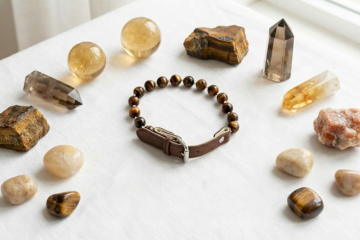
Jewelry and bracelets: With tiger's eye bracelets, evenly cut beads are the first quality signal. All beads in a strand should match each other in size, luster, and fiber orientation. Each individual bead should show chatoyancy – and ideally the fiber should run crosswise to the bead axis, so the light effect is visible when worn. Also pay attention to the workmanship: secure clasps, high-quality cords, no loose-fitting beads. A bracelet made of 6 mm tiger's eye beads differs noticeably in wearing comfort from an 8 mm version – the quality of the stone itself is independent of that.
Tumbled stones and palm stones: Polished tumbled stones reveal their quality in the surface. Cracks, dull spots, or uneven polish are signs of weaker workmanship. The luster should run evenly across the entire surface. With the tiger's eye palm stones from our range, the fiber structure can be felt particularly well and rotated in the light – a good opportunity to experience the chatoyancy directly.
Spheres and eggs: Tiger's eye spheres and the tiger's eye egg are more demanding in terms of workmanship, because the cut must create an even curvature across the entire fiber structure. High-quality specimens also show a clearly traveling band of light here when you slowly rotate the sphere under light.
Color Quality When Buying Tiger's Eye – What to Look For
Color is a direct quality characteristic. Naturally grown tiger's eye shows intense brown tones – from warm golden yellow to deep chestnut brown – with clearly defined dark brown to nearly black striped zones. The more contrast-rich the interplay of light and dark zones, the more pronounced the visual effect.
Pale, yellowish, or grayish-looking pieces often come from less productive areas of the deposit or were not carefully selected. Such specimens are not worthless – but they don't show the full potential of what tiger's eye can visually achieve.
Treated variants: On the market you'll also find color-treated tiger's eye. The best-known example is Royal Blue Tiger's Eye – a genuine tiger's eye stone whose blue coloring is produced through heat treatment or iron dyeing. This is not a quality flaw, as long as the seller is transparent about it. Anyone wanting to buy Royal Blue Tiger's Eye should know that it is a treated stone. A corresponding bracelet made of Royal Blue Tiger's Eye beads 8 mm with charm can be found in our range – clearly labeled as a treated variant.
Evenness of coloring is another quality signal: blotchy discoloration, cloudy inclusions, or irregular striping patterns can indicate weathering, poor polishing, or weak starting quality.
Prices for Tiger's Eye: What Does Real Quality Cost?
Tiger's eye is one of the more accessible minerals – but that doesn't mean quality comes without a price. Simple tumbled stones without pronounced chatoyancy are available cheaply. Well-polished pieces with a clearly visible light effect, intense coloring, and even fiber structure cost more – rightly so.
With jewelry pieces, besides stone quality, material and craftsmanship also play a role. A bracelet with carefully selected, matching beads, a high-quality clasp, and stable cord construction is more labor-intensive to produce than a quickly strung piece – and that's reflected in the price.
A rule of thumb: if the price is significantly below the market average, a second look is worthwhile. Not every low-priced offer is inferior – but exceptionally low prices often come with imprecise selection, poor polishing, or missing origin information. Conversely, a high price alone does not guarantee quality. What matters is always color, luster, fiber structure, and – for jewelry – the quality of workmanship.
Anyone wanting to buy tiger's eye will find bracelets, tumbled stones, spheres, eggs, and palm stones in our tiger's eye collection – each piece individually selected and photographed.
One special aspect that is often overlooked: tiger's eye contains bound iron and is one of the stones not suited for direct water application. What this means and how you can still use it in practice is explained in our article on the indirect method for tiger's eye as a water stone.
Frequently Asked Questions
Can even a beginner reliably identify tiger's eye?
Yes. The characteristic fiber structure and the cat's eye effect are reliable identifying features. Rotate the polished stone under a light source: if a bright band of light travels across the surface, the fiber structure is intact. Anyone can perform this test – no prior knowledge required. With a bit of attention, you can quickly distinguish genuine tiger's eye from dull or color-weak variants.
Is Royal Blue Tiger's Eye genuine tiger's eye?
Yes, it is a genuine tiger's eye stone. The blue color is created through heat treatment or iron dyeing – a process widely used in the jewelry industry. As long as this treatment is openly communicated, Royal Blue Tiger's Eye is a fully valid, traceable variant. The price is usually somewhat higher than for natural brown tiger's eye.
What should I look for when buying a tiger's eye bracelet?
Look for evenly cut beads of uniform size, a secure clasp, and stable cord construction. Each individual bead should show the fiber structure and the characteristic silky luster. Beads that sit loosely or differ significantly in luster and color from one another indicate weak selection.
Is a high price automatically a sign of better quality?
Not necessarily. A high price can be due to material, workmanship, or brand. What matters is color quality, fiber structure, chatoyancy, and clean workmanship – and these characteristics don't always cost the most money. Compare specifically: look at luster, fiber pattern, and evenness, not just the price tag.
Are there tiger's eye bracelets in different sizes?
Yes. Tiger's eye is processed in various bead sizes – 6 mm and 8 mm are common measurements. Smaller beads look more delicate, larger ones more striking. The bead size affects wearing comfort and appearance, but not automatically the quality of the stone itself.
Where can I buy tiger's eye and be sure of what I'm getting?
What matters is that each piece is photographed individually – so you see exactly the specimen you will receive. Sample images showing the best specimen of a batch are unfortunately widespread in the mineral trade. Also look for clear origin information and transparent notes about any treatments such as dyeing or heating.


Leave a comment
This site is protected by hCaptcha and the hCaptcha Privacy Policy and Terms of Service apply.