







Article: Chrysocolla: The Copper Mineral with History and Shine

Chrysocolla: The Copper Mineral with History and Shine
Chrysocolla: The Copper Mineral with History and Shine
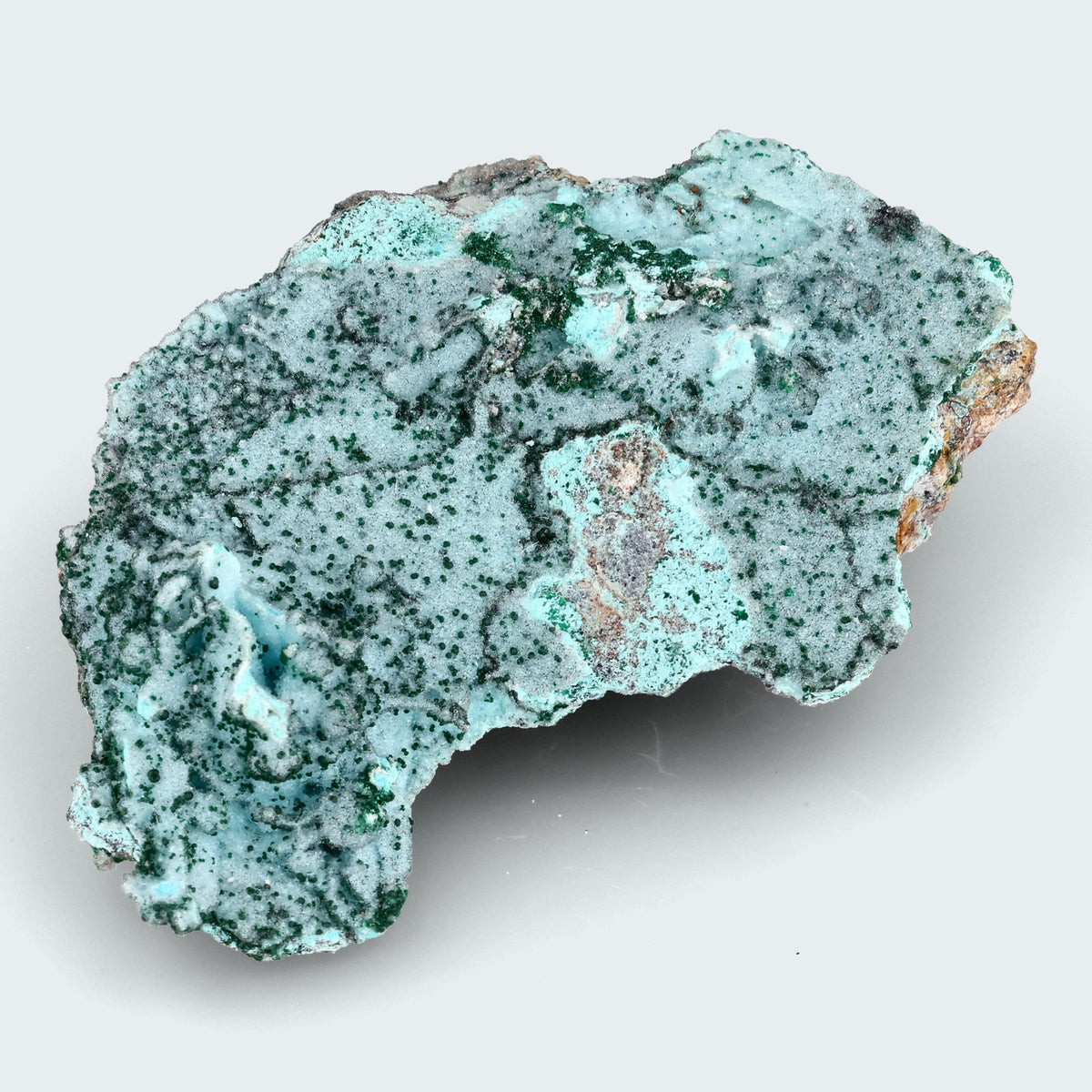
When we at Crystal Paradise hold a new specimen from the Congo in our hands, the same thing happens every time: a brief moment of pause. The color – that intense blue-green reminiscent of shallow tropical water – makes it hard to simply set the stone down. Chrysocolla is one of those minerals that surprises even experienced collectors again and again. Not through glamour or rarity alone, but through the quiet persistence with which it shows its beauty. In this article, you'll learn what defines this copper mineral mineralogically, where the most important deposits are located, how to recognize quality – and why it shouldn't be missing from any serious mineral collection.
What is Chrysocolla? – Mineralogical Basics
Chrysocolla is a secondary copper mineral and belongs to the class of sheet silicates (phyllosilicates). The chemical formula Cu₂H₂Si₂O₅(OH)₄·nH₂O makes clear what defines this stone: copper, silicon, and water combine in the oxidation zone of copper-bearing deposits to form a compound that is visually hard to surpass. The mineral forms when oxygen- and water-rich groundwater weathers copper-bearing ores. The result is botryoidal, kidney-shaped aggregates, crusts, and fine-grained masses – rarely truly crystalline, but with an unmistakable appearance.
The Mohs hardness is only 2 to 2.5. This makes it one of the softer minerals in the collector's spectrum. The porosity is not a weakness but a defining characteristic – it explains the matte to waxy luster and the tendency to absorb moisture. Color tones range from light green through turquoise to deep blue-green. The name derives from the Greek: chrysos (gold) and kolla (glue) – a reference to its historical use as a soldering flux in goldsmithing. The mineral frequently occurs together with malachite or azurite, which points to its formation in the same copper oxidation environment. You can find more on the mineralogical特性 in our encyclopedia article.
Origin and Deposits: Peru and the Congo
The most important deposits worldwide are located in Peru, the Democratic Republic of the Congo, Chile, Australia, and the United States (Arizona). For collectors, two regions are especially relevant: Peru and the Congo.
From the Peruvian region of Huánuco come specimens and raw stones with intense colors and comparatively good crystal formation. Peruvian examples are often medium-sized, show clear color zoning, and impress through homogeneity. The deposit conditions in the Peruvian highlands – old copper belts with intense weathering zones – favor the formation of collector-worthy pieces. The Chrysocolla Pyramid from Huánuco, Peru in our range also comes from exactly this region.
Congolese deposits present themselves quite differently. The Tenke-Fungurume deposit in Kolwezi, Lualaba Province, is known for large-format specimens with impressive surface formations and characteristic mineral associations. Pieces from the Congo stand out for their sheer size and often complex accompanying minerals – malachite, occasionally azurite, sometimes metallic-shining copper phases. We source such specimens directly from collectors and selected dealers in the source regions, without wholesalers in between – so the provenance documentation remains fully traceable.
Regional differences in coloring, size, and accompanying minerals allow experienced collectors to assign pieces to their origin. Those who collect comparatively have a rewarding subject of study in this copper mineral.
As a Collector's Stone: Raw Stones, Specimens, and Jewelry
Collectors encounter the mineral in various forms – and each one opens a different approach. Raw stones show it as it comes from the earth: unworked, with all the traces of its formation. Here the porosity is directly noticeable, the color still somewhat more matte, the mineralogical character most clearly readable.
Specimens – meaning grown examples with free faces – are the classic collector's format. Large-format Chrysocolla specimens from Tenke-Fungurume, Kolwezi, Lualaba, DR Congo impress through their dimensions and the complexity of the surface. At Crystal Paradise, each specimen is individually selected, inspected, and photographed from all sides. What you see in the shop is exactly what you get – no piece exists twice, no sample images.
Polished forms such as pyramids are created by grinding and bring out the mineral's color intensity more clearly. The copper mineral is also processed into jewelry: bead bracelets use the vivid color for wearable objects. The Crystal Paradise range includes raw stones and specimens as well as jewelry pieces – including the Bracelet made of Chrysocolla beads 8 mm with charm and the Bracelet made of Chrysocolla and Moonstone beads 8 mm with charm. You can find all available pieces directly in our collection.
Each form of the goods offers a different perspective: the raw stone for understanding formation, the specimen for admiring the crystallography, the jewelry for everyday companionship.
Quality Characteristics and Signs of Authenticity
How do you recognize a high-quality specimen? There are several factors we consider when selecting each piece.
First, the color intensity: deep blue-green or saturated turquoise are considered especially appealing. Here, the homogeneity of the coloring is decisive – uneven, faded, or grayish-brown overlaid areas indicate weathering or inferior storage. For specimens, size, completeness, and the quality of the mineral association also count. A piece that shows malachite or azurite in clear distinction is mineralogically especially interesting.
Porosity is not a flaw. Porous pieces can be collectible valuable – provided the other quality characteristics are right. It becomes critical when the pores have been filled with synthetic resin or other substances to create an apparently smoother surface. Under a loupe, genuine material shows the characteristic botryoidal surface structure and the typical accompanying mineralization.
Responsible documentation always includes the exact indication of locality and geological context. Pieces without proof of origin are harder to classify – and less suitable for systematic collections. At Crystal Paradise, we describe every stone with honest words: locality, weight, characteristics – without embellishment.
Special Features and Fascination of This Mineral
What makes chrysocolla so special that collectors keep returning to it?
First there is the color. This blue-green arises from the high copper content and is comparatively rare in this purity in the mineral kingdom. Even in its raw state, without any processing, the mineral appears as if polished.
Then there is the history. It was already used in antiquity – as a flux for gold soldering, which the Greek name references, and as a pigment in painting and glassmaking. Pliny the Elder mentions the mineral in his Naturalis Historia. Whoever holds a specimen in their hands also holds a piece of cultural history.
The mineralogical association with malachite or azurite documents the complex processes in the oxidation zone – made visible in a single piece. Large Congolese specimens from Tenke-Fungurume can show this complexity in an impressive way.
For many collectors, this copper mineral is the entry point into systematic engagement with copper minerals. The softness and porosity require careful handling – and this deepens the relationship with the object. A mineral that demands care becomes, over time, a familiar companion in the collection. Since 2025, Crystal Paradise has supported the Mineralienatlas (mineralienatlas.de) – because we are convinced that well-founded knowledge about minerals is the best reason for genuine enthusiasm.
Frequently Asked Questions about Chrysocolla
How do I distinguish genuine chrysocolla from similar minerals?
The mineral has a characteristic green to blue-green color, is relatively soft (Mohs hardness 2–2.5), and porous. It differs from malachite by the lack of typical banding; from azurite by its green rather than blue base color. Under a loupe, the botryoidal surface structure and typical accompanying mineralization are often visible. A precise indication of locality and the geological documentation of the piece are part of reliable classification.
How do I care for and store chrysocolla specimens?
The material is porous and soft – dry storage is important, since high humidity can lead to surface changes. Strong temperature fluctuations should be avoided. Care should be taken when handling to avoid breakage. Direct sunlight can, over a long period, lead to slight color change. A stable placement protected from dust and moisture preserves the piece optimally.
What differences exist between Peruvian and Congolese specimens?
Peruvian pieces – for example from Huánuco – often show more intense, homogeneous colors and small to medium formats with good crystal formation. Congolese specimens from Tenke-Fungurume stand out through large-format specimens and a characteristic mineral association. Both origins are mineralogically valuable. The choice depends on collector preference – and whether one prefers compactness or dimension.
Is chrysocolla prone to breakage?
Yes. The softness and porosity make the mineral susceptible to breakage. Specimens should be placed stably and protected from pressure. Jewelry pieces made of this material are wearable but require more conscious handling than harder stones like quartz or agate.
For which collectors is chrysocolla especially interesting?
The mineral appeals to collectors interested in copper minerals or looking to build regionally comparative collections. It is also well suited as an entry-level mineral: visually appealing, with a rich history of formation, and available in various forms – from raw stone to specimen to jewelry. Those who appreciate large-format display pieces will find particularly impressive examples among Congolese specimens.

Written by Christian Neumayer
Leave a comment
This site is protected by hCaptcha and the hCaptcha Privacy Policy and Terms of Service apply.