







Vanadinite - red beauty
Vanadinite – Fiery Mineral with a Fascinating Character

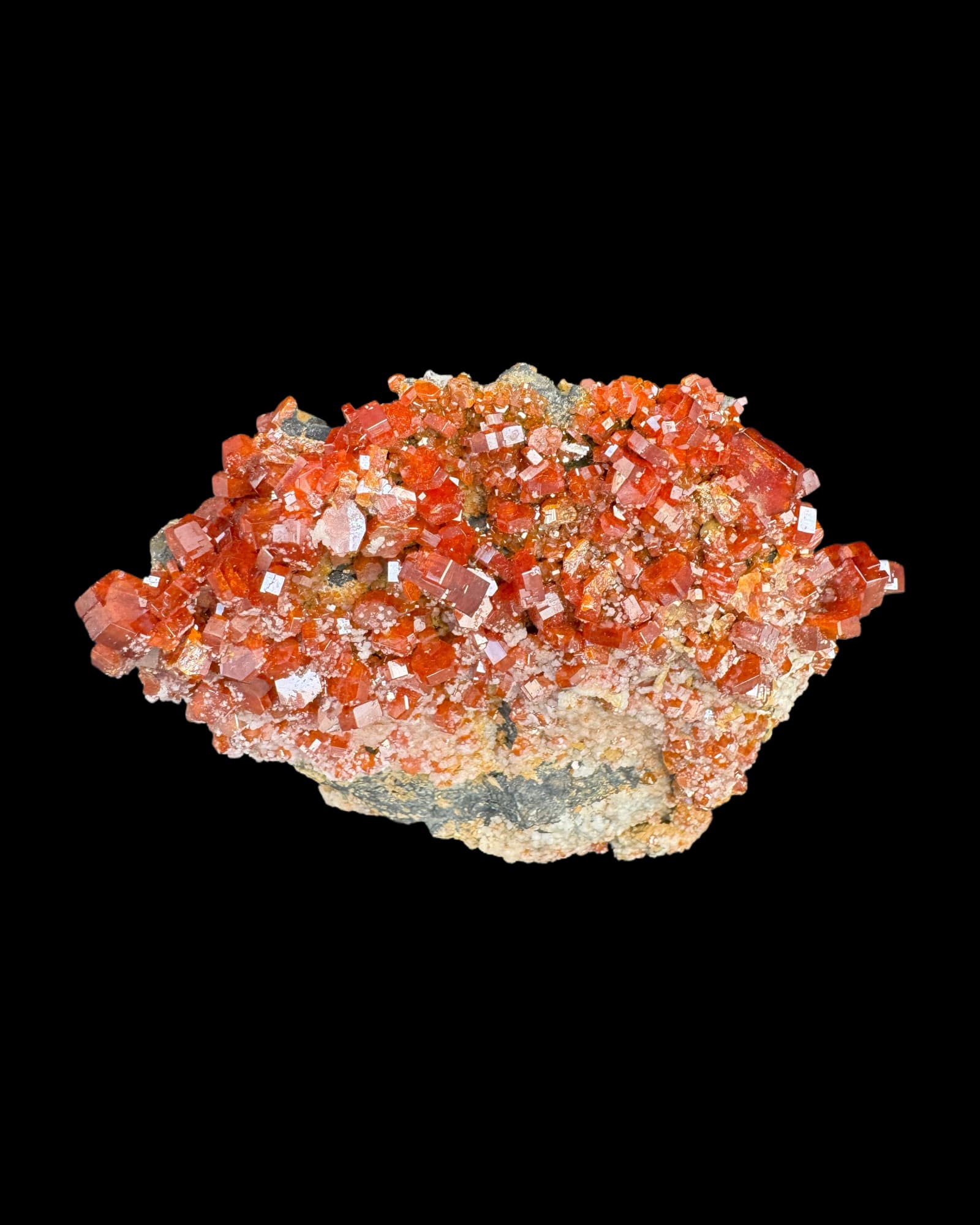
Vanadinite is a rare lead vanadate mineral with the chemical formula Pb₅(VO₄)₃Cl. It belongs to the apatite group and forms bright red to orange-red, hexagonal prisms – often of exceptional clarity and brilliance. The color results from the high vanadium content in the crystal structure. Vanadinite is among the sought-after collector minerals worldwide. In our shop at Crystal Paradise, we've valued it for years as a true eye-catcher – for both beginners and advanced mineral collectors.
Mineralogical Classification: What Exactly Is Vanadinite?
Vanadinite was first scientifically described in 1838. The name derives from the chemical element vanadium. This element, in turn, was named after Vanadís – a Norse epithet of the goddess Freya.
Mineralogically, vanadinite belongs to the phosphate class, more precisely to the pyromorphite group. It crystallizes in the hexagonal system. The crystals are usually short-prismatic to tabular, sometimes hollow or skeletal in form.
Key Mineralogical Properties
- Chemical formula: Pb₅(VO₄)₃Cl
- Crystal system: Hexagonal
- Mohs hardness: 2.5 to 3 – making vanadinite relatively soft
- Density: approx. 6.9 g/cm³ – unusually heavy for its size
- Luster: Adamantine to resinous
- Color: Deep red, orange-red, yellow-orange, rarely brown
- Transparency: Translucent to opaque
- Streak: Yellowish to white
The high density of almost 7 g/cm³ is immediately noticeable when held. Even a small vanadinite crystal feels surprisingly heavy. This is a reliable feature of authenticity.
Origin and Localities of Vanadinite
The most beautiful and best-known vanadinite deposits are located in Morocco. The region around Mibladen in the Midelt Province is considered a world-class source in particular. Specimens from there show vividly red crystal clusters on white baryte gangue rock. They are the epitome of this mineral's "red beauty."
Other significant localities include:
- Mexico (Sierra de Santa Rosa, Durango): often orange-colored crystals
- USA (Arizona, New Mexico): important historical localities
- Namibia: sometimes with a brownish to yellowish tint
- Argentina: rather rare, smaller specimens
- Austria: historical finds, hardly active today
Vanadinite forms in the oxidation zone of lead deposits. It develops as a secondary mineral when vanadium-bearing solutions come into contact with primary lead ores. This formation process explains its typical association with minerals such as baryte, goethite, or wulfenite.
In our showroom in Feldkirchen near Munich, we've noticed from experience: customers are always fascinated by how vivid and deep the color of a genuine vanadinite specimen from Mibladen appears – even compared to photos.
Vanadinite in Crystal Healing – Traditional Meaning
Vanadinite is not just a visual highlight for collectors. It also holds a certain significance in crystal healing. Note: All properties mentioned are spiritual traditions – no scientific evidence exists for them.
In crystal healing, vanadinite is traditionally considered a stone of energy and endurance. It is said to:
- according to traditional lore, strengthen joie de vivre and vitality
- according to spiritual tradition, stimulate creativity and drive
- be valued as a companion for goals and projects – said to symbolize perseverance
- be associated with grounding, thus said to represent inner stability
- be associated with the sacral and root chakra – fitting its fiery red color
In traditional color symbolism, red stands for strength, passion, and determination. Vanadinite combines this energy with an unusual mineralogical character. This makes it a valued companion stone in spiritual circles.
Those interested in other energetically significant red minerals will find valuable information and comparisons in the article about Red Tourmaline – Fascinating for Collectors and Healing Stone Enthusiasts.
Care and Handling of Vanadinite – Important Notes

Vanadinite is a mineral that requires special care. Mishandling it risks damaging the often delicate crystals. Furthermore, vanadinite contains lead – an important safety consideration.
Precautions When Handling
Vanadinite contains lead (Pb) in its chemical structure. This specifically means:
- Always wash hands thoroughly after handling
- Never store or keep it near food
- Not suitable as a play stone for children under 12 years
- Do not use for making gemstone water
- Keep out of reach of pets
Storage and Cleaning
The Mohs hardness of 2.5 to 3 makes vanadinite very susceptible to scratches. The following care measures are recommended:
- Store in a softly padded case or on soft fabric
- Clean only with a dry, soft cloth – do not use water
- No ultrasonic cleaners and no steam cleaners
- Avoid temperatures above 60 °C – heat can damage the crystal structure
- Avoid direct sunlight long-term – it can cause the color to fade slightly
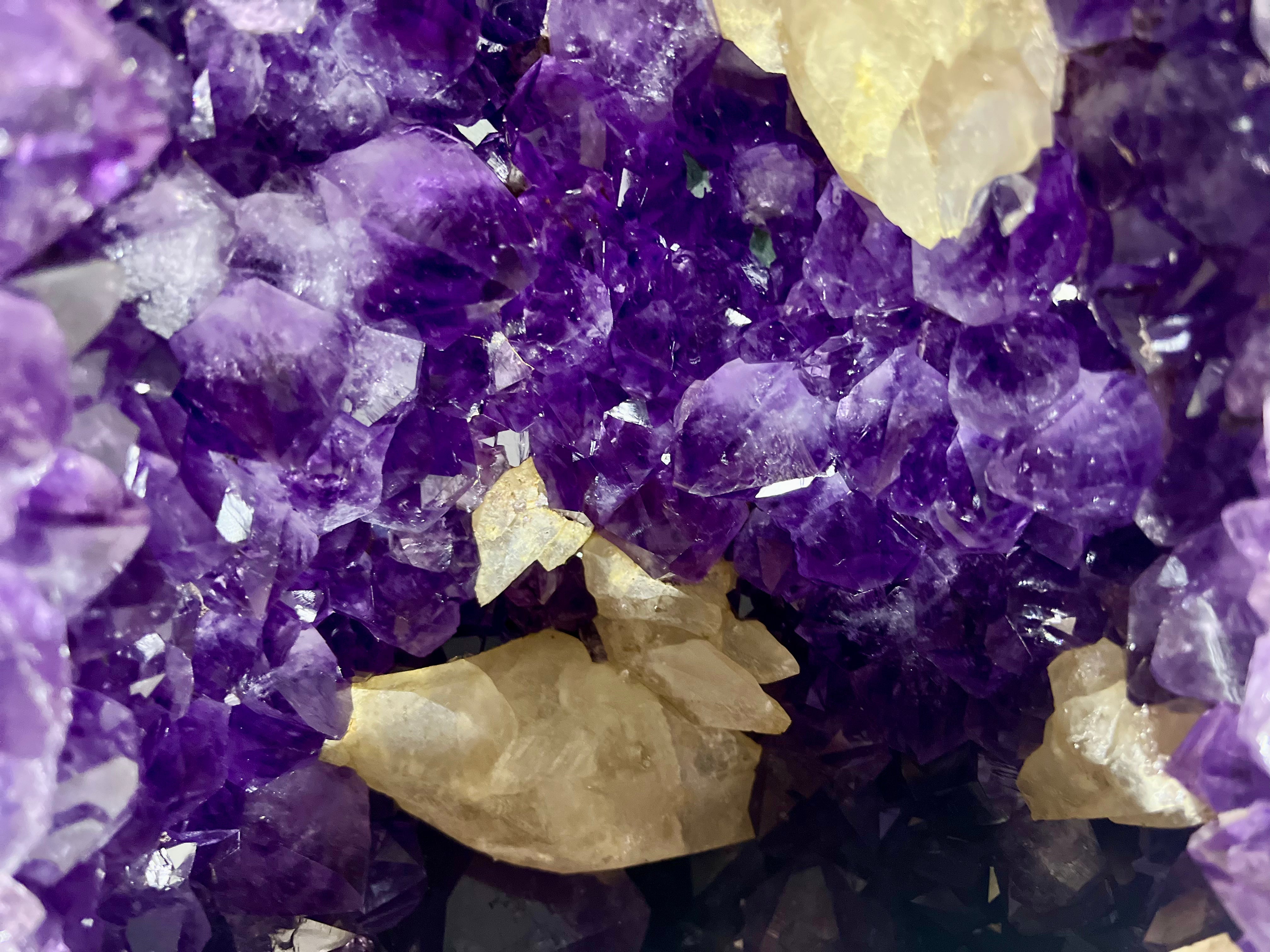
Those seeking minerals with equally impressive structures will also find fascinating showpieces for their collection and decor among our Amethyst Geodes.
Buying Vanadinite – What You Should Pay Attention To
Many vanadinite specimens are available on the market. Quality differences are considerable. What matters when buying?
Quality Features of Good Specimens
- Crystal clarity: Well-formed, clearly defined prisms are more valuable than diffuse masses
- Color depth: Deep, vibrant red without fading is the ultimate quality feature
- Gangue rock: A beautiful white baryte base significantly increases attractiveness
- Locality information: Reputable dealers name Mibladen, Durango, or another specific location
- Weight: Genuine vanadinite is heavy – significantly heavier than it looks
In our showroom in Feldkirchen near Munich, you can pick up and compare vanadinite specimens directly. We recommend always viewing several specimens side by side. Only then does it become apparent how great the differences in color and crystal formation can be.
Browse directly through our handpicked Vanadinite Collection and find your personal favorite piece. Every specimen is unique – with its own story from the earth of Morocco or Mexico.
If you're interested in other special mineral forms, it's also worth taking a look at our article about Obelisks Made of Fine Minerals – a special way to showcase natural stones.
Vanadinite as a Collector's Item and Decoration
Vanadinite is no ordinary decoration. It's a statement piece. The intensely red color combined with the geometric elegance of the hexagonal crystals makes every specimen a natural work of art.
Particularly popular are large-format specimens from Mibladen with crystals of 1 to 3 cm in edge length. These regularly achieve high prices at mineral fairs. Smaller specimens with flawlessly formed crystals under 5 mm also find enthusiastic admirers.
As decoration, vanadinite is especially suited for display cases, side tables, or as an accent stone on a bookshelf. It inevitably draws attention. However, if used as table decoration, it should be positioned on a stable stand – specimens can easily tip over due to their weight if placed improperly.
At mineral fairs – such as our successful trade show appearances in Landshut and Nuremberg in November 2024 – vanadinite is consistently among the most photographed and admired minerals.
Frequently Asked Questions

Is Vanadinite Dangerous Because of Its Lead Content?
Vanadinite contains lead in its mineral structure. There is no acute danger from normal viewing or occasional handling. However, hands should be washed thoroughly after touching it. Vanadinite is unsuitable for children under 12 years and for making gemstone water. As a collector's item or decoration – out of reach of children – it can be displayed without concern. External information on lead safety is available from the German Federal Institute for Risk Assessment (BfR).
Where Is Vanadinite Mainly Found?
The most significant locality worldwide is the Mibladen region in Morocco. Specimens of world-class quality have been mined there for decades. Other important localities include Mexico (Durango), the USA (Arizona), and Namibia. Moroccan specimens from Mibladen are considered reference pieces among collectors for vivid red color and perfect crystal formation. Scientific mineralogical data can be found, among other places, at Mindat.org – the world's largest mineral database.
What Mohs Hardness Does Vanadinite Have?
Vanadinite has a Mohs hardness of 2.5 to 3. This makes it significantly softer than many other collector stones. For comparison: a simple fingernail already scratches at a hardness of 2.5. Vanadinite crystals should therefore never be stored together with harder minerals

Written by Christian Neumayer
%E2%82%83Cl.%20It%20belongs%20to%20the%20apatite%20group%20and%20forms%20bright%20red%20to%20...)
Leave a comment
This site is protected by hCaptcha and the hCaptcha Privacy Policy and Terms of Service apply.