







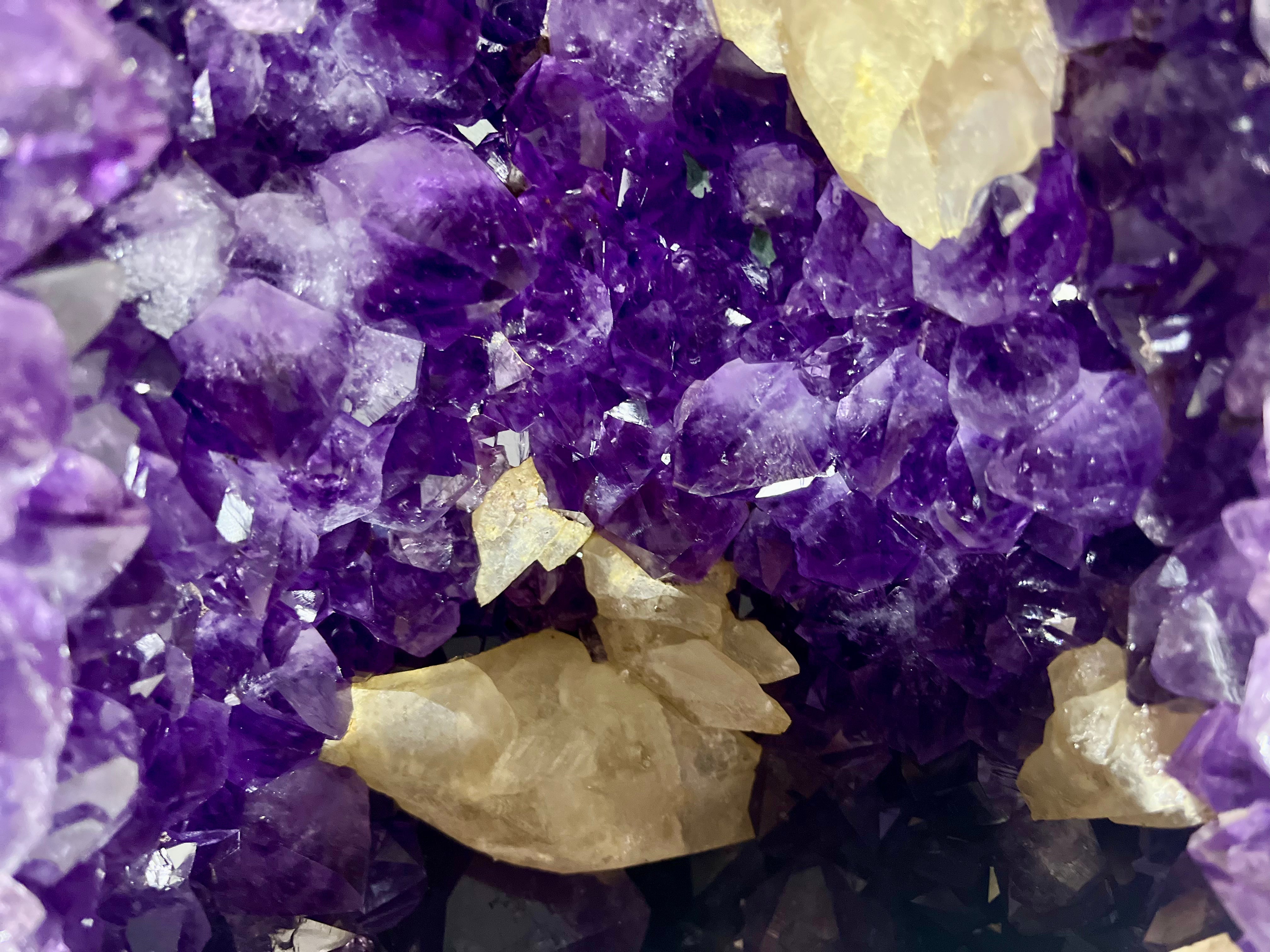
Amethyst - violet gemstone made of quartz
Amethyst Stone: The Violet Gemstone from Quartz – Origin, Meaning, and Properties

The Amethyst Stone is one of the most well-known and popular gemstones in the world. It is a violet variety of the mineral quartz, chemically known as silicon dioxide (SiO₂). Its characteristic color ranges from delicate lavender to rich deep violet. The color is caused by iron ions in the crystal lattice, activated by natural radiation. With a Mohs hardness of 7, amethyst is robust, suitable for everyday use, and versatile – as a jewelry stone, collector's piece, decorative object, and spiritual companion.
Mineralogical Classification of the Amethyst Stone
Amethyst belongs to the quartz group. Within this group, it is one of the macrocrystalline quartzes – its crystals are visible to the naked eye. The name derives from the Greek word amethystos, which means "not drunk." In ancient Greece, it was believed that the stone protected against intoxication.
The most important mineralogical data at a glance:
- Mineral class: Oxides, quartz (SiO₂)
- Hardness (Mohs): 7
- Density: approx. 2.65 g/cm³
- Crystal system: trigonal
- Color: light violet to deep violet, rarely reddish-violet
- Transparency: transparent to translucent
- Luster: vitreous luster
Amethyst is one of the oldest known gemstones in human history. More than 4,000 years ago, amethysts were already used as jewelry stones in Egypt and Mesopotamia.
Origin and Locations: Where Does Amethyst Come From?
Today amethyst is found on almost every continent. The most important mining regions in the world are Brazil, Uruguay, Namibia, Zambia, Russia, and India. Each region produces stones with a slightly different character.
Brazil – the World's Largest Supplier
The Brazilian state of Rio Grande do Sul is known for its enormous amethyst geodes. These cavities in basalt rock can be several meters tall. The crystals are often medium violet and very clear. Brazil supplies an estimated over 80% of the world's amethyst production.
Uruguay – Intense and Dark
Uruguayan amethysts are considered particularly high quality. Their color is deep and intensely violet, often with a bluish undertone. They also form in basalt cavities. At Crystal Paradise we carry our own selection of agatized amethysts from Uruguay – a special natural spectacle in which amethyst and agate are combined in a single piece.
Africa – Vivid and Valuable
Zambian amethysts often show an especially rich, reddish-violet color play. Namibian deposits also yield high-quality collector's pieces. African amethysts are frequently praised by gemologists for their exceptional saturation.
Amethyst Stone in Its Various Forms
In our showroom in Feldkirchen near Munich and in our online shop at Crystal Paradise, amethyst appears in many different forms. From years of experience in the mineral trade, we know: each form has its own unique appeal and its own applications.
Geodes and Druses
Amethyst druses and geodes are probably the most impressive forms. These are rock bodies with a cavity that is completely lined with amethyst crystals. They make an impressive impact as room decoration pieces and retain their effect for decades. Our amethyst geodes are hand-selected and come from controlled sources.
Points and Specimens
Amethyst points are natural or polished crystal points. They emphasize the mineral's natural growth form. Amethyst columns or specimens show a smooth-cut base with a natural crystal face. Both forms are excellent as decorative objects or for stone meditation.
Spheres and Tumbled Stones
Perfectly round amethyst spheres are cut from raw amethyst material. They require great craftsmanship. Tumbled stones are small, smoothly polished stones – ideal for beginners, as a pocket stone, or for children.
Care and Cleaning of the Amethyst Stone
With a Mohs hardness of 7, amethyst is relatively durable. Still, there are a few points to consider when caring for it.
- Avoid light: Amethyst is light-sensitive. Intense, prolonged sun exposure can lighten or fade the color. This is due to the temperature-dependent stability of the color-causing iron ions. The color begins to change at around 200°C.
- Clean gently: Rinsing with lukewarm clear water is sufficient. Do not use aggressive cleaning agents or ultrasonic cleaners.
- Store separately: Since amethyst itself has a Mohs hardness of 7, it cannot scratch harder minerals like topaz (hardness 8) or corundum (hardness 9) – but it can be scratched by them.
- Moisture: After cleaning, dry thoroughly to avoid water spots on polished surfaces.
- Energetic cleansing: In many spiritual traditions, amethyst is placed together with clear quartz or charged in moonlight. This practice is a personal choice without scientific basis.
Amethyst in Culture, History, and Spirituality

Amethyst has accompanied humans for thousands of years. In ancient Egypt it was worn as a protective amulet. In the Middle Ages it was reserved for bishops – purple-violet was considered the color of power and purity. Papal rings were frequently set with amethyst. In the 18th century, it lost some of its exclusivity when enormous deposits were discovered in Brazil.
In traditional stone lore, amethyst is regarded as the "stone of calm and clarity." According to traditional belief, it is said to promote inner balance, clear the mind, and calm a space. These properties have been passed down for centuries – they are spiritual attributions without scientific evidence.
Those interested in the spiritual side will find a deeper exploration of these traditions in our article Amethyst – The Stone of Inner Calm and Clarity.
Amethyst as a Water Stone and in Gemstone Water
A particularly popular topic is the use of amethyst as a water stone. Here, stones are used in direct or indirect contact with water to make what is known as gemstone water. In this tradition, amethyst is considered a suitable water stone.
Important to know: amethyst is water-stable and does not release harmful substances upon brief contact. Nevertheless, out of caution we always recommend the indirect method – meaning the stone is kept outside the water in a second container. Learn more in our detailed article Amethyst as a Water Stone & Gemstone Water.
Amethyst as a Gift – A Timeless Choice
The Amethyst Stone is a classic gift. Its violet color appears elegant and special. It is suitable for many occasions:
- Birthday – amethyst is the traditional birthstone for February
- Anniversary – amethyst is considered a symbol of fidelity and connection
- Christmas and jubilees – a personal, sustainable gift from nature
- Housewarming gift – an amethyst geode as room decoration is an unforgettable housewarming gift
- Graduation or promotion – as a sign of appreciation
Anyone looking for the right gemstone gift will find helpful guidance in our article Choosing a Gemstone Gift Made Easy.
Buying Amethyst: What Should You Look For?
When buying an amethyst, there are several quality criteria worth paying attention to:
- Color: The deeper and more even the violet, the more valuable. A bluish or reddish undertone increases the quality.
- Clarity: Transparent crystals with few inclusions are considered higher quality – for decorative pieces, inclusions play a lesser role.
- Origin: Pay attention to information about the source. Uruguayan or Zambian amethysts are especially prized.
- Treatment: Natural, untreated amethysts are rarer. Heated amethyst (which then appears yellowish) is marketed as citrine – this difference should be made transparent.
- Authenticity: Buy from reputable dealers who disclose origin and authenticity.
In our shop you'll find a hand-selected range of genuine amethysts in various forms: from raw specimens to polished spheres to impressive geodes. All pieces are personally inspected and curated by us.
For external mineralogical reference information, we recommend the Mindat.org data sheet on amethyst as well as the GIA (Gemological Institute of America), the world's leading institution for gemology.
Frequently Asked Questions

What exactly is an Amethyst Stone?
An Amethyst Stone is a violet variety of the mineral quartz (SiO₂). The color is caused by iron ions in the crystal lattice, activated by natural gamma radiation. With a Mohs hardness of 7, it is a robust gemstone used in jewelry as well as in decoration and stone collecting.
Where does the violet color of amethyst come from?
The violet color is caused by iron ions (Fe³⁺) incorporated into the quartz lattice. Natural radioactive radiation in the rock activates these ions, producing the typical violet hue. Heating the stone above 200°C fades or changes the color – it can turn yellow (citrine) or gray.
What forms of amethyst are available?
Amethyst is available in numerous forms: as a raw specimen or geode, as a polished tumbled stone, as an obelisk, sphere, or freeform, as well as a jewelry stone in necklaces and bracelets. Geodes show off the crystal points most impressively, while tumbled stones feel pleasant in the hand and are easy to carry.
Note: The described effects of gemstones and minerals are based on traditional experiences and beliefs. They are not scientifically proven and do not replace medical treatment or therapy.

Written by Christian Neumayer

Leave a comment
This site is protected by hCaptcha and the hCaptcha Privacy Policy and Terms of Service apply.