







Identifying Genuine Rose Quartz – How to Spot Fakes
How to Identify Rose Quartz at a Glance – What You Need to Know

Identifying genuine rose quartz is easier than you might think – once you know what to look for. Genuine rose quartz is a natural quartz mineral with the chemical formula SiO₂ and a hardness of 7 on the Mohs scale. Its characteristic pink color comes from tiny inclusions of titanite, rutile, or dumortierite. Fakes, on the other hand, are often made of colored glass, dyed resin, or low-grade quartz with an artificial coating. In this article, we'll show you how to reliably tell real rose quartz apart from imitations – with practical tests you can do at home.
Characteristics of Genuine Rose Quartz – These Are the Signs to Look For
Natural rose quartz comes mainly from Brazil, Madagascar, India, and the United States. The best-known deposits are located in the Brazilian state of Minas Gerais and in northern Madagascar. From our own experience in our showroom in Feldkirchen near Munich, we know: no two pieces of rose quartz look exactly alike. This uniqueness is an important sign of authenticity.
Color and Transparency
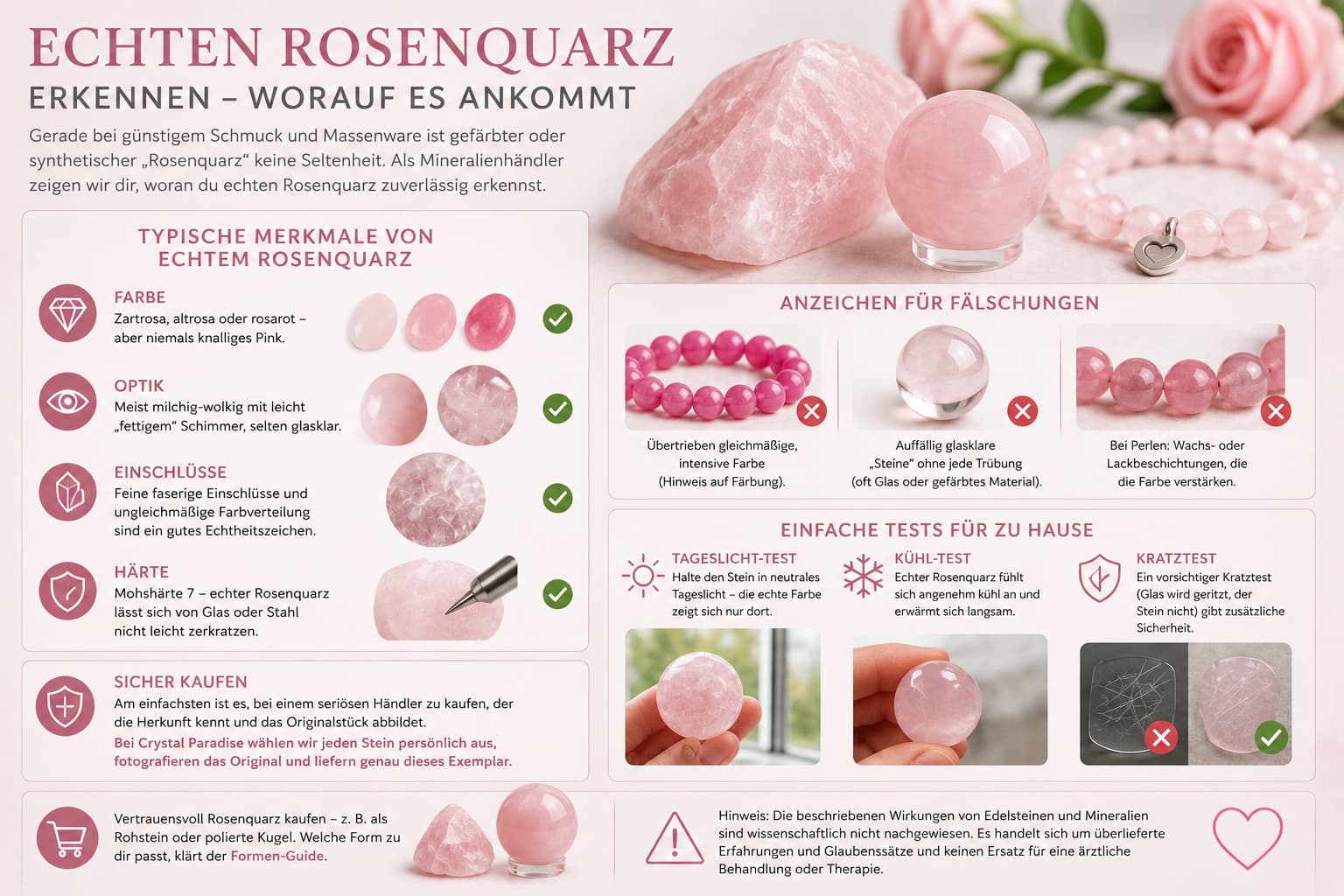
Genuine rose quartz shows a muted, milky-pink hue. The color appears naturally uneven. It ranges from delicate baby pink to deep, saturated pink. Glass imitations, on the other hand, often have a color that's too uniform and almost perfect. They appear strikingly clear and vibrant – a clear warning sign. Natural stone often contains slight streaks, clouding, or fine inclusions. These small "flaws" are actually proof of authenticity.
Transparency and Structure
Genuine rose quartz is typically translucent to opaque. Completely transparent, bubble-free pieces in intense pink are almost always glass or resin. Hold the stone up to a light source. Do you see tiny bubbles or complete clarity without any structure at all? That strongly suggests a fake. Genuine stone shows a slightly "milky" depth under light.
The Star Effect – Asterism
High-quality rose quartz from Madagascar shows a rare optical effect known as asterism. When illuminated, a six-rayed star appears on the surface. This effect is caused by needle-like rutile inclusions. No glass imitation can replicate this effect naturally. If you can see such a star, you're very likely holding a genuine stone.
Identifying Rose Quartz – Simple Tests You Can Do at Home
You don't need laboratory equipment to expose fakes. These practical tests will help you quickly and reliably.
The Temperature Test
Genuine quartz conducts heat very slowly. Hold the stone in your hand for about 30 seconds. Genuine rose quartz feels noticeably cooler at first than glass or plastic. Glass warms up quickly. Resin even picks up body heat very fast. Genuine stone stays noticeably cool for longer. This is one of the simplest and most reliable tests.
The Hardness Test
With a Mohs hardness of 7, rose quartz easily scratches ordinary window glass. Glass has a Mohs hardness of about 5.5. Perform the test carefully on an inconspicuous spot. Caution: only apply this test to stones you already own – and be gentle, so you don't damage valuable pieces. Resin, on the other hand, can easily be scratched with a fingernail (Mohs 2.5).
The Magnifying Glass Test
A simple 10x magnifying glass is a valuable tool. Glass often shows tiny air bubbles under magnification – a typical manufacturing feature. Genuine rose quartz instead shows natural growth lines, streaks, or mineral inclusions. These details are often hard to see with the naked eye, but clearly visible under magnification.
The Weight Test
Quartz has a density of about 2.65 g/cm³. Resin is noticeably lighter. Hold the stone in your hand and compare it to similarly sized objects. Genuine rose quartz feels "heavier" than it looks. Glass imitations, on the other hand, tend to feel light. Experienced collectors develop an intuitive sense for this over time.
Common Counterfeiting Methods – What You Should Know

The market for gemstones and minerals is booming. Unfortunately, there are also many fakes. Here are the most common tricks used by unscrupulous dealers:
- Colored glass: The classic among fakes. Often dyed in an intense, uniform pink.
- Resin imitations: Cheaply produced, very light, and warm to the touch. Often mixed with glitter or color.
- Coated quartz: Low-grade quartz receives a thin color coating. The coating can flake off or dissolve in water.
- Dyed rock crystal: Clear quartz is heated and treated with dyes. It has the correct hardness, but an unnatural color.
- Synthetic quartz glass: Produced in a lab, chemically similar, but without natural inclusions and growth features.
- Low-grade tumbled stones: Mass-produced, of unclear origin, and often without any quality control.
If you're interested in authentic, hand-selected pieces, Crystal Paradise offers a curated selection of genuine rose quartz in various forms – from raw stones to spheres.
Quality Features When Buying – What to Look for in a Dealer
A reputable dealer gives you all the important information. Pay attention to the following points when buying:
- Origin information: A good dealer states the country of origin and ideally the deposit. Example: "Rose quartz from Minas Gerais, Brazil".
- Certificate of authenticity: An important quality feature for high-quality collector's pieces.
- Transparent description: Clear information about treatments, processing, or enhancements.
- Photography: Professional photos from multiple angles show the real stone structure and color nuances.
- Return and warranty policy: Reputable shops like Crystal Paradise offer free returns and a satisfaction guarantee.
Our team is happy to advise you personally – in our showroom in Feldkirchen near Munich or through our customer service. We have carried hand-selected rose quartz in various forms for years: as rose quartz spheres, rose quartz raw stones, and as finely shaped rose quartz carvings.
For more in-depth comparisons, our article on identifying genuine amethyst is also worth reading – the testing methods are similar in many respects.
Rose Quartz in Crystal Lore – Traditional Meaning
In crystal lore, rose quartz is traditionally considered the stone of love and the heart. It is traditionally said to promote openness, compassion, and inner calm. According to tradition, it is said to resonate with the heart chakra and be connected to inner trust. These qualities make it one of the most popular healing stones of all. You can learn more in our detailed article on rose quartz meaning.
Importantly: all these traditional properties apply only to genuine stone. A fake made of glass or resin has no mineral structure of its own and no natural origin. That's another good reason to pay attention to authenticity when buying.
The scientific basis for rose quartz is provided by the Mindat Mineral Encyclopedia, an internationally recognized database for minerals and their properties. You can find detailed documentation of its mineralogical classification and occurrence there. The Spektrum.de Encyclopedia of Earth Sciences also offers well-founded background information on the formation and mineral structure of rose quartz.
Frequently Asked Questions

How can I identify rose quartz without doing a test?
Genuine rose quartz can be recognized by its milky-matte, uneven color, natural inclusions, and cool touch. Overly uniform color, bubbles, and a warm feel are warning signs of glass or resin. A trained eye often spots fakes at first glance – this experience develops over time.
Can dyed quartz be just as "good" as genuine rose quartz?
Mineralogically speaking, dyed rock crystal is also quartz with a Mohs hardness of 7, but it is not genuine rose quartz. The natural color comes from specific mineral inclusions – something no artificial treatment can fully replicate. For collectors and lovers of natural minerals, authenticity is a key quality feature.
Are there certificates for genuine rose quartz?
For high-quality collector's pieces, gemological reports can be issued. This is uncommon for standard tumbled stones or smaller decorative pieces. Trust here is built through a transparent dealer with clear origin information, a right of return, and proven experience in the mineral trade.
Is rose quartz from Madagascar better than from Brazil?
Both regions of origin produce high-quality rose quartz. Madagascan rose quartz more often shows the sought-after asterism effect (star quartz) and is considered especially valuable among collectors. Brazilian rose quartz from Minas Gerais stands out for its intense color and large deposits. Both origins are legitimate and high-quality.
Can I put rose quartz in water?
Genuine rose quartz is water-resistant and can be briefly cleaned in clear water. However, make sure there are no coatings or treatments present – these can come off. You can find more information in our article on cleaning and charging rose quartz.
Note: The properties mentioned are spiritual traditions without scientific evidence.

Written by Christian Neumayer

Leave a comment
This site is protected by hCaptcha and the hCaptcha Privacy Policy and Terms of Service apply.