







12 Mineralien für Einsteiger — und drei, die man am Anfang meiden sollte
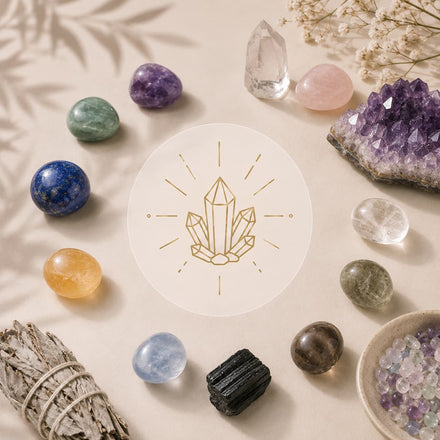
In short: For getting started, minerals with a Mohs hardness of 6 or above are best — chemically stable and affordable in the trade. These are mainly the quartzes — rock crystal, amethyst, rose quartz, citrine, smoky quartz, agate, aventurine, and tiger's eye — plus tourmaline, labradorite, pyrite, and aquamarine. Three very popular stones are, as it happens, not suited for beginners: fluorite, calcite, and malachite. They are soft, cleavable, or acid-soluble, and quickly suffer damage in everyday use.
What we based our selection on
A recommendation list without criteria is arbitrary. These four rules form the basis of the selection, and every stone below is measured against them:
- Mohs hardness of 6 or above. Household dust contains quartz grains with a hardness of 7. Anything softer becomes dull over time if left out or carried in a pocket.
- Chemically resistant. No breakdown in water, no solubility in weak acids, no abrasion from heavy metals.
- Affordable and available. A starter piece should be available for under 20 euros, otherwise collecting becomes more expensive than the interest justifies.
- Clearly identifiable. Beginners want to be able to tell pieces apart — without a lab.
The twelve
Rock Crystal
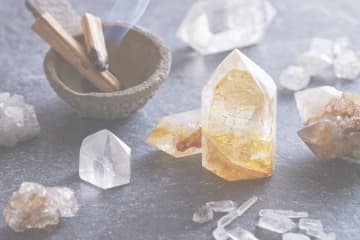
Colorless quartz, Mohs hardness 7, trigonal. The reference stone: it teaches how a quartz crystal is structured — six-sided prism, six-faced tip. Insensitive to water and light. Because it is transparent, inclusions and growth traces are especially well visible. To the encyclopedia entry
Amethyst
Violet quartz, hardness 7. The color comes from iron and natural irradiation. Important to know: amethyst fades in direct sunlight — that is not a quality defect, but physics. Don't place it on a windowsill. To the encyclopedia entry
Rose Quartz
Hardness 7, usually massive rather than in crystals. The pink color comes from tiny inclusions, not a dye. It too fades in strong sun. The most affordable starter pieces in our range start at 30 cents. To the encyclopedia entry
Citrine
Yellow quartz, hardness 7. Here a second look pays off: a large part of the material on the market is heat-treated amethyst — in that case the color tends toward orange-brown and is concentrated at the tip. Natural citrine is paler and more even. Both are genuine quartz, but the distinction belongs on the receipt. To the encyclopedia entry
Smoky Quartz
Brown to almost black, hardness 7. The coloring arises from natural irradiation of aluminum inclusions. Robust, insensitive, and a good example of the fact that quartz colors usually come from trace elements. To the encyclopedia entry
Agate
Fine-crystalline quartz in layers, hardness 7. The banding forms in stages in cavities of volcanic rock. Ideal for beginners because the structure is visible to the naked eye. Watch out when buying: many colorful agate slices are dyed. Natural colors are shades of gray, white, and brown, red being rarer.
Aventurine
Quartzite with fuchsite inclusions, hardness 6.5–7. The green sparkle — aventurescence — comes from tiny mica flakes. Not to be confused with aventurine glass ("goldstone"), a man-made product with copper flecks. To the encyclopedia entry
Tiger's Eye
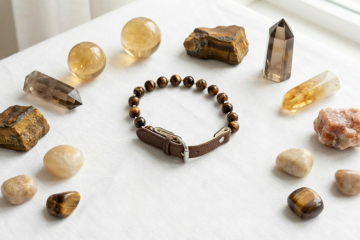
Hardness 6.5–7. The silky band of light arises from the fibrous structure: here quartz has replaced fibrous crocidolite and taken over its form. Here too — part of the material on the market is heat-treated or a glass imitation. To the encyclopedia entry
Tourmaline
Hardness 7–7.5, trigonal. An entire mineral group, not a single species — hence the variety of colors from black through green to pink. The typical longitudinal striping of the crystals is a good identifying feature. To the encyclopedia entry
Labradorite
Feldspar, hardness 6–6.5. The blue-green shimmer (labradorescence) arises from light refraction on the finest lamellae within the crystal — it is not a surface color, but an effect within the depth. That's why it's only visible from certain angles. As a feldspar, it has good cleavage unlike quartz: don't drop it. To the encyclopedia entry
Pyrite
Iron sulfide, hardness 6–6.5, cubic. The stone on which to learn crystal forms: cubic and pentagonal dodecahedral crystals with fine striping. Do not put in water — pyrite is a sulfide and can decompose with moisture ("pyrite decay"), producing sulfuric acid. Stored dry, it holds up without problems. To the encyclopedia entry
Aquamarine
Beryl, hardness 7.5–8 — the hardest on this list and thus the most durable. Six-sided prisms, often with smooth end faces. Good pieces are more expensive than the other eleven, but small rough pieces are already available cheaply. To the encyclopedia entry
Three popular stones to avoid at the start
These are not bad minerals — quite the opposite, they are among the most beautiful. But they require handling that has to be learned first. All three are among the best-selling categories, and that's exactly the problem: they get bought early and damaged early.
| Stone | Mohs hardness | The problem | When it's suitable |
|---|---|---|---|
| Fluorite | 4 | Soft and perfectly cleavable in four directions — a fall onto a table edge is enough to cause chipping. Also fades in sunlight. | In a display case, not in a pants pocket. |
| Calcite | 3 | Dissolves in weak acids, even vinegar fumes or acidic cleaners are enough. Hardly scratches with a fingernail, but easily with a coin. | Dry, dust-free, with no cleaning agents nearby. |
| Malachite | 3.5–4 | Soft, copper-bearing, sensitive to acids and heat. Grinding produces copper-bearing dust. | As a polished piece for display — do not work on it, do not put in water. |
What a starter set should cost
Realistic is 20 to 40 euros for five to eight pieces. Small rough pieces and tumbled stones from the quartz family start in the cent range, decent hand specimens range between 10 and 40 euros. Spending more doesn't buy better display material, but rarer pieces — that's the step after next.
More sensible than a ready-made set is your own selection based on a theme: all colors of one mineral species, or one stone from each crystal system, or specimens from a single deposit. An organizing principle turns stones into a collection.
Frequently Asked Questions
Which minerals are best suited for beginners?
The quartzes: rock crystal, amethyst, rose quartz, citrine, smoky quartz, agate, aventurine, and tiger's eye. All have a Mohs hardness of 7 or just below, are chemically stable, affordable, and available in every form. Those wanting variety can add tourmaline, labradorite, pyrite, and aquamarine.
Why is Mohs hardness so important for beginners?
Because ordinary household dust contains quartz grains with a hardness of 7. Anything softer gets scratched when wiped and becomes dull over time. From hardness 6, a stone is suitable for everyday use, from 7 practically insensitive to dust.
Which minerals should not be put in water?
Sulfides such as pyrite, copper-bearing minerals such as malachite and azurite, carbonates such as calcite and aragonite, as well as water-soluble minerals such as selenite. With fluorite, water is unproblematic, its sensitivity lies in impact and light. This is covered in detail in our article on water stones.
How can I recognize dyed or treated stones?
Three clues: unnaturally intense, uniform colors; color that collects in cracks rather than being evenly distributed; and a price that is noticeably below what's usual for natural material. Dyed agate, heat-treated amethyst sold as citrine, and heat-treated tiger's eye are the most common cases. Reputable sellers disclose treatments.
Do I need certificates for minerals?
Not for starter-level collector pieces. More important than a certificate is the statement of the locality: it can be professionally verified, a certificate without provenance cannot. For expensive gemstones with suspected treatment, a gemological report makes sense — for a 15-euro rock crystal, it does not.
How do I properly store a small collection?
Dry, low-dust, and out of direct sunlight. Amethyst, rose quartz, and fluorite fade in light. Lay soft pieces separately so they don't scratch each other — a rock crystal will scratch a calcite effortlessly. Add a locality label: without provenance, a stone is just a pretty object.

Written by Christian Neumayer
Leave a comment
This site is protected by hCaptcha and the hCaptcha Privacy Policy and Terms of Service apply.