







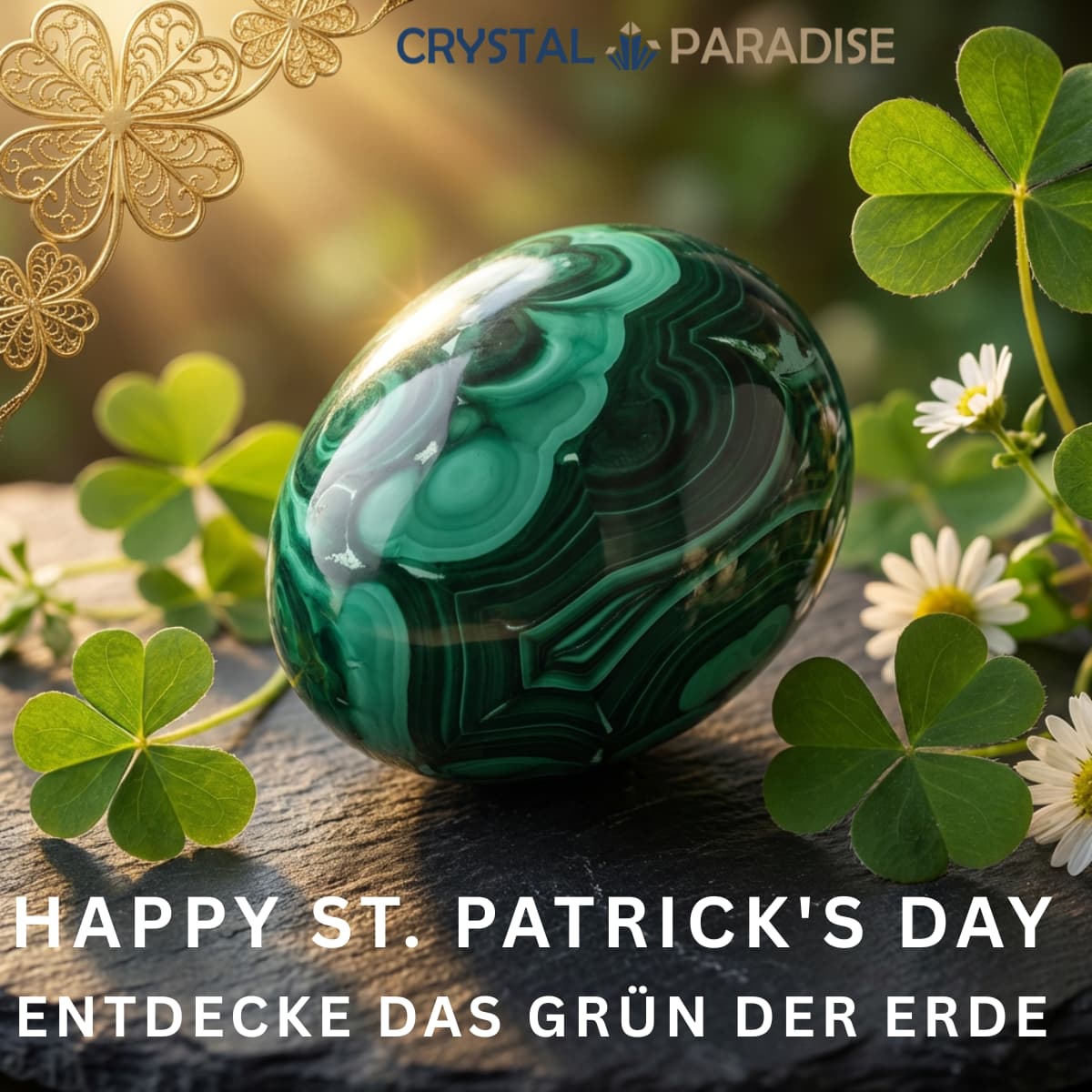
Happy St. Patrick's Day - Discover the Green of the Earth
Green Minerals: The Most Beautiful Stones for St. Patrick's Day

On March 17th, millions of people around the world celebrate St. Patrick's Day – the Irish festival of hope, spring, and of course, green. But the green of the earth isn't only found in shamrocks. Green minerals are fascinating natural treasures that form deep within the earth. They owe their color to chemical compounds such as iron, chromium, or copper – and have captivated collectors, mineralogists, and nature lovers alike for centuries. In this article, we introduce you to the most beautiful green stones on earth and explain what makes them so special.
What Makes Green Minerals So Special?
Green is the color of life, growth, and nature. No wonder green minerals hold a special fascination. Their color arises from a variety of different chemical processes. Some owe their green to the trace element chromium – like Emerald, one of the most sought-after gemstone varieties of beryl. Others, like Malachite, form through copper oxidation and display characteristic banded structures in rich shades of green.
Mineralogically speaking, green minerals belong to one of the most diverse color groups of all. Hardness levels range from 2 (Malachite) to 7.5 (Emerald on the Mohs scale). Formation temperatures vary depending on the mineral type between roughly 100 °C and over 600 °C. This enormous range explains why green stones originate from so many different geological environments. A well-founded scientific overview of mineral colors and their causes is offered by the portal of the German Mineralogical Society.
In our showroom in Feldkirchen near Munich, we see every day how strongly people are drawn to green minerals. We recommend that every beginner hold the variety of green stones directly in their hands – because only in direct comparison does it become clear how different the texture, luster, and depth of these minerals truly are.
The Most Well-Known Green Minerals at a Glance
Here are some of the most fascinating representatives of the green mineral world – from classic to rare:
Malachite – The Green Copper Ore
Malachite is one of the best-known green minerals of all. It forms as a secondary copper ore through the weathering of copper-bearing rocks. Its characteristic feature is the concentric bands in various shades of green. On the Mohs scale, Malachite reaches a hardness of 3.5 to 4. Significant deposits are found in the Democratic Republic of the Congo, Russia, and Namibia. In the Minerals from the DR Congo Collection, you'll find exceptional specimens at Crystal Paradise, sourced directly from one of the world's most important mining regions.
In lithotherapy, Malachite is traditionally regarded as a stone of transformation and change. These attributions are spiritual traditions without scientific evidence.
Emerald – King of the Green Gemstones
Emerald is probably the most famous green gemstone in the world. It belongs to the beryl silicate mineral group and gets its intense green color from traces of chromium and vanadium. With a hardness of 7.5 to 8 on the Mohs scale, it is significantly more durable than many other green stones. The most important deposits are located in Colombia, Zambia, and Brazil. High-quality Emeralds have been used and revered by humans for over 3,500 years – a testament to their timeless beauty. Mineralogical background on the beryl group is documented in detail, among other places, at the international mineral reference portal Mindat.org.
Green Apophyllite – Crystal-Clear Elegance
Green Apophyllite is a true insider tip among green minerals. It forms crystal-clear, tetragonal crystals that shine in a delicate green. The hardness is about 4.5 to 5. The best-known deposits are located in Pune (India). Apophyllite often grows together with Stilbite on basalt rock. Learn more about this fascinating stone in our blog post about Green Apophyllite.
Aventurine – The Stone of Luck
Green Aventurine is a quartz variety with a characteristic sparkle effect. This so-called aventurescence is created by embedded fuchsite flakes (green mica). The hardness is 6.5 to 7. Aventurine is often used for spheres, freeforms, and jewelry pieces. It is found worldwide, with significant deposits in India, Russia, and Austria. It is traditionally attributed with luck and confidence – fitting for St. Patrick's Day and its shamrock symbolism.
Amazonite – Blue-Green Feldspar
Amazonite is a blue-green feldspar with a hardness of 6 to 6.5. Its characteristic turquoise-green coloring is caused by lead and water inclusions in the crystal lattice. Significant deposits are located in Russia, the United States (Colorado), and Brazil. Amazonite is a popular stone for jewelry and decorations.
Green Minerals and Their Cultural Significance

Green stones have always played a special role throughout human history. In antiquity, Emerald was considered the sacred stone of the goddess Venus. The ancient Egyptians used Malachite as a decorative stone and pigment more than 4,000 years ago. The Aztec civilization revered Jade as a symbol of life and fertility. Today, too, many people associate green minerals with growth, renewal, and connection to nature.
St. Patrick's Day on March 17th is a wonderful occasion to celebrate this connection. The Irish festival reminds us how deeply the green of nature is rooted in our cultural memory – and green minerals are a genuine, enduring part of this earth.
If you'd like to learn more about the fascinating world of rare minerals, we recommend our article about 8 Rare Mineral Types with Special Charm.
Buying Green Minerals: What You Should Look For
There are several important points to consider when buying green minerals. Not all stones that appear green are truly natural. Here are our most important tips:
- Check authenticity: Look for transparent origin information. Reputable dealers state the country and region of origin.
- Question treatments: Some stones are dyed or stabilized with synthetic resin. Ask specifically about untreated natural pieces.
- Know quality features: With Malachite, clear banding is a quality feature. With Aventurine, the sparkle effect is decisive.
- Choose dealers with expertise: Family-run shops with their own showroom experience often offer better guidance than anonymous marketplaces.
- Follow care instructions: Soft stones like Malachite (hardness 3.5–4) should not come into contact with acids or aggressive cleaners.
Are you new to the world of minerals? Then it's worth taking a look at our collection Discover the Fascinating World of Minerals for Beginners – with curated starter pieces and easy-to-understand descriptions.
Care and Storage of Green Minerals
Green minerals deserve loving care. The rule is: the softer a stone, the more sensitive it is. Here are our practical recommendations:
- Cleaning: Most green minerals can be cleaned with a soft, slightly damp cloth. Malachite should never be placed in water – it is sensitive to acids and moisture.
- Storage: Hard stones like Emerald or Aventurine can be stored together. Soft stones like Malachite should be stored separately to avoid scratches.
- Light protection: Some minerals can fade with prolonged sun exposure. Green Aventurine, on the other hand, is largely light-resistant.
- Energetic care: In lithotherapy, it is traditionally attributed that stones should occasionally be cleaned under running water or placed in fresh air. This practice is spiritual in nature.
Frequently Asked Questions

Which green minerals are particularly rare?
Among the rarer green minerals are Tsavorite (a green garnet variety), Demantoid from the Urals, and Paraiba Tourmaline. These stones are especially sought after due to their limited occurrence and intense colors. Tsavorite was only discovered in 1967 in Tanzania, making it, geologically speaking, a comparatively recent find for mineralogy.
Why do some green minerals differ so much in color?
The color differences arise from various chemical trace elements in the crystal lattice. Chromium produces intense green tones as in Emerald. Copper creates blue-green tones as in Malachite or Amazonite. Iron can produce both yellow-green and dark green shades. Even minimal concentration differences – sometimes under 0.1 percent – visibly change the color.
Are green minerals suitable as a gift?
Absolutely. Green minerals make excellent gifts – especially for spring or occasions like St. Patrick's Day. Aventurine is traditionally regarded as a lucky stone and makes a symbolically meaningful present. Malachite impresses with its visual uniqueness. For beginners, we recommend polished freeforms or spheres, as they are especially handy and decorative.
How can I recognize genuine green minerals?
Genuine minerals feel cooler to the touch than plastic and have natural irregularities. Dyed stones often have a color that is too uniform, without natural inclusions or shading. It's best to buy from dealers who transparently disclose origin and composition. At Crystal Paradise, all pieces are hand-selected and provided with clear origin information.
Which green minerals are suitable for jewelry and bracelets?
For jewelry and bracelets, harder green minerals such as Aventurine (hardness 6.5–7), Jade, or Turquoise are especially suitable. They are more resistant to everyday wear. Malachite (hardness 3.5–4) is suitable for pendants but should not be worn constantly. Our Bracelets Collection offers you a selection of handcrafted pieces with genuine minerals.
Note: The properties mentioned are spiritual traditions without scientific evidence. Crystal Paradise makes no medical healing claims. Minerals and healing stones do not replace

Written by Christian Neumayer


Leave a comment
This site is protected by hCaptcha and the hCaptcha Privacy Policy and Terms of Service apply.