







Birthstone by Month: All 12 Birthstones at a Glance
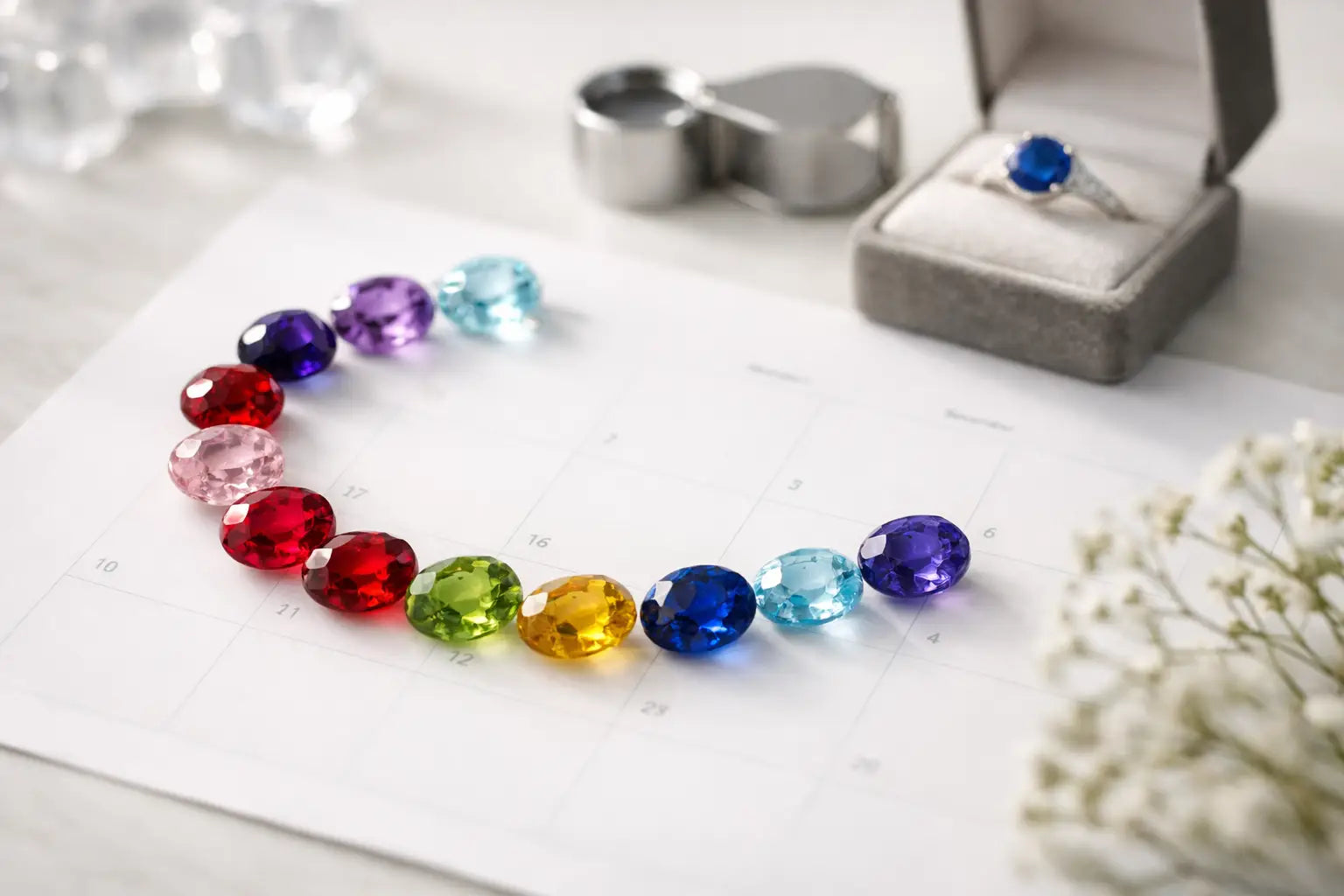
In short: Each month is assigned a birthstone. The list used internationally today was standardized in 1912 by the American jewelers' association. The birthstone for February is amethyst.
| Month | Birthstone |
|---|---|
| January | Garnet |
| February | Amethyst |
| March | Aquamarine |
| April | Diamond |
| May | Emerald |
| June | Moonstone |
| July | Ruby |
| August | Peridot |
| September | Sapphire |
| October | Opal |
| November | Topaz |
| December | Turquoise |
Birthstone by Month: The Complete Overview for All 12 Months

The birthstone by month is a time-honored gemstone assigned to a person's birth month. This tradition dates back thousands of years – the earliest written mentions can be found as far back as the 1st century AD, by the Jewish-Roman historian Flavius Josephus. Today, this tradition is widespread around the world and offers a wonderful guide: whether for a personal gift, as a jewelry stone, or as a spiritual companion – the matching birthstone by month carries a meaning that goes far beyond mere appearance.
At Crystal Paradise, we have been helping our customers find the right stone for years. We always recommend choosing a birthstone not only based on tradition, but also on personal resonance. In this article, we explain all 12 months with their classic birthstones, their mineralogical properties, and their traditional meaning.
Why the Birthstone by Month Carries Such Special Meaning
The idea of assigning a specific gemstone to each month is not a modern invention. The modern, internationally recognized list of birthstones was officially standardized in 1912 by the American jewelers' association. Since then, it has served as the global reference. You can find a detailed overview of the modern birthstone list, for example, at the Gemological Institute of America (GIA), one of the world's leading institutions for gemology.
Why are birthstones so popular? Quite simply: they combine natural beauty with personal meaning. A stone that belongs to one's own birth month carries its own story. It is not just any piece of jewelry – it is a personal companion from the earth.
- Personal connection: A birthstone feels individual – suited to you, not to everyone.
- Tradition and history: Thousands of years of lore give the stone depth and symbolic power.
- A gift idea with meaning: A birthstone is a thoughtful, personal gift.
- Spiritual dimension: In crystal healing lore, each birthstone is said to carry its own energy.
- Aesthetics and variety: From deep blue to vibrant green – the color palette is impressive.
Anyone interested in the topic of gemstones as gifts will find valuable tips for choosing the right one in our blog article Choosing a Gemstone Gift Made Personal and Easy.
Birthstone by Month: The Complete List of All 12 Stones

Here you will find all 12 months with their classic birthstones, a brief mineralogical classification, and their traditional meaning. The mineralogical data is based on recognized mineralogical sources, including the mineral database Mindat.org, the world's most extensive public mineral reference.
January – Garnet
Garnet is one of the oldest gemstones used by humankind. Mineralogically, it is a group of silicates with a Mohs hardness of 6.5 to 7.5. The best-known color is a deep dark red, but garnets also occur in green, orange, and even blue. In crystal healing lore, garnet is traditionally said to strengthen energy and zest for life.
February – Amethyst
Amethyst is a purple variety of quartz. Its color is caused by traces of iron within the crystal lattice. With a hardness of 7 on the Mohs scale, it is durable and versatile. Important deposits are found in Brazil and Uruguay. In crystal healing lore, amethyst is traditionally regarded as a stone of calm and inner clarity. Our agatized amethysts from Uruguay are among the most sought-after pieces in our collection.
March – Aquamarine
Aquamarine is a blue-green variety of the mineral beryl. Its Mohs hardness is 7.5 to 8. The name derives from the Latin "aqua marina" – seawater. Aquamarine is traditionally said to promote clarity in communication and inner calm. Important deposits are found in Brazil and Pakistan.
April – Diamond
Diamond is the hardest natural mineral – with a hardness of 10 on the Mohs scale. It consists of 100% carbon. As April's birthstone, it has traditionally stood for purity, strength, and lasting bonds. Its extraordinary refraction of light makes it the most coveted gemstone in the world.
May – Emerald
Like aquamarine, emerald belongs to the beryl family. Its rich green color is due to traces of chromium and vanadium. Emeralds have a hardness of 7.5 to 8. In many cultures, it is traditionally said to strengthen compassion, loyalty, and inner growth. Historical finds come from Egypt – ancient mines are believed to be over 3,500 years old.
June – Moonstone
Moonstone is a variety of feldspar and displays a characteristic play of light known as adularescence. Its Mohs hardness is 6 to 6.5 – making it relatively delicate. In crystal healing lore, moonstone is traditionally said to promote intuition and inner balance. Important deposits are found in Sri Lanka and India.
July – Ruby
Ruby is a red variety of the mineral corundum. With a hardness of 9, it is one of the hardest minerals of all. Its vivid red color is caused by traces of chromium. It is traditionally regarded as a stone of passion, vitality, and life force. The most valuable rubies come from Myanmar (Burma).
August – Peridot
Peridot is one of the few gemstones that occurs in only one color – a characteristic olive green. Chemically, it is a magnesium-iron silicate (olivine) with a hardness of 6.5 to 7. Interestingly, peridot also occurs in meteorites. In crystal healing lore, it is traditionally said to promote balance and openness.
September – Sapphire
Like ruby, sapphire is a variety of corundum – but in blue, caused by traces of titanium and iron. Its hardness is also 9 on the Mohs scale. Sapphire has traditionally stood for wisdom, truth, and inner strength. Sri Lanka, Kashmir, and Myanmar are important sources.
October – Opal
Opal is a fascinating mineral that lacks a crystalline lattice – it is considered a mineral gel. Its Mohs hardness is 5.5 to 6.5, which is why it requires special care. Opal's famous play of color is caused by the diffraction of light on tiny spheres of silicon dioxide. In crystal healing lore, opal is traditionally said to promote creativity and spontaneity.
November – Topaz
Topaz is an aluminum fluorosilicate with a hardness of 8. The classic birthstone for November is golden-yellow topaz, though it also occurs in blue, pink, and colorless varieties. Important deposits are found in Brazil, Pakistan, and Russia. In crystal healing lore, topaz is traditionally regarded as a stone of warmth, joy, and inner strength.
December – Turquoise
Turquoise is one of the oldest known gem minerals. It was already in use more than 5,000 years ago in ancient Egypt. Its Mohs hardness is 5 to 6. Its characteristic blue-green color is caused by copper and aluminum compounds. In crystal healing lore, turquoise is traditionally associated with protection and harmony. Important deposits are found in Iran, the USA, and the Sinai.
Birthstone by Month as a Gift – Our Practical Recommendations
From years of experience working with crystals and gemstones, we at Crystal Paradise know: the most beautiful birthstone is the one that truly resonates. In our showroom in Feldkirchen near Munich, we see every day how people intuitively reach for their stone – and it is exactly this connection that makes a birthstone gift so special.
We recommend the following steps for the perfect selection:
- Quality over price: Look for genuine, untreated stones. Many cheap offers are dyed or synthetic.
- Know the origin: A stone with a known source is more valuable – both mineralogically and symbolically.
- Form according to purpose: Polished stones are suitable for jewelry, while hand specimens or freeforms work well for home decor.
- Personal resonance: Let the recipient choose – or choose intuitively. Often the first instinct is right.
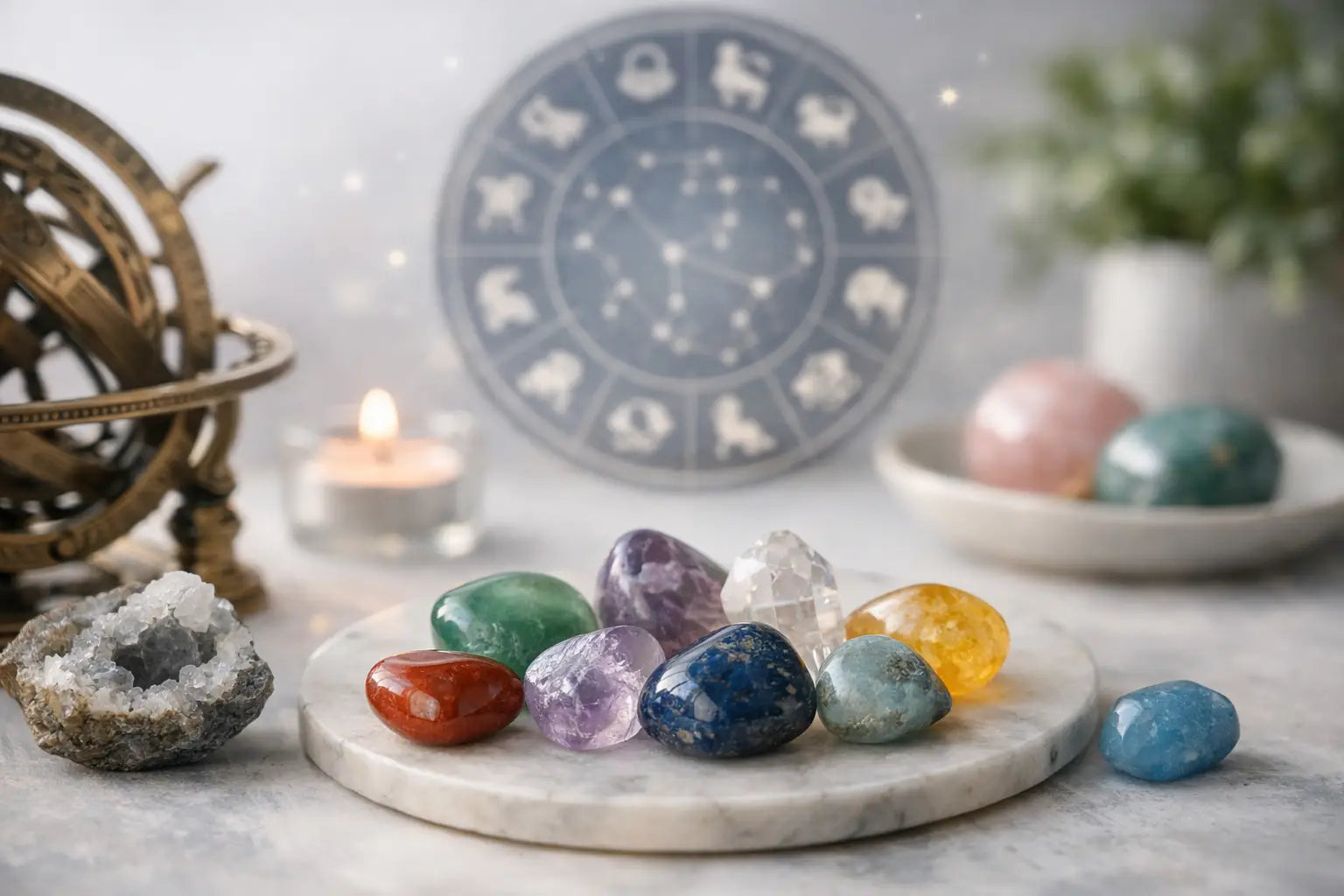
- Combination with zodiac sign: A birthstone by month and a zodiac stone don't have to be identical – both complement each other wonderfully.
Anyone wanting to deepen the connection between stones and zodiac signs will find helpful information in our article Finding Healing Stones by Zodiac Sign Made Easy. And for those just starting out, we recommend our guide Choosing Healing Stones for Beginners Made Easy.
You can find all birthstones from our curated collection directly in our Birthstones Collection – handpicked, with origin information, and available in various forms.
Care and Handling of Birthstones

Gemstones and minerals need care. A few basic tips will help preserve the beauty of your birthstone over the long term:
- Cleaning: Most stones can be carefully cleaned with lukewarm water and a soft cloth. Delicate stones such as opal or turquoise should not be soaked in water for long.
- Storage: Stones of different hardness should be stored separately to avoid scratches. Diamond, with a hardness of 10, can for example damage amethyst (hardness 7).
- Sunlight: Amethysts and other colored quartzes can fade with prolonged sun exposure. Cool, light-protected storage is ideal.
- Avoid chemicals: Perfume, cleaning products, and sweat can damage sensitive stones – opals and turquoise are especially sensitive.
- Energetic care: In crystal healing lore, it is traditionally recommended to regularly cleanse stones under f
Note: The effects mentioned are spiritual traditions without scientific evidence. They do not replace medical advice or treatment.

Leave a comment
This site is protected by hCaptcha and the hCaptcha Privacy Policy and Terms of Service apply.