







Azurite: Properties, Origin and Identifying Features
Azurite: Properties, Origin, and Identifying Features
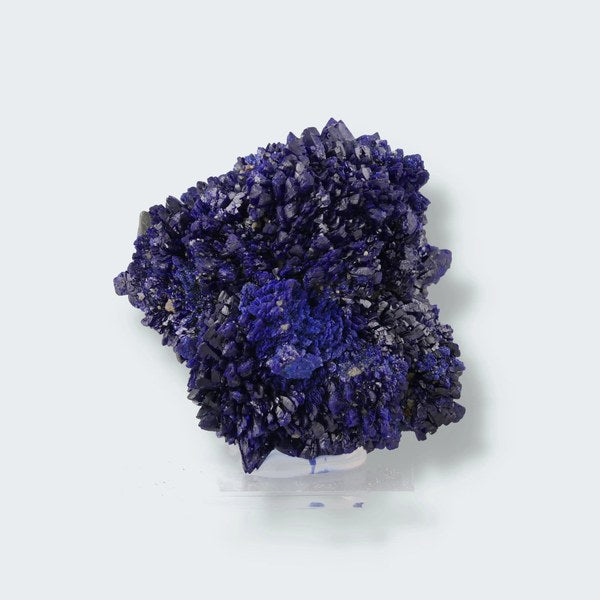
Azurite is one of the most colorful minerals in the copper group. This deep blue copper carbonate hydroxide mineral fascinates collectors and geologists alike – through its intense color, its interesting formation history, and the often spectacular intergrowths with green malachite. Anyone familiar with this copper stone quickly understands why it has attracted attention for centuries. In this article you'll find all the essential information: mineralogical basics, important localities, identifying features, and care instructions – compiled from the experience we gain at Crystal Paradise while purchasing, examining, and selecting these pieces.
What is Azurite Mineralogically?
Azurite is a secondary copper carbonate hydroxide mineral with the chemical formula Cu₃(CO₃)₂(OH)₂. It does not form at depth, but in the oxidation zone of copper ore deposits – where water, oxygen, and primary copper sulfides react with one another. This weathering process is what gives the mineral its characteristic appearance.
The deep blue to slightly violet coloration results from the presence of Cu²⁺ ions in the crystal lattice. With a Mohs hardness of 3.5 to 4, the mineral is relatively soft – comparable to fluorite, but noticeably softer than quartz. This significantly affects both processing and storage.
Crystallographically, the stone belongs to the monoclinic crystal system. In nature, however, it occurs more often as massive, botryoidal, or reniform aggregates than as well-formed individual crystals. Glassy to silky luster and a transparency ranging from translucent to opaque characterize the mineral visually. Particularly noteworthy: azurite and malachite often form together at the same localities – both are copper carbonates, but differ clearly in color and chemical composition.
Origin: Where Does This Copper Stone Occur?
The mineral forms wherever copper ore deposits oxidize at the earth's surface. Localities exist worldwide – from Morocco to Australia and Namibia to Chile and the United States. Historically known deposits in Arizona (USA) once yielded significant collector's specimens; localities such as Bisbee or Morenci are still well-known names in the collecting world today.
Kazakhstan is today one of the most important sources for collector-grade specimens of this mineral. Kazakh specimens are often characterized by intense blue coloration and well-developed surfaces. Material from Laos rounds out the available range from Central Asia. These localities are known for azurite. At Crystal Paradise, we select our pieces according to mineralogical quality criteria and authenticity – each one is individually inspected.
Morocco – particularly the region around Touissit – is also known for its deposits. Australian localities such as Broken Hill were historically significant. The quality of specimens varies greatly depending on locality and geological conditions: crystal size, color intensity, associated minerals, and the formation of aggregates sometimes differ considerably from region to region.
If you'd like to learn more about our available range, take a look at our Azurite Collection – there you'll find raw mineral specimens from Kazakhstan as well as material from Laos.
Real or Mistaken? How to Identify the Mineral
Azurite is occasionally confused with other blue minerals in the trade. Experienced collectors know the most important distinguishing features by heart – and at Crystal Paradise we check exactly these characteristics before a piece enters our range.
Azurite vs. Malachite: Malachite is green, the copper stone deep blue. Both form from copper ore and often grow together – the so-called azurite-malachite is a natural intergrowth, not a fake. The boundary zone between blue and green on a single piece is a reliable mark of authenticity.
Azurite vs. Lapis Lazuli: Lapis lazuli is noticeably denser, often contains visible pyrite inclusions (golden flecks), and shows a more uniform, matte blue. The mineral appears more intense and less even on the surface. The Mohs hardness of lapis lazuli is 5 to 6 – significantly higher than that of the copper stone.
Azurite vs. Synthetic Material: Genuine azurite reacts with diluted hydrochloric acid – bubbling occurs (CO₂ release). Synthetic blue stones do not show this reaction. Density, hardness, and the typical surface structure also help with differentiation. If in doubt, it's best to rely on a reputable dealer and ask about provenance.
Another feature: the mineral is relatively easy to scratch. A fingernail (Mohs hardness ~2.5) cannot damage the surface, but a steel knife (Mohs hardness ~5.5) leaves a scratch easily. This simple test helps with classification.
Deposit Regions and Quality Features
Not every specimen is the same. What distinguishes high-quality collector's pieces can be determined by a few characteristics: intensity of the blue coloration, formation of the aggregates or crystals, surface quality, and associated minerals.
Specimens from Kazakhstan generally stand out due to their pronounced, irregularly structured surface. The aggregates are often botryoidal to reniform and display the typical silky to glassy luster. Collectors particularly value those pieces where the blue coloration remains even and intense – without too strong signs of weathering toward malachite.
Material from Laos often provides pieces with their own character. Associated minerals such as malachite or copper oxides sometimes give specimens from this region a special visual depth. With Azurite-Malachite Intergrowths, the ratio between blue and green determines whether the piece is classified more as one mineral or the other.
For tumbled stones and carvings, dense, less fragmented material is preferred. The softness of the mineral requires careful processing – pieces that are too porous or heavily fractured break easily under mechanical stress. Pure, well-formed raw specimens without strong signs of weathering are the first choice for a collection.
At Crystal Paradise, each piece is individually selected and photographed from all sides – what you see in the shop is exactly the piece you'll receive. No sample images, no surprise package.
Care and Storage
Azurite is a sensitive mineral – there's no sugarcoating that. Anyone who wants to keep their pieces in good condition over the years should know a few basic rules.
Avoid moisture: Under sustained humidity, the mineral can slowly transform into malachite. This is a natural weathering process – chemically speaking, the piece loses CO₂ and transforms into the more stable copper carbonate hydroxide malachite. Green discoloration on a blue specimen is therefore not a sign of forgery, but of genuine material under improper storage conditions.
Store dry and dark: A dry display cabinet without direct sunlight is ideal. UV light can affect the color over the long term. Temperature fluctuations are less critical than sustained moisture exposure.
Cleaning: Clean only with a dry, soft brush. No water, no chemical cleaners, no ultrasonic baths. Acids should generally be avoided – the mineral reacts to them, as the authenticity test shows.
Protection from scratches: With a Mohs hardness of 3.5 to 4, pieces can be easily damaged. Specimens should not be stored loose together with other minerals. Individual display surfaces or cotton beds in the cabinet protect the surface.
In Collection and Range
Azurite is excellently suited as a collector's piece. The deep color, the interesting formation history, and the intergrowths with malachite make it a versatile mineral for any collection – whether for beginners or experienced collectors.
At Crystal Paradise, we carry raw mineral specimens from Kazakhstan in various sizes – from compact specimens to heavier pieces. Azurite-malachite material is also available, including tumbled stones. Azurite from Laos rounds out the range.
Anyone interested in the related mineral lapis lazuli, which is also deep blue and can likewise form from copper minerals, will find a dedicated selection in our Lapis Lazuli range – including tumbled stones from Badakhshan, historically the most significant locality for lapis lazuli worldwide.
Selection at Crystal Paradise always takes place on site: each piece is individually inspected and photographed from all sides. Anyone who would rather view the pieces in person is warmly invited to visit our showroom in Feldkirchen near Munich – or to meet us at mineral shows.
Frequently Asked Questions
Is Azurite-Malachite a Fake?
No. Azurite and malachite often grow together because both minerals form from the weathering of copper ore. This natural intergrowth is mineralogically completely genuine and valued by collectors. It is neither an artificial treatment nor a mixture – the transition from blue to green forms directly within the deposit.
Why Does My Azurite Turn Green When I Store It?
This is natural weathering. Under humid conditions, the mineral slowly transforms into malachite – it loses CO₂ in the process and changes its chemical composition. Stored dry and dark, the piece remains stable. A green discoloration is not a sign of poor quality, but an indication that the material is genuine and reacting to its environment.
Can Azurite Be Worn or Made into Jewelry?
Due to its low Mohs hardness of 3.5 to 4, the mineral is unsuitable for rings or jewelry worn daily. The surface would scratch quickly. Pendants or earrings in a protective setting are more feasible, but should still be handled carefully. For collecting and displaying on a shelf or in a display cabinet, however, the copper stone is excellently suited.
How Do I Know If My Piece Is Genuine?
Genuine specimens show an intense deep blue color and react with diluted acid – bubbles form due to CO₂ release. In addition, the mineral is relatively soft (a fingernail leaves no scratch, a knife does) and has a moderate density. Comparison with reference material helps, as does buying from a transparent dealer with clear provenance information.
Which Origin Is Most Valuable?
Kazakhstan is known among collectors for intense coloration and well-formed aggregates. Historically valued deposits from Arizona (USA) or Morocco also yield high-quality pieces. Ultimately, color, aggregate formation, surface quality, and size determine the value – not the locality alone. Material from Laos can be just as appealing as specimens from other regions of the world.

Written by Christian Neumayer

Leave a comment
This site is protected by hCaptcha and the hCaptcha Privacy Policy and Terms of Service apply.