







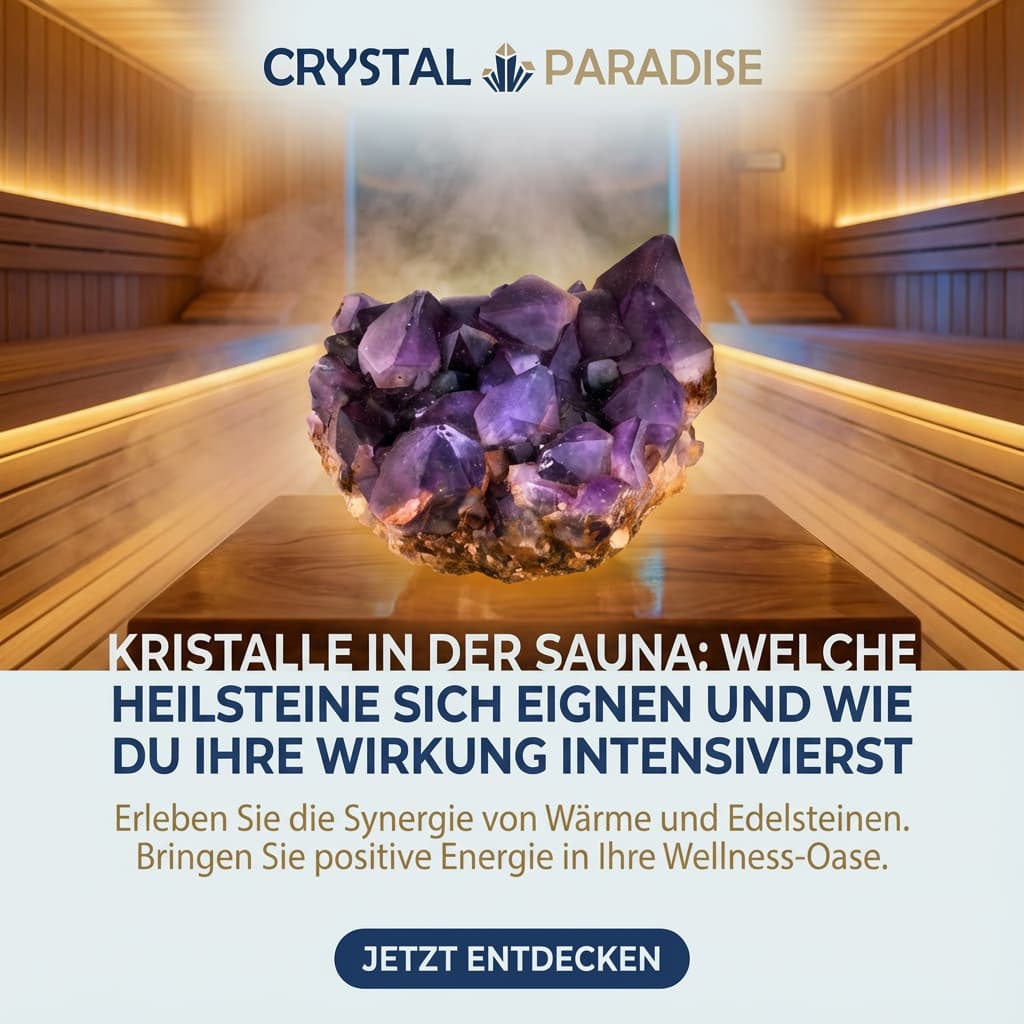
Crystals in the Sauna: The best healing stones for relaxation, detox & energy work
Crystals in the Sauna – What's Behind the Trend?

Crystals in the sauna – this combination is inspiring more and more wellness fans in the German-speaking world. The idea behind it is as simple as it is fascinating: Selected stones are brought into the sauna area – traditionally as a deliberately placed element, to make the ritual more mindful. But which stones are really suitable for temperatures of up to 100 °C? And what should be considered mineralogically? This article gives clear answers – factual, practical, and with real added value.
At Crystal Paradise, we've been accompanying people on their journey with crystals and healing stones for years. From our own experience, we know that the trip to the sauna can become one of the most intense moments in which a stone unfolds its full potential as a companion – provided you choose the right one.
Why Crystals in the Sauna? Mineralogical Basics
Before we introduce specific stones, it's important to take a brief look at mineral physics. Not every stone tolerates heat and steam equally well. Three factors are decisive:
- Mohs hardness: This describes a mineral's scratch resistance on a scale of 1 to 10. Soft stones below hardness level 5 can suffer more quickly from steam and condensation.
- Water content in the mineral: Some stones like opal contain up to 21% bound water. Intense heat can cause them to crack or become cloudy.
- Chemical stability: Certain minerals are sensitive to moisture or heat – for example pyrite, which can oxidize.
Stones with a Mohs hardness of at least 6, without water inclusions and with a stable crystal structure, are therefore ideal for the sauna. These include mainly quartz varieties and massive, dense minerals. A well-founded mineralogical overview is offered by the mineral database Mindat.org, which is recognized worldwide as a reference for mineralogical data. Further general information on crystal structure and mineral classification can be found at the Mineralienatlas, the largest German-language mineral information portal.
The Best Crystals for the Sauna – Our Top Recommendations
Rose Quartz – Gentle Warmth for Heart and Mind
Rose quartz is one of the most popular quartz varieties of all. With a Mohs hardness of 7, it is robust enough for the sauna area. It belongs to the trigonal crystal class and gets its delicate pink hue from fine mineral fiber inclusions.
In stone lore, rose quartz is traditionally associated with warmth, security, and the heart chakra. In the sauna, tradition holds that it can help release emotional tension and transform the sauna experience into a moment of true self-care. A rose quartz tumbler or a small raw specimen on the sauna bench creates a calm, soft atmosphere.
Amethyst – The Classic Attributed with Relaxation in Stone Lore
Amethyst is a violet quartz variety, also with a Mohs hardness of 7. Its color is created by iron ions in the crystal lattice, combined with natural radiation in the rock. Deposits such as Brazil and Uruguay yield the most intense specimens with deep, rich color.
In stone lore, amethyst is considered one of the classic relaxation stones. It is traditionally said to calm the mind and promote inner stillness – an attribution that fits well with the meditative character of the sauna. We recommend a handy amethyst sphere or a polished freeform as a sauna companion.
Clear Quartz – Clear, Powerful, and Heat-Stable
Clear quartz is the purest form of quartz (SiO₂), with a Mohs hardness of 7 and clear, glass-like transparency. It is one of the mineralogically most stable stones and easily withstands sauna temperatures.
In energy work, clear quartz is traditionally considered a universal clearing stone. In stone lore, it is regarded as a stone attributed with a clarifying effect on the mind – an association many find fitting for the cleansing ritual of the sauna. Clear quartz points can be nicely placed on a small wooden coaster next to you.
Black Tourmaline (Schorl) – Grounding in a Hot Moment
Black tourmaline belongs to the tourmaline group and reaches a Mohs hardness of 7 to 7.5. It is one of the few minerals that possess piezoelectric properties – meaning it can develop weak electrical charges under pressure and heat. This mineralogical feature makes it particularly interesting for the sauna.
In stone lore, it is traditionally attributed with grounding and protective effects. In combination with sauna heat, tradition holds it is perceived especially intensely. A compact schorl tumbler works well placed near your towel.
Obsidian – Deep Effect Through Volcanic Glass
Obsidian is not a mineral in the geological sense, but a volcanic natural glass. It forms through rapid cooling of lava rock and has a Mohs hardness of about 5 to 5.5. For the sauna: obsidian can be used at moderate temperatures below 80 °C but should not be exposed to strong temperature fluctuations.
In stone lore, obsidian is considered a deeply effective stone for self-reflection and letting go. In the sauna, where many people slip into a meditative state anyway, it is traditionally described as a powerful companion for inner processes. Caution: Do not place directly on hot stones or the sauna stove.
Crystals in the Sauna – Stones You Should Better Leave Outside

Not all healing stones are suitable for the sauna. Some minerals can be damaged by heat, steam, or rapid temperature changes. The following stones do not belong in the sauna:
- Opal: Contains up to 21% bound water. Heat can cause it to become cloudy or crack.
- Pyrite: Can oxidize due to moisture and heat and trigger unpleasant reactions.
- Malachite: Contains copper carbonate. In strong heat, undesirable fumes may possibly develop.
- Selenite: Mohs hardness only 2, very soft and extremely moisture-sensitive.
- Azurite: Similar to malachite, contains copper, and is not suitable for heat.
- Treated stones with adhesives or coatings: Heat can dissolve binding agents or damage surfaces.
Proper Care – Cleaning and Charging Crystals After the Sauna
Heat and steam are an intense strain on any stone. After a sauna session, you should take careful care of your crystals. First let the stone cool slowly at room temperature – for at least 10 to 15 minutes. Rapid cooling under cold water can subject even robust quartz to thermal shock.
A thorough cleaning is recommended afterward. Especially after intense energy work in the sauna, many crystal enthusiasts appreciate a mindful cleansing routine. You can find out how in detail in our guide: Cleaning Healing Stones – How to Discharge and Clear Crystals Properly.
After cleaning, you can recharge the stones. Sunlight (15 to 30 minutes for robust quartz), moonlight, or placing them on an amethyst geode are proven methods. More on this: Charging & Cleaning Healing Stones – Instructions.
Practical Tips for Your Crystal Sauna Experience
How to Prepare
- Choose a maximum of 2 to 3 stones for one sauna session – quality over quantity.
- Never place crystals directly on the sauna stove or the sauna stones.
- Use a small wooden coaster or a natural cloth as a base.
- Set an intention before your session – what do you want to release or receive?
- Hold the stone in your hand or place it within reach, so you can consciously sense it.
Combining Sauna and Meditation with Crystals
The sauna is a natural meditation space. Heat, silence, and the focus on breathing create ideal conditions for inner work. Clear quartz or amethyst can accompany and deepen this state. Let yourself be inspired by our article The Best Crystals for Meditation at Home – many recommendations can be directly transferred to the sauna context.
If you feel calm and grounded after your sauna session, that's also a good moment for first steps into the world of crystals. Our guide Discover the Fascinating World of Minerals for Beginners shows you how to continue exploring the topic.
Frequently Asked Questions

Which crystals are best suited for the sauna?
Particularly well suited are quartz varieties such as rose quartz, amethyst, and clear quartz, all with a Mohs hardness of 7. Black tourmaline, with a Mohs hardness of 7 to 7.5, is also robust enough. What matters is a dense, stable crystal structure without water inclusions. Opal, selenite, pyrite, and malachite, on the other hand, do not belong in the sauna.
Can I place crystals directly on the sauna stones?
No. Sauna stoves reach very high temperatures on the surface of the stones – this would damage or destroy even robust crystals. Always place healing stones on the sauna bench, a wooden coaster, or your towel. The usual sauna air temperature is between 70 and 100 °C – that's the safe range for suitable stones.
Do crystals need to be cleaned after a sauna session?
Yes, that's recommended. Heat and the intense atmosphere can put energetic strain on stones. First let the crystals cool slowly to room temperature for at least 10 to 15 minutes. Afterward you can rinse them with clear water – for water-stable stones like quartz – and then charge them in moonlight or sunlight. You can find our detailed cleaning guide at Cleaning Healing Stones.
How many crystals should I bring into the sauna?
Less is more. We recommend 1 to 3 stones per sauna session. This way, your focus stays clear and you can consciously engage with each stone. More stones would mean

Written by Christian Neumayer


Leave a comment
This site is protected by hCaptcha and the hCaptcha Privacy Policy and Terms of Service apply.